
Cleanroom Apparels Market – Global Market Size, Strategic Growth Drivers, Risk Assessment Framework, Regulatory Landscape Review, Competitive Intensity Mapping & Long-Term Industry Outlook to 2032
Overview
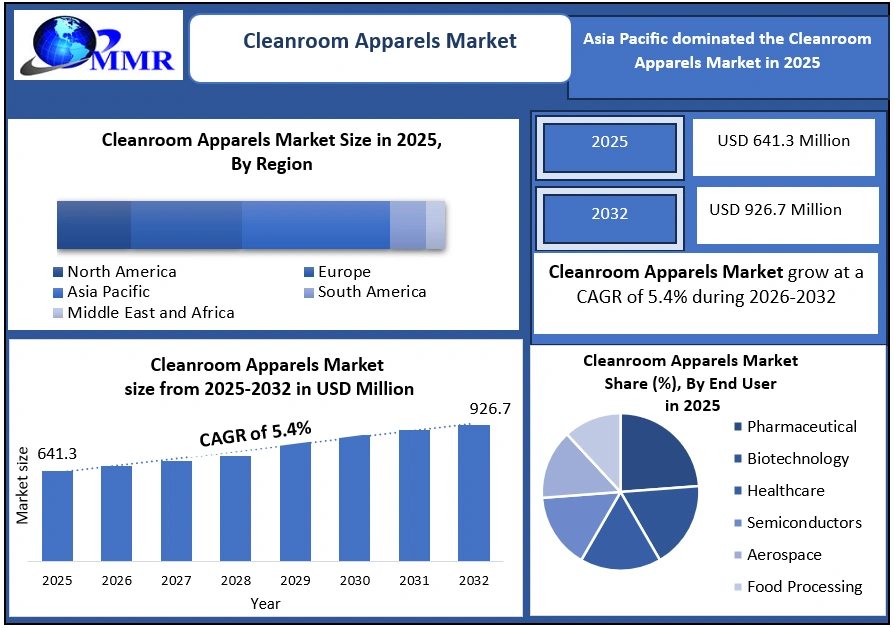
The Cleanroom Apparels Market was valued at USD 641.3 million in 2025 and is estimated to reach USD 926.7 million by 2032, growing at a CAGR of 5.4% over the forecast period. This growth highlights the expanding demand across the Cleanroom Clothing Market and Cleanroom PPE Market globally.
The Cleanroom Apparels Market comprises specialized protective clothing designed to control contamination and protect personnel in regulated environments. This Cleanroom Protective Clothing Market includes products such as cleanroom coveralls, cleanroom hoods, cleanroom booties, cleanroom gowns, cleanroom gloves, and cleanroom face masks, offering varying levels of protection ranging from standard cleanroom apparel to high-performance and ESD cleanroom apparel. These cleanroom garments are manufactured using materials such as polyester, polypropylene, and cotton to meet ISO cleanroom apparel and hygiene standards. The market serves pharmaceutical, biotechnology, healthcare, semiconductor, aerospace, and food processing industries.
To know about the Research Methodology :- Request Free Sample Report
Key Highlights
• The semiconductor industry remains a key growth driver for the cleanroom garments market, as advanced fabrication plants require ISO Class 1–5 cleanroom apparel and ESD cleanroom garments for semiconductor fabs. TSMC’s USD 100 billion additional U.S. investment highlights sustained demand for premium ESD cleanroom suits, cleanroom coveralls, cleanroom hoods, and specialised cleanroom footwear.
• Asia-Pacific is the fastest-growing cleanroom apparel market, driven by expanding electronics manufacturing, pharmaceutical manufacturing, and biotechnology research in China, South Korea, Japan, and India. The region records the highest volume growth for cleanroom coveralls, cleanroom masks, cleanroom hoods, and cleanroom booties, supported by ongoing cleanroom facility expansions.
• Food safety concerns are driving increased adoption of cleanroom PPE and protective clothing worldwide. Unsafe food causes 600 million illnesses and 420,000 deaths annually, while 48 million people fall ill each year in the U.S., reinforcing demand for cleanroom apparel for food processing industry environments.
• In Europe, 5,691 foodborne outbreaks were reported in 2023, resulting in 52,127 cases, 2,894 hospitalizations, and 65 deaths. European Commission hygiene regulations are accelerating adoption of cleanroom clothing, gloves, hairnets, masks, and cleanroom footwear across food processing operations.
Cleanroom Apparels Market Dynamics
Cleanroom Apparels Market Drivers
• The high prevalence of healthcare-associated infections (HAIs) continues to drive demand for cleanroom PPE and sterile cleanroom apparel in medical and emergency services. With 1 in 31 hospital patients affected by HAIs and ~99,000 annual deaths in U.S. hospitals, healthcare providers increasingly rely on cleanroom gloves, cleanroom masks, respirators, cleanroom suits, and sterile PPE to minimize cross-contamination.
• Regulatory mandates, including OSHA Bloodborne Pathogens standards and EU GMP guidelines, are strengthening adoption of GMP compliant cleanroom clothing across healthcare, laboratory, and pharmaceutical environments. N95 respirators reduce infection risk by ~83%, while layered cleanroom PPE systems reduce airborne pathogen exposure by over 99%.
• Rising exposure to hazardous chemicals, toxic compounds, microorganisms, and HPAPIs in laboratories and pharmaceutical manufacturing drives demand for sterile cleanroom apparel for pharmaceutical manufacturing. Approximately 60–70% of laboratory staff handle hazardous substances daily, while 40–45% of pharmaceutical processes involve potent compounds.

Cleanroom Apparels Market Opportunities
• Increasing R&D investment in the European pharmaceutical industry, which reached USD 59.9 billion in 2024, is creating opportunities for advanced cleanroom apparel, disposable cleanroom apparel, and reusable cleanroom garments that support innovation and regulatory compliance.
• The growing volume of clinical research, with 21,500 clinical trials hosted in Europe in 2024, is expanding demand for cleanroom garments for medical device manufacturing, cleanroom PPE for biotech laboratories, and contamination-control products.
• Intensifying regulatory scrutiny, including a 35% increase in sterile production inspections between 2019 and 2023, is accelerating the adoption of EU GMP Annex 1 cleanroom apparel and validated ISO Class 1–8 cleanroom garments.
Cleanroom Apparels Market Restraints
• High compliance costs and operational complexity act as key restraints in the Cleanroom Apparel Market. Regulatory non-compliance can cost manufacturers USD 2.2–3.3 million per incident and delay launches by 4–6 months.
• Frequent PPE replacement requirements, including 3,000–6,000 glove pairs and 300–800 masks per worker annually, increase operational costs and strain supply chains.
• Continuous updates to regulatory frameworks, including the EU GMP Annex 1 revision (2023), increase documentation and validation burdens for cleanroom clothing manufacturers and buyers.
Cleanroom Apparels Market Segment Analysis
Based on product type, the Cleanroom Apparels Market is segmented into cleanroom coveralls, cleanroom hoods, cleanroom booties, cleanroom gowns, cleanroom gloves, cleanroom face masks, and others. Among these, cleanroom coveralls dominated the Cleanroom Apparels Market in 2025 and is expected to maintain dominance during the forecast period.
The dominance of cleanroom coveralls is attributed to their full-body protection and critical role in reducing human-borne contamination. Coveralls are widely used across pharmaceutical manufacturing, biotechnology laboratories, medical device production, and semiconductor cleanrooms, particularly in ISO Class 5–7 and EU GMP Grade A–C environments. Their integration with hoods, masks, gloves, and booties into complete cleanroom gowning systems further strengthens adoption. In value terms, coveralls account for the largest share of cleanroom apparel spending, often procured as sterile cleanroom apparel packs.
Cleanroom Apparels Market Regional Analysis
Asia-Pacific accounted for the largest share of the global Cleanroom Apparel Market in 2025 and remains the fastest-growing region. Growth is driven by large-scale investments in semiconductor cleanrooms, pharmaceutical manufacturing, and biotechnology research across China, South Korea, Japan, Taiwan, and India. The region records the highest consumption of cleanroom coveralls, cleanroom hoods, cleanroom masks, and cleanroom booties due to high workforce intensity and frequent gowning cycles. Cost-competitive manufacturing and increasing adherence to global quality standards reinforce Asia-Pacific’s dominance in the Cleanroom Apparels Market.
Recent Developments:
In 2024, DuPont expanded its Tyvek IsoClean cleanroom apparel portfolio and extended its recycling program for disposable cleanroom garments, supporting sustainability and contamination control. These initiatives strengthened DuPont’s position in pharmaceutical, biotechnology, and semiconductor cleanroom applications.
In 2024, Ansell Limited strengthened its cleanroom presence through the acquisition of Kimberly-Clark’s PPE business, including Kimtech and KleenGuard brands, expanding its sterile PPE and cleanroom apparel offerings while advancing sustainability initiatives and regulatory-compliant solutions.
Global Cleanroom Apparels Market Scope: Inquire before buying
| Global Cleanroom Apparels Market | |||
|---|---|---|---|
| Report Coverage | Details | ||
| Base Year: | 2025 | Forecast Period: | 2026-2032 |
| Historical Data: | 2020 to 2025 | Market Size in 2025: | USD 641.3 Mn. |
| Forecast Period 2026 to 2032 CAGR: | 5.4% | Market Size in 2032: | USD 926.7 Mn. |
| Segments Covered: | by Product Type | Coveralls Hoods Booties Gowns Gloves Face Masks Others |
|
| by Protection Level | Controlled Environment Standard Protection High-Performance Protection ESD (Electrostatic Discharge) Protection Particle-repellent |
||
| by Material Type | Polyester Polypropylene Cotton Others |
||
| by End-User | Pharmaceutical Biotechnology Healthcare Semiconductors Aerospace Food Processing |
||
| by Distribution Channel | Online Retail Distributors Direct Sales Wholesale Specialty Stores |
||
Cleanroom Apparels Market, by Region
North America (United States, Canada, and Mexico)
Europe (UK, France, Germany, Italy, Spain, Sweden, Austria, and the Rest of Europe)
Asia Pacific (China, South Korea, Japan, India, Australia, ASEAN, Indonesia, Philippines, Malaysia, Vietnam, Thailand, ASEAN, Rest of Asia Pacific)
Middle East & Africa (South Africa, GCC, Nigeria, Rest of ME&A)
South America (Brazil, Argentina, Rest of South America)
Cleanroom Apparels Market, Key Players
1. DuPont
2. Kimberly-Clark / Kimtech
3. 3M
4. Ansell (BioClean)
5. Berkshire Corporation
6. Alpha Pro Tech
7. Lakeland Industries (CleanMax)
8. Micronclean
9. Valutek
10. KM Corporation
11. Worklon (Superior Uniform Group)
12. Aramark
13. Cintas
14. UniClean (UniFirst Corporation)
15. Prudential Cleanroom Services
16. Cardinal Health
17. Medline Industries
18. Honeywell
19. Cole-Parmer (Antylia Scientific)
20. Contec, Inc.
21. Illinois Tool Works (ITW)
22. CliniMed Holdings
23. Dycem
24. Foamtec International (WCC)
25. High Tech Conversions
26. Terra Universal
27. VAI (Veltek Associates, Inc.)
28. Micronova Manufacturing
29. Narang Medical
30. Lindström
31. Others
FAQs
1. Which product segment dominates the Cleanroom Apparels Market?
Answer: Cleanroom coveralls dominate the market due to their full-body protection, high adoption in ISO Class 5–7 and EU GMP Grade A–C cleanrooms, and frequent use in pharmaceutical manufacturing and semiconductor fabrication facilities.
2. What industries drive demand for cleanroom apparels?
Answer: Key demand-driving industries include pharmaceuticals, biotechnology, healthcare, semiconductors, aerospace, and food processing, where strict hygiene, sterility, and contamination-control regulations mandate the use of cleanroom garments.
3. Why is Asia-Pacific the fastest-growing region in the Cleanroom Apparels Market?
Answer: Asia-Pacific leads growth due to rapid expansion of semiconductor fabs, pharmaceutical manufacturing, and biotechnology facilities in countries such as China, South Korea, Japan, Taiwan, and India, resulting in high-volume demand for cleanroom coveralls, hoods, masks, and booties.
4. What is the future outlook of the Cleanroom Apparels Market?
Answer: The market is expected to grow steadily, driven by stricter regulatory standards, increasing sterile drug production, rising semiconductor investments, and growing food safety concerns, with continued demand for sterile, ESD-safe, and high-performance cleanroom apparel.
5. What is the Cleanroom Apparels Market?
Answer: The Cleanroom Apparels Market includes specialized protective garments such as coveralls, hoods, booties, gowns, gloves, and face masks designed to control contamination and protect personnel in regulated environments like pharmaceuticals, biotechnology, semiconductors, healthcare, and food processing.