Global Smart Kitchen Appliances Market Product, Application, Technology, Fuel Type and Region – Global Market Size Estimation, Industry-Wide Analysis, Competitive Landscape Assessment & Long-Term Forecast to 2034

18.6%
CAGR (2026-2034)
121.99 USD Bn.
Forecast Market Size
316
Report Pages
133
Market Tables

Overview

Smart Kitchen Appliances Market is expected to reach US$ 121.99 Bn. by 2034, at a CAGR of 18.6% during the forecast period.

Smart Kitchen Appliances Market Overview:

Increasing customer disposable income & growing technological trends like Internet of Things (IoT) and Artificial Intelligence (AI) supported devices are spurring the market development. Growing implementation of smart kitchen appliances in residential as well as commercial sectors through the world is also one of the key factors driving the market growth towards the north.

The market is anticipated to grow at a 18.63% CAGR thanks to features like connected security, intelligent sensors, time saving, & convenience. Shifting customer trend toward technology controlled products is pouring the need for electric & energy saving appliances in the kitchen environment. The evolution of smart homes in the U.S. is significantly higher as compared to the rest of the world due to greater penetration of technically equipped advanced products.

Smart Kitchen Appliances Market Analysis from 2025 to 2034
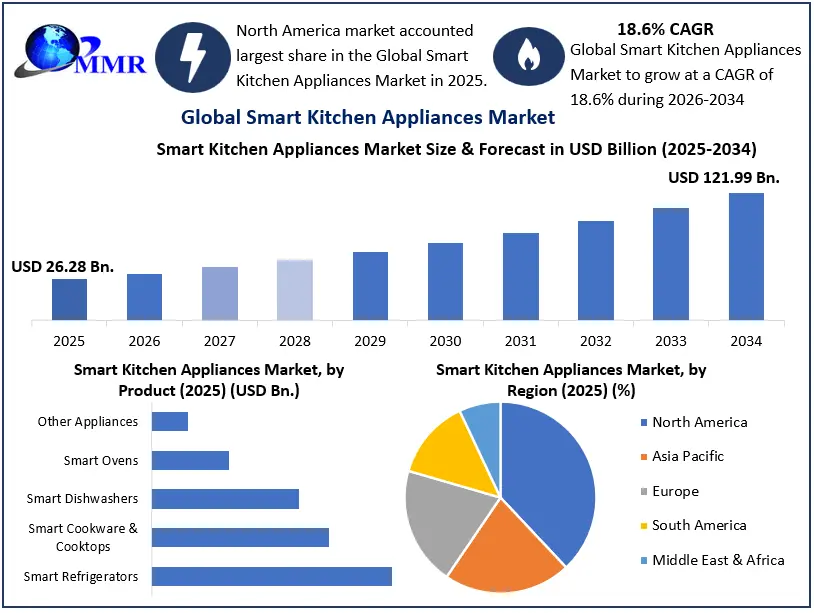
Smart Kitchen Appliances Market Growth

To know about the Research Methodology:-Request Free Sample Report

Growing importance of kitchen renewal or remodeling in order to build a modular kitchen is important to a fast-paced development for smart kitchen appliances like cookware, cooktops, & dishwashers. The digital support applications in voice-controlled devices like Amazon Echo & Google Home are gaining popularity owing to their ability to control your home. According to a recent study by MMR, around 39 Mn people in America held a smart speaker for a connected home environment in the year 2021. These voice & speaker interface permits the kitchen appliances such as refrigerators & ovens to be controlled & accessed remotely.

In the U.S., the food network has combined with Amazon to bring live & on-demand cooking courses for the Echo show the line of the smart displays. In adding, the rising importance on energy efficiency actions has inclined kitchen appliance manufacturers to liftoff eco-friendly appliances with extraordinary ENERGY STAR ratings for energy efficiency. For example, some of the main players like Samsung & Whirlpool focus more on increasing the ENERGY STAR ratings for kitchen appliances such as refrigerators & ovens in order to rise their product penetration in the marketplace.

The penetration of smart dishwashers in U.K. & Germany raised at 42.87 percent & 53.98 percent respectively in the year 2021. Top European kitchen appliance companies such as BSH Hausgerate GmbH & Miele emphasis on product inventions that are suitable to consumer lifestyle. The other appliances like coffee machines, smart kettles, & thermostats are also going to see a lift in their market share during the forecast period.

Smart Kitchen Appliances Market Segment Analysis

The smart kitchen appliances market is segmented by product, application, technology, and fuel type.

By Product, the market includes smart refrigerators, smart cookware and cooktops, smart dishwashers, smart ovens, and other appliances. Smart refrigerators are gaining strong adoption due to connected features such as remote temperature control, food monitoring, energy management, and smartphone integration. Smart cookware and cooktops are increasingly preferred for automated cooking and precise temperature control, while smart dishwashers are gaining popularity because of their water- and energy-saving capabilities. Smart ovens are also witnessing growing demand owing to features such as remote operation, automated cooking programs, and temperature monitoring. Other appliances include connected coffee makers, kettles, food processors, and other smart kitchen devices.

By Application, the market is divided into residential and commercial segments. The residential segment represents a major share of demand as consumers increasingly adopt connected appliances to improve convenience, reduce cooking time, manage energy consumption, and automate routine kitchen activities. The commercial segment includes restaurants, hotels, cafés, catering businesses, and institutional kitchens, where smart appliances are being adopted to improve operational efficiency, cooking consistency, resource management, and remote monitoring.

By Technology, the market is segmented into Wi-Fi and Bluetooth. Wi-Fi-enabled appliances are widely used because they allow users to remotely monitor and control appliances through smartphones and connected home platforms. Bluetooth technology is primarily useful for short-range communication and device pairing and is commonly incorporated into smaller smart kitchen appliances. The increasing adoption of smart-home ecosystems is encouraging manufacturers to integrate multiple, automation, and connected features. Gas-based cooking appliances continue to have a strong presence in markets where cooking gas remains widely used, while hybrid and alternative technologies are creating connectivity options into their products.

By Fuel Type, smart kitchen appliances are categorized into cooking gas, electricity, and other fuel sources. Electricity is gaining importance as smart appliances increasingly incorporate electronic controls, sensors, automation, and connected features. Gas-based cooking appliances continue to have a strong presence in markets where cooking gas remains widely used, while hybrid and alternative technologies are creating additional opportunities for manufacturers.

Smart Kitchen Appliances Market – Innovation in the Kitchen

Innovation is becoming an important factor shaping the smart kitchen appliances market, as consumers increasingly look for convenience, automation, energy efficiency, and connected functionality. According to The NPD Group’s Retail Tracking Service, the home industry recorded 5.34% growth in 2020, making it one of the stronger-performing industries during that period. Looking ahead, growth was expected to moderate to around 2.54%–4.75% in 2025, highlighting the need for continued innovation to maintain market momentum. Smart kitchen appliances can support this transition through features such as Wi-Fi connectivity, smartphone control, voice assistance, AI-based functions, automated cooking programs, energy monitoring, and personalized settings. Manufacturers are therefore increasingly focusing on connected and multifunctional appliances that improve the overall kitchen experience while creating opportunities for product differentiation and premiumization.

Smart Kitchen Appliances Market, Digital Platforms Create New Opportunities:

The increase of online shopping & DTC channels has given power to brands, retailers, & grocers to rethink traditional range layouts & discovery new ways to appeal to customers through suggestive selling. Innovative digital layouts, such as Safeway’s, assort products based on customer needs rather than what works for the grocery store, & deliver new opportunities to encourage their private labels. As the smart kitchen raises, entire new product categories will be created & existing classes will become smarter through improved connectivity. All of this change will need brands, retailers, & grocers to train customers—an opportunity for suggestive selling to make the customer’s life easier while promoting specific products. Strong digital platforms will be active to these efforts.

Market Share of Companies in the global domestic appliances market in 2025:

The report covers Residential, Commercial type with detailed analysis Global Database Encryption Market industry with the classifications of the market on the Products, Application, & region. Analysis of past market dynamics from 2026 to 2034 is given in the report, which will help readers to benchmark the past trends with current market scenarios with the key players' contribution in it.

The report has profiled fifteen key players in the market from different regions. However, the report has considered all market leaders, followers, and new entrants with investors while analyzing the market and estimation the size of the same. The manufacturing environment in each region is different and focus is given on the regional impact on the cost of manufacturing, supply chain, availability of raw materials, labor cost, availability of advanced technology, trusted vendors are analyzed and the report has come up with recommendations for a future hot spot in five regions. The major country’s policies about manufacturing & Covid 19 impact on demand side are covered in the report.

Smart Kitchen Appliances Market, Regional Insights:

North America was a major market for smart kitchen appliances in 2025, supported by the increasing adoption of technology-enabled household appliances and connected-home solutions. The United States remains the leading market in the region, driven by high consumer awareness, strong purchasing power, and the availability of advanced smart appliances. Rising disposable incomes, changing lifestyles, kitchen renovation activities, and consumer preference for modern and convenient appliances are further supporting regional growth. The presence of established appliance manufacturers and well-developed retail and e-commerce infrastructure also contributes to the strong adoption of smart kitchen technologies.

Asia Pacific is expected to be one of the fastest-growing regions in the smart kitchen appliances market, with growth supported by increasing urbanization, rising disposable incomes, expanding middle-class populations, and rapid adoption of smart-home technologies. Countries such as China, Japan, South Korea, and India are contributing significantly to regional demand. The growing adoption of smart refrigerators, smart ovens, connected cookers, and other IoT-enabled appliances is creating new opportunities for manufacturers. Increasing smartphone penetration and expanding e-commerce platforms are also making smart kitchen products more accessible to consumers across the region.

Europe is witnessing steady growth in smart kitchen appliances as consumers increasingly prioritize energy efficiency, convenience, sustainability, and advanced functionality. Countries such as Germany, the United Kingdom, France, and Italy are important markets, supported by high household appliance penetration and strong interest in connected-home technologies. The region's focus on reducing energy consumption is encouraging demand for smart appliances equipped with energy-monitoring and automated power-management features. Manufacturers are also introducing premium products with sleek designs and integrated connectivity to appeal to technology-conscious European consumers.

South America represents an emerging market for smart kitchen appliances, supported by increasing urbanization, improving household purchasing power, and growing consumer interest in connected and convenient home technologies. Brazil and Argentina are among the important markets in the region, with demand gradually increasing for smart refrigerators, connected ovens, smart cooking appliances, and other technology-enabled kitchen products. The expansion of e-commerce, wider availability of international brands, and increasing smartphone and internet penetration are improving consumer access to smart appliances. However, relatively high product prices and differences in purchasing power across countries remain important factors influencing adoption.

Middle East & Africa offers growing opportunities for smart kitchen appliance manufacturers due to urban development, rising purchasing power in several markets, and increasing investment in modern residential and hospitality infrastructure. Countries in the Gulf region are particularly receptive to premium and connected kitchen appliances because of higher consumer spending and strong demand for modern home technologies. Meanwhile, improving retail networks and increasing digital adoption across African markets are creating longer-term opportunities for smart appliance penetration.

Smart Kitchen Appliances Market – Competitive Analysis

The smart kitchen appliances market is highly competitive, with global appliance manufacturers, electronics companies, and specialized smart-home brands competing through technology, product innovation, connectivity, pricing, and brand strength. Leading companies such as Samsung Electronics, LG Electronics, Whirlpool, Haier, Electrolux, Panasonic, BSH Hausgeräte, Midea, Miele, and Philips are expanding their smart appliance portfolios by integrating Wi-Fi connectivity, artificial intelligence, voice control, automation, and energy-management features.

Competition is increasingly shifting from conventional appliance functionality toward connected and intelligent kitchen experiences. Companies are developing refrigerators, ovens, cooktops, dishwashers, coffee makers, and other appliances that can be monitored and controlled through smartphones and smart-home platforms. AI-based cooking recommendations, automated temperature adjustment, food monitoring, remote diagnostics, and personalized settings are becoming important areas of product differentiation.

The competitive environment also includes specialized smart-kitchen companies such as Breville, SharkNinja, Tovala, June Life, and Gourmia, which focus on specific categories such as smart cooking systems, coffee makers, air fryers, and connected countertop appliances. These specialized players compete with larger manufacturers by offering innovative, user-focused products and differentiated connected features.

Overall, the market is characterized by continuous technological innovation, strong brand competition, expanding smart-home ecosystems, and increasing demand for energy-efficient and connected appliances. Companies that can combine reliable appliance performance with intuitive connectivity, AI capabilities, attractive pricing, and strong after-sales support are likely to gain a stronger competitive position.

Smart Kitchen Appliances Market Recent Industry Development

Date Company Development Impact
05 January 2026 Samsung Electronics Unveiled its expanded 2026 Bespoke AI appliance lineup featuring enhanced AI Vision Inside technology and integrated Matter smart home protocol support. Boosts interoperability and energy efficiency across connected kitchen ecosystems while optimizing real-time food management.
06 January 2026 LG Electronics Debuted its next-generation InstaView smart refrigerator platform powered by generative AI and advanced voice control capabilities. Strengthens LG's position in the premium smart home market by offering predictive meal planning and automated inventory tracking.
02 January 2026 GE Profile GE Profile unveiled its 27.9 Cu. Ft. Smart 4-Door French-Door Refrigerator with Kitchen Assistant ahead of CES 2026, featuring a patented built-in barcode scanner to streamline grocery inventory. The release enhances connected kitchen automation by transforming refrigerators into intelligent hubs that minimize food waste and simplify daily meal planning.
13 January 2026 BSH Home Appliances BSH Home Appliances Group debuted Bosch Cook AI at CES 2026, incorporating personalized artificial intelligence directly into premium cooking and cooling platforms. The technological integration strengthens BSH's position in adaptive smart appliances and Matter-standard home network compatibility.

Smart Kitchen Appliances Market Scope: Inquire before buying

Global Smart Kitchen Appliances Market
Report Coverage Details
Base Year: 2025 Forecast Period: 2026-2034
Historical Data: 2020 to 2025 Market Size in 2025: US $ 26.28 Bn.
Forecast Period 2026 to 2034 CAGR: 18.6% Market Size in 2034: US $ 121.99 Bn.
Segments Covered: by Product Smart Refrigerators
Smart Cookware & Cooktops
Smart Dishwashers
Smart Ovens
Other Appliances
by Application Residential
Commercial
by Technology Wi-Fi
Bluetooth
by Fuel Type Cooking gas
Electricity
Others

Smart Kitchen Appliances Market, by Region

North America (United States, Canada and Mexico)
Europe (UK, France, Germany, Italy, Spain, Sweden, Austria, Turkey, Russia and Rest of Europe)
Asia Pacific (China, India, Japan, South Korea, Australia, ASEAN and Rest of APAC)
Middle East and Africa (South Africa, GCC, Egypt, Nigeria and Rest of ME&A)
South America (Brazil, Argentina, Columbia and Rest of South America)

Smart Kitchen Appliances Market, Key Players

1. Samsung Electronics Co. Ltd.
2. LG Electronics Inc.
3. Whirlpool Corporation
4. Haier Smart Home Co. Ltd.
5. Electrolux AB
6. Panasonic Corporation
7. BSH Hausgeräte GmbH
8. Midea Group Co. Ltd.
9. Breville Group Limited
10. Miele & Cie. KG
11. Koninklijke Philips N.V.
12. SharkNinja Operating LLC
13. Xiaomi Corporation
14. Sub-Zero Group Inc.
15. SMEG S.p.A.
16. Groupe SEB
17. Arçelik A.Ş. (Beko)
18. Gorenje d.d.
19. Dacor
20. Kenmore
21. Instant Brands Inc.
22. De'Longhi S.p.A.
23. Sharp Corporation
24. Siemens AG
25. General Electric Appliances
26. Godrej & Boyce Manufacturing Company Ltd.
27. Havells India Ltd.
28. IFB Industries Ltd.
29. Voltas Beko Home Appliances Pvt. Ltd.
30. Bajaj Electricals Ltd.
31. Orient Electric Ltd.
32. Coway Co. Ltd.
33. Liebherr International Deutschland GmbH
34. Gourmia Inc.
35. June Life Inc.
36. Smarter Applications Ltd.
37. Tovala Inc.
38. Bartesian LLC
39. MEATER Inc.
40. Morphy Richards Limited

Frequently Asked Questions:

1. Which region has the largest share in Global Smart Kitchen Appliances Market?
Ans: North America region holds the highest share in 2025.

2. What is the growth rate of Global Smart Kitchen Appliances Market?
Ans: The Global Smart Kitchen Appliances Market is growing at a CAGR of 18.6 % during forecasting period 2026-2034.

3. What is scope of the Global Smart Kitchen Appliances market report?
Ans: Global Smart Kitchen Appliances Market report helps with the PESTEL, PORTER, COVID-19 Impact analysis, Recommendations for Investors & Leaders, and market estimation of the forecast period.

4. Who are the key players in Global Smart Kitchen Appliances market?
Ans: The important key players in the Global Smart Kitchen Appliances Market are – Whirlpool Corporation, LG Electronics, AB Electrolux, Samsung Electronics Co. Ltd, Haier Group, Panasonic Corporation, BSH Hausgerate GmbH, Koninklijke Phillips N.V., Miele & Cie. KG, Dongbu Daewoo Electronics, Middleby Corporation, Welbilt, Rational AG Inc, Dover Corporation, and Cambro Manufacturing Co. Inc.

5. What is the study period of this market?
Ans: The Global Smart Kitchen Appliances Market is studied from 2020 to 2034.

Table of Contents

1. Smart Kitchen Appliances Market Introduction 1.1. Study Assumption and Market Definition 1.2. Scope of the Study 1.3. Executive Summary 2. Global Smart Kitchen Appliances Market: Competitive Landscape 2.1. MMR Competition Matrix 2.2. Competitive Landscape 2.3. Key Players Benchmarking 2.3.1. Company Name 2.3.2. Business Segment 2.3.3. End-user Segment 2.3.4. Revenue (2025) 2.3.5. Company Locations 2.4. Leading Smart Kitchen Appliances Market Companies, by market capitalization 2.5. Market Structure 2.5.1. Market Leaders 2.5.2. Market Followers 2.5.3. Emerging Players 2.6. Mergers and Acquisitions Details 3. Smart Kitchen Appliances Market: Dynamics 3.1. Smart Kitchen Appliances Market Trends by Region 3.1.1. North America Smart Kitchen Appliances Market Trends 3.1.2. Europe Smart Kitchen Appliances Market Trends 3.1.3. Asia Pacific Smart Kitchen Appliances Market Trends 3.1.4. Middle East and Africa Smart Kitchen Appliances Market Trends 3.1.5. South America Smart Kitchen Appliances Market Trends 3.2. Smart Kitchen Appliances Market Dynamics by Region 3.2.1. North America 3.2.1.1. North America Smart Kitchen Appliances Market Drivers 3.2.1.2. North America Smart Kitchen Appliances Market Restraints 3.2.1.3. North America Smart Kitchen Appliances Market Opportunities 3.2.1.4. North America Smart Kitchen Appliances Market Challenges 3.2.2. Europe 3.2.2.1. Europe Smart Kitchen Appliances Market Drivers 3.2.2.2. Europe Smart Kitchen Appliances Market Restraints 3.2.2.3. Europe Smart Kitchen Appliances Market Opportunities 3.2.2.4. Europe Smart Kitchen Appliances Market Challenges 3.2.3. Asia Pacific 3.2.3.1. Asia Pacific Smart Kitchen Appliances Market Drivers 3.2.3.2. Asia Pacific Smart Kitchen Appliances Market Restraints 3.2.3.3. Asia Pacific Smart Kitchen Appliances Market Opportunities 3.2.3.4. Asia Pacific Smart Kitchen Appliances Market Challenges 3.2.4. Middle East and Africa 3.2.4.1. Middle East and Africa Smart Kitchen Appliances Market Drivers 3.2.4.2. Middle East and Africa Smart Kitchen Appliances Market Restraints 3.2.4.3. Middle East and Africa Smart Kitchen Appliances Market Opportunities 3.2.4.4. Middle East and Africa Smart Kitchen Appliances Market Challenges 3.2.5. South America 3.2.5.1. South America Smart Kitchen Appliances Market Drivers 3.2.5.2. South America Smart Kitchen Appliances Market Restraints 3.2.5.3. South America Smart Kitchen Appliances Market Opportunities 3.2.5.4. South America Smart Kitchen Appliances Market Challenges 3.3. PORTER's Five Forces Analysis 3.4. PESTLE Analysis 3.5. Technology Roadmap 3.6. Regulatory Landscape by Region 3.6.1. North America 3.6.2. Europe 3.6.3. Asia Pacific 3.6.4. Middle East and Africa 3.6.5. South America 3.7. Key Opinion Leader Analysis For Smart Kitchen Appliances Industry 3.8. Analysis of Government Schemes and Initiatives For Smart Kitchen Appliances Industry 3.9. Smart Kitchen Appliances Market Trade Analysis 3.10. The Global Pandemic Impact on Smart Kitchen Appliances Market 4. Smart Kitchen Appliances Market: Global Market Size and Forecast by Segmentation (in USD Billion) 2025-2034 4.1. Smart Kitchen Appliances Market Size and Forecast, by Product (2025-2034) 4.1.1. Smart Refrigerators 4.1.2. Smart Cookware & Cooktops 4.1.3. Smart Dishwashers 4.1.4. Smart Ovens 4.1.5. Other Appliances 4.2. Smart Kitchen Appliances Market Size and Forecast, by Application (2025-2034) 4.2.1. Residential 4.2.2. Commercial 4.3. Smart Kitchen Appliances Market Size and Forecast, by Technology (2025-2034) 4.3.1. Wi-Fi 4.3.2. Bluetooth 4.4. Smart Kitchen Appliances Market Size and Forecast, by Fuel Type (2025-2034) 4.4.1. Cooking gas 4.4.2. Electricity 4.4.3. Others 4.5. Smart Kitchen Appliances Market Size and Forecast, by Region (2025-2034) 4.5.1. North America 4.5.2. Europe 4.5.3. Asia Pacific 4.5.4. Middle East and Africa 4.5.5. South America 5. North America Smart Kitchen Appliances Market Size and Forecast by Segmentation (in USD Billion) 2025-2034 5.1. North America Smart Kitchen Appliances Market Size and Forecast, by Product (2025-2034) 5.1.1. Smart Refrigerators 5.1.2. Smart Cookware & Cooktops 5.1.3. Smart Dishwashers 5.1.4. Smart Ovens 5.1.5. Other Appliances 5.2. North America Smart Kitchen Appliances Market Size and Forecast, by Application (2025-2034) 5.2.1. Residential 5.2.2. Commercial 5.3. North America Smart Kitchen Appliances Market Size and Forecast, by Technology (2025-2034) 5.3.1. Wi-Fi 5.3.2. Bluetooth 5.4. North America Smart Kitchen Appliances Market Size and Forecast, by Fuel Type (2025-2034) 5.4.1. Cooking gas 5.4.2. Electricity 5.4.3. Others 5.5. North America Smart Kitchen Appliances Market Size and Forecast, by Country (2025-2034) 5.5.1. United States 5.5.1.1. United States Smart Kitchen Appliances Market Size and Forecast, by Product (2025-2034) 5.5.1.1.1. Smart Refrigerators 5.5.1.1.2. Smart Cookware & Cooktops 5.5.1.1.3. Smart Dishwashers 5.5.1.1.4. Smart Ovens 5.5.1.1.5. Other Appliances 5.5.1.2. United States Smart Kitchen Appliances Market Size and Forecast, by Application (2025-2034) 5.5.1.2.1. Residential 5.5.1.2.2. Commercial 5.5.1.3. United States Smart Kitchen Appliances Market Size and Forecast, by Technology (2025-2034) 5.5.1.3.1. Wi-Fi 5.5.1.3.2. Bluetooth 5.5.1.4. United States Smart Kitchen Appliances Market Size and Forecast, by Fuel Type (2025-2034) 5.5.1.4.1. Cooking gas 5.5.1.4.2. Electricity 5.5.1.4.3. Others 5.5.2. Canada 5.5.2.1. Canada Smart Kitchen Appliances Market Size and Forecast, by Product (2025-2034) 5.5.2.1.1. Smart Refrigerators 5.5.2.1.2. Smart Cookware & Cooktops 5.5.2.1.3. Smart Dishwashers 5.5.2.1.4. Smart Ovens 5.5.2.1.5. Other Appliances 5.5.2.2. Canada Smart Kitchen Appliances Market Size and Forecast, by Application (2025-2034) 5.5.2.2.1. Residential 5.5.2.2.2. Commercial 5.5.2.3. Canada Smart Kitchen Appliances Market Size and Forecast, by Technology (2025-2034) 5.5.2.3.1. Wi-Fi 5.5.2.3.2. Bluetooth 5.5.2.4. Canada Smart Kitchen Appliances Market Size and Forecast, by Fuel Type (2025-2034) 5.5.2.4.1. Cooking gas 5.5.2.4.2. Electricity 5.5.2.4.3. Others 5.5.3. Mexico 5.5.3.1. Mexico Smart Kitchen Appliances Market Size and Forecast, by Product (2025-2034) 5.5.3.1.1. Smart Refrigerators 5.5.3.1.2. Smart Cookware & Cooktops 5.5.3.1.3. Smart Dishwashers 5.5.3.1.4. Smart Ovens 5.5.3.1.5. Other Appliances 5.5.3.2. Mexico Smart Kitchen Appliances Market Size and Forecast, by Application (2025-2034) 5.5.3.2.1. Residential 5.5.3.2.2. Commercial 5.5.3.3. Mexico Smart Kitchen Appliances Market Size and Forecast, by Technology (2025-2034) 5.5.3.3.1. Wi-Fi 5.5.3.3.2. Bluetooth 5.5.3.4. Mexico Smart Kitchen Appliances Market Size and Forecast, by Fuel Type (2025-2034) 5.5.3.4.1. Cooking gas 5.5.3.4.2. Electricity 5.5.3.4.3. Others 6. Europe Smart Kitchen Appliances Market Size and Forecast by Segmentation (in USD Billion) 2025-2034 6.1. Europe Smart Kitchen Appliances Market Size and Forecast, by Product (2025-2034) 6.2. Europe Smart Kitchen Appliances Market Size and Forecast, by Application (2025-2034) 6.3. Europe Smart Kitchen Appliances Market Size and Forecast, by Technology (2025-2034) 6.4. Europe Smart Kitchen Appliances Market Size and Forecast, by Fuel Type (2025-2034) 6.5. Europe Smart Kitchen Appliances Market Size and Forecast, by Country (2025-2034) 6.5.1. United Kingdom 6.5.1.1. United Kingdom Smart Kitchen Appliances Market Size and Forecast, by Product (2025-2034) 6.5.1.2. United Kingdom Smart Kitchen Appliances Market Size and Forecast, by Application (2025-2034) 6.5.1.3. United Kingdom Smart Kitchen Appliances Market Size and Forecast, by Technology (2025-2034) 6.5.1.4. United Kingdom Smart Kitchen Appliances Market Size and Forecast, by Fuel Type (2025-2034) 6.5.2. France 6.5.2.1. France Smart Kitchen Appliances Market Size and Forecast, by Product (2025-2034) 6.5.2.2. France Smart Kitchen Appliances Market Size and Forecast, by Application (2025-2034) 6.5.2.3. France Smart Kitchen Appliances Market Size and Forecast, by Technology (2025-2034) 6.5.2.4. France Smart Kitchen Appliances Market Size and Forecast, by Fuel Type (2025-2034) 6.5.3. Germany 6.5.3.1. Germany Smart Kitchen Appliances Market Size and Forecast, by Product (2025-2034) 6.5.3.2. Germany Smart Kitchen Appliances Market Size and Forecast, by Application (2025-2034) 6.5.3.3. Germany Smart Kitchen Appliances Market Size and Forecast, by Technology (2025-2034) 6.5.3.4. Germany Smart Kitchen Appliances Market Size and Forecast, by Fuel Type (2025-2034) 6.5.4. Italy 6.5.4.1. Italy Smart Kitchen Appliances Market Size and Forecast, by Product (2025-2034) 6.5.4.2. Italy Smart Kitchen Appliances Market Size and Forecast, by Application (2025-2034) 6.5.4.3. Italy Smart Kitchen Appliances Market Size and Forecast, by Technology (2025-2034) 6.5.4.4. Italy Smart Kitchen Appliances Market Size and Forecast, by Fuel Type (2025-2034) 6.5.5. Spain 6.5.5.1. Spain Smart Kitchen Appliances Market Size and Forecast, by Product (2025-2034) 6.5.5.2. Spain Smart Kitchen Appliances Market Size and Forecast, by Application (2025-2034) 6.5.5.3. Spain Smart Kitchen Appliances Market Size and Forecast, by Technology (2025-2034) 6.5.5.4. Spain Smart Kitchen Appliances Market Size and Forecast, by Fuel Type (2025-2034) 6.5.6. Sweden 6.5.6.1. Sweden Smart Kitchen Appliances Market Size and Forecast, by Product (2025-2034) 6.5.6.2. Sweden Smart Kitchen Appliances Market Size and Forecast, by Application (2025-2034) 6.5.6.3. Sweden Smart Kitchen Appliances Market Size and Forecast, by Technology (2025-2034) 6.5.6.4. Sweden Smart Kitchen Appliances Market Size and Forecast, by Fuel Type (2025-2034) 6.5.7. Austria 6.5.7.1. Austria Smart Kitchen Appliances Market Size and Forecast, by Product (2025-2034) 6.5.7.2. Austria Smart Kitchen Appliances Market Size and Forecast, by Application (2025-2034) 6.5.7.3. Austria Smart Kitchen Appliances Market Size and Forecast, by Technology (2025-2034) 6.5.7.4. Austria Smart Kitchen Appliances Market Size and Forecast, by Fuel Type (2025-2034) 6.5.8. Rest of Europe 6.5.8.1. Rest of Europe Smart Kitchen Appliances Market Size and Forecast, by Product (2025-2034) 6.5.8.2. Rest of Europe Smart Kitchen Appliances Market Size and Forecast, by Application (2025-2034) 6.5.8.3. Rest of Europe Smart Kitchen Appliances Market Size and Forecast, by Technology (2025-2034) 6.5.8.4. Rest of Europe Smart Kitchen Appliances Market Size and Forecast, by Fuel Type (2025-2034) 7. Asia Pacific Smart Kitchen Appliances Market Size and Forecast by Segmentation (in USD Billion) 2025-2034 7.1. Asia Pacific Smart Kitchen Appliances Market Size and Forecast, by Product (2025-2034) 7.2. Asia Pacific Smart Kitchen Appliances Market Size and Forecast, by Application (2025-2034) 7.3. Asia Pacific Smart Kitchen Appliances Market Size and Forecast, by Technology (2025-2034) 7.4. Asia Pacific Smart Kitchen Appliances Market Size and Forecast, by Fuel Type (2025-2034) 7.5. Asia Pacific Smart Kitchen Appliances Market Size and Forecast, by Country (2025-2034) 7.5.1. China 7.5.1.1. China Smart Kitchen Appliances Market Size and Forecast, by Product (2025-2034) 7.5.1.2. China Smart Kitchen Appliances Market Size and Forecast, by Application (2025-2034) 7.5.1.3. China Smart Kitchen Appliances Market Size and Forecast, by Technology (2025-2034) 7.5.1.4. China Smart Kitchen Appliances Market Size and Forecast, by Fuel Type (2025-2034) 7.5.2. S Korea 7.5.2.1. S Korea Smart Kitchen Appliances Market Size and Forecast, by Product (2025-2034) 7.5.2.2. S Korea Smart Kitchen Appliances Market Size and Forecast, by Application (2025-2034) 7.5.2.3. S Korea Smart Kitchen Appliances Market Size and Forecast, by Technology (2025-2034) 7.5.2.4. S Korea Smart Kitchen Appliances Market Size and Forecast, by Fuel Type (2025-2034) 7.5.3. Japan 7.5.3.1. Japan Smart Kitchen Appliances Market Size and Forecast, by Product (2025-2034) 7.5.3.2. Japan Smart Kitchen Appliances Market Size and Forecast, by Application (2025-2034) 7.5.3.3. Japan Smart Kitchen Appliances Market Size and Forecast, by Technology (2025-2034) 7.5.3.4. Japan Smart Kitchen Appliances Market Size and Forecast, by Fuel Type (2025-2034) 7.5.4. India 7.5.4.1. India Smart Kitchen Appliances Market Size and Forecast, by Product (2025-2034) 7.5.4.2. India Smart Kitchen Appliances Market Size and Forecast, by Application (2025-2034) 7.5.4.3. India Smart Kitchen Appliances Market Size and Forecast, by Technology (2025-2034) 7.5.4.4. India Smart Kitchen Appliances Market Size and Forecast, by Fuel Type (2025-2034) 7.5.5. Australia 7.5.5.1. Australia Smart Kitchen Appliances Market Size and Forecast, by Product (2025-2034) 7.5.5.2. Australia Smart Kitchen Appliances Market Size and Forecast, by Application (2025-2034) 7.5.5.3. Australia Smart Kitchen Appliances Market Size and Forecast, by Technology (2025-2034) 7.5.5.4. Australia Smart Kitchen Appliances Market Size and Forecast, by Fuel Type (2025-2034) 7.5.6. Indonesia 7.5.6.1. Indonesia Smart Kitchen Appliances Market Size and Forecast, by Product (2025-2034) 7.5.6.2. Indonesia Smart Kitchen Appliances Market Size and Forecast, by Application (2025-2034) 7.5.6.3. Indonesia Smart Kitchen Appliances Market Size and Forecast, by Technology (2025-2034) 7.5.6.4. Indonesia Smart Kitchen Appliances Market Size and Forecast, by Fuel Type (2025-2034) 7.5.7. Malaysia 7.5.7.1. Malaysia Smart Kitchen Appliances Market Size and Forecast, by Product (2025-2034) 7.5.7.2. Malaysia Smart Kitchen Appliances Market Size and Forecast, by Application (2025-2034) 7.5.7.3. Malaysia Smart Kitchen Appliances Market Size and Forecast, by Technology (2025-2034) 7.5.7.4. Malaysia Smart Kitchen Appliances Market Size and Forecast, by Fuel Type (2025-2034) 7.5.8. Vietnam 7.5.8.1. Vietnam Smart Kitchen Appliances Market Size and Forecast, by Product (2025-2034) 7.5.8.2. Vietnam Smart Kitchen Appliances Market Size and Forecast, by Application (2025-2034) 7.5.8.3. Vietnam Smart Kitchen Appliances Market Size and Forecast, by Technology (2025-2034) 7.5.8.4. Vietnam Smart Kitchen Appliances Market Size and Forecast, by Fuel Type (2025-2034) 7.5.9. Taiwan 7.5.9.1. Taiwan Smart Kitchen Appliances Market Size and Forecast, by Product (2025-2034) 7.5.9.2. Taiwan Smart Kitchen Appliances Market Size and Forecast, by Application (2025-2034) 7.5.9.3. Taiwan Smart Kitchen Appliances Market Size and Forecast, by Technology (2025-2034) 7.5.9.4. Taiwan Smart Kitchen Appliances Market Size and Forecast, by Fuel Type (2025-2034) 7.5.10. Rest of Asia Pacific 7.5.10.1. Rest of Asia Pacific Smart Kitchen Appliances Market Size and Forecast, by Product (2025-2034) 7.5.10.2. Rest of Asia Pacific Smart Kitchen Appliances Market Size and Forecast, by Application (2025-2034) 7.5.10.3. Rest of Asia Pacific Smart Kitchen Appliances Market Size and Forecast, by Technology (2025-2034) 7.5.10.4. Rest of Asia Pacific Smart Kitchen Appliances Market Size and Forecast, by Fuel Type (2025-2034) 8. Middle East and Africa Smart Kitchen Appliances Market Size and Forecast by Segmentation (in USD Billion) 2025-2034 8.1. Middle East and Africa Smart Kitchen Appliances Market Size and Forecast, by Product (2025-2034) 8.2. Middle East and Africa Smart Kitchen Appliances Market Size and Forecast, by Application (2025-2034) 8.3. Middle East and Africa Smart Kitchen Appliances Market Size and Forecast, by Technology (2025-2034) 8.4. Middle East and Africa Smart Kitchen Appliances Market Size and Forecast, by Fuel Type (2025-2034) 8.5. Middle East and Africa Smart Kitchen Appliances Market Size and Forecast, by Country (2025-2034) 8.5.1. South Africa 8.5.1.1. South Africa Smart Kitchen Appliances Market Size and Forecast, by Product (2025-2034) 8.5.1.2. South Africa Smart Kitchen Appliances Market Size and Forecast, by Application (2025-2034) 8.5.1.3. South Africa Smart Kitchen Appliances Market Size and Forecast, by Technology (2025-2034) 8.5.1.4. South Africa Smart Kitchen Appliances Market Size and Forecast, by Fuel Type (2025-2034) 8.5.2. GCC 8.5.2.1. GCC Smart Kitchen Appliances Market Size and Forecast, by Product (2025-2034) 8.5.2.2. GCC Smart Kitchen Appliances Market Size and Forecast, by Application (2025-2034) 8.5.2.3. GCC Smart Kitchen Appliances Market Size and Forecast, by Technology (2025-2034) 8.5.2.4. GCC Smart Kitchen Appliances Market Size and Forecast, by Fuel Type (2025-2034) 8.5.3. Nigeria 8.5.3.1. Nigeria Smart Kitchen Appliances Market Size and Forecast, by Product (2025-2034) 8.5.3.2. Nigeria Smart Kitchen Appliances Market Size and Forecast, by Application (2025-2034) 8.5.3.3. Nigeria Smart Kitchen Appliances Market Size and Forecast, by Technology (2025-2034) 8.5.3.4. Nigeria Smart Kitchen Appliances Market Size and Forecast, by Fuel Type (2025-2034) 8.5.4. Rest of ME&A 8.5.4.1. Rest of ME&A Smart Kitchen Appliances Market Size and Forecast, by Product (2025-2034) 8.5.4.2. Rest of ME&A Smart Kitchen Appliances Market Size and Forecast, by Application (2025-2034) 8.5.4.3. Rest of ME&A Smart Kitchen Appliances Market Size and Forecast, by Technology (2025-2034) 8.5.4.4. Rest of ME&A Smart Kitchen Appliances Market Size and Forecast, by Fuel Type (2025-2034) 9. South America Smart Kitchen Appliances Market Size and Forecast by Segmentation (in USD Billion) 2025-2034 9.1. South America Smart Kitchen Appliances Market Size and Forecast, by Product (2025-2034) 9.2. South America Smart Kitchen Appliances Market Size and Forecast, by Application (2025-2034) 9.3. South America Smart Kitchen Appliances Market Size and Forecast, by Technology (2025-2034) 9.4. South America Smart Kitchen Appliances Market Size and Forecast, by Fuel Type (2025-2034) 9.5. South America Smart Kitchen Appliances Market Size and Forecast, by Country (2025-2034) 9.5.1. Brazil 9.5.1.1. Brazil Smart Kitchen Appliances Market Size and Forecast, by Product (2025-2034) 9.5.1.2. Brazil Smart Kitchen Appliances Market Size and Forecast, by Application (2025-2034) 9.5.1.3. Brazil Smart Kitchen Appliances Market Size and Forecast, by Technology (2025-2034) 9.5.1.4. Brazil Smart Kitchen Appliances Market Size and Forecast, by Fuel Type (2025-2034) 9.5.2. Argentina 9.5.2.1. Argentina Smart Kitchen Appliances Market Size and Forecast, by Product (2025-2034) 9.5.2.2. Argentina Smart Kitchen Appliances Market Size and Forecast, by Application (2025-2034) 9.5.2.3. Argentina Smart Kitchen Appliances Market Size and Forecast, by Technology (2025-2034) 9.5.2.4. Argentina Smart Kitchen Appliances Market Size and Forecast, by Fuel Type (2025-2034) 9.5.3. Rest Of South America 9.5.3.1. Rest Of South America Smart Kitchen Appliances Market Size and Forecast, by Product (2025-2034) 9.5.3.2. Rest Of South America Smart Kitchen Appliances Market Size and Forecast, by Application (2025-2034) 9.5.3.3. Rest Of South America Smart Kitchen Appliances Market Size and Forecast, by Technology (2025-2034) 9.5.3.4. Rest Of South America Smart Kitchen Appliances Market Size and Forecast, by Fuel Type (2025-2034) 10. Company Profile: Key Players 10.1. Samsung Electronics Co. Ltd. 10.1.1. Company Overview 10.1.2. Business Portfolio 10.1.3. Financial Overview 10.1.4. SWOT Analysis 10.1.5. Strategic Analysis 10.1.6. Scale of Operation (small, medium, and large) 10.1.7. Details on Partnership 10.1.8. Regulatory Accreditations and Certifications Received by Them 10.1.9. Awards Received by the Firm 10.1.10. Recent Developments 10.2. LG Electronics Inc. 10.3. Whirlpool Corporation 10.4. Haier Smart Home Co. Ltd. 10.5. Electrolux AB 10.6. Panasonic Corporation 10.7. BSH Hausgeräte GmbH 10.8. Midea Group Co. Ltd. 10.9. Breville Group Limited 10.10. Miele & Cie. KG 10.11. Koninklijke Philips N.V. 10.12. SharkNinja Operating LLC 10.13. Xiaomi Corporation 10.14. Sub-Zero Group Inc. 10.15. SMEG S.p.A. 10.16. Groupe SEB 10.17. Arçelik A.Ş. (Beko) 10.18. Gorenje d.d. 10.19. Dacor 10.20. Kenmore 10.21. Instant Brands Inc. 10.22. De'Longhi S.p.A. 10.23. Sharp Corporation 10.24. Siemens AG 10.25. General Electric Appliances 10.26. Godrej & Boyce Manufacturing Company Ltd. 10.27. Havells India Ltd. 10.28. IFB Industries Ltd. 10.29. Voltas Beko Home Appliances Pvt. Ltd. 10.30. Bajaj Electricals Ltd. 10.31. Orient Electric Ltd. 10.32. Coway Co. Ltd. 10.33. Liebherr International Deutschland GmbH 10.34. Gourmia Inc. 10.35. June Life Inc. 10.36. Smarter Applications Ltd. 10.37. Tovala Inc. 10.38. Bartesian LLC 10.39. MEATER Inc. 10.40. Morphy Richards Limited 11. Key Findings 12. Industry Recommendations 13. Smart Kitchen Appliances Market: Research Methodology 14. Terms and Glossary

Custom Market Research Services

We Will Customise The Research For You, In Case The Report Listed Above Does Not Meet With Your Requirements