
Global Cinema Camera Market Size, Forecast, Share by Countries and Global Players, and Growth Analysis 2026–2034
Overview
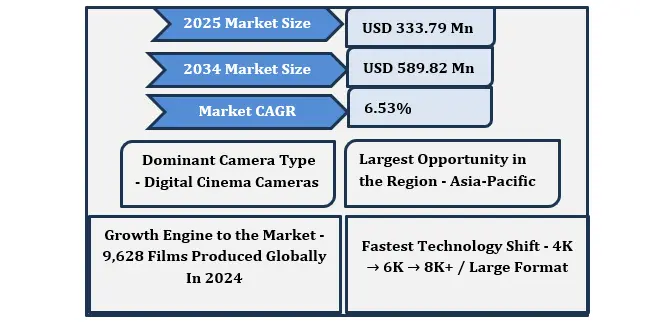
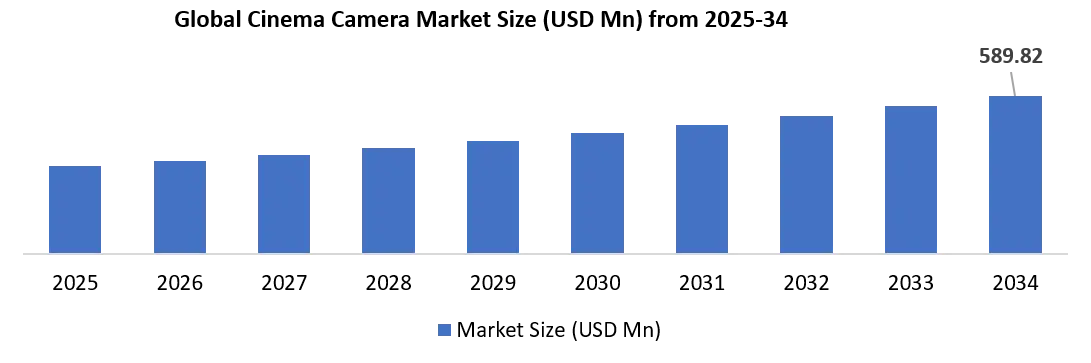
The Global Cinema Camera Market was valued at USD 333.79 million in 2025; it is estimated to reach USD 589.82 million by 2034. It is estimated to grow at a CAGR of 6.53% during the forecast period.
Global Cinema Camera Market — At a Glance
This report provides a comprehensive view of the global cinema camera market, covering market size, growth outlook, regional opportunities, camera types, sensor formats, technology trends, and competitive positioning. It helps clients understand how leading players such as ARRI, Sony, Canon, Nikon, Blackmagic Design, Panasonic, and Fujifilm position their portfolios across professional, independent, premium, and virtual-production segments. The report also highlights market opportunities, evolving production requirements, premiumization trends, and competitive strategies, enabling camera manufacturers, investors, production companies, distributors, and technology providers to identify attractive segments, assess competitive threats, and make informed decisions on product development, market expansion, investment, and strategic positioning.
To know about the Research Methodology :- Request Free Sample Report
Global Cinema Camera Industry Overview
The global cinema camera market comprises professional imaging equipment designed to capture high-quality motion pictures for feature films, television and streaming productions, documentaries, advertising, music videos, and other professional cinematography applications. Cinema Cameras are engineered to cater to the requirements of professional filmmaking. The camera features high dynamic range and advanced color science. Interchangeable cinema lenses, large-format and specialized image sensors, high-resolution recording, professional codecs, and flexible workflows for post- production. The market includes digital cinema cameras with various formats such as Super 35, full-frame, and large-format systems, with increasing adoption of 4K, 6K, and 8K acquisition technologies. Demand is closely connected to the volume and sophistication of content production because cameras represent a core component of the image-capture workflow.
The expansion of theatrical filmmaking, streaming content, television production, commercial cinematography, and independent filmmaking therefore creates a broad addressable market for professional cinema camera manufacturers. This production ecosystem continues to grow across multiple regions. The European Audiovisual Observatory reports that 2,523 feature films were produced across 36 European markets in 2024, representing a record level of production. The Observatory also reports that EUR 25.1 billion was spent on European original films and series in 2024, with global streaming platforms accounting for approximately one-third of this investment. These growing investments in digital filmmaking are highlighting the increasing importance of professionally produced content and associated production equipment.
The premium large-format segment is also gaining strategic momentum, with IMAX expanding its ecosystem of certified digital cameras; in January 2026, Fujifilm’s large-format GFX ETERNA 55 became an IMAX-certified digital camera, reinforcing the growing convergence between large-format sensor technology and premium theatrical cinematography.
The scale of film production provides an important underlying indicator of equipment demand: the European Audiovisual Observatory recorded 2,523 feature films across 36 European markets in 2024; the highest production level recorded at that time and above the previous 2019 peak. In addition, European films generated 311 million worldwide cinema admissions in 2024, 24% higher than in 2023 and the strongest level since 2019, demonstrating renewed international circulation of professionally produced film content. The market therefore benefits not only from new camera purchases but also from replacement demand as production companies, cinematographers, rental houses, broadcasters, and studios upgrade equipment to support higher-resolution workflows and increasingly demanding cinematography requirements. Over the forecast period, continued investment in original content, digital filmmaking, large-format cinematography, and advanced imaging technologies is expected to sustain the cinema camera market growth trajectory.
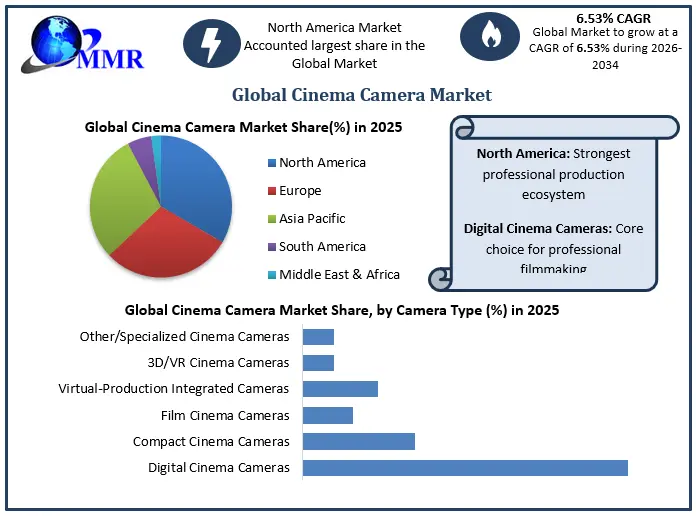
Global Cinema Camera Market Share Outlook
Global Cinema Camera Market Dynamics
Rising Global Content Production Drives Cinema Camera Demand
The expansion of professional film and audiovisual production directly increases the addressable demand for cinema cameras. The European Audiovisual Observatory reports that 2,523 feature films were produced across 36 European markets in 2024, representing a record production level. In addition, spending on European original films and series reached EUR 25.1 billion in 2024, with global streaming platforms contributing approximately one-third of this investment. The continued expansion of professionally produced content supports demand for high-resolution digital cinema cameras, particularly among studios, production companies, rental houses, and independent filmmakers.
High Professional Camera Prices Limit Adoption Among Smaller Producers
The relatively high acquisition cost of professional cinema equipment remains a barrier for independent filmmakers and smaller production companies. For example, Sony's Cinema Line portfolio currently ranges from approximately USD 1,799.99 for the FX30 to USD 6,999.99 for the FX6, while the flagship FX7 is priced at USD 11,999.99 on Sony's U.S. website. In India, Sony lists the FX3A at INR 405,990, demonstrating the substantial upfront investment required even for compact full-frame cinema systems. These costs, combined with lenses, storage, monitoring, and other production accessories, can encourage smaller users to rent equipment rather than purchase it.
Streaming Investment Expands the Addressable Production Equipment Market
The continuous investment in original streaming is an opportunity for cinema camera manufacturers as production companies require professional imaging equipment for sophisticated content workflows. The European Audiovisual Observatory estimates that EUR 25.1 billion was spent on European original works in 2024, excluding news and sports rights, with one-third of this spending coming from global streamers. This sustained investment supports demand for advanced cameras capable of meeting the resolution, dynamic-range, color, and post-production requirements of premium film and episodic content.
High-End Hybrid Cameras Increase Price Competition, Challenge the Market
The growing capabilities of hybrid and mirrorless cameras create increasing competitive pressure on dedicated cinema cameras, particularly in independent and small-production segments. Sony, for example, positions its USD 4,299.99 FX3 as a full-frame Cinema Line camera offering 15+ stops of dynamic range, 4K recording at up to 120p, and a compact form factor. At the same time, Sony's broader interchangeable-lens portfolio includes high-end mirrorless cameras offering 8K/30p and 4K/120p recording. This convergence of specifications gives filmmakers lower-cost alternatives for applications that previously required dedicated cinema-camera systems, forcing manufacturers to differentiate through professional codecs, thermal performance, ergonomics, reliability, dynamic range, and specialized production workflows.
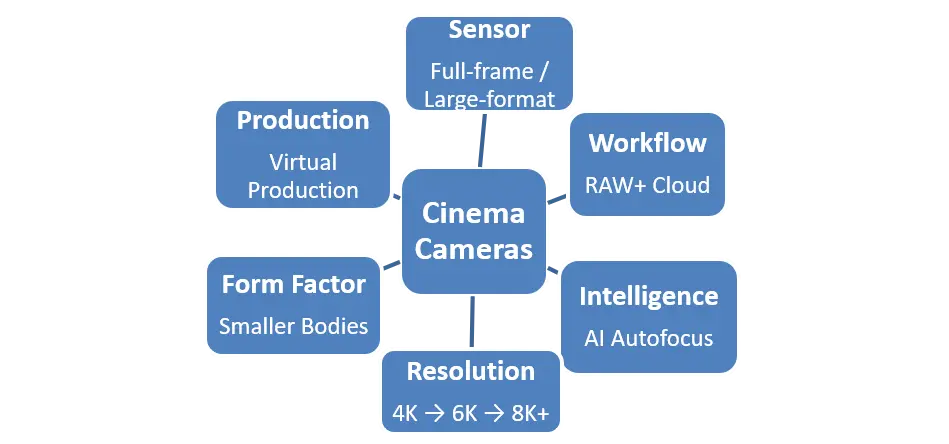
What is Changing in the Global Cinema Camera Market?
| “Cinema cameras are evolving from standalone image-capture devices into compact, intelligent, and connected production platforms.” |
Global Cinema Camera Market Trends
Full-Frame and Large-Format Sensors Gain Traction - Cinema camera manufacturers are increasingly moving toward full-frame and large-format sensors to deliver wider fields of view, stronger low-light performance, greater depth-of-field control, and a more cinematic visual aesthetic. Sony's VENICE 2, for example, uses an 8.6K full-frame sensor with 16 stops of exposure latitude, while its newer FX5, introduced in July 2026, combines a full-frame stacked CMOS sensor with 15+ stops of dynamic range.
Higher Resolution and Open-Gate Recording Growth- The market is shifting toward cameras that provide higher-resolution acquisition and greater flexibility during post-production. The latest Sony FX5 supports 5K recording up to 60 fps and 4K up to 120 fps, while also introducing Open Gate recording and internal X-OCN RAW to the FX series. These capabilities allow filmmakers to capture more image information and adapt footage for different production and distribution formats.
Virtual Production Integration Accelerates - Cinema cameras are increasingly being designed for integration with virtual production, LED volumes, camera tracking, and real-time rendering workflows. Sony's FR7, for instance, received support for OpenTrackIO, an open standard for virtual-production camera tracking that enables synchronization of camera, lens, timecode, and positional data with CG environments. The expansion of the broader virtual production market is going to support the production ecosystem surrounding cinema cameras.
AI and Advanced Connectivity Become More Important - Camera manufacturers are increasingly integrating AI-powered functions, remote monitoring, automated framing, and connected production workflows into professional camera systems. Sony's 2026 Cinema Line developments include AI-based Auto Framing on the FR7 and expanded smartphone, tablet, and computer-based monitoring and control capabilities. This indicates a shift toward cinema cameras functioning as connected production systems rather than standalone image-capture devices.
Cinema Camera Market Segment Analysis:
By Camera Type,
Digital cinema cameras dominated the global cinema camera market in 2025. This domination reflects their central role in professional film, television, streaming, documentary, advertising, and commercial production. The underlying production environment strongly supports this demand: the World Intellectual Property Organization reports that 9,628 feature films were produced globally in 2024, an all-time high and 2.4% above the 2023 record.
Global production was also 4.4% above the previous 2019 peak of 9,223 films. This increasing production base supports continued requirements for professional digital image-capture equipment. Digital cinema cameras also increasingly combine high-resolution recording, RAW workflows, wide dynamic range, advanced color science, and professional connectivity, making them suitable across increasingly diverse production environments. The transition is not limited to theatrical films: European audiovisual data show that 78% of SVOD viewing time in 2024 was devoted to television series, demonstrating the importance of episodic content alongside feature-film production.
Within the camera-type landscape, virtual-production-integrated cameras and 3D/VR cinema cameras represent higher-potential specialist applications, while conventional digital cinema cameras retain the largest installed demand base. Virtual production increasingly connects camera systems with LED stages, real-time rendering, tracking, and computer-generated environments, expanding cinema cameras' role beyond conventional location and studio shooting. At the same time, film cameras remain relevant for productions deliberately seeking analog image characteristics, while 3D/VR systems serve immersive and specialized content creation. The long-term opportunity therefore lies in cameras that combine conventional cinematic image quality with virtual-production compatibility, high-resolution capture, advanced tracking, and flexible post-production workflows. The growth in global production provides a structural foundation for this expansion: worldwide feature-film output more than doubled between 2004 and 2024, according to WIPO's analysis.
By Sensor Type
Full-frame and large-format sensors dominated the global cinema camera market in 2025, supported by their increasing adoption in premium filmmaking, streaming productions, advertising, and independent cinematography. Larger sensors provide filmmakers with greater control over depth of field, wider fields of view, low-light performance, and overall image aesthetics. The shift toward larger formats is also visible in new professional equipment development. For example, current full-frame cinema systems offer features such as 15+ stops of latitude, dual-base ISO, Log recording, and 4K/60p capture, demonstrating how large-format sensors are being paired with increasingly sophisticated image-processing capabilities. The expansion is occurring at both premium and more accessible price points, broadening the potential customer base beyond major studios toward independent filmmakers, commercial producers, and small production teams.

Large-format sensor adoption is likely to remain one of the strongest structural trends during the forecast period,
The increasing integration of large-format cameras into premium theatrical ecosystems further strengthens this opportunity. In 2026, Fujifilm’s GFX ETERNA 55, featuring a 43.8 × 32.9 mm sensor approximately 1.7 times larger than a 35mm full-frame sensor, joined the IMAX-certified digital-camera ecosystem, highlighting the growing commercial relevance of larger image formats for high-end filmmaking. although Super 35 continues to maintain an important professional installed base. The technology is progressing beyond conventional full-frame dimensions as manufacturers introduce even larger sensors for cinematography.
A recent large-format filmmaking system launched in India, for example, uses a 43.8 × 32.9 mm sensor, approximately 1.7 times larger than a 35-mm full-frame sensor, and supports multiple cinema formats including 35 mm and Super 35. At the same time, Super 35 remains relevant because of its established production workflows, lens compatibility, and familiarity among professional cinematographers. Smaller formats such as Micro Four Thirds retain opportunities in applications where compactness and mobility are important, while Super 16 and film remain specialized formats. Therefore, the future sensor landscape is likely to develop around larger-format adoption for premium image production while established formats continue serving cost-sensitive and specialized workflows.
Analyst Perspective
The key change is that sensor format is increasingly becoming a product-positioning factor rather than simply a technical specification. Manufacturers are using larger sensors alongside higher resolution, wider dynamic range, RAW recording, AI-assisted processing, and improved mobility to address different levels of professional production. For example, current professional systems range from full-frame 6K cameras with RAW recording to systems capable of 8K and higher-resolution acquisition, illustrating how sensor size and resolution are increasingly being developed together
Global Cinema Camera Market Regional Analysis
North America Maintains a Premium Cinema Camera Market
North America remains one of the most important markets for professional cinema cameras, supported by its concentration of major film studios, streaming production, television production, commercial filmmaking, rental houses, and established cinematography infrastructure. The United States produced 544 feature films in 2024, up from 510 in 2023. Although this production volume is substantially lower than India, North America's importance comes from the value and technical sophistication of productions rather than film volume alone.
Consumer preferences in the region are strongly oriented toward premium image quality, large-format cinematography, high dynamic range, 4K/8K acquisition, RAW workflows, and integration with virtual production and sophisticated post-production systems. The presence of major studios and high-budget streaming productions supports demand for flagship cinema cameras, while independent filmmakers and commercial producers create demand for more compact full-frame and Super 35 systems. The region therefore represents a high-value replacement and technology-upgrade market, with future growth increasingly linked to virtual production, episodic streaming content, large-format cinematography, and professional camera-rental ecosystems.
Europe Maintains a Diverse and Production-Intensive Market
Europe represents a highly diversified cinema camera market, supported by a large number of national film industries, established production infrastructure, public film-support mechanisms, international co-productions, and strong demand for local-language content. The European Audiovisual Observatory reports that 2,514 feature films were produced across 36 European markets in 2024, the highest production level recorded. Italy led with 350 films, followed by Spain with 303, the UK with 294, France with 231, and Türkiye with 223.
The region also demonstrates strong consumer preference for local-language cinema and culturally differentiated content. European films accounted for around 2.8% of European cinema admissions in 2024, up from 27.2% in 2023. Türkiye recorded a 57% national-film market share, while France reached 41.2% and the UK 38.6%. This diversity creates demand across premium studio cameras, lightweight systems for independent productions, documentary-oriented equipment, and cameras suited to international co-productions. Future growth potential remains strong in the UK, France, Italy, Spain, Türkiye, and Central and Eastern European production hubs, particularly as streaming platforms expand European original-content production.
Asia Pacific Provides the Strongest Production Capacity
Asia Pacific represents the largest production-capacity opportunity for cinema cameras, primarily because of the region's exceptionally high volume of film and audiovisual content creation. WIPO reports that India produced 2,605 feature films in 2024, representing more than one-quarter of global feature-film production. Japan produced 685 films, while China produced 612 films. This production scale creates a large installed and replacement market for cinema cameras, lenses, accessories, rental equipment, and production systems.
Consumer and producer preferences vary considerably across the region. India's multilingual film ecosystem supports demand for cameras across Hindi, Tamil, Telugu, Malayalam, and other regional-language productions. Japan's strong animation ecosystem and domestic theatrical market create a different production profile. China combines large-scale domestic production with significant investment in technologically advanced filmmaking. India also provides particularly strong future potential: its media and entertainment industry reached INR 2.5 trillion in 2024, while digital media became the largest segment at INR 802 billion, growing 17%. More than 1,600 films were released in India in 2024, despite a 5% decline in film-sector revenue.
From an analyst perspective, Asia Pacific offers the strongest volume-driven growth opportunity, while premium markets within the region support higher-value equipment demand. Increasing streaming consumption, regional-language content, expanding production infrastructure, and growing adoption of digital filmmaking technologies should support demand for 4K/6K/8K cameras, full-frame systems, compact cinema cameras, and virtual-production equipment.
South America Expands Through Local Content and Production Recovery
South America presents an emerging growth opportunity, supported by expanding domestic film production, local-language content, streaming distribution, and improving production ecosystems. Brazil is particularly important: WIPO reports that Brazilian feature-film production increased from 161 films in 2023 to 197 in 2024, representing 22% growth. Argentina also recorded one of the largest year-on-year increases globally, adding 63 films in 2024.
The regional market is characterized by demand for versatile and cost-efficient professional cinema equipment, reflecting a mixture of established production companies, independent filmmakers, commercial producers, and expanding streaming-oriented production. Filmmakers increasingly require equipment capable of delivering professional image quality while remaining suitable for smaller crews and location-based production. The future opportunity therefore lies in compact cinema cameras, full-frame systems, rental-based access, and cameras supporting high-resolution digital workflows. Brazil and Argentina are likely to remain the principal production centers, while other Latin American markets can provide incremental demand as local content ecosystems mature.
Middle East and Africa Develop Specialized Cinema Camera Demand
The Middle East and Africa represent an emerging cinema camera opportunity, with growth supported by new production infrastructure, government-backed film initiatives, international productions, regional streaming content, and expanding audiovisual industries. The opportunity differs from mature markets because demand is increasingly being created through capacity development and new production ecosystems, rather than primarily through replacement of large installed camera fleets.
Consumer preferences across the region are increasingly shaped by local-language storytelling, international co-productions, premium television and streaming content, documentaries, advertising, and culturally specific productions. Countries developing film-production infrastructure can attract international productions while simultaneously strengthening domestic filmmaking capabilities. From an analyst perspective, this makes the region a long-term capacity-building market: adoption is likely to favor versatile professional cameras that can support feature films, television, advertising, documentaries, and smaller independent productions without requiring the extensive infrastructure associated with the largest established film markets.
Global Cinema Camera Market Competitive Landscape
The Global Cinema Camera Market remains moderately concentrated, with competition increasingly shifting from standalone camera specifications toward complete cinematography ecosystems. The competitive environment includes established professional cinema-camera specialists as well as diversified imaging companies. Key players include ARRI, Sony, Canon, RED, Blackmagic Design, Panasonic, Nikon, and Fujifilm, with competition occurring across premium digital cinema, full-frame and large-format cameras, compact cinema systems, virtual production, and professional video.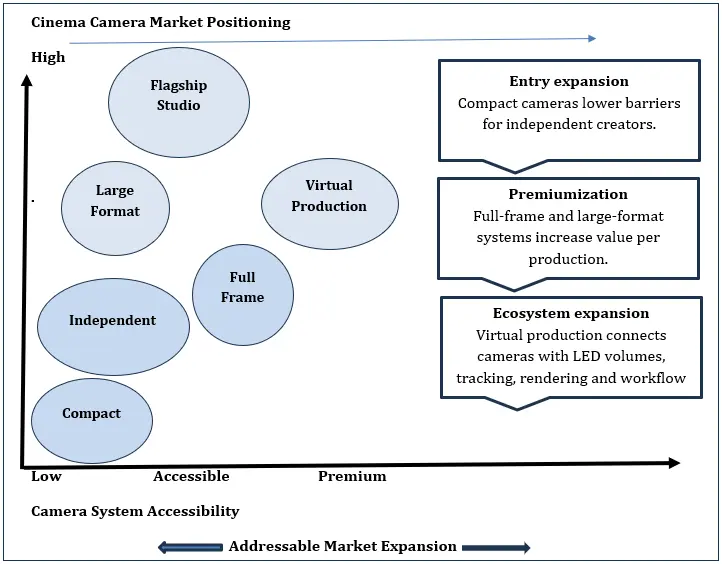
Premium Players Strengthen High-End Cinematography Positioning
ARRI maintains a premium, production-centric position in high-end feature films, television, and cinematography, where color science, reliability, workflow compatibility, and industry acceptance drive purchasing decisions. Its global presence across 15 countries is supported by regional sales, service, and rental infrastructure. Rather than competing primarily on camera-body price, ARRI focuses on an integrated cinematography ecosystem covering cameras, lenses, lighting, accessories, workflow solutions, and technical support, strengthening its appeal among cinematographers and rental houses.
Sony follows a broader market-coverage strategy through its Cinema Line, serving professional filmmaking, episodic content, independent production, and creator-led cinematography. Its portfolio spans from the FX30 at approximately USD 1,800 to the FX6 at around USD 7,000 and FR7 at approximately USD 12,000. At the premium end, VENICE 2 offers 8K and 6K full-frame sensors with internal X-OCN recording, while the FX series targets mobile production. This product ladder helps Sony expand users across its wider camera, lens, monitoring, and professional-production ecosystem.
Imaging Companies Expand Cinema Portfolios Through Technology Convergence
Canon positions its Cinema EOS portfolio around full-frame imaging, high-resolution acquisition, low-light performance, and lens integration. The EOS C80 features a full-frame back-illuminated stacked CMOS sensor, 6K RAW recording at 30p, 4K at 120p, and triple-base ISO. This allows Canon to leverage its imaging and optical technologies across professional cinema, television, documentary, and commercial production while serving different price and performance requirements.
Nikon's acquisition of RED Digital Cinema expands its presence in dedicated cinema cameras by combining Nikon's imaging and lens capabilities with RED's digital-cinema technology and professional customer base. The combination bridges still imaging, hybrid cameras, and high-end cinema systems as professional users increasingly seek autofocus, compact form factors, advanced sensors, and high-resolution RAW workflows.
Value-Oriented Players Increase Competitive Pressure
Blackmagic Design competes through strong technology-to-price positioning, targeting independent filmmakers, production companies, education, broadcast, and smaller professional teams. Its strategy combines high-resolution recording, RAW workflows, integrated software, and compatibility with DaVinci Resolve, creating a vertically integrated production ecosystem and lowering the entry barrier to professional filmmaking.
Panasonic and Fujifilm strengthen the mid-to-premium segment through full-frame and large-format imaging, emphasizing mobility, video functionality, color reproduction, and lens ecosystems. They target users seeking professional cinematic output without the cost and complexity of larger studio systems. This segment gains importance as independent filmmakers, commercial producers, and small crews seek high image quality with lower equipment and staffing requirements.
Regional Presence Shapes Competitive Positioning
| Region | Competitive Characteristics | Key Player Positioning |
| North America | High-budget films, streaming, television, rental ecosystem | Premium cinema systems, virtual production, large-format |
| Europe | Strong cinematography culture, national film industries, co-productions | Premium cameras, rental networks, production workflows |
| Asia Pacific | Largest production volume and rapidly expanding content ecosystem | Broad product portfolios, localized pricing, compact cinema systems |
| South America | Growing local production and rental demand | Professional yet cost-efficient equipment |
| Middle East & Africa | Developing production infrastructure and international filming | Versatile systems, regional service and distribution |
Global Cinema Camera Market Recent Developments
| Date | Company | Development | Strategic Impact on the Cinema Camera Market |
| July 2026 | ARRI | ALEXA 35 Live Xtreme launches with high-frame-rate output of up to 8× in HD and 2× in UHD through SDI, targeting live and multicamera production. | Expands cinema-camera applications beyond traditional filmmaking into live entertainment and broadcast production, creating an additional demand segment for high-end cinematic cameras. |
| April 2026 | Sony | FX5 Cinema Line camera launches with a newly developed sensor, Open Gate recording, internal RAW recording, and enhanced operability, extending advanced cinema features into a more compact form factor. | Strengthens the shift toward compact professional cinema cameras and increases competition in the independent filmmaking, commercial production, and small-crew segment. |
| September 2025 | Nikon / RED | Nikon launches the ZR, its first Z Cinema camera developed using Nikon and RED technologies. The full-frame camera supports R3D NE recording and RED-based color science, targeting film production, high-end production, and creators. | Marks a significant competitive expansion into the cinema-camera segment, combining Nikon's lens ecosystem with RED's cinema technology and increasing pressure on established full-frame cinema-camera portfolios. |
| July 2025 | ARRI | ALEXA 35 Xtreme launches with frame rates up to 660 fps, 17 stops of dynamic range at up to 330 fps, and the new ARRICORE codec designed to reduce data rates while maintaining post-production flexibility. | Raises the performance benchmark for high-speed cinematography while addressing data-management costs. The upgrade path for existing ALEXA 35 users also strengthens customer retention and protects installed-equipment investments. |
| April 2025 | Blackmagic Design | PYXIS 12K launches with a full-frame 12K RGBW sensor, 16 stops of dynamic range, dual CFexpress recording, 10G Ethernet, and Blackmagic Cloud synchronization, priced at USD 4,995 at launch. | Intensifies price-performance competition by bringing 12K full-frame acquisition, RAW workflows, and cloud-connected production into a comparatively accessible price category, increasing pressure on mid-range professional cinema-camera manufacturers. |
Cinema Camera Market Scope: Inquire before buying
| Cinema Camera Market | |||
|---|---|---|---|
| Report Coverage | Details | ||
| Base Year: | 2025 | Forecast Period: | 2026-2034 |
| Historical Data: | 2020 to 2025 | Market Size in 2025: | USD 333.79 Mn. |
| Forecast Period 2026 to 2034 CAGR: | 6.53% | Market Size in 2034: | USD 589.82 Mn. |
| Segments Covered: | by Camera Type | Digital Cinema Cameras Professional Digital Cinema Cameras Full-Frame & Large-Format Digital Cameras IMAX-Certified Digital Cameras Film Cameras 35mm Film Cameras 65mm / Large-Format Film Cameras IMAX 65mm Film Cameras Virtual Production Cameras LED Volume-Compatible Cameras Camera-Tracking-Integrated Systems Real-Time Production Cameras 3D/VR Cinema Cameras 3D Cinema Cameras 360° / VR Cameras Immersive Capture Systems |
|
| by Sensor Format | Full-Frame / Large Format Super 35 Micro Four Thirds Super 16 & Film |
||
| by Resolution | 2K and Below 4K 6K 8K and Above |
||
| by Distribution Channel | Direct Sales & Rental Houses Online Retail / E-commerce Specialty Camera Stores Authorized Resellers & System Integrators |
||
| by End- User | Feature Film Production Television & Streaming Production Documentary Filmmaking Advertising & Commercial Production Broadcast & Live Production Online Content Creation Others |
||
Global Cinema Camera Market, by region
North America (United States, Canada, and Mexico)
Europe (UK, France, Germany, Italy, Spain, Sweden, Austria, and the Rest of Europe)
Asia Pacific (China, South Korea, Japan, India, Australia, Indonesia, Malaysia, Vietnam, Taiwan, Bangladesh, Pakistan, and the Rest of APAC)
Middle East and Africa (South Africa, GCC, Egypt, Nigeria, and the Rest of ME&A)
South America (Brazil, Argentina Rest of South America)
Global Cinema Camera Market Key Players by Region
North America
1. RED Digital Cinema — United States
2. Eastman Kodak Company — United States
3. Silicon Imaging — United States
4. GoPro — United States
5. AJA Video Systems — United States
6. Panavision — United States
Europe
7. ARRI — Germany
8. Leica Camera — Germany
9. Cooke Optics — United Kingdom
10. Angénieux — France
11. Zeiss — Germany
12. Blackmagic Design Europe — European operations
Asia Pacific
13. Sony Group Corporation — Japan
14. Canon Inc. — Japan
15. Nikon Corporation — Japan
16. Panasonic Corporation — Japan
17. Fujifilm Holdings Corporation — Japan
18. JVCKENWOOD Corporation — Japan
19. Ikegami Tsushinki Co., Ltd. — Japan
20. Sharp Corporation — Japan
21. Sigma Corporation — Japan
22. Kinefinity — China
23. DJI — China
24. Z CAM — China
25. Kandao Technology — China
26. Samyang Optics — South Korea
27. Blackmagic Design — Australia
South America
28. Blackmagic Design — Australia/global presence
29. Sony — Japan/global presence
30. Canon — Japan/global presence
31. Panasonic — Japan/global presence
32. ARRI — Germany/global presence
33. Nikon / RED — Japan/United States
Middle East & Africa
34. ARRI — Germany
35. Sony — Japan
36. Canon — Japan
37. Panasonic — Japan
38. Nikon / RED — Japan / United States
39. Blackmagic Design — Australia
40. Fujifilm — Japan
Global Cinema Camera Market Frequently Asked Questions
1. What is the global cinema camera market?
The global cinema camera market comprises professional cameras used to capture high-quality video for feature films, television, streaming content, documentaries, advertising, and other professional cinematography applications.
2. What is the global cinema camera market size in 2025?
The global cinema camera market is valued at USD 333.79 million in 2025 and is estimated to reach USD 589.82 million by 2034, growing at a CAGR of 6.53% during the forecast period.
3. Which camera type dominates the cinema camera market?
Digital cinema cameras dominate the global cinema camera market, supported by their widespread use across feature films, streaming productions, television, advertising, documentaries, and independent filmmaking.
4. Which sensor type dominates the global cinema camera market?
Full-frame and large-format sensors dominate the market, driven by growing demand for wider fields of view, improved low-light performance, greater depth-of-field control, and cinematic image quality.
5. What factors drive cinema camera market growth?
The major factors driving cinema camera market growth include increasing film and streaming content production, adoption of 4K and 8K cinematography, growth in virtual production, advances in large-format sensors, and increasing investment in professional digital filmmaking.
6. What are the major trends in the cinema camera market?
Key cinema camera market trends include the adoption of full-frame and large-format sensors, higher-resolution 6K and 8K recording, virtual-production integration, AI-assisted camera functions, RAW workflows, and greater connectivity between cameras and professional production systems.
7. Which regions offer the highest growth potential in the cinema camera market?
Asia Pacific offers strong volume-driven growth potential because of its large film-production base and expanding streaming ecosystem, while North America remains a high-value market supported by premium film, television, streaming, and virtual-production activity. Europe also provides significant opportunities through its diverse local-language film industries and expanding original-content production.