Brucellosis Treatment Market Size by Pathogen Species, Diagnosis, Treatment Type, Target Application and End-User, Trends, Key Opportunities, Drivers, Restraints, Regional and Competitive Analysis

5.48%
CAGR (2026-2034)
439.46 USD Mn.
Forecast Market Size
302
Report Pages
154
Market Tables

Overview

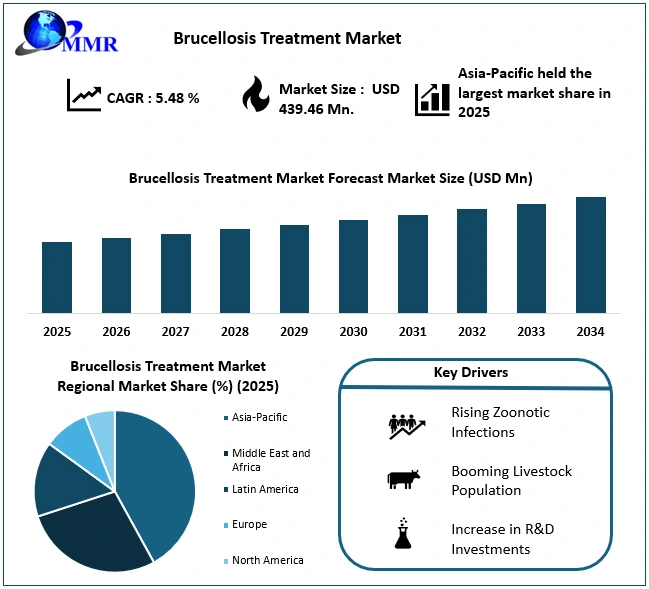
The Global Brucellosis Treatment Market size was valued at USD 439.46 Million in 2025 and is expected to reach a forecast market size of USD 711.23 Million by 2034. This steady upward trend relies heavily on ongoing public health campaigns and local livestock protection programs, driving a CAGR of 5.48% over the 2025–2034 forecast period. This momentum is building because of smarter livestock screening programs, tighter safety rules for dairy farms, and a clearer medical consensus that combining different antibiotics is the best way to cure patients.

Brucellosis is a zoonotic bacterial infection caused by Brucella species, transmitted mainly from infected livestock to humans through contact with animals, contaminated tissues and fluids, or consumption of unpasteurized milk and dairy products. The disease is particularly relevant in regions with substantial livestock farming and limited animal-health controls, with approximately 500,000 reported human cases historically cited each year; however, a 2023 global epidemiological assessment estimated that the actual annual incidence could be considerably higher, at around 1.6–2.1 million new human infections, reflecting substantial underdiagnosis and underreporting. Treatment is primarily antibiotic-based and generally requires combination therapy for at least 6 weeks, with doxycycline and rifampin commonly used for several major Brucella infections, while alternative regimens may be required for specific patient groups or bacterial strains.

The brucellosis treatment market represents the demand for pharmaceutical therapies used to manage human infections and is closely influenced by disease prevalence, diagnostic coverage, livestock exposure, healthcare accessibility and public-health surveillance. Market expansion is being supported by the continuing disease burden across parts of Asia, the Middle East, Africa, the Mediterranean region and Latin America, where close human–animal interaction and consumption of inadequately treated animal products can sustain transmission.

Increasing recognition of brucellosis as a One Health issue, together with improvements in disease surveillance and laboratory diagnosis, is creating greater opportunities for timely treatment and management. At the same time, the market faces limitations because brucellosis is frequently misdiagnosed due to its nonspecific symptoms, while prolonged combination antibiotic therapy creates challenges related to treatment adherence, adverse effects and relapse. Consequently, future market development is expected to depend not only on antibiotic demand but also on earlier diagnosis, improved treatment protocols, management of complicated infections and stronger coordination between human and veterinary healthcare systems.

Brucellosis Treatment Market Growth and Regional Share
Brucellosis Treatment Market Share
To know about the Research Methodology :- Request Free Sample Report

Brucellosis Treatment Market Dynamics

Brucellosis Treatment Market : Drivers

Rise in Animal-to-Human Transmission: Closer everyday contact between livestock workers and their herds drives up infection rates. Consuming unpasteurized dairy acts as a major source of infection

Booming Livestock Inventories: Growing global meat and dairy demand leads to larger farm herd populations. Quick access to effective medications is essential to protect farmers' livelihoods from outbreaks

Strict Public Screening Rules: Governments are stepping in with mandatory health checks for farm animals. State-subsidized care programs help rural clinics maintain steady medication supplies.

Focus on Advanced Vaccine and Drug R&D: Drug companies are investing more to solve long-standing medical gaps in farming communities. High-risk populations and livestock accelerate funding for novel combination therapies and DNA-based vaccines.

Brucellosis Treatment Market : Restraints

Initial Diagnostic Challenges:
Patient symptoms closely mimic seasonal influenza, leading to frequent misdiagnoses.
Delayed diagnosis prevents early medical intervention, stalling the procurement and distribution of targeted therapies.

Scarcity of Novel Therapeutics:
This market relies on legacy antibiotic pairings due to a lack of next-generation molecules.
A stagnant drug discovery pipeline restricts industry expansion, leaving networks with few pharmaceutical alternatives.

Lack of a Human Vaccine:
This shifts the entire commercial market focus onto post-infection therapeutics.
Veterinary containment measures fail to eliminate zoonotic risks, creating a recurring patient load that drives product sales.

Patient Resistance Risks:
Prolonged multi-week antibiotic treatment protocols lead to low patient adherence and early treatment dropouts.

Brucellosis Treatment Market : Key Opportunities

Investment in Fixed-Dose Combination Drug Formulations:
Developing single-pill oral treatments that merge multiple antibiotic classes significantly improves patient compliance, helping companies capture lucrative public procurement tenders and expand market potential.

Pairing Diagnostics with Therapeutic Packages for Rural Procurement:
Bundling rapid field-test kits directly with immediate antibiotic packs unlocks high-volume distribution channels funded by regional healthcare upgrades in endemic agricultural zones.

Capital Deployment in Target-Specific Intracellular Delivery Matrices:
Investing in advanced nano-carriers and lipid-based platforms bypasses corporate competition by upgrading legacy antibiotics into premium, high-margin products within the industry.

Bulk Supply Expansion for Veterinary Herd Stabilization Programs:
Scaling up production of bulk animal anti-infectives targets the massive commercial demand from large-scale agricultural cooperatives seeking to meet strict livestock trade safety mandates.

Brucellosis Treatment Market Key Opportunities

Brucellosis Treatment Market: Challenges

Extensive Underdiagnosis and Misidentification:
Patient symptoms look exactly like a routine flu, which leads to frequent misdiagnoses that hide the true customer demand and artificially compress the actual market size for therapies.

Complex Multi-Country Regulatory Obstacles:
Confusing, non-standardized international approval rules for updating old antibiotic mixes lengthen development timelines, heavily draining corporate investment capital within the global industry.

Active Ingredient Sourcing Deficits:
Ongoing international shipping bottlenecks cause sudden shortages of the raw chemical ingredients needed to make medications, completely disrupting bulk manufacturing schedules.

High Attrition from Protracted Therapy Relapses:
Keeping patients on harsh pill regimens for up to six weeks is incredibly difficult, leading to early dropouts that trigger painful infection relapses long-term market potential.

Brucellosis Treatment Market : Trends

Growing Acceptance of Standardized Combination Therapies:
Hospital protocols are completely phasing out single-antibiotic options due to high clinical failure rates, establishing multi-drug combination tracking as the absolute global medical standard to maximize market potential.

Rapid Market Penetration of Branded Generic Antibiotics:
High healthcare costs in endemic rural regions are driving procurement networks toward affordable generic alternatives, allowing generic variants to capture over 65% of the regional distribution pipelines within the industry.

Integration of One-Health Collaborative Control Models:
International health ministries are shifting procurement strategies toward unified programs that link human therapy with livestock disease management, streamlining medication stockpiling and stabilizing long-term market potential.

Surge in Demand for Long-Term Anti-Inflammatory Adjuvants:
Managing secondary chronic bone and joint complications requires a steady supply of supportive therapeutics alongside standard antibiotics, expanding the commercial footprint of anti-inflammatory drugs across the global industry.

Brucellosis Treatment Market Trends

Brucellosis Treatment Market: Regional Insights

Asia-Pacific Holds Largest Market Share:
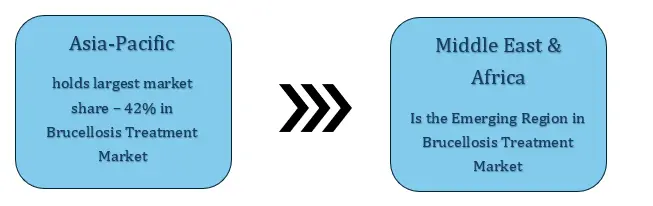
The Asia-Pacific region dominates the global Brucellosis Treatment market, commanding a leading 42% market share of the total global industry. Sales are rising due to massive commercial livestock inventories, heavy government funding for agricultural health infrastructure, and large-scale public procurement contracts in India and China. According to formal epidemiological tracking models compiled by the National Institutes of Health (NIH) in 2025, the wider Asian regional territory sustains an evidence-based conservative baseline of 1,410,000 active human cases annually. China's National Notifiable Disease Reporting System tracked in 2023 showed that human infections within individual national boundaries reached 70,439 active human cases, confirming the massive long-term market potential and high product volume demand across this territory.

Middle East and Africa Drives High Clinical Demand:
Deep disease presence and close contact with livestock maintain a high demand for therapeutic options across this region. Momentum is growing because of traditional farming practices, open animal grazing, and a high volume of occupational exposure in pastoral communities. In 2024, World Health Organization (WHO) data revealed that 20.45% of people in rural farming areas tested positive for the infection. Outbreaks in high-burden countries like Kuwait and Qatar caused infection rates to spike among farming groups in 2025.

South America Coordinates Local Distribution Hubs:
This regional sector focuses on setting up local drug delivery networks to protect farming communities while bypassing high border taxes. Local demand is rising because regional distributors are shifting toward generic supply agreements to provide affordable anti-infectives to remote agricultural hubs. In 2025, regional monitoring logs from agricultural ministries showed rising herd infections in Peru and Mexico, creating a sudden spike in treatment requirements

Europe Emphasizes Stringent Safety Standards:
Medical centers follow rigid European medicine regulations and strict containment guidelines to systematically eliminate zoonotic spillover. Product sales are rising due to an increased veterinary focus on immediate infection control to prevent localized transmission from disrupting commercial dairy export pipelines. Public surveillance data showed that animal outbreaks were met with rapid antibiotic treatments to protect dairy supplies.

North America Focuses on Surveillance and Occupational Care: Commercial spending is rising in this region due to increased procurement of high-margin combination therapies and supportive drugs to treat chronic osteoarticular complications in imported cases. In 2025, national health protection systems noted that domestic livestock transmissions remained rare due to strict dairy safety laws.
Brucellosis Treatment Market Regional Insights

Brucellosis Treatment Market : Segment Analysis

By Pathogen Species

Brucella melitensis: High-virulence bacterial strains in sheep and goats command overall market volume metrics within this category, serving as the primary biological trigger that accelerates acute patient caseloads and expands long-term market potential.

Brucella abortus: Cattle-specific infection vectors steadily secure a massive bulk procurement position because commercial dairy operations purchase heavy volumes of specialized anti-infectives to clear agricultural herds and protect revenue lines.

Other Species: Swine and canine pathogens hold a vital, highly specialized niche space by requiring distinct antibiotic formulations tailored for industrial breeding facilities, showing steady demand over the forecast period.

Brucellosis Treatment by Pathogern Species
By Application

Humans: Patient-centered medical interventions dominate the commercial revenue space since multi-week combination therapies, long-term hospital infrastructure, and rigorous diagnostic tracking command premium pharmaceutical pricing within the global industry.

Animals: Livestock management protocols retain a highly predictable, volume-driven market presence because large-scale farming entities place consistent wholesale orders for therapeutic bundles to protect herd assets from cross-border trade bans.

Brucellosis Treatment Market by Application
By Diagnosis

Serological Screening Tests: Standardized blood assays like ELISA and Rose Bengal tests firmly anchor high-throughput institutional testing by serving as the primary, low-cost checkpoint that triggers subsequent drug procurement across the industry.

Advanced Imaging Modalities (MRI/CT): Magnetic resonance imaging and computed tomography scans rapidly capture specialized hospital radiology budgets to confirm deep tissue complications and direct targeted secondary therapies.

Biopsies and Culture Isolations: Bone marrow biopsies and slow-growing blood cultures strictly dictate definitive clinical validation in complex cases, unlocking high-value hospital laboratory revenues during the forecast period.
Others

By Treatment Type

Antibiotics: Target-specific antibacterial drug sales heavily dictate the principal therapeutic pipeline, capturing the primary revenue share through prolonged multi-week regimens like doxycycline, rifampicin, and streptomycin.

Anti-Infectives: Alternative specialized agents and folate synthesis inhibitors progressively secure expanding market segments to handle unique patient restrictions or drug-resistant mutations.

Vaccines: Animal immunizations using live attenuated strains steadily secure a massive bulk procurement position via government-funded livestock safety mandates to eliminate zoonotic transmission chains at the farm level.

Others: Supportive care adjuncts, including non-steroidal anti-inflammatory drugs (NSAIDs) and systemic corticosteroids, steadily maintain a vital secondary procurement channel within the total market size.

By End-User

Hospitals: Centralized human emergency centers firmly capture the highest single buying share to manage severe acute cases, oversee complicated drug distribution schedules, and track patient recovery.

Veterinary Clinics: Dedicated animal health networks completely govern bulk pharmaceutical deployment channels by directly prescribing and administering specialized anti-infective volumes on a massive scale.

Outpatient Hubs: Community health centers and rural clinics progressively act as a vital long-term care provider by monitoring farming populations, tracking medication compliance, and managing multi-week oral treatment programs.

Brucellosis Treatment Market by Enduser

Brucellosis Treatment Market: Competitive Landscape

Zoetis Inc.: This industry leader scales its global market potential by locking down multi-year public procurement contracts with national agricultural ministries for bulk therapeutic supply lines. The corporation relies heavily on a high-margin bundling strategy that pairs rapid, field-ready diagnostic kits directly with its targeted anti-infective portfolios. This approach captures high-volume clinical demand and secures a leading revenue position across core endemic regions.

Merck & Co., Inc. / Merck Animal Health: Corporate growth is anchored by extensive portfolio optimization that targets high-burden pastoral economies with standardized, multi-class anti-infectives. The company stabilizes its long-term distribution channels by maintaining deep institutional partnerships with global healthcare and veterinary authorities like the World Organisation for Animal Health (WOAH). These international framework agreements ensure a highly predictable and steady supply pipeline across emerging markets.

Boehringer Ingelheim International GmbH: Strategic capital deployment is directed toward advanced, target-specific micro-carrier drug delivery architectures to revitalize and upgrade legacy antibiotic lines into premium formulations. By streamlining its localized supply networks and packaging facilities across the high-growth Asia-Pacific territory, the firm effectively bypasses border tariffs. This operational agility allows the enterprise to successfully capture dominant public hospital tenders.

Ceva Santé Animale: Market expansion relies on establishing specialized regional manufacturing and distribution hubs directly inside endemic agricultural zones to lower frontline logistics costs. The corporation strengthens its competitive footprint by offering comprehensive veterinary containment packages to massive agricultural cooperatives. These bundled solutions secure exclusive supply agreements and block low-cost generic entry into their primary networks.

Indian Immunologicals Limited: The company maximizes its commercial footprint by commanding high-volume, generic anti-infective distribution pipelines across central and southern Asia. Operating under a low-cost manufacturing model, the firm aligns its core production schedules directly with government-funded national disease control mandates. This close public-sector integration guarantees a stable, highly resilient revenue flow throughout the forecast period.

Brucellosis Treatment Market : Recent Developments

In May 2025: Merck Animal Health completed a massive USD 895 million expansion of its advanced manufacturing facility in Kansas. This infrastructure upgrade secures critical bulk capacity and high-throughput packaging lines, effectively shielding global commercial distributors against supply bottlenecks to maximize long-term market potential.

In August 2025: The European Medicines Agency (EMA) issued formalized regulatory guidance clarifying approval pathways for next-generation multiepitope and plasmid-based therapies. This milestone framework has heavily reduced drug development risks, immediately accelerating corporate research and capital investments across the global industry.

In December 2025: India’s Department of Biotechnology successfully completed advanced immunogenicity trials for its novel MEV1 and MEV2 multi-epitope treatments. The therapeutic data demonstrated exceptional biological protection rates against Brucella abortus and B. melitensis, setting up the platform for near-term commercial rollouts during the forecast period.

In March 2026: The Government of India’s Livestock Health and Disease Control Programme launched a nationwide centralized procurement and cold-chain supply strategy. This state-funded public health initiative has systematically distributed millions of doses, drastically reducing regional transmission spikes and securing massive wholesale contract channels.

In June 2026: Zoetis Inc. finalized a multi-agency partnership with the FDA and USDA to deploy rapid treatment and containment frameworks across vulnerable global supply lines. By leveraging refocused capital from divested assets, the corporation has locked down steady bulk distribution contracts with international farming cooperatives to optimize total market size.

Brucellosis Treatment Market Scope: Inquire before buying

Brucellosis Treatment Market
Report Coverage Details
Base Year: 2025 Forecast Period: 2026-2032
Historical Data: 2020 to 2025 Market Size in 2025: USD 439.46 Mn.
Forecast Period 2026 to 2032 CAGR: 5.48% Market Size in 2032: USD 711.23 Mn.
Segments Covered: by Pathogen Species Brucella melitensis
Brucella abortus
Other Species
by Diagnosis Serological Screening Tests
Advanced Imaging Modalities (MRI/CT)
Biopsies and Culture Isolations
by Treatment Type Antibiotics
Preventative Veterinary Vaccines
Anti-Infectives
Others
by Target Application Humans
Animals
by End-User Hospitals
Veterinary Clinics
Outpatient Hubs

Brucellosis Treatment Market by Region

North America (United States, Canada, and Mexico)
Europe (UK, France, Germany, Italy, Spain, Sweden, Austria, and the Rest of Europe)
Asia Pacific (China, South Korea, Japan, India, Australia, ASEAN, Indonesia, Philippines, Malaysia, Vietnam, Thailand, ASEAN, Rest of Asia Pacific)
Middle East & Africa (South Africa, GCC, Nigeria, Rest of ME&A)
South America (Brazil, Argentina, Rest of South America)

Brucellosis Treatment Market : Key Players

North America
1. Zoetis Inc.
2. Merck & Co., Inc. / Merck Animal Health
3. Elanco Animal Health Incorporated
4. Phibro Animal Health Corporation
5. Neogen Corporation
6. Colorado Serum Company

Europe
7. Boehringer Ingelheim
8. Ceva Santé Animale
9. Virbac
10. Vetoquinol
11. Norbrook Laboratories
12. Kela N.V.
13. Livisto Group
14. Huvepharma
15. Zendal / CZ Vaccines

Asia-Pacific (APAC)
16. Indian Immunologicals Limited (IIL)
17. Hester Biosciences Limited
18. Biomed Private Limited
19. Shenzhen Senior Technology

Middle East & Africa (MEA)
20. Vetal Animal Health Products
21. Saudi Pharmaceutical Industries (SPIMACO)
22. Afrigen Biologics

South America
23. Tecnovax
24. Laboratorios König
25. Biogenesis Bagó
Others

Why Buy This Report?

The Global Brucellosis Treatment market report delivers direct operational insights for clinical investors, healthcare operators, and pharmaceutical manufacturers looking to scale their corporate footprints. It provides a definitive roadmap to unlock long-term market potential and upgrade product portfolios across core anti-infective formulations and veterinary intervention platforms. This analysis equips commercial teams with the necessary intelligence to navigate the competitive landscape, capture expanding volumes, and secure long-term procurement contracts across the global industry.

Frequently Asked Questions :

Q1. What is the market size of the Global Brucellosis Treatment market for 2025?
Ans. The global market size is valued at USD 439.46 Million in 2025, reflecting massive capital deployment across clinical anti-infective distribution channels and agricultural disease containment networks worldwide.

Q2. Which pathogen species classification commands the most significant portion of this medical industry?
Ans. Brucella melitensis treatment channels completely command the commercial space by holding over 52% of total revenue, followed closely by Brucella abortus control pipelines across massive livestock cooperatives.

Q3. What is the CAGR and forecast market for the Brucellosis Treatment market through the 2025 to 2034 forecast period?
Ans. The overall Brucellosis Treatment market maintains a steady growth rate with a validated CAGR of 5.48% through 2034, reaching a projected value of USD 711.23 Million as health ministries ramp up mandatory herd stability programs.

Q4. Which regional sector currently commands the highest individual portion of total revenue in Brucellosis Treatment Market?
Ans. The Asia-Pacific region captures the leading position in the industry, commanding a dominant 42% market share due to its expansive livestock farming inventories and centralized government-funded drug distribution programs.

Q5. What treatment type currently dictates the principal therapeutic pipeline for patients in Brucellosis Treatment Market?
Ans. Target-specific antibiotics firmly anchor the principal therapeutic pipeline, driven by heavy clinical reliance on prolonged, multi-week combination drug regimens like doxycycline and rifampicin to prevent high infection relapses.

Table of Contents

1. Brucellosis Treatment Market Introduction 1.1. Study Assumptions and Market Definition 1.2. Scope of the Study 1.3. Executive Summary 2. Brucellosis Treatment Market: Competitive Landscape 2.1. MMR Competition Matrix 2.2. Competitive Landscape 2.3. Key Players Benchmarking 2.3.1. Company Name 2.3.2. Business Segment 2.3.3. End-user Segment 2.3.4. Revenue (2025) 2.3.5. Company Locations 2.4. Leading Brucellosis Treatment Market Companies, by market capitalization 2.5. Market Structure 2.5.1. Market Leaders 2.5.2. Market Followers 2.5.3. Emerging Players 2.6. Mergers and Acquisitions Details 3. Brucellosis Treatment Market: Dynamics 3.1. Brucellosis Treatment Market Trends by Region 3.1.1. North America Brucellosis Treatment Market Trends 3.1.2. Europe Brucellosis Treatment Market Trends 3.1.3. Asia Pacific Brucellosis Treatment Market Trends 3.1.4. Middle East and Africa Brucellosis Treatment Market Trends 3.1.5. South America Brucellosis Treatment Market Trends 3.2. Brucellosis Treatment Market Dynamics by Region 3.2.1. North America 3.2.1.1. North America Brucellosis Treatment Market Drivers 3.2.1.2. North America Brucellosis Treatment Market Restraints 3.2.1.3. North America Brucellosis Treatment Market Opportunities 3.2.1.4. North America Brucellosis Treatment Market Challenges 3.2.2. Europe 3.2.2.1. Europe Brucellosis Treatment Market Drivers 3.2.2.2. Europe Brucellosis Treatment Market Restraints 3.2.2.3. Europe Brucellosis Treatment Market Opportunities 3.2.2.4. Europe Brucellosis Treatment Market Challenges 3.2.3. Asia Pacific 3.2.3.1. Asia Pacific Brucellosis Treatment Market Drivers 3.2.3.2. Asia Pacific Brucellosis Treatment Market Restraints 3.2.3.3. Asia Pacific Brucellosis Treatment Market Opportunities 3.2.3.4. Asia Pacific Brucellosis Treatment Market Challenges 3.2.4. Middle East and Africa 3.2.4.1. Middle East and Africa Brucellosis Treatment Market Drivers 3.2.4.2. Middle East and Africa Brucellosis Treatment Market Restraints 3.2.4.3. Middle East and Africa Brucellosis Treatment Market Opportunities 3.2.4.4. Middle East and Africa Brucellosis Treatment Market Challenges 3.2.5. South America 3.2.5.1. South America Brucellosis Treatment Market Drivers 3.2.5.2. South America Brucellosis Treatment Market Restraints 3.2.5.3. South America Brucellosis Treatment Market Opportunities 3.2.5.4. South America Brucellosis Treatment Market Challenges 3.3. PORTER's Five Forces Analysis 3.4. PESTLE Analysis 3.5. Technology Roadmap 3.6. Regulatory Landscape by Region 3.6.1. North America 3.6.2. Europe 3.6.3. Asia Pacific 3.6.4. Middle East and Africa 3.6.5. South America 3.7. Key Opinion Leader Analysis For Brucellosis Treatment Industry 3.8. Analysis of Government Schemes and Initiatives For Brucellosis Treatment Industry 3.9. Brucellosis Treatment Market Trade Analysis 3.10. The Global Pandemic Impact on Brucellosis Treatment Market 4. Brucellosis Treatment Market: Global Market Size and Forecast by Segmentation (in USD Million) 2025-2034 4.1. Brucellosis Treatment Market Size and Forecast, by Pathogen Species (2025-2034) 4.1.1. Brucella melitensis 4.1.2. Brucella abortus 4.1.3. Other Species 4.2. Brucellosis Treatment Market Size and Forecast, by Treatment Type & Intervention Portfolio (2025-2034) 4.2.1. Antibiotics 4.2.2. Preventative Veterinary Vaccines 4.2.3. Anti-Infectives 4.2.4. Others 4.3. Brucellosis Treatment Market Size and Forecast, by Institutional End-user (2025-2034) 4.3.1. Hospitals 4.3.2. Veterinary Clinics 4.3.3. Outpatient Hubs 4.4. Brucellosis Treatment Market Size and Forecast, by Region (2025-2034) 4.4.1. North America 4.4.2. Europe 4.4.3. Asia Pacific 4.4.4. Middle East and Africa 4.4.5. South America 5. North America Brucellosis Treatment Market Size and Forecast by Segmentation (in USD Million) 2025-2034 5.1. North America Brucellosis Treatment Market Size and Forecast, by Pathogen Species (2025-2034) 5.1.1. Brucella melitensis 5.1.2. Brucella abortus 5.1.3. Other Species 5.2. North America Brucellosis Treatment Market Size and Forecast, by Treatment Type & Intervention Portfolio (2025-2034) 5.2.1. Antibiotics 5.2.2. Preventative Veterinary Vaccines 5.2.3. Anti-Infectives 5.2.4. Others 5.3. North America Brucellosis Treatment Market Size and Forecast, by End-user (2025-2034) 5.3.1. Hospitals 5.3.2. Veterinary Clinics 5.3.3. Outpatient Hubs 5.4. North America Brucellosis Treatment Market Size and Forecast, by Country (2025-2034) 5.4.1. United States 5.4.1.1. United States Brucellosis Treatment Market Size and Forecast, by Pathogen Species (2025-2034) 5.4.1.1.1. Brucella melitensis 5.4.1.1.2. Brucella abortus 5.4.1.1.3. Other Species 5.4.1.2. United States Brucellosis Treatment Market Size and Forecast, by Treatment Type & Intervention Portfolio (2025-2034) 5.4.1.2.1. Antibiotics 5.4.1.2.2. Preventative Veterinary Vaccines 5.4.1.2.3. Anti-Infectives 5.4.1.2.4. Others 5.4.1.3. United States Brucellosis Treatment Market Size and Forecast, by End-user (2025-2034) 5.4.1.3.1. Hospitals 5.4.1.3.2. Veterinary Clinics 5.4.1.3.3. Outpatient Hubs 5.4.2. Canada 5.4.2.1. Canada Brucellosis Treatment Market Size and Forecast, by Pathogen Species (2025-2034) 5.4.2.1.1. Brucella melitensis 5.4.2.1.2. Brucella abortus 5.4.2.1.3. Other Species 5.4.2.2. Canada Brucellosis Treatment Market Size and Forecast, by Treatment Type & Intervention Portfolio (2025-2034) 5.4.2.2.1. Antibiotics 5.4.2.2.2. Preventative Veterinary Vaccines 5.4.2.2.3. Anti-Infectives 5.4.2.2.4. Others 5.4.2.3. Canada Brucellosis Treatment Market Size and Forecast, by End-user (2025-2034) 5.4.2.3.1. Hospitals 5.4.2.3.2. Veterinary Clinics 5.4.2.3.3. Outpatient Hubs 6. Europe Brucellosis Treatment Market Size and Forecast by Segmentation (in USD Million) 2025-2034 6.1. Europe Brucellosis Treatment Market Size and Forecast, by Pathogen Species (2025-2034) 6.2. Europe Brucellosis Treatment Market Size and Forecast, by Treatment Type & Intervention Portfolio (2025-2034) 6.3. Europe Brucellosis Treatment Market Size and Forecast, by End-user (2025-2034) 6.4. Europe Brucellosis Treatment Market Size and Forecast, by Country (2025-2034) 6.4.1. United Kingdom 6.4.1.1. United Kingdom Brucellosis Treatment Market Size and Forecast, by Pathogen Species (2025-2034) 6.4.1.2. United Kingdom Brucellosis Treatment Market Size and Forecast, by Treatment Type & Intervention Portfolio (2025-2034) 6.4.1.3. United Kingdom Brucellosis Treatment Market Size and Forecast, by End-user (2025-2034) 6.4.2. France 6.4.2.1. France Brucellosis Treatment Market Size and Forecast, by Pathogen Species (2025-2034) 6.4.2.2. France Brucellosis Treatment Market Size and Forecast, by Treatment Type & Intervention Portfolio (2025-2034) 6.4.2.3. France Brucellosis Treatment Market Size and Forecast, by End-user (2025-2034) 6.4.3. Germany 6.4.3.1. Germany Brucellosis Treatment Market Size and Forecast, by Pathogen Species (2025-2034) 6.4.3.2. Germany Brucellosis Treatment Market Size and Forecast, by Treatment Type & Intervention Portfolio (2025-2034) 6.4.3.3. Germany Brucellosis Treatment Market Size and Forecast, by End-user (2025-2034) 6.4.4. Italy 6.4.4.1. Italy Brucellosis Treatment Market Size and Forecast, by Pathogen Species (2025-2034) 6.4.4.2. Italy Brucellosis Treatment Market Size and Forecast, by Treatment Type & Intervention Portfolio (2025-2034) 6.4.4.3. Italy Brucellosis Treatment Market Size and Forecast, by End-user (2025-2034) 6.4.5. Spain 6.4.5.1. Spain Brucellosis Treatment Market Size and Forecast, by Pathogen Species (2025-2034) 6.4.5.2. Spain Brucellosis Treatment Market Size and Forecast, by Treatment Type & Intervention Portfolio (2025-2034) 6.4.5.3. Spain Brucellosis Treatment Market Size and Forecast, by End-user (2025-2034) 6.4.6. Sweden 6.4.6.1. Sweden Brucellosis Treatment Market Size and Forecast, by Pathogen Species (2025-2034) 6.4.6.2. Sweden Brucellosis Treatment Market Size and Forecast, by Treatment Type & Intervention Portfolio (2025-2034) 6.4.6.3. Sweden Brucellosis Treatment Market Size and Forecast, by End-user (2025-2034) 6.4.7. Austria 6.4.7.1. Austria Brucellosis Treatment Market Size and Forecast, by Pathogen Species (2025-2034) 6.4.7.2. Austria Brucellosis Treatment Market Size and Forecast, by Treatment Type & Intervention Portfolio (2025-2034) 6.4.7.3. Austria Brucellosis Treatment Market Size and Forecast, by End-user (2025-2034) 6.4.8. Rest of Europe 6.4.8.1. Rest of Europe Brucellosis Treatment Market Size and Forecast, by Pathogen Species (2025-2034) 6.4.8.2. Rest of Europe Brucellosis Treatment Market Size and Forecast, by Treatment Type & Intervention Portfolio (2025-2034) 6.4.8.3. Rest of Europe Brucellosis Treatment Market Size and Forecast, by Institutional End-user (2025-2034) 7. Asia Pacific Brucellosis Treatment Market Size and Forecast by Segmentation (in USD Million) 2025-2034 7.1. Asia Pacific Brucellosis Treatment Market Size and Forecast, by Pathogen Species (2025-2034) 7.2. Asia Pacific Brucellosis Treatment Market Size and Forecast, by Treatment Type & Intervention Portfolio (2025-2034) 7.3. Asia Pacific Brucellosis Treatment Market Size and Forecast, by End-user (2025-2034) 7.4. Asia Pacific Brucellosis Treatment Market Size and Forecast, by Country (2025-2034) 7.4.1. China 7.4.1.1. China Brucellosis Treatment Market Size and Forecast, by Pathogen Species (2025-2034) 7.4.1.2. China Brucellosis Treatment Market Size and Forecast, by Treatment Type & Intervention Portfolio (2025-2034) 7.4.1.3. China Brucellosis Treatment Market Size and Forecast, by End-user (2025-2034) 7.4.2. S Korea 7.4.2.1. S Korea Brucellosis Treatment Market Size and Forecast, by Pathogen Species (2025-2034) 7.4.2.2. S Korea Brucellosis Treatment Market Size and Forecast, by Treatment Type & Intervention Portfolio (2025-2034) 7.4.2.3. S Korea Brucellosis Treatment Market Size and Forecast, by End-user (2025-2034) 7.4.3. Japan 7.4.3.1. Japan Brucellosis Treatment Market Size and Forecast, by Pathogen Species (2025-2034) 7.4.3.2. Japan Brucellosis Treatment Market Size and Forecast, by Treatment Type & Intervention Portfolio (2025-2034) 7.4.3.3. Japan Brucellosis Treatment Market Size and Forecast, by End-user (2025-2034) 7.4.4. India 7.4.4.1. India Brucellosis Treatment Market Size and Forecast, by Pathogen Species (2025-2034) 7.4.4.2. India Brucellosis Treatment Market Size and Forecast, by Treatment Type & Intervention Portfolio (2025-2034) 7.4.4.3. India Brucellosis Treatment Market Size and Forecast, by End-user (2025-2034) 7.4.5. Australia 7.4.5.1. Australia Brucellosis Treatment Market Size and Forecast, by Pathogen Species (2025-2034) 7.4.5.2. Australia Brucellosis Treatment Market Size and Forecast, by Treatment Type & Intervention Portfolio (2025-2034) 7.4.5.3. Australia Brucellosis Treatment Market Size and Forecast, by End-user (2025-2034) 7.4.6. Indonesia 7.4.6.1. Indonesia Brucellosis Treatment Market Size and Forecast, by Pathogen Species (2025-2034) 7.4.6.2. Indonesia Brucellosis Treatment Market Size and Forecast, by Treatment Type & Intervention Portfolio (2025-2034) 7.4.6.3. Indonesia Brucellosis Treatment Market Size and Forecast, by End-user (2025-2034) 7.4.7. Malaysia 7.4.7.1. Malaysia Brucellosis Treatment Market Size and Forecast, by Pathogen Species (2025-2034) 7.4.7.2. Malaysia Brucellosis Treatment Market Size and Forecast, by Treatment Type & Intervention Portfolio (2025-2034) 7.4.7.3. Malaysia Brucellosis Treatment Market Size and Forecast, by End-user (2025-2034) 7.4.8. Vietnam 7.4.8.1. Vietnam Brucellosis Treatment Market Size and Forecast, by Pathogen Species (2025-2034) 7.4.8.2. Vietnam Brucellosis Treatment Market Size and Forecast, by Treatment Type & Intervention Portfolio (2025-2034) 7.4.8.3. Vietnam Brucellosis Treatment Market Size and Forecast, by End-user (2025-2034) 7.4.9. Taiwan 7.4.9.1. Taiwan Brucellosis Treatment Market Size and Forecast, by Pathogen Species (2025-2034) 7.4.9.2. Taiwan Brucellosis Treatment Market Size and Forecast, by Treatment Type & Intervention Portfolio (2025-2034) 7.4.9.3. Taiwan Brucellosis Treatment Market Size and Forecast, by End-user (2025-2034) 7.4.10. Rest of Asia Pacific 7.4.10.1. Rest of Asia Pacific Brucellosis Treatment Market Size and Forecast, by Pathogen Species (2025-2034) 7.4.10.2. Rest of Asia Pacific Brucellosis Treatment Market Size and Forecast, by Treatment Type & Intervention Portfolio (2025-2034) 7.4.10.3. Rest of Asia Pacific Brucellosis Treatment Market Size and Forecast, by Institutional End-user (2025-2034) 8. Middle East and Africa Brucellosis Treatment Market Size and Forecast by Segmentation (in USD Million) 2025-2034 8.1. Middle East and Africa Brucellosis Treatment Market Size and Forecast, by Pathogen Species (2025-2034) 8.2. Middle East and Africa Brucellosis Treatment Market Size and Forecast, by Treatment Type & Intervention Portfolio (2025-2034) 8.3. Middle East and Africa Brucellosis Treatment Market Size and Forecast, by End-user (2025-2034) 8.4. Middle East and Africa Brucellosis Treatment Market Size and Forecast, by Country (2025-2034) 8.4.1. South Africa 8.4.1.1. South Africa Brucellosis Treatment Market Size and Forecast, by Pathogen Species (2025-2034) 8.4.1.2. South Africa Brucellosis Treatment Market Size and Forecast, by Treatment Type & Intervention Portfolio (2025-2034) 8.4.1.3. South Africa Brucellosis Treatment Market Size and Forecast, by End-user (2025-2034) 8.4.2. GCC 8.4.2.1. GCC Brucellosis Treatment Market Size and Forecast, by Pathogen Species (2025-2034) 8.4.2.2. GCC Brucellosis Treatment Market Size and Forecast, by Treatment Type & Intervention Portfolio (2025-2034) 8.4.2.3. GCC Brucellosis Treatment Market Size and Forecast, by End-user (2025-2034) 8.4.3. Nigeria 8.4.3.1. Nigeria Brucellosis Treatment Market Size and Forecast, by Pathogen Species (2025-2034) 8.4.3.2. Nigeria Brucellosis Treatment Market Size and Forecast, by Treatment Type & Intervention Portfolio (2025-2034) 8.4.3.3. Nigeria Brucellosis Treatment Market Size and Forecast, by End-user (2025-2034) 8.4.4. Rest of ME&A 8.4.4.1. Rest of ME&A Brucellosis Treatment Market Size and Forecast, by Pathogen Species (2025-2034) 8.4.4.2. Rest of ME&A Brucellosis Treatment Market Size and Forecast, by Treatment Type & Intervention Portfolio (2025-2034) 8.4.4.3. Rest of ME&A Brucellosis Treatment Market Size and Forecast, by End-user (2025-2034) 9. South America Brucellosis Treatment Market Size and Forecast by Segmentation (in USD Million) 2025-2034 9.1. South America Brucellosis Treatment Market Size and Forecast, by Pathogen Species (2025-2034) 9.2. South America Brucellosis Treatment Market Size and Forecast, by Treatment Type & Intervention Portfolio (2025-2034) 9.3. South America Brucellosis Treatment Market Size and Forecast, by End-user (2025-2034) 9.4. South America Brucellosis Treatment Market Size and Forecast, by Country (2025-2034) 9.4.1. Brazil 9.4.1.1. Brazil Brucellosis Treatment Market Size and Forecast, by Pathogen Species (2025-2034) 9.4.1.2. Brazil Brucellosis Treatment Market Size and Forecast, by Treatment Type & Intervention Portfolio (2025-2034) 9.4.1.3. Brazil Brucellosis Treatment Market Size and Forecast, by End-user (2025-2034) 9.4.2. Argentina 9.4.2.1. Argentina Brucellosis Treatment Market Size and Forecast, by Pathogen Species (2025-2034) 9.4.2.2. Argentina Brucellosis Treatment Market Size and Forecast, by Treatment Type & Intervention Portfolio (2025-2034) 9.4.2.3. Argentina Brucellosis Treatment Market Size and Forecast, by End-user (2025-2034) 9.4.3. Rest of South America 9.4.3.1. Rest of South America Brucellosis Treatment Market Size and Forecast, by Pathogen Species (2025-2034) 9.4.3.2. Rest of South America Brucellosis Treatment Market Size and Forecast, by Treatment Type & Intervention Portfolio (2025-2034) 9.4.3.3. Rest of South America Brucellosis Treatment Market Size and Forecast, by Institutional End-user (2025-2034) 10. Company Profile: Key Players 10.1. Zoetis Inc. 10.1.1. Company Overview 10.1.2. Business Portfolio 10.1.3. Financial Overview 10.1.4. SWOT Analysis 10.1.5. Strategic Analysis 10.1.6. Scale of Operation (small, medium, and large) 10.1.7. Details on Partnership 10.1.8. Regulatory Accreditations and Certifications Received by Them 10.1.9. Awards Received by the Firm 10.1.10. Recent Developments 10.2. Merck & Co., Inc. / Merck Animal Health 10.2.1. Company Overview 10.2.2. Business Portfolio 10.2.3. Financial Overview 10.2.4. SWOT Analysis 10.2.5. Strategic Analysis 10.2.6. Scale of Operation (small, medium, and large) 10.2.7. Details on Partnership 10.2.8. Regulatory Accreditations and Certifications Received by Them 10.2.9. Awards Received by the Firm 10.2.10. Recent Developments 10.3. Elanco Animal Health Incorporated 10.3.1. Company Overview 10.3.2. Business Portfolio 10.3.3. Financial Overview 10.3.4. SWOT Analysis 10.3.5. Strategic Analysis 10.3.6. Scale of Operation (small, medium, and large) 10.3.7. Details on Partnership 10.3.8. Regulatory Accreditations and Certifications Received by Them 10.3.9. Awards Received by the Firm 10.3.10. Recent Developments 10.4. Boehringer Ingelheim 10.4.1. Company Overview 10.4.2. Business Portfolio 10.4.3. Financial Overview 10.4.4. SWOT Analysis 10.4.5. Strategic Analysis 10.4.6. Scale of Operation (small, medium, and large) 10.4.7. Details on Partnership 10.4.8. Regulatory Accreditations and Certifications Received by Them 10.4.9. Awards Received by the Firm 10.4.10. Recent Developments 10.5. Ceva Santé Animale 10.5.1. Company Overview 10.5.2. Business Portfolio 10.5.3. Financial Overview 10.5.4. SWOT Analysis 10.5.5. Strategic Analysis 10.5.6. Scale of Operation (small, medium, and large) 10.5.7. Details on Partnership 10.5.8. Regulatory Accreditations and Certifications Received by Them 10.5.9. Awards Received by the Firm 10.5.10. Recent Developments 10.6. Indian Immunologicals Limited (IIL) 10.6.1. Company Overview 10.6.2. Business Portfolio 10.6.3. Financial Overview 10.6.4. SWOT Analysis 10.6.5. Strategic Analysis 10.6.6. Scale of Operation (small, medium, and large) 10.6.7. Details on Partnership 10.6.8. Regulatory Accreditations and Certifications Received by Them 10.6.9. Awards Received by the Firm 10.6.10. Recent Developments 10.7. Phibro Animal Health Corporation 10.7.1. Company Overview 10.7.2. Business Portfolio 10.7.3. Financial Overview 10.7.4. SWOT Analysis 10.7.5. Strategic Analysis 10.7.6. Scale of Operation (small, medium, and large) 10.7.7. Details on Partnership 10.7.8. Regulatory Accreditations and Certifications Received by Them 10.7.9. Awards Received by the Firm 10.7.10. Recent Developments 10.8. Neogen Corporation 10.8.1. Company Overview 10.8.2. Business Portfolio 10.8.3. Financial Overview 10.8.4. SWOT Analysis 10.8.5. Strategic Analysis 10.8.6. Scale of Operation (small, medium, and large) 10.8.7. Details on Partnership 10.8.8. Regulatory Accreditations and Certifications Received by Them 10.8.9. Awards Received by the Firm 10.8.10. Recent Developments 10.9. Hester Biosciences Limited 10.9.1. Company Overview 10.9.2. Business Portfolio 10.9.3. Financial Overview 10.9.4. SWOT Analysis 10.9.5. Strategic Analysis 10.9.6. Scale of Operation (small, medium, and large) 10.9.7. Details on Partnership 10.9.8. Regulatory Accreditations and Certifications Received by Them 10.9.9. Awards Received by the Firm 10.9.10. Recent Developments 10.10. Virbac 10.10.1. Company Overview 10.10.2. Business Portfolio 10.10.3. Financial Overview 10.10.4. SWOT Analysis 10.10.5. Strategic Analysis 10.10.6. Scale of Operation (small, medium, and large) 10.10.7. Details on Partnership 10.10.8. Regulatory Accreditations and Certifications Received by Them 10.10.9. Awards Received by the Firm 10.10.10. Recent Developments 10.11. Vetoquinol 10.11.1. Company Overview 10.11.2. Business Portfolio 10.11.3. Financial Overview 10.11.4. SWOT Analysis 10.11.5. Strategic Analysis 10.11.6. Scale of Operation (small, medium, and large) 10.11.7. Details on Partnership 10.11.8. Regulatory Accreditations and Certifications Received by Them 10.11.9. Awards Received by the Firm 10.11.10. Recent Developments 10.12. Norbrook Laboratories 10.12.1. Company Overview 10.12.2. Business Portfolio 10.12.3. Financial Overview 10.12.4. SWOT Analysis 10.12.5. Strategic Analysis 10.12.6. Scale of Operation (small, medium, and large) 10.12.7. Details on Partnership 10.12.8. Regulatory Accreditations and Certifications Received by Them 10.12.9. Awards Received by the Firm 10.12.10. Recent Developments 10.13. Tecnovax 10.13.1. Company Overview 10.13.2. Business Portfolio 10.13.3. Financial Overview 10.13.4. SWOT Analysis 10.13.5. Strategic Analysis 10.13.6. Scale of Operation (small, medium, and large) 10.13.7. Details on Partnership 10.13.8. Regulatory Accreditations and Certifications Received by Them 10.13.9. Awards Received by the Firm 10.13.10. Recent Developments 10.14. Biogenesis Bagó 10.14.1. Company Overview 10.14.2. Business Portfolio 10.14.3. Financial Overview 10.14.4. SWOT Analysis 10.14.5. Strategic Analysis 10.14.6. Scale of Operation (small, medium, and large) 10.14.7. Details on Partnership 10.14.8. Regulatory Accreditations and Certifications Received by Them 10.14.9. Awards Received by the Firm 10.14.10. Recent Developments 10.15. Saudi Pharmaceutical Industries (SPIMACO) 10.15.1. Company Overview 10.15.2. Business Portfolio 10.15.3. Financial Overview 10.15.4. SWOT Analysis 10.15.5. Strategic Analysis 10.15.6. Scale of Operation (small, medium, and large) 10.15.7. Details on Partnership 10.15.8. Regulatory Accreditations and Certifications Received by Them 10.15.9. Awards Received by the Firm 10.15.10. Recent Developments 10.16. Laboratorios König 10.16.1. Company Overview 10.16.2. Business Portfolio 10.16.3. Financial Overview 10.16.4. SWOT Analysis 10.16.5. Strategic Analysis 10.16.6. Scale of Operation (small, medium, and large) 10.16.7. Details on Partnership 10.16.8. Regulatory Accreditations and Certifications Received by Them 10.16.9. Awards Received by the Firm 10.16.10. Recent Developments 10.17. Vetal Animal Health Products 10.17.1. Company Overview 10.17.2. Business Portfolio 10.17.3. Financial Overview 10.17.4. SWOT Analysis 10.17.5. Strategic Analysis 10.17.6. Scale of Operation (small, medium, and large) 10.17.7. Details on Partnership 10.17.8. Regulatory Accreditations and Certifications Received by Them 10.17.9. Awards Received by the Firm 10.17.10. Recent Developments 10.18. Colorado Serum Company 10.18.1. Company Overview 10.18.2. Business Portfolio 10.18.3. Financial Overview 10.18.4. SWOT Analysis 10.18.5. Strategic Analysis 10.18.6. Scale of Operation (small, medium, and large) 10.18.7. Details on Partnership 10.18.8. Regulatory Accreditations and Certifications Received by Them 10.18.9. Awards Received by the Firm 10.18.10. Recent Developments 11. Key Findings 12. Industry Recommendations 13. Global Brucellosis Treatment Market: Research Methodology 14. Terms and Glossary

Custom Market Research Services

We Will Customise The Research For You, In Case The Report Listed Above Does Not Meet With Your Requirements