
Board Sports Market by Product, Application, Distribution Channel and Region – Global Market Size Estimation, Industry-Wide Analysis, Competitive Landscape Assessment & Long-Term Forecast to 2032
Overview
The Board Sports Market size was valued at USD 38.80 Billion in 2024 and the total Board Sports revenue is expected to grow at a CAGR of 5.3% from 2025 to 2032, reaching nearly USD 58.65 Billion.
Board Sports Market Overview
Board sports, also known as board riding or action sports, encompass a range of thrilling activities where participants ride and maneuver on boards. These sports occur across diverse surfaces, including water, snow, and concrete, demanding balance, coordination, and skill for executing tricks and maneuvers.
Among the most popular board sports is surfing, where riders ride waves on surfboards, attempting maneuvers like carving, cutbacks, and aerial tricks. Skateboarding involves performing flips, spins, and grinds on urban structures using a skateboard, while snowboarding entails descending snow-covered slopes, performing jumps, spins, and tricks. Wakeboarding combines water and board skills as riders execute jumps, flips, and spins on the water's surface while being towed.
Kitesurfing integrates elements of surfing, wakeboarding, and windsurfing, utilizing a large kite to ride across water. Longboarding incorporates cruising, commuting, and downhill racing with longer skateboards, often involving sliding and freestyle tricks. Stand-up Paddle boarding (SUP) involves standing on a large board and using a paddle to navigate calm waters. Windsurfing combines sailing and surfing, utilizing a sail and a board to catch wind and glide across water, executing jumps and tricks.
The Board Sports Market is a flourishing sector that centers on the creation, trade, and utilization of gear, attire, and additional items for a variety of board sports including wave riding, skateboarding, snowboarding, wakeboarding, kiteboarding, longboarding, stand-up paddleboarding (SUP), and windsurfing. This industry serves a diverse group of individuals, encompassing both expert athletes and leisurely enthusiasts spanning across all age groups.
The extent of the market for board sports covers gear such as wave boards, street boards, mountain boards, wind-borne surfing gear, lengthy boards, stand-up paddle boards, and related add-ons.
It also comprises clothing, add-ons, gatherings, contests, retail and distribution networks, teaching and coaching services, as well as media and entertainment platforms. With its wide attractiveness and varied customer foundation, the board sports market is affected by elements such as customer inclinations, technological advancements, ecological considerations, and economic circumstances. As board sports gain further recognition and evolve, the market is expected to continue expanding, presenting new opportunities for businesses, fostering innovation, and promoting community engagement.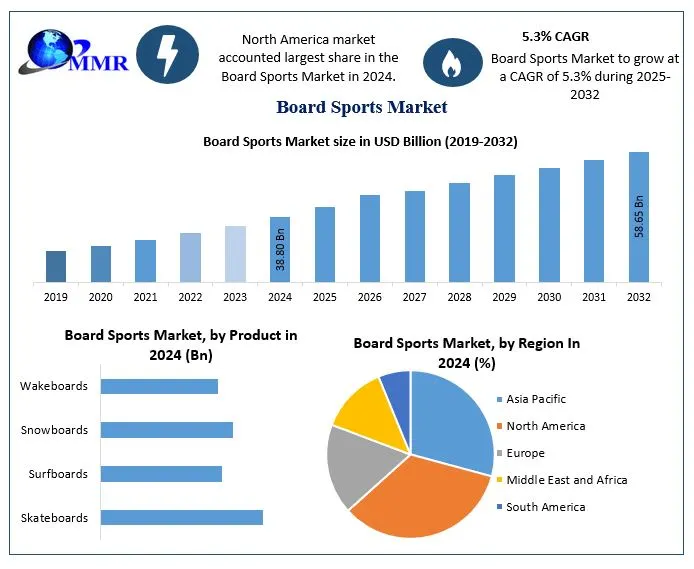 To know about the Research Methodology :- Request Free Sample Report
Board Sports Market Dynamics
Commercial Board Sports Major Drivers
The complex and interconnected nature of today's business Increasing Popularity and Participation: Board sports have experienced a surge in popularity worldwide, with a growing number of individuals, across various age groups, embracing these activities. Factors such as increased media coverage, social media promotion, and the aspirational appeal of board sports have contributed to their rising popularity. This increased interest and participation drive the demand for board sports equipment, apparel, and accessories.
The board sports market has witnessed significant technological advancements in recent years. Innovations in board design, materials, and manufacturing techniques have resulted in improved performance, durability, and safety of board sports equipment. For example, the development of lightweight and durable materials, advanced board shapes, and high-performance bindings and fins have enhanced the overall experience for participants. Technological advancements continue to drive the market by attracting both professional athletes seeking improved performance and recreational participants looking for safer and more enjoyable experiences.
Board Sports Market Opportunities
Emerging Markets Board sports are increasingly gaining popularity in emerging markets across Asia, Latin America, and Africa. As these regions experience economic growth and greater exposure to international trends, there is a growing potential for the expansion of the board sports market. Businesses have the potential to enter these markets by launching their offerings, setting up networks for distribution, and meeting the distinct demands and inclinations of customers in these geographic locations.
Environmentally-Friendly Approaches: In the world of board sports, there is a rising spotlight on sustainability and a conscientious approach toward the environment. Customers are becoming increasingly cognizant of the ecological consequences of their decisions and are actively searching for products that align with their principles. This opens up avenues for companies to design eco-conscious board sports gear, and clothing crafted from recycled or renewable resources, and embrace sustainable manufacturing techniques. Embracing sustainability not only attract environmentally conscious consumers but also contribute to the long-term viability and growth of the board sports market as a whole.
Board Sports Market Major Restraints
High Cost of Entry: Participating in board sports can often require a significant upfront investment, especially when it comes to purchasing equipment and gear. This can act as a restraint, particularly for individuals who are new to the sport or have budget constraints. The cost of high-quality boards, protective gear, and specialized apparel can limit accessibility and hinder market growth. Overcoming this restraint involves finding ways to make board sports more affordable and accessible, such as offering rental services, entry-level equipment options, or financing programs.
The availability of suitable locations and infrastructure for board sports can be a restraint in certain regions. For example, access to suitable waves for surfing or snow-covered slopes for snowboarding may be limited, particularly in landlocked or urban areas. Lack of proper facilities, such as skate parks or water bodies suitable for wakeboarding, can also pose challenges. Expanding infrastructure, developing artificial wave pools or indoor facilities, and advocating for the inclusion of board sports in public spaces can help address these limitations and enhance accessibility for enthusiasts.
Board Sports Market Challenges
The Board Sports Market is highly competitive, leading to Safety and Risk Factors: Board sports inherently involve certain risks, and ensuring participant safety is a significant challenge for the industry. Accidents and injuries can occur due to factors such as inadequate training, lack of proper protective gear, or reckless behavior. Maintaining safety standards, promoting education and training programs, and raising awareness about responsible participation are ongoing challenges for the board sports market.
Many board sports, such as surfing, snowboarding, and windsurfing, are heavily reliant on favorable weather conditions and specific seasons. This presents a challenge in terms of market demand fluctuations and revenue generation. Businesses in the board sports industry often face seasonal peaks and off-season periods, which require effective planning and management to ensure consistent sales and profitability.
Diversification of offerings, exploring indoor or alternative venues, and promoting year-round participation through events or training programs can help mitigate the impact of seasonal fluctuations. price pressure and potential constraints on profitability. Insurers may face challenges in achieving adequate premium rates that adequately reflect the risks being covered. The intense competition among insurers, particularly in markets, can squeeze profit margins and impact the sustainability of certain lines of business.
Board Sports Market Trends
The board sports market is witnessing several significant trends that are shaping the industry. One prominent trend is the growing emphasis on sustainability and eco-consciousness. Consumers are increasingly seeking environmentally friendly products made from recycled or sustainable materials, prompting companies to develop more sustainable board materials and adopt eco-friendly practices.
Technological innovations are another key trend in the board sports market, enhancing performance, safety, and user experience. Advanced materials, improved board designs, and integrated technology components are driving the industry forward. Wearable technology and smart devices are also being incorporated into board sports equipment, offering real-time feedback and tracking performance metrics.
The rise of women's participation is a notable trend, leading to increased demand for women-specific equipment and apparel. Companies are responding with women-specific designs, sizing options, and inclusive marketing campaigns, tapping into a growing market segment.
Board Sports Market Segment Analysis
Based on Product: The Board Sports market is segmented into Skateboards, Surfboards, Snowboards, Wakeboards and Others.
Skateboards: Skateboarding is the most beloved type of board sport, and this classification is expected to witness a compound annual growth rate (CAGR) of 5.6% from 2025 to 2032 The surge of this classification is driven by the soaring popularity of skateboarding among adolescents and grown-ups, coupled with the increasing acknowledgment of the health benefits associated with it.
Surfboards: The surfboarding sector is foreseen to experience a CAGR of 5.4% from 2025 to 2032. The growth in this sector is propelled by the growing preference for surfing among both vacationers and locals, in addition to the rising disposable incomes of consumers.
Snowboards: The snowboarding classification is anticipated to witness a CAGR of 1.7% from 2025 to 2032. The expansion of this segment is driven by the escalating interest in snowboarding among adolescents and grown-ups, as well as the growing number of ski resorts worldwide.
Wakeboards: The wakeboarding sector is expected to experience a CAGR of 4.9% from 2025 to 2032. The growth of this segment is driven by the increasing popularity of wakeboarding among both teenagers and adults, alongside the rising number of cable parks around the globe.
Based on Distribution Channel: The Board Sports market is segmented into Online and Offline.
Online Distribution: The online retail channel is projected to witness a CAGR of 6.2% from 2025 to 2032. The growth of online distribution is attributed to the surging popularity of online shopping and the convenience it offers for purchasing board sports equipment.
Offline Distribution: The traditional retail channel is expected to undergo a CAGR of 4.9% from 2025 to 2032. The growth of the offline distribution channel is fueled by the expanding presence of physical stores that specialize in selling board sports products.
Board Sports Market Regional Insights
Asia Pacific: Asia Pacific has a vibrant board sports market with a significant presence of surf, skate, and snowboarding communities. Countries like Australia, Indonesia, Japan, and New Zealand have a strong surf culture and are renowned for their world-class waves. Australia, in particular, has a well-developed board sports industry, hosting major surfing events and nurturing top surfers. In addition to traditional board sports, emerging activities such as stand-up paddle boarding and wakeboarding are gaining popularity. The region also offers opportunities for growth in the production and distribution of board sports equipment and apparel, driven by a rising interest in outdoor recreational activities and a growing middle class with disposable income.
Europe: Europe has a thriving board sports market, with a rich history and strong participation in sports like surfing, skateboarding, and snowboarding. Countries like France, Portugal, Spain, and the UK are known for their surf spots, hosting international surfing competitions. The region has a well-established infrastructure, including skate parks, snow parks, and surf schools, catering to enthusiasts and professionals. The European market emphasizes design, style, and technical performance, with a strong presence of leading board sports brands. Sustainability is also a growing focus, with eco-friendly initiatives and environmentally conscious practices gaining traction in the industry.
North America: North America is a prominent market for board sports, encompassing a wide range of activities. The United States, in particular, has a strong presence in surfing, skateboarding, and snowboarding, with California serving as a hub for board sports culture and industry. The region is home to iconic surf breaks, skate parks, and renowned snow destinations. North America has a market with a well-established infrastructure, including specialized retail stores, skate shops, and surf shops. The market emphasizes innovation, technology, and performance, driving advancements in board designs, materials, and equipment. The region also hosts numerous competitions and events, attracting athletes and enthusiasts from around the world.
Latin America and LAMEA (Latin America, Middle East, and Africa): Latin America and the LAMEA (Latin America, Middle East, and Africa) region has a growing board sports market with significant potential. Countries like Brazil, Costa Rica, and Chile offer excellent surf conditions and have a strong surfing culture. The region is also witnessing growth in other board sports such as skateboarding and stand-up paddle boarding. While the market may not be as developed as other regions, it presents opportunities for the expansion of board sports infrastructure, manufacturing, and distribution. Increasing interest in outdoor recreational activities, rising disposable income, and a growing young population contribute to the market's growth potential. However, challenges such as limited access to resources, economic disparities, and lack of developed infrastructure can impact the market's growth trajectory in some areas within the region.
Board Sports Market Competitive Landscape
The board sports market features a competitive landscape with global brands like Quiksilver, Billabong, Vans, Burton Snowboards, and Hyperlite holding significant market share. Regional and local players also play a vital role, catering to specific markets with localized products. Sustainability has become a key differentiator, with brands adopting eco-friendly practices and materials. Innovation and product performance drive competition, as brands constantly develop new technologies and designs. Effective marketing strategies and brand image are crucial for visibility and consumer loyalty. The market is characterized by a mix of global brands, regional players, and niche manufacturers, with sustainability, innovation, performance, and marketing as key competitive factors.
Board Sports Market Scope: Inquire before buying
| Global Board Sports Market | |||
|---|---|---|---|
| Report Coverage | Details | ||
| Base Year: | 2024 | Forecast Period: | 2025-2032 |
| Historical Data: | 2019 to 2024 | Market Size in 2024: | USD 38.80 Bn. |
| Forecast Period 2025 to 2032 CAGR: | 5.3% | Market Size in 2032: | USD 58.65 Bn. |
| Segments Covered: | By Product | Skateboards Surfboards Snowboards Wakeboards Others |
|
| By Application | Water Land Snow Sand Air Others |
||
| By Distribution Channel | Online Offline |
||
Board Sports Market, by Region
North America (United States, Canada and Mexico)
Europe (UK, France, Germany, Italy, Spain, Sweden, Austria and Rest of Europe)
Asia Pacific (China, South Korea, Japan, India, Australia, Indonesia, Malaysia, Vietnam, Taiwan, Bangladesh, Pakistan and Rest of APAC)
Middle East and Africa (South Africa, GCC, Egypt, Nigeria and Rest)
South America (Brazil, Argetina and Rest of South America)
Board Sports Market Major Competitors
North America
1. Quiksilver, Inc. (United States)
2. Billabong International Limited (United States)
3. Rip Curl, LLC (United States)
4. O'Neill, Inc. (United States)
5. Vans, Inc. (United States)
6. NHS, Inc. (United States)
7. Skate One Corp. (United States)
8. Burton Corporation (United States)
9. Mervin Manufacturing, Inc. (United States)
10. Ride Snowboard Company (United States)
11. HO Sports Company, Inc. (United States)
12. Kent Watersports Holdings, LLC (United States)
13. Square One Distribution, Inc. (United States)
14. Naish International, Inc. (United States)
15. CI Surfboards, LLC (United States)
16. Nike, Inc. (United States)
17. Adidas America, Inc. (United States)
18. Patagonia, Inc. (United States)
19. Hurley, LLC (United States)
20. Volcom, LLC (United States)
21. Quiksilver, Inc. (United States)
Asia Pacific
22. Starboard Co. Ltd. (Thailand)
23. Neil Pryde Ltd. (China)
Europe
24. Tushingham Sails Ltd. (United Kingdom)
25. Adidas AG (Germany)
FAQS:
1. What are the growth drivers for the Board Sports Market?
Ans. The growth drivers for the board sports market include increasing popularity and participation, technological advancements, and the rising emphasis on sustainability and eco-consciousness.
2. What is the major restraint for the Board sports market growth?
Ans. The major restraint for the board sports market growth is the potential safety risks and challenges associated with these activities, which may deter some potential participants.
3. Which region is expected to lead the global Board Sports Market during the forecast period?
Ans. Based on current trends and market analysis, North America is expected to lead the global Board Sports Market during the forecast period.
4. What was the Global Board Sports Market size in 2024?
Ans: The Global Board Sports Market size was USD 38.80 Billion in 2024.
5. What segments are covered in the Board Sports Market report?
Ans. The segments covered in the Board Sports Market report are Product, Distribution, End-user, Age group, and region.