
Biosolids Market by Form, Product Type, Application, and Region – Global Market Size Estimation, Industry-Wide Analysis, Competitive Landscape Assessment & Long-Term Forecast to 2034
Overview
The Biosolids Market size was valued at USD 4.01 Billion in 2025 and the total Biosolids revenue is expected to grow at a CAGR of 4.5% from 2026 to 2034, reaching nearly USD 5.96 Billion.
Biosolids Market Overview:
Biosolids Market is expected to reach US$ 5.01 Bn. by. The process of treating wastewater results in the creation of biosolids. The liquids and solids in wastewater are separated during treatment. These solids are then subjected to physical and chemical processing to create biosolids, a semisolid, nutrient-rich by-product. This report focuses on the different segments of the Biosolids market (Form, Product Type, Application, and Region). The leading industry players and regions are thoroughly examined in this report (North America, Asia Pacific, Europe, Middle East & Africa, and South America). It's a thorough examination of today's quick advances in a variety of sectors. Facts and figures, visualisations, and presentations are used to highlight the primary data analysis from 2025 to 2034. The market drivers, restraints, opportunities, and challenges for Biosolids are examined in this report. The MMR report's investment suggestions are based on a thorough examination of the current competitive environment in the Biosolids market.
Biosolids Market Growth Outlook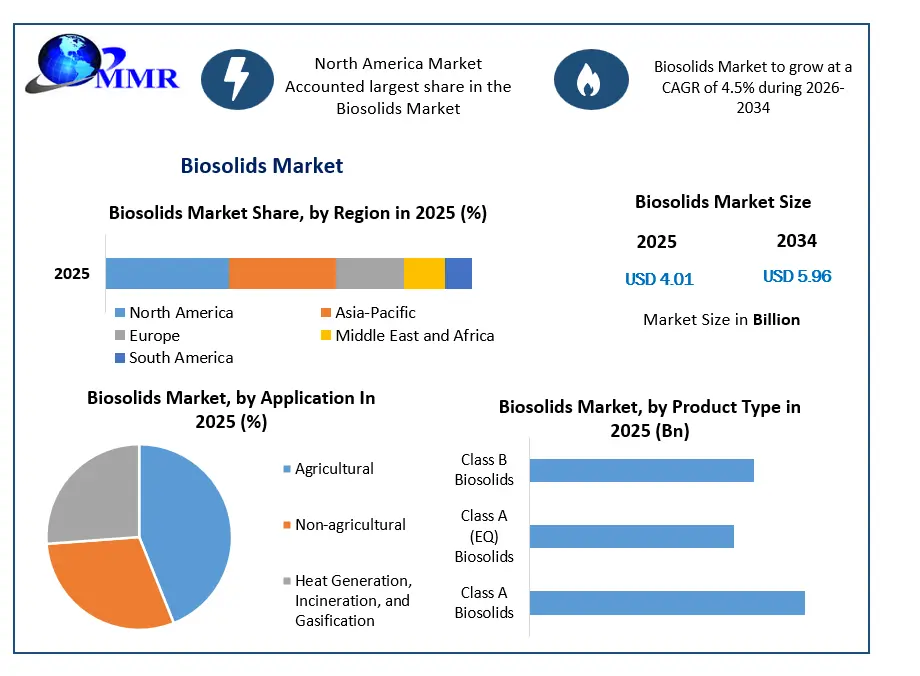 To know about the Research Methodology:-Request Free Sample Report
Biosolids Market Dynamics:
Due to their high nutritional content, which includes both micro and macronutrients, they are used in agriculture as fertilizers, soil replacement products, or soil conditioners. The agriculture industry is expected to be a major driver of Biosolids development during the forecast period. Additionally, they do not have the same negative effects on the environment as chemical fertilizers.
Additionally, Biosolids have a number of benefits, such as a decrease in the need for synthetic fertilizers, a decrease in greenhouse gas emissions, an increase in water holding capacity, and an improvement in soil structure. Since they can aid in the development of flora and enhance mined soil, these are also expected to play an important role in the treatment and reclamation of former mining sites. Additionally, over the past five years, Biosolids have become increasingly popular in horticulture, forestry, gardening, and heat generating.
Government regulations on the use of harmful chemicals are strict.
Many developed countries, including Europe, have government rules restricting the use of fertilisers that have an environmental impact. Growing customer demand for organic food and crops that were grown with fewer chemicals. Such legal frameworks have promoted the substitution of risky chemicals for fertilisers to boost crop output.
Low technological advancement and high capital expenditure.
The biosolids market is expected to be hampered during the forecast period by the high investment and operating costs associated with processing sewage or sludge to produce the product. Additionally, the market growth during the forecast period is expected to be hampered by limited technological advancements.
Biosolids Market Segment Analysis:
The Biosolids Market is segmented by Form, Product Type, and Application.
Based on the Product Type, the market is segmented into Class A Biosolids, Class A (EQ) Biosolids, and Class B Biosolids. Class A Biosolids segment is expected to hold the largest market share of xx% by 2034. Bacterium-free class A type can be applied in situations when there will likely be public interaction. Legislation from the European Commission and the US Environmental Protection Agency, for example, are examples of regulations that Class A conforms with.
Due to illnesses, bad odour, and excessive vector attraction, customers are moving from class B to class A and class A (EQ). Additionally, as more people learn about using biosolids as a cost-effective substitute for bagged fertilisers, the global market is expected to experience tremendous growth.
Based on the Application, the market is segmented into Agricultural, Non-agricultural, and Heat Generation, Incineration, and Gasification. Agricultural segment is expected to grow rapidly at a CAGR of xx% during the forecast period 2026-2034. The application of biosolids can help cultivated land, woodlands, rangelands, and scattered farmland that needs to be reclaimed. It can be used as soil conditioners and fertilisers for the cultivation of edible crops. They are often incorporated into the soil using common agricultural equipment. Additionally, they are used as fertiliser when growing crops intended for animal feed.
Large firms and farmers are exerting a growing amount of influence over cattle ranching and the marketing of beef products. Due to the rising demand for crops used as animal feed, biosolids are being employed more frequently as fertilisers in the cultivation of these crops.
Agricultural uses make up the majority of Biosolids usage in terms of consumption. Population growth is expected to increase demand for higher agricultural outputs in North America and Asia Pacific, which could further increase the usage of biosolids in the agricultural sector.
Biosolids Market Regional Insights:
The North American region is expected to dominate the Biosolids Market during the forecast period 2026-2034. The North American region is expected to hold the largest market share of 4.5% by 2034. Due to public and governmental funding for environmentally friendly technologies in nations like the United States and Canada, North America dominated the market. One of the few factors driving the biosolids market in the United States at the moment is public and governmental support for environmentally friendly solutions. In order to distinguish high-quality treated sewage sludge from raw sewage sludge, which contains significant amounts of contaminants, the US EPA adopted the term "biosolids." The country currently has non-reuse options (such landfilling) as well as advantageous reuse technology for managing wastewater biosolids (such as landfilling with biogas and energy recoveries).
The US EPA 40 CFR part 503 standards are frequently satisfied by biosolids, which are produced during wastewater treatment operations. The majority of the nation's currently produced biosolids are anticipated to be EQ or PC biosolids, which contain low levels of contaminants. About half of the nation's production of biosolids is put to good use enhancing soils. In order to enhance and maintain productive soils and promote plant growth, biosolids are either recycled or used as fertiliser in the United States. Instead of taking up space in a landfill or other disposal site, the biosolids produced by treating sewage sludge are used as beneficial fertiliser. Approximately half of all biosolids are recycled onto land. North America is therefore expected to hold the largest market share during the forecast period due to the aforementioned factors.
The objective of the report is to present a comprehensive analysis of the Global Biosolids Market to the stakeholders in the industry. The past and current status of the industry with the forecasted market size and trends are presented in the report with the analysis of complicated data in simple language. The report covers all the aspects of the industry with a dedicated study of key players that include market leaders, followers, and new entrants.
PORTER, PESTEL analysis with the potential impact of micro-economic factors of the market has been presented in the report. External as well as internal factors that are supposed to affect the business positively or negatively have been analyzed, which will give a clear futuristic view of the industry to the decision-makers.
The reports also help in understanding the Global Biosolids Market dynamic and structure by analyzing the market segments and projecting the Global Biosolids Market size. Clear representation of competitive analysis of key players by Distribution Channel, price, financial position, product portfolio, growth strategies, and regional presence in the Biosolids Market make the report investor’s guide.
Biosolids Market Recent Development
| Date | Company | Development | Impact |
|---|---|---|---|
| 02 June 2026 | 374Water | The company successfully completed a factory acceptance test for its AirSCWO technology for the Orange County Sanitation District. | This milestone advances the commercialization of destruction-based solutions for biosolids management, offering a viable alternative to traditional disposal. |
| 09 June 2026 | 374Water | 374Water expanded its partnership with the City of Orlando through an amended license agreement to establish a PFAS waste destruction and manufacturing hub. | The expansion significantly increases the company's operational scale and capabilities to address emerging contaminant risks in biosolids. |
| 30 June 2026 | 374Water | The company's mobile AirSCWO system successfully completed Phase 1 operations in St. Cloud, Minnesota. | Successful field deployment validates the efficiency and mobility of the technology for local waste destruction services. |
| 01 July 2026 | 374Water | 374Water was officially added to the Russell Microcap Index while simultaneously establishing a new waste destruction services hub. | This inclusion improves financial visibility and supports the company's long-term capital growth for its biosolids treatment infrastructure. |
Biosolids Market Scope: Inquire before buying
| Biosolids Market | |||
|---|---|---|---|
| Report Coverage | Details | ||
| Base Year: | 2025 | Forecast Period: | 2026-2034 |
| Historical Data: | 2020 to 2034 | Market Size in 2025: | USD 4.01 Bn. |
| Forecast Period 2026 to 2034 CAGR: | 4.5% | Market Size in 2034: | USD 5.96 Bn. |
| Segments Covered: | by Form | Cakes Liquid Pellets |
|
| by Product Type | Class A Biosolids Class A (EQ) Biosolids Class B Biosolids |
||
| by Application | Agricultural Non-agricultural Heat Generation, Incineration, and Gasification |
||
Biosolids Market, by Region
North America (United States, Canada and Mexico)
Europe (UK, France, Germany, Italy, Spain, Sweden, Austria, Turkey, Russia and Rest of Europe)
Asia Pacific (China, India, Japan, South Korea, Australia, ASEAN and Rest of APAC)
Middle East and Africa (South Africa, GCC, Egypt, Nigeria and Rest of ME&A)
South America (Brazil, Argentina, Columbia and Rest of South America)
Biosolids Market, Key Players
1. Agrivert Ltd
2. Aguas Andinas S.A
3. Alan S.r.l.
4. Azienda Agricola Allevi srl
5. BCR Environmental
6. Burch Hydro
7. BASF
8. Corteva
9. Cambi Group AS
10. Casella Waste Systems, Inc.
11. Cleanaway
12. CRE Centro Ricerche Ecologiche
13. DC Water
14. Eco-trass
15. Englobe
16. FCC Group
17. Lystek International
Frequently Asked Questions:
1. Which region has the largest share in Global Biosolids Market?
Ans: North American region held the highest share in 2025.
2. What is the growth rate of Global Biosolids Market?
Ans: The Global Biosolids Market is growing at a CAGR of 4.5% during forecasting period 2026-2034
3. What is scope of the Global Biosolids Market report?
Ans: Global Biosolids Market report helps with the PESTEL, PORTER, COVID-19 Impact analysis, Recommendations for Investors & Leaders, and market estimation of the forecast period.
4. Who are the key players in Global Biosolids Market?
Ans: The important key players in the Global Biosolids Market are – Agrivert Ltd, Aguas Andinas S.A, Alan S.r.l., Azienda Agricola Allevi srl, BCR Environmental, Burch Hydro, BASF, Corteva, Cambi Group AS, Casella Waste Systems, Inc., Cleanaway, CRE Centro Ricerche Ecologiche, DC Water, Eco-trass, Englobe, FCC Group, Lystek International.
5. What is the study period of this Market?
Ans: The Global Biosolids Market is studied from 2020 to 2034