
Bio-based Polyurethane Foam Market - Industry Structure Evaluation, Demand Drivers Analysis, Regional Growth Analysis and Identification, Competitive Positioning / Landscape Review & Global Market Size Forecast to 2032
Overview
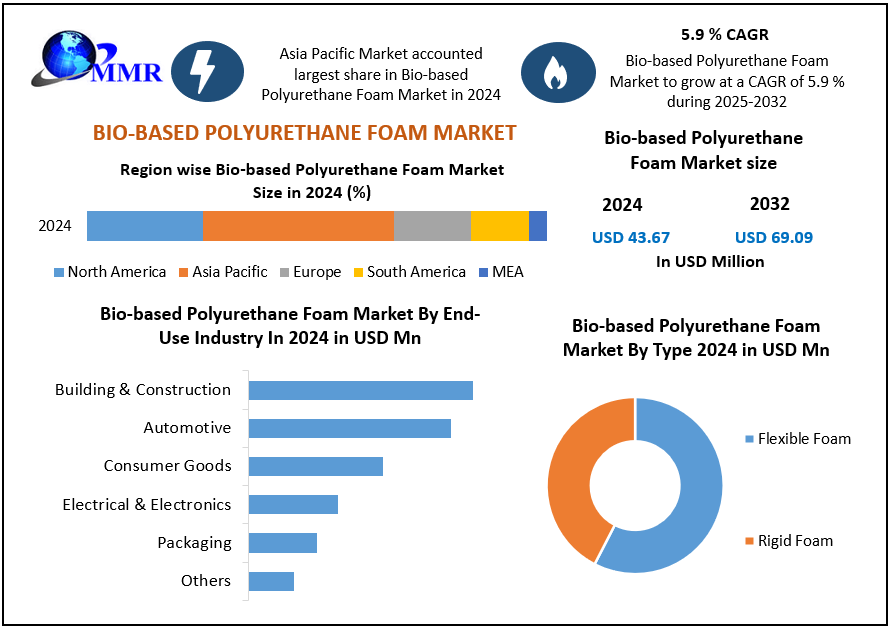
Bio-based Polyurethane Foam Market size was valued at USD 43.67 Million in 2024 and the total revenue is expected to grow at CAGR 5.9 % through 2025 to 2032, reaching nearly USD 69.09 Million.
The MMR Bio-based Polyurethane Foam Market Report provides a detailed analysis covering technological advancements and sustainability impacts, including breakthroughs in manufacturing, lifecycle analysis, carbon footprint reduction, circular economy initiatives, and government regulations driving market growth. It also examines investment and cost dynamics, comparing bio-based and petrochemical PU foam, highlighting funding trends, ROI, profitability, and future market projections. the report details end-to-end supply chain insights, encompassing sourcing, production, packaging, storage, distribution, sales, marketing, and customer support, offering a holistic view for industry stakeholders.
Bio-based Polyurethane resins are made from natural oils, such as castor, soybean, and sunflower, with diisocyanates. The Bio-based Polyurethane Foam resins are used in a variety of applications including rigid and flexible foams, coatings, adhesives, sealants, elastomers, membranes, and fibres in sectors such as automotive, building and construction, electrical and electronics, packaging, and consumer products. Natural fiber-reinforced plastics and plant-based polymer resins used in automotive applications can reduce CO2 emissions and vehicle weight, which improves fuel efficiency.
Rising worries about reducing CO2 emissions throughout the world are expected to drive demand for Bio-based Polyurethane Foam in automotive applications in the forecast period. Ford Motor Company, one of the world's largest automakers, is using soy-based polyurethane foam for seat cushions and seatbacks. Demand for Bio-based Polyurethane Foam in automotive sector for armrests, head restraints has been increased in recent times and the analysis of same is done with tangible market size expected from the sector.
 To know about the Research Methodology :- Request Free Sample Report
Bio-based Polyurethane Foam Market Dynamics
High Demand for Green Buildings to Drive Bio-based Polyurethane Foam Market Growth
The global energy crisis has expedited green building development and the implementation of various sustainable construction projects. Sustainability in building development is a broad topic that includes numerous measures that must be implemented throughout the primary construction stages due to the possible environmental effect. As a result of increased expenditures in smart energy-efficient business and residential structures, green buildings are progressively entering the construction market. Increased building material effectiveness has resulted in a greater requirement for efficient insulating materials to control heating, ventilation, and air conditioning (HVAC) and offset the amount of energy lost owing to ineffective insulation.
Bio-based Polyurethane Foam are used as effective insulation materials, resulting in better energy savings. Due to increased government and federal regulations supporting proper insulation methods and green buildings, the Bio-based Polyurethane Foam Market is likely to rise significantly during the forecast period. Organizations and groups like as LEED, Canada Green Building Council (CaGBC), World Green Building Council (WorldGBC), and The Green Building Council of Australia (GBCA), among others, govern and administer the certification and operation of green buildings across the world.
Increasing Demand from Automotive Industry to Boost the Growth of Bio-based Polyurethane Foam Market
Increasing environmental concerns and customer preferences for sustainable products are pushing automobile manufacturers to use Bio-based Polyurethane Foam in automotive applications. For example, Ford Motor Company, one of the world's largest automakers, uses Bio-based Polyurethane Foam in the above car applications. The growing need to lessen reliance on foreign oil, as well as growing concern about CO2 emissions, is driving demand for Bio-based Polyurethane Foam among automotive makers. The growth of the automobile sector as a result of rising income levels and more industrialisation is also expected to benefit the global Bio-based Polyurethane Foam Market.
Concerns about improved fuel efficiency are also expected to drive demand for Bio-based Polyurethane Foam in the future years. Growing Corporate Average Fuel Economy (CAFE) has encouraged automakers to look for new ways to reduce fuel use. Because of the natural relationship between mass and fuel consumption, light weight is a critical demand in these rules. Automobile manufacturers are primarily focused on car components made of various types of plastics in order to improve vehicle performance and follow the trend of lightweight vehicles. As a result, all of the aforementioned reasons are expected to drive the growth Bio-based Polyurethane Foam industry over the forecast period.
Cost Competitiveness of Bio-based Polyurethane Foam over Conventional Polyurethane to Restraint Bio-based Polyurethane Foam Market
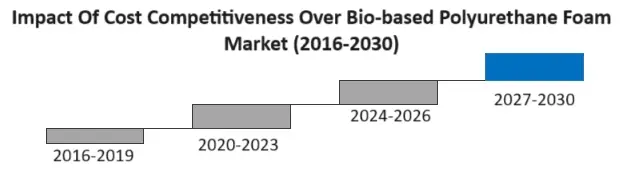
Despite the fact that Bio-based Polyurethane Foam is gaining popularity across the world. However, the path to bio-based polyurethane is not without challenges. The biggest market limitation is the high cost to the end user as compared to traditional polyurethane. Currently, Bio-based Polyurethane Foam cannot compete because to the cheap prices of conventional polyurethane. Aside from the expense, the complicated methods required to make Bio-based Polyurethane Foam in comparison to other bioplastics are expected to be a barrier to its manufacturing. The average price of Bio-based Polyurethane Foam per kg is between USD 18.0 and USD 19.15, making it more expensive than conventional polyurethane. However, even though the production cost of Bio-based Polyurethane Foam is high, the willingness to pay for their consumption is rising among the consumer due to its eco-friendly and recyclable nature. This is expected to restraint the Bio-based Polyurethane Foam industry growth during the forecast period.
Bio-based Polyurethane Foam Market Opportunity
Concerns over hazardous petrochemical hazards, as well as dwindling crude oil sources, have fueled the development of bio-based polymers such as Bio-based Polyurethane Foam. Most countries' regulations banning the use of petroleum-based plastics in specific applications, such as medical devices, are expected to encourage the manufacturing of Bio-based Polyurethane Foam during the forecast period. North America, Europe, and Asia Pacific account for the majority of global bioplastic material production. The increased use of environmentally friendly polymers in a variety of industries such as automotive, building and construction, packaging, consumer goods, and medical is expected to drive global demand for Bio-based Polyurethane Foam. Bio-based Polyurethane Foam is gaining acceptance in electrical & electronics, medical devices, construction, automotive, and consumer goods among others. Its controlled biotic & abiotic degradation and shape memory behaviour properties have been instrumental in making it suitable for use as a plastic product in bio-medical applications. This is expected to create lucrative opportunity for the Bio-based Polyurethane Foam market growth during the forecast period.
Bio-based Polyurethane Foam Market Challenges
Because of its low cost, conventional polyurethane is expected to have a high penetration throughout end-use sectors, which will have a detrimental influence on the adoption of Bio-based Polyurethane Foam. As bio-polyol is obtained from crops such as soybean, palm, linseed, and others, rising demand for raw materials for Bio-based Polyurethane Foam is expected to disrupt the balance between industrial and food crops. Improving disposable income in developing nations is expected to contribute to increased consumption of milk and meat products in the future years, driving demand for animal feed.
To reduce land consumption, it is critical to streamline agricultural output distribution for food and industrial crops. Thus, rising demand for the aforementioned raw materials from food, feedstock, and bio-products is expected to have an influence on the availability of these raw materials for Bio-based Polyurethane Foam. This is expected to create challenges for the Bio-based Polyurethane Foam market growth during the forecast period.
Bio-based Polyurethane Foam Market Segment Analysis
Based on Type, in 2024, the Bio-based Polyurethane Foam Market is dominated by Flexible Foam, driven by high-volume demand across industrial applications such as automotive interiors, aerospace, and machinery cushioning, as well as commercial and residential uses requiring comfort, vibration control, and lightweight solutions. Rigid Foam ranks second, growing steadily in construction, insulation, and specialized industrial components where thermal efficiency and structural support are critical.
Based on End-Use Industry, in 2024, the Bio-based Polyurethane Foam Market is dominated by the Building & Construction segment, driven by growing demand for energy-efficient, sustainable, and lightweight building materials. The Automotive segment follows, supported by applications in interiors, seating, and cushioning for enhanced comfort and safety. Consumer Goods contribute significantly through furniture, bedding, and lifestyle products, while Electrical & Electronics leverage foam for insulation and protective components. Packaging is gaining traction due to eco-friendly and shock-absorbing solutions, and Others including medical, footwear, and industrial applications represent smaller yet steadily growing market shares, reflecting both volume-driven industrial demand and value-driven commercial adoption.
Bio-based Polyurethane Foam Market Regional Insights
Asia Pacific was the largest segment in 2024 and accounted for 38.25% of the overall Bio-based Polyurethane Foam market revenue share. North America emerged as the second-largest segment in 2024. It was followed by Europe as the third-largest segment in 2024. Central & South America and the Middle East & Africa segments held 2.96% and 1.26% respectively of the Bio-based Polyurethane Foam industry revenue share in the same year.
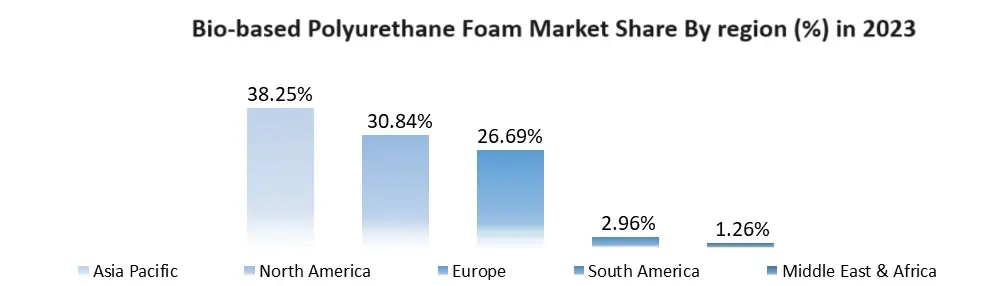
Asia Pacific dominated the Bio-based Polyurethane Foam market in 2024 and is expected to dominate the Bio-based Polyurethane Foam industry during the forecast period, thanks to increased demand from major sectors such as automotive, consumer goods, electrical & electronics, packaging, and building & construction in emerging nations like as China and India. The Asia Pacific area is distinguished by a vast supply of trained labour at a low cost, as well as easy access to land. The shift in the manufacturing environment toward developing economies, notably China and India, is expected to boost Bio-based Polyurethane Foam market growth during the forecast period. Construction, automotive, electronics, consumer products, and other rapidly developing industries in the region provide attractive development potential for Bio-based Polyurethane Foam makers.
North America accounts for a sizable portion of the global Bio-based Polyurethane Foam market and is expected to develop at a rapid pace over the forecast period. Because of its high sustainability and lightweight features, the Bio-based Polyurethane Foam industry is expected to grow in the key end-use sectors such as building and construction and automotive over the forecast period. Because of the increasing demand for non-residential construction projects such as hospitals, commercial buildings, and colleges, the construction sector in North America is estimated to develop significantly in the future years. Furthermore, government initiatives boosting the housing sector's recovery are likely to have a favourable influence on future building patterns. Reconstruction activities in the U.S. coupled with infrastructure development in Canada and Mexico is expected to fuel the product demand in North America over the forecast period.
Bio-based Polyurethane Foam Market Scope: Inquire before buying
| Global Bio-based Polyurethane Foam Market | |||
|---|---|---|---|
| Report Coverage | Details | ||
| Base Year: | 2024 | Forecast Period: | 2025-2032 |
| Historical Data: | 2019 to 2024 | Market Size in 2024: | USD 43.67 Mn. |
| Forecast Period 2025 to 2032 CAGR: | 5.9% | Market Size in 2032: | USD 69.09 Mn. |
| Segments Covered: | by Type | Flexible Foam Rigid Foam |
|
| by Raw Material | Sugarcane-Based Soy-Based Corn-Based Caster-Oil-Based Others |
||
| by End Use Industry | Automotive Building & Construction Consumer Goods Electrical & Electronics Packaging Others |
||
| by Application | Flexible Foam Applicators Rigid Foam Applicators Spray Applicators Molded Foam Applicators Others |
||
Bio-based Polyurethane Foam Market, by Region
North America (United States, Canada and Mexico)
Europe (UK, France, Germany, Italy, Spain, Sweden, Austria and Rest of Europe)
Asia Pacific (China, South Korea, Japan, India, Australia, Indonesia, Malaysia, Vietnam, Taiwan, Bangladesh, Pakistan and Rest of APAC)
Middle East and Africa (South Africa, GCC, Egypt, Nigeria and Rest of ME&A)
South America (Brazil, Argentina Rest of South America)
Bio-based Polyurethane Foam Market, Key Players are:
1. BASF SE
2. Cargill, Inc. (U.S.)
3. MCPU Polymer Engineering LLC (U.S.)
4. RAMPF Holding GmbH & Co. KG (Germany)
5. Covestro AG (Germany)
6. MCNS (U.S.)
7. Huntsman International LLC (U.S.)
8. The Lubrizol Corporation (U.S.)
9. Woodbridge (U.S.)
10. Miracll Chemicals Co. Ltd (China)
11. Mitsui Chemicals Inc. (Japan)
12. Toray Industries Inc. (Japan)
13. Teijin Limited (Japan)
14. Arkema
15. Stahl Holdings BV (The Netherlands)
16. Bewi Group (Sweden)
17. INOAC Corporation (Japan)
18. INTERNORM GmbH
19. Sealed Air Corporation (U.S.)
20. Sinomax USA (U.S.)
21. DomFoam (Canada)
22. Ecoglobal Manufacturing (U.S.)
23. Nomaco (U.S.)
24. Stora Enso (Finland)
25. Braskem (U.S.)
26. Algenesis Materials (U.S.)
27. Oskar Pahlke GmbH (Germany)
28. Hwa Ching Industry (Taiwan)
29. IPL Packaging (Canada)
30. Foamindo Industri Uretan (Indonesia)
31. Others
Frequently Asked Questions:
1] What segments are covered in the Bio-based Polyurethane Foam Market report?
Ans. The segments covered in the Bio-based Polyurethane Foam Market report are based on Type, Raw Material, End-Use Industry, Applicator, and region
2] Which region is expected to hold the highest share of the Bio-based Polyurethane Foam Market?
Ans. Asia Pacific region is expected to hold the highest share of the Bio-based Polyurethane Foam Market.
3] What is the market size of Bio-based Polyurethane Foam Market by 2032?
Ans. The market size of Bio-based Polyurethane Foam Market by 2032 is USD 69.09 Mn.
4] What is the growth rate of Bio-based Polyurethane Foam Market?
Ans. The Global Bio-based Polyurethane Foam Market is growing at a CAGR of 5.9% during forecasting period 2025-2032.
5] What was the market size of Bio-based Polyurethane Foam Market in 2024?
Ans. The market size of Bio-based Polyurethane Foam Market in 2024 was USD 43.67 Mn.