Bee Pollen Market Size by Product Type, Application, Region, Industry-Wide Analysis, Competitive Landscape Assessment & Long-Term Forecast to 2032

6.1%
CAGR (2026-2032)
948 USD Mn.
Market Size
302
Report Pages
158
Market Tables

Overview

The Bee Pollen Market size was valued at USD 948 Million in 2025 and the total Bee Pollen revenue is expected to grow at a CAGR of 6.1% from 2026 to 2032, reaching nearly USD 1434.88 Million.

Bee Pollen Market Overview:

Bee pollen is made up of pollen balls that have been packed into pellets by worker honeybees. Bee pollen contains extra honey and honey secretions and is stored in the storage of the brood cell. Bee pollen can also be found in chambers of honey bees or wood and mud, which are created by female Ground-nesting bees, such as the Leaf Cutting Bee. Once the pollen ball has been packed, the single female will lay an egg atop the pollen ball and seal the brood cell. The pollen ball is harvested as a food for humans and is sometimes called bee pollen. When it comes to Honeybees, it is important to remember that the foragers that gather pollen don’t eat it themselves because when they move into seeking, they don’t produce the protein needed to digest the pollen.

Bee pollen contains simple sugar, protein, minerals, vitamins, fatty acids and a small amount of other components. It has anti-fungal, anti-cancer immune stimulating properties, antimicrobial properties, antiviral properties, anti-inflammatory properties, hepato- protection properties and local analgesia properties. Bee Pollen is used for nutrition to increase endurance and athletic performance. It is also used for premature aging. Bee pollen is also used for appetite stimulant by mouth.

Growth of Bee Pollen market is driven by Pharmaceuticals, Nutraceutical industry and demand for bee pollen. Nutraceuticals are one of the fastest growing sector in food industry when it comes to innovation, development and marketing. Also it provides various opportunities to expand bee pollen market. The demand for bee pollen is derived by the increasing preference of consumers for natural dietary supplements which offers nutritional benefits and protection against chronic conditions such as arthritis.
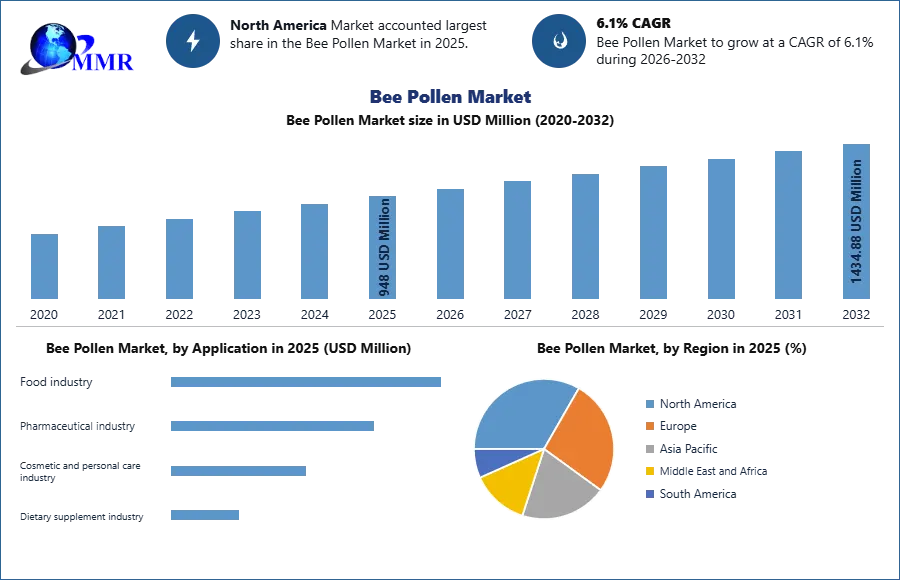
Bee Pollen Market Growth, Trend and Forecast

To know about the Research Methodology :- Request Free Sample Report

Bee Pollen Market scope and Research Methodology:

The report highlights the competitive market view, segment analysis based on the Product Type, Applications and Region. First, the market overview describes the market trends, key market drivers, market restraints, opportunities, and challenges for the Bee Pollen Market.

The Market is segmented by product type into Wildflower bee pollen, Camellia bee pollen, and Rape bee pollen. Market is also classified by its applications into Food industry, Pharmaceutical industry, Cosmetic and personal care industry, and Dietary supplement industry. The market size and trends for the Bee Pollen Market were analysed by using both primary and secondary data. Top down approach is used to estimate market size of the Bee Pollen Market.

Market projections were based on historical data, present sector developments, and future market opportunities and challenges. The SWOT analysis of the major market players, which included their strengths, weaknesses, opportunities, and threats, was also included in the research to provide a thorough knowledge of the market dynamics. By employing the PESTLE analysis, the operating environment of an organization can be assessed. Porter's analysis were used to identify crucial factors that directly affect market profitability.

Bee Pollen Market Dynamics:

Market Drivers

Increasing awareness of health benefits

The Bee Pollen Market is undergoing rapid expansion as increasing awareness of health benefits of bee pollen. The demand for bee pollen products is growing as more people become aware of the nutritional benefits of bee pollen and its potential health advantages, such as immune support system, increased energy levels and allergy relief. Health-conscious customers are increasingly looking for natural and organic options in lieu of synthetic supplements, and the association of bee pollen with a natural super food position it favourably in this regard. This increased awareness not only drives consumer interest, but also encourages the incorporation of bee pollen into dietary supplement, nutraceutical, and food and beverage formulations, thus furthering the market's development.

Growing demand for bee pollen in pharmaceutical industry

The growing demand for bee pollen in pharmaceutical industry drives the growth of bee pollen market by recognizing its potential therapeutic and medicinal abilities. Bee Pollen contains high concentration of minerals, antioxidants and bioactive compounds, making it appealing for therapeutic purposes. It is used in the development of nutritional supplements, herbal treatments and natural medicines because it is believe to provide a various health benefits such as immune system support, anti-inflammatory properties and allergy relief. This demand from pharmaceutical sector not only expands the number of applications for bee pollen, but also strengthen its credibility as a natural health assistance, contributing to significant market growth.

Growing demand of bee pollen in Food Industry

The growing demand for bee pollen in the food and beverage industries drives the bee pollen market ahead by increasing its uses and expanding its market reach. Bee pollen is recognized for its rich nutritional profile and potential health advantages as customers seek for natural and nutritious ingredients in their food and beverages. Because of this demand, bee pollen has been included in a variety of food and beverage products, such as energy bars, oats, smoothies, and even honey mixes. This expansion of market for bee pollen not only increase nutritional benefits, but also improved the profitability of the market, as it provides more functional and healthier options for consumers.

Market Trends

The sports nutrition industry’s increasing interest in bee pollen was one of the most significant trends in bee pollen market in . There was a growing awareness of bee pollen’s benefits in improving athletic performance, muscle recovery and providing key nutrients to athletes and fitness aficionados. This was part of a larger trend towards natural and pure ingredients in sports nutritional products. Bee Pollen is a nutrient-rich food source, providing athletes and fitness enthusiasts with an energy boost, muscle recovery and overall well-being. This in line with the needs of those engaging in sports and physical activity. As the world of sports nutrition continues to shift towards natural and pure ingredients, the association of bee pollen with a super food status resonates with the industry’s preference for efficient, natural and eco-friendly products, which has led to an increase in its usage and presence in sports nutrition products and dietary regimens.

The rise of online bee pollen products was indeed one of the most significant trend in the market of bee pollen. Consumers are increasingly turning to online platforms for their health and wellness needs. Bee pollen is considered a super food that offers many health benefits and is growing in popularity online. E-commerce platforms make it easy for consumers to find a wide range of bee pollen products, from raw pollen to nutritional supplements and processed products. These products respond to different consumer preferences. Online customer reviews, informative content, and straightforward brand and product comparisons make it easier for consumers to make informed decisions.

Market Opportunities

Bee pollen products are becoming increasingly popular as people seek natural solutions to improve their health and well-being. Companies can manufacture and promote new bee pollen supplements that address the special demands of diverse consumer groups. Companies, for example, may create bee pollen supplements designed for athletes, women, or seniors.

The use of bee pollen by athletes and fitness enthusiasts as a natural supplement to enhance performance and recovery is becoming increasingly popular. Companies have the potential to create and market sports nutrition products based on bee pollen. For instance, companies could create bee pollen protein shakes and bee pollen energy bars.

Bee pollen is increasingly being incorporated into food and beverage formulations as a natural component. Companies have the opportunity to create and market new and innovative bee pollen products. Such products are honey yogurt, granola and smoothies, and energy bars.

Beekeepers and bee pollen manufacturers are increasingly recognizing the importance of sustainable sourcing. Businesses can take advantage of this trend by sourcing their bee pollen from sustainable sources and marketing their products as being sustainably sourced.

In addition to these opportunities, the bee pollen market offers opportunities for innovation. Companies, for example, Companies, might develop innovative ways of processing and preserving bee pollen in order to retain its nutrients and efficiency. Companies might potentially create new bee pollen delivery systems, such as bee pollen-infused beverages or snacks.

Market Restraints/ Challenges

The production of bee pollen depends on several factors such as bee activity, environmental conditions and colony health. Bee pollen is a seasonal product which means it can sometimes be in short supply. This can be problem for bee pollen companies because it can affect their ability to meet customer demand, keep inventory level high and keep prices stable. In addition, habitat loss and other environmental stresses affecting bee populations can exacerbate bee pollen shortages. Therefore, bee pollen companies must carefully manage bee pollen limits. This can be done through effective procurement strategies as well as diversifying their supply sources to avoid operational disruptions.
Bee pollen is perishable. The quality of bee pollen varies depending on harvest, processing and storage. Therefore, companies must have strong quality control processes to ensure consistent quality bee pollen products. Companies can make sure their bee pollen products are high quality by testing them for purity, strength, and any contaminants. They can also get certified by third parties like organic and non-GMO certifications to show that their products are good quality.

The market for bee pollen is regulated in several countries. Companies must follow all regulations for their bee pollen products. Companies can take steps to ensure compliance regulations by hiring experienced consultants and lawyers. Additionally companies stay also up to date on the latest regulatory developments.

Bee Pollen Market Segment Analysis:

Based on product type Bee Pollen Market is segmented into Wildflower bee pollen, Camellia bee pollen, and Rape bee pollen.

Wildflower bee pollen dominates the bee pollen market, accounting for more than half of the market share. This is because wildflower bee pollen is the most frequent type of bee pollen available and rich in vitamins, minerals and antioxidants. Camellia bee pollen is also rich in vitamins and minerals. It is often used in Chinese traditional medicine. Rape bee pollen is a great source of protein. It is sometimes used for sports nutrition products.

On the basis of application, Bee Pollen Market is classified into Food industry, Pharmaceutical industry, Cosmetic and personal care industry, and Dietary supplement industry. Bee pollen is used in Food industry as a component in items such as yogurt, granola bars, and energy drinks. Bee pollen is used in pharmaceutical sector in goods such as allergy medicines and immune system boosters. Bee pollen is also used in cosmetic and personal care products such as facial masks, shampoos and conditioners. Bee pollen is also available in capsule, powder and tablet form in the dietary supplement business.

The dietary supplement industry dominates the bee pollen market, accounting for more than 60% of the market share. This is because of its great nutritional value and potential health advantages. The dietary supplement industry has growing due to growing popularity of natural and wellness products among customers. Bee pollen is one of the popular natural dietary supplement in the market due to its high nutritional and anti-oxidant content. It is attracted health-conscious consumers due to its convenient standardisation and convenient packaging in capsules and tablets.

Bee Pollen Market Regional Insights:

Bee Pollen Market dominated by the North-American Region with 40% of global market share. This is due to the region's high demand for bee pollen dietary supplements.

The bee pollen market in North-America has experience a growing popularity due to several factors. North American region’s consumer base is highly health conscious and has a strong preference for natural food products. And Bee pollen is seen as a nutritious supplement which making it attractive for consumers in North America. Additionally this region has a long- history of beekeeping and collecting bee pollen. Marketing and Education about the advantages of bee pollen in North-America has made it a popular choice.

The major key players in North America are Comvita, YS Bee Farms, Beekeeper's Naturals, Swanson Health Products, NOW Foods. These companies provide a comprehensive selection of bee pollen-based products such as Dietary supplements to Food & Beverages items, Cosmetic and personal care products. Additionally they have significant presence in the retail sector of North America, with their goods being stocked in health food shops, drugstores and other retailers.

Europe is the second largest bee pollen market in the world. Germany, UK and France are the biggest bee pollen consumers in Europe. Europe’s bee pollen market has grown due to an ageing population and the growing need for preventive healthcare solutions. Bee Pollen has been seen as a natural, healthy way to increase immunity and overall health.

Bee Pollen Market Competitive Landscape:

The bee pollen market is a highly competitive business in which leading competitors are always innovating and developing new products to satisfy changing consumer demands. The competitive landscape is projected to remain challenging in the future years as key firms engage in further development and innovation.

The major key players are Comvita, YS Bee Farms, Beekeeper's Naturals, Swanson Health Products, NOW Foods, Apicoltura Laterza, Mellisana, BeeVital, Polenectar. These market leaders are investing in R & D to create new products and enhance their existing products as well as they are expanding their distribution channels and entering into new market.

The Bee Pollen Market is a widely expanding market with lots of opportunities for new players. Emerging companies can take advantage of these opportunities by offering unique products and services that fulfil consumers' needs. Some of the emerging players are Bee Pollen Power, Manuka Health, Holland & Barrett, Simply Bee, Honey Pacifica, Bee King's and livemoor. These emerging players are focusing on the development of innovative products and the expansion of the distribution channel. Additionally they are focusing on distinct niche markets such as organic bee pollen products and bee pollen products for athletes.

Bee Pollen Market Scope: Inquiry Before Buying

Bee Pollen Market
Report Coverage Details
Base Year: 2025 Forecast Period: 2026-2032
Historical Data: 2020 to 2025 Market Size in 2025: 948 USD Million
Forecast Period 2026-2032 CAGR: 6.1% Market Size in 2032: 1434.88 USD Million
Segments Covered: by Type Wildflower bee pollen
Camellia bee pollen
Rape bee pollen
by Application Food industry
Pharmaceutical industry
Cosmetic and personal care industry
Dietary supplement industry
by Form Granules
Powder
Capsules
Liquid Extracts
Tablets
by Distribution Channel Online Retail / E-commerce
Supermarkets / Hypermarkets
Specialty Stores
Pharmacies & Drug Stores

Bee Pollen Market, by Region:

North America (United States, Canada and Mexico)
Europe (United Kingdom, France, Germany, Italy, Spain, Sweden, Austria and Rest of Europe)
Asia Pacific (China, South Korea, Japan, India, Australia, Indonesia, Malaysia, Vietnam, Taiwan, Bangladesh, Pakistan and Rest of APAC)
Middle East and Africa (South Africa, GCC, Egypt, Nigeria and Rest of ME&A)
South America (Brazil, Argentina Rest of South America)

Key Players / Competitors Profiles Covered in Brief in Global Bee Pollen Market Report in Strategic Perspective:

  1. NOW Foods
  2. Bee Pollen Australia
  3. Stakich Inc.
  4. Y.S. Eco Bee Farms
  5. Pollen Harvesters
  6. Nature's Way Products, LLC
  7. Manuka Health New Zealand
  8. Dabur India Ltd.
  9. Royal Jelly Bee Products
  10. BeeAlive
  11. Herbalife Nutrition Ltd.
  12. NutraBlast
  13.  Swanson Health Products
  14. BulkSupplements.com
  15. Mountain Rose Herbs
  16. Beekeeper's Naturals
  17. Comvita
  18. Honey Pacifica
  19. Beenefits
  20. Sattvic Foods
  21. Livemoor
  22. Bee & You
  23. Cammells Honey
  24. Apisflora
  25. Anhui Puren Bee Industry Co., Ltd.

Table of Contents

1. Bee Pollen Market Introduction
1.1. Study Assumption and Market Definition
1.2. Scope of the Study
1.3. Executive Summary
2. Global Bee Pollen Market: Competitive Landscape
2.1. MMR Competition Matrix
2.2. Competitive Landscape
2.3. Key Players Benchmarking
2.3.1. Company Name
2.3.2. Business Segment
2.3.3. End-user Segment
2.3.4. Revenue (2025)
2.3.5. Company Locations
2.4. Leading Bee Pollen Market Companies, by market capitalization
2.5. Market Structure
2.5.1. Market Leaders
2.5.2. Market Followers
2.5.3. Emerging Players
2.6. Mergers and Acquisitions Details
3. Bee Pollen Market: Dynamics
3.1. Bee Pollen Market Trends by Region
3.1.1. North America Bee Pollen Market Trends
3.1.2. Europe Bee Pollen Market Trends
3.1.3. Asia Pacific Bee Pollen Market Trends
3.1.4. Middle East and Africa Bee Pollen Market Trends
3.1.5. South America Bee Pollen Market Trends
3.2. Bee Pollen Market Dynamics by Region
3.2.1. North America
3.2.1.1. North America Bee Pollen Market Drivers
3.2.1.2. North America Bee Pollen Market Restraints
3.2.1.3. North America Bee Pollen Market Opportunities
3.2.1.4. North America Bee Pollen Market Challenges
3.2.2. Europe
3.2.2.1. Europe Bee Pollen Market Drivers
3.2.2.2. Europe Bee Pollen Market Restraints
3.2.2.3. Europe Bee Pollen Market Opportunities
3.2.2.4. Europe Bee Pollen Market Challenges
3.2.3. Asia Pacific
3.2.3.1. Asia Pacific Bee Pollen Market Drivers
3.2.3.2. Asia Pacific Bee Pollen Market Restraints
3.2.3.3. Asia Pacific Bee Pollen Market Opportunities
3.2.3.4. Asia Pacific Bee Pollen Market Challenges
3.2.4. Middle East and Africa
3.2.4.1. Middle East and Africa Bee Pollen Market Drivers
3.2.4.2. Middle East and Africa Bee Pollen Market Restraints
3.2.4.3. Middle East and Africa Bee Pollen Market Opportunities
3.2.4.4. Middle East and Africa Bee Pollen Market Challenges
3.2.5. South America
3.2.5.1. South America Bee Pollen Market Drivers
3.2.5.2. South America Bee Pollen Market Restraints
3.2.5.3. South America Bee Pollen Market Opportunities
3.2.5.4. South America Bee Pollen Market Challenges
3.3. PORTER's Five Forces Analysis
3.4. PESTLE Analysis
3.5. Technology Roadmap
3.6. Regulatory Landscape by Region
3.6.1. North America
3.6.2. Europe
3.6.3. Asia Pacific
3.6.4. Middle East and Africa
3.6.5. South America
3.7. Key Opinion Leader Analysis For Bee Pollen Industry
3.8. Analysis of Government Schemes and Initiatives For Bee Pollen Industry
3.9. Bee Pollen Market Trade Analysis
3.10. The Global Pandemic Impact on Bee Pollen Market
4. Bee Pollen Market: Global Market Size and Forecast by Segmentation (in USD Million) 2025-2032
4.1. Bee Pollen Market Size and Forecast, by Type (2025-2032)
4.1.1. Wildflower bee pollen
4.1.2. Camellia bee pollen
4.1.3. Rape bee pollen
4.2. Bee Pollen Market Size and Forecast, by Application (2025-2032)
4.2.1. Food industry
4.2.2. Pharmaceutical industry
4.2.3. Cosmetic and personal care industry
4.2.4. Dietary supplement industry
4.3. Bee Pollen Market Size and Forecast, by Form (2025-2032)
4.3.1. Granules
4.3.2. Powder
4.3.3. Capsules
4.3.4. Liquid Extracts
4.3.5. Tablets
4.4. Bee Pollen Market Size and Forecast, by Distribution Channel (2025-2032)
4.4.1. Online Retail / E-commerce
4.4.2. Supermarkets / Hypermarkets
4.4.3. Specialty Stores
4.4.4. Pharmacies & Drug Stores
4.5. Bee Pollen Market Size and Forecast, by Region (2025-2032)
4.5.1. North America
4.5.2. Europe
4.5.3. Asia Pacific
4.5.4. Middle East and Africa
4.5.5. South America
5. North America Bee Pollen Market Size and Forecast by Segmentation (in USD Million) 2025-2032
5.1. North America Bee Pollen Market Size and Forecast, by Type (2025-2032)
5.1.1. Wildflower bee pollen
5.1.2. Camellia bee pollen
5.1.3. Rape bee pollen
5.2. North America Bee Pollen Market Size and Forecast, by Application (2025-2032)
5.2.1. Food industry
5.2.2. Pharmaceutical industry
5.2.3. Cosmetic and personal care industry
5.2.4. Dietary supplement industry
5.3. North America Bee Pollen Market Size and Forecast, by Form (2025-2032)
5.3.1. Granules
5.3.2. Powder
5.3.3. Capsules
5.3.4. Liquid Extracts
5.3.5. Tablets
5.4. North America Bee Pollen Market Size and Forecast, by Distribution Channel (2025-2032)
5.4.1. Online Retail / E-commerce
5.4.2. Supermarkets / Hypermarkets
5.4.3. Specialty Stores
5.4.4. Pharmacies & Drug Stores
5.5. North America Bee Pollen Market Size and Forecast, by Country (2025-2032)
5.5.1. United States
5.5.1.1. United States Bee Pollen Market Size and Forecast, by Type (2025-2032)
5.5.1.1.1. Wildflower bee pollen
5.5.1.1.2. Camellia bee pollen
5.5.1.1.3. Rape bee pollen
5.5.1.2. United States Bee Pollen Market Size and Forecast, by Application (2025-2032)
5.5.1.2.1. Food industry
5.5.1.2.2. Pharmaceutical industry
5.5.1.2.3. Cosmetic and personal care industry
5.5.1.2.4. Dietary supplement industry
5.5.1.3. United States Bee Pollen Market Size and Forecast, by Form (2025-2032)
5.5.1.3.1. Granules
5.5.1.3.2. Powder
5.5.1.3.3. Capsules
5.5.1.3.4. Liquid Extracts
5.5.1.3.5. Tablets
5.5.1.4. United States Bee Pollen Market Size and Forecast, by Distribution Channel (2025-2032)
5.5.1.4.1. Online Retail / E-commerce
5.5.1.4.2. Supermarkets / Hypermarkets
5.5.1.4.3. Specialty Stores
5.5.1.4.4. Pharmacies & Drug Stores
5.5.2. Canada
5.5.2.1. Canada Bee Pollen Market Size and Forecast, by Type (2025-2032)
5.5.2.1.1. Wildflower bee pollen
5.5.2.1.2. Camellia bee pollen
5.5.2.1.3. Rape bee pollen
5.5.2.2. Canada Bee Pollen Market Size and Forecast, by Application (2025-2032)
5.5.2.2.1. Food industry
5.5.2.2.2. Pharmaceutical industry
5.5.2.2.3. Cosmetic and personal care industry
5.5.2.2.4. Dietary supplement industry
5.5.2.3. Canada Bee Pollen Market Size and Forecast, by Form (2025-2032)
5.5.2.3.1. Granules
5.5.2.3.2. Powder
5.5.2.3.3. Capsules
5.5.2.3.4. Liquid Extracts
5.5.2.3.5. Tablets
5.5.2.4. Canada Bee Pollen Market Size and Forecast, by Distribution Channel (2025-2032)
5.5.2.4.1. Online Retail / E-commerce
5.5.2.4.2. Supermarkets / Hypermarkets
5.5.2.4.3. Specialty Stores
5.5.2.4.4. Pharmacies & Drug Stores
5.5.3. Mexico
5.5.3.1. Mexico Bee Pollen Market Size and Forecast, by Type (2025-2032)
5.5.3.1.1. Wildflower bee pollen
5.5.3.1.2. Camellia bee pollen
5.5.3.1.3. Rape bee pollen
5.5.3.2. Mexico Bee Pollen Market Size and Forecast, by Application (2025-2032)
5.5.3.2.1. Food industry
5.5.3.2.2. Pharmaceutical industry
5.5.3.2.3. Cosmetic and personal care industry
5.5.3.2.4. Dietary supplement industry
5.5.3.3. Mexico Bee Pollen Market Size and Forecast, by Form (2025-2032)
5.5.3.3.1. Granules
5.5.3.3.2. Powder
5.5.3.3.3. Capsules
5.5.3.3.4. Liquid Extracts
5.5.3.3.5. Tablets
5.5.3.4. Mexico Bee Pollen Market Size and Forecast, by Distribution Channel (2025-2032)
5.5.3.4.1. Online Retail / E-commerce
5.5.3.4.2. Supermarkets / Hypermarkets
5.5.3.4.3. Specialty Stores
5.5.3.4.4. Pharmacies & Drug Stores
6. Europe Bee Pollen Market Size and Forecast by Segmentation (in USD Million) 2025-2032
6.1. Europe Bee Pollen Market Size and Forecast, by Type (2025-2032)
6.2. Europe Bee Pollen Market Size and Forecast, by Application (2025-2032)
6.3. Europe Bee Pollen Market Size and Forecast, by Form (2025-2032)
6.4. Europe Bee Pollen Market Size and Forecast, by Distribution Channel (2025-2032)
6.5. Europe Bee Pollen Market Size and Forecast, by Country (2025-2032)
6.5.1. United Kingdom
6.5.1.1. United Kingdom Bee Pollen Market Size and Forecast, by Type (2025-2032)
6.5.1.2. United Kingdom Bee Pollen Market Size and Forecast, by Application (2025-2032)
6.5.1.3. United Kingdom Bee Pollen Market Size and Forecast, by Form (2025-2032)
6.5.1.4. United Kingdom Bee Pollen Market Size and Forecast, by Distribution Channel (2025-2032)
6.5.2. France
6.5.2.1. France Bee Pollen Market Size and Forecast, by Type (2025-2032)
6.5.2.2. France Bee Pollen Market Size and Forecast, by Application (2025-2032)
6.5.2.3. France Bee Pollen Market Size and Forecast, by Form (2025-2032)
6.5.2.4. France Bee Pollen Market Size and Forecast, by Distribution Channel (2025-2032)
6.5.3. Germany
6.5.3.1. Germany Bee Pollen Market Size and Forecast, by Type (2025-2032)
6.5.3.2. Germany Bee Pollen Market Size and Forecast, by Application (2025-2032)
6.5.3.3. Germany Bee Pollen Market Size and Forecast, by Form (2025-2032)
6.5.3.4. Germany Bee Pollen Market Size and Forecast, by Distribution Channel (2025-2032)
6.5.4. Italy
6.5.4.1. Italy Bee Pollen Market Size and Forecast, by Type (2025-2032)
6.5.4.2. Italy Bee Pollen Market Size and Forecast, by Application (2025-2032)
6.5.4.3. Italy Bee Pollen Market Size and Forecast, by Form (2025-2032)
6.5.4.4. Italy Bee Pollen Market Size and Forecast, by Distribution Channel (2025-2032)
6.5.5. Spain
6.5.5.1. Spain Bee Pollen Market Size and Forecast, by Type (2025-2032)
6.5.5.2. Spain Bee Pollen Market Size and Forecast, by Application (2025-2032)
6.5.5.3. Spain Bee Pollen Market Size and Forecast, by Form (2025-2032)
6.5.5.4. Spain Bee Pollen Market Size and Forecast, by Distribution Channel (2025-2032)
6.5.6. Sweden
6.5.6.1. Sweden Bee Pollen Market Size and Forecast, by Type (2025-2032)
6.5.6.2. Sweden Bee Pollen Market Size and Forecast, by Application (2025-2032)
6.5.6.3. Sweden Bee Pollen Market Size and Forecast, by Form (2025-2032)
6.5.6.4. Sweden Bee Pollen Market Size and Forecast, by Distribution Channel (2025-2032)
6.5.7. Austria
6.5.7.1. Austria Bee Pollen Market Size and Forecast, by Type (2025-2032)
6.5.7.2. Austria Bee Pollen Market Size and Forecast, by Application (2025-2032)
6.5.7.3. Austria Bee Pollen Market Size and Forecast, by Form (2025-2032)
6.5.7.4. Austria Bee Pollen Market Size and Forecast, by Distribution Channel (2025-2032)
6.5.8. Rest of Europe
6.5.8.1. Rest of Europe Bee Pollen Market Size and Forecast, by Type (2025-2032)
6.5.8.2. Rest of Europe Bee Pollen Market Size and Forecast, by Application (2025-2032)
6.5.8.3. Rest of Europe Bee Pollen Market Size and Forecast, by Form (2025-2032)
6.5.8.4. Rest of Europe Bee Pollen Market Size and Forecast, by Distribution Channel (2025-2032)
7. Asia Pacific Bee Pollen Market Size and Forecast by Segmentation (in USD Million) 2025-2032
7.1. Asia Pacific Bee Pollen Market Size and Forecast, by Type (2025-2032)
7.2. Asia Pacific Bee Pollen Market Size and Forecast, by Application (2025-2032)
7.3. Asia Pacific Bee Pollen Market Size and Forecast, by Form (2025-2032)
7.4. Asia Pacific Bee Pollen Market Size and Forecast, by Distribution Channel (2025-2032)
7.5. Asia Pacific Bee Pollen Market Size and Forecast, by Country (2025-2032)
7.5.1. China
7.5.1.1. China Bee Pollen Market Size and Forecast, by Type (2025-2032)
7.5.1.2. China Bee Pollen Market Size and Forecast, by Application (2025-2032)
7.5.1.3. China Bee Pollen Market Size and Forecast, by Form (2025-2032)
7.5.1.4. China Bee Pollen Market Size and Forecast, by Distribution Channel (2025-2032)
7.5.2. S Korea
7.5.2.1. S Korea Bee Pollen Market Size and Forecast, by Type (2025-2032)
7.5.2.2. S Korea Bee Pollen Market Size and Forecast, by Application (2025-2032)
7.5.2.3. S Korea Bee Pollen Market Size and Forecast, by Form (2025-2032)
7.5.2.4. S Korea Bee Pollen Market Size and Forecast, by Distribution Channel (2025-2032)
7.5.3. Japan
7.5.3.1. Japan Bee Pollen Market Size and Forecast, by Type (2025-2032)
7.5.3.2. Japan Bee Pollen Market Size and Forecast, by Application (2025-2032)
7.5.3.3. Japan Bee Pollen Market Size and Forecast, by Form (2025-2032)
7.5.3.4. Japan Bee Pollen Market Size and Forecast, by Distribution Channel (2025-2032)
7.5.4. India
7.5.4.1. India Bee Pollen Market Size and Forecast, by Type (2025-2032)
7.5.4.2. India Bee Pollen Market Size and Forecast, by Application (2025-2032)
7.5.4.3. India Bee Pollen Market Size and Forecast, by Form (2025-2032)
7.5.4.4. India Bee Pollen Market Size and Forecast, by Distribution Channel (2025-2032)
7.5.5. Australia
7.5.5.1. Australia Bee Pollen Market Size and Forecast, by Type (2025-2032)
7.5.5.2. Australia Bee Pollen Market Size and Forecast, by Application (2025-2032)
7.5.5.3. Australia Bee Pollen Market Size and Forecast, by Form (2025-2032)
7.5.5.4. Australia Bee Pollen Market Size and Forecast, by Distribution Channel (2025-2032)
7.5.6. Indonesia
7.5.6.1. Indonesia Bee Pollen Market Size and Forecast, by Type (2025-2032)
7.5.6.2. Indonesia Bee Pollen Market Size and Forecast, by Application (2025-2032)
7.5.6.3. Indonesia Bee Pollen Market Size and Forecast, by Form (2025-2032)
7.5.6.4. Indonesia Bee Pollen Market Size and Forecast, by Distribution Channel (2025-2032)
7.5.7. Malaysia
7.5.7.1. Malaysia Bee Pollen Market Size and Forecast, by Type (2025-2032)
7.5.7.2. Malaysia Bee Pollen Market Size and Forecast, by Application (2025-2032)
7.5.7.3. Malaysia Bee Pollen Market Size and Forecast, by Form (2025-2032)
7.5.7.4. Malaysia Bee Pollen Market Size and Forecast, by Distribution Channel (2025-2032)
7.5.8. Vietnam
7.5.8.1. Vietnam Bee Pollen Market Size and Forecast, by Type (2025-2032)
7.5.8.2. Vietnam Bee Pollen Market Size and Forecast, by Application (2025-2032)
7.5.8.3. Vietnam Bee Pollen Market Size and Forecast, by Form (2025-2032)
7.5.8.4. Vietnam Bee Pollen Market Size and Forecast, by Distribution Channel (2025-2032)
7.5.9. Taiwan
7.5.9.1. Taiwan Bee Pollen Market Size and Forecast, by Type (2025-2032)
7.5.9.2. Taiwan Bee Pollen Market Size and Forecast, by Application (2025-2032)
7.5.9.3. Taiwan Bee Pollen Market Size and Forecast, by Form (2025-2032)
7.5.9.4. Taiwan Bee Pollen Market Size and Forecast, by Distribution Channel (2025-2032)
7.5.10. Rest of Asia Pacific
7.5.10.1. Rest of Asia Pacific Bee Pollen Market Size and Forecast, by Type (2025-2032)
7.5.10.2. Rest of Asia Pacific Bee Pollen Market Size and Forecast, by Application (2025-2032)
7.5.10.3. Rest of Asia Pacific Bee Pollen Market Size and Forecast, by Form (2025-2032)
7.5.10.4. Rest of Asia Pacific Bee Pollen Market Size and Forecast, by Distribution Channel (2025-2032)
8. Middle East and Africa Bee Pollen Market Size and Forecast by Segmentation (in USD Million) 2025-2032
8.1. Middle East and Africa Bee Pollen Market Size and Forecast, by Type (2025-2032)
8.2. Middle East and Africa Bee Pollen Market Size and Forecast, by Application (2025-2032)
8.3. Middle East and Africa Bee Pollen Market Size and Forecast, by Form (2025-2032)
8.4. Middle East and Africa Bee Pollen Market Size and Forecast, by Distribution Channel (2025-2032)
8.5. Middle East and Africa Bee Pollen Market Size and Forecast, by Country (2025-2032)
8.5.1. South Africa
8.5.1.1. South Africa Bee Pollen Market Size and Forecast, by Type (2025-2032)
8.5.1.2. South Africa Bee Pollen Market Size and Forecast, by Application (2025-2032)
8.5.1.3. South Africa Bee Pollen Market Size and Forecast, by Form (2025-2032)
8.5.1.4. South Africa Bee Pollen Market Size and Forecast, by Distribution Channel (2025-2032)
8.5.2. GCC
8.5.2.1. GCC Bee Pollen Market Size and Forecast, by Type (2025-2032)
8.5.2.2. GCC Bee Pollen Market Size and Forecast, by Application (2025-2032)
8.5.2.3. GCC Bee Pollen Market Size and Forecast, by Form (2025-2032)
8.5.2.4. GCC Bee Pollen Market Size and Forecast, by Distribution Channel (2025-2032)
8.5.3. Nigeria
8.5.3.1. Nigeria Bee Pollen Market Size and Forecast, by Type (2025-2032)
8.5.3.2. Nigeria Bee Pollen Market Size and Forecast, by Application (2025-2032)
8.5.3.3. Nigeria Bee Pollen Market Size and Forecast, by Form (2025-2032)
8.5.3.4. Nigeria Bee Pollen Market Size and Forecast, by Distribution Channel (2025-2032)
8.5.4. Rest of ME&A
8.5.4.1. Rest of ME&A Bee Pollen Market Size and Forecast, by Type (2025-2032)
8.5.4.2. Rest of ME&A Bee Pollen Market Size and Forecast, by Application (2025-2032)
8.5.4.3. Rest of ME&A Bee Pollen Market Size and Forecast, by Form (2025-2032)
8.5.4.4. Rest of ME&A Bee Pollen Market Size and Forecast, by Distribution Channel (2025-2032)
9. South America Bee Pollen Market Size and Forecast by Segmentation (in USD Million) 2025-2032
9.1. South America Bee Pollen Market Size and Forecast, by Type (2025-2032)
9.2. South America Bee Pollen Market Size and Forecast, by Application (2025-2032)
9.3. South America Bee Pollen Market Size and Forecast, by Form (2025-2032)
9.4. South America Bee Pollen Market Size and Forecast, by Distribution Channel (2025-2032)
9.5. South America Bee Pollen Market Size and Forecast, by Country (2025-2032)
9.5.1. Brazil
9.5.1.1. Brazil Bee Pollen Market Size and Forecast, by Type (2025-2032)
9.5.1.2. Brazil Bee Pollen Market Size and Forecast, by Application (2025-2032)
9.5.1.3. Brazil Bee Pollen Market Size and Forecast, by Form (2025-2032)
9.5.1.4. Brazil Bee Pollen Market Size and Forecast, by Distribution Channel (2025-2032)
9.5.2. Argentina
9.5.2.1. Argentina Bee Pollen Market Size and Forecast, by Type (2025-2032)
9.5.2.2. Argentina Bee Pollen Market Size and Forecast, by Application (2025-2032)
9.5.2.3. Argentina Bee Pollen Market Size and Forecast, by Form (2025-2032)
9.5.2.4. Argentina Bee Pollen Market Size and Forecast, by Distribution Channel (2025-2032)
9.5.3. Rest Of South America
9.5.3.1. Rest Of South America Bee Pollen Market Size and Forecast, by Type (2025-2032)
9.5.3.2. Rest Of South America Bee Pollen Market Size and Forecast, by Application (2025-2032)
9.5.3.3. Rest Of South America Bee Pollen Market Size and Forecast, by Form (2025-2032)
9.5.3.4. Rest Of South America Bee Pollen Market Size and Forecast, by Distribution Channel (2025-2032)
10. Company Profile: Key Players
10.1. NOW Foods
10.1.1. Company Overview
10.1.2. Business Portfolio
10.1.3. Financial Overview
10.1.4. SWOT Analysis
10.1.5. Strategic Analysis
10.1.6. Scale of Operation (small, medium, and large)
10.1.7. Details on Partnership
10.1.8. Regulatory Accreditations and Certifications Received by Them
10.1.9. Awards Received by the Firm
10.1.10. Recent Developments
10.2. Bee Pollen Australia
10.3. Stakich Inc.
10.4. Y.S. Eco Bee Farms
10.5. Pollen Harvesters
10.6. Nature's Way Products LLC
10.7. Manuka Health New Zealand
10.8. Dabur India Ltd.
10.9. Royal Jelly Bee Products
10.10. BeeAlive
10.11. Herbalife Nutrition Ltd.
10.12. NutraBlast
10.13. Swanson Health Products
10.14. BulkSupplements.com
10.15. Mountain Rose Herbs
10.16. Beekeeper's Naturals
10.17. Comvita
10.18. Honey Pacifica
10.19. Beenefits
10.20. Sattvic Foods
10.21. Livemoor
10.22. Bee & You
10.23. Cammells Honey
10.24. Apisflora
10.25. Anhui Puren Bee Industry Co. Ltd.
11. Key Findings
12. Industry Recommendations
13. Bee Pollen Market: Research Methodology
14. Terms and Glossary

Custom Market Research Services

We Will Customise The Research For You, In Case The Report Listed Above Does Not Meet With Your Requirements