
Global Baby Wipes Market Size by Product, Distribution Channel, Packaging, Region and Forecast 2034
Overview
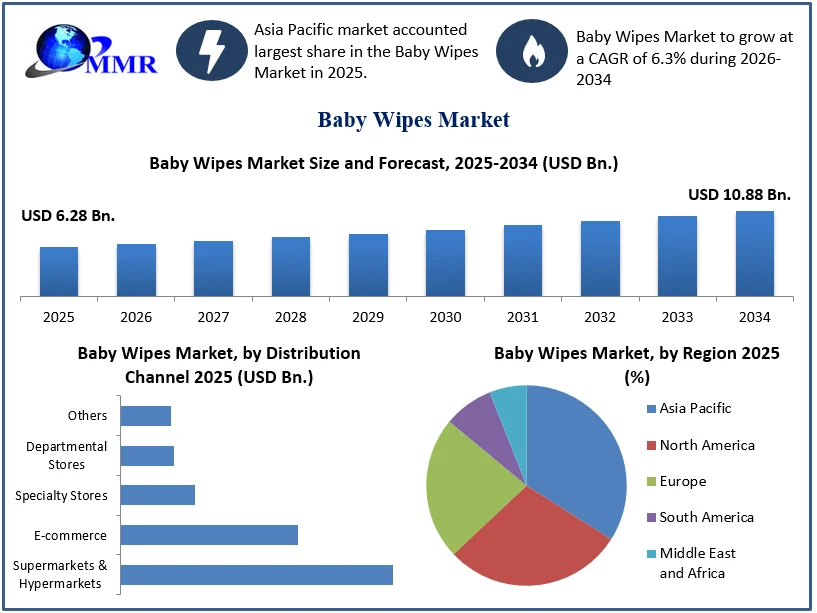
The Baby Wipes Market Size was valued at USD 6.28 Billion in 2025 and is estimated to grow at a CAGR of 6.3% over the forecast period, reaching USD 10.88 Billion by 2034.
Baby Wipes Market Overview:
Baby wipes are disposable pre-moistened sheets used for cleaning a baby’s skin, mainly during diaper changes and everyday infant care. They are generally manufactured from soft nonwoven materials and contain water-based cleansing formulations, moisturizers, skin conditioners, or other ingredients designed for gentle cleaning. The Baby Wipes Market includes products developed for newborns, infants, and toddlers and covers different product formulations, material types, packaging formats, and distribution channels. Baby wipes are widely used at home, during travel, at childcare facilities, and whenever convenient cleaning is required, making them an important product category within the baby care, infant hygiene, diaper care, and personal care market.
The Baby Wipes Market is growing use of disposable wipes for diaper changes, cleaning, and daily infant care. Demand is increasing as parents look for convenient, gentle, and hygienic products, with stronger interest in hypoallergenic, fragrance-free, water-based, plant-based, and biodegradable baby wipes. Asia Pacific held the leading share in 2025, supported by a large infant population, rising awareness of infant hygiene, urbanization, and wider access to modern retail and e-commerce. Companies such as Kimberly-Clark, Procter & Gamble, Unicharm, and Pigeon are strengthening their presence through product innovation, skin-friendly formulations, sustainable materials, and broader distribution networks.
MMR's Baby Wipes Market research provides clients with a detailed assessment of market size, market share, market trends, market growth, product segmentation, distribution channels, regional demand, competitive landscape, key players, market drivers, restraints, opportunities, and challenges. The study helps manufacturers, investors, distributors, retailers, and new market entrants identify attractive areas for business development and product innovation. Key opportunities include the development of biodegradable and plant-based baby wipes, sustainable packaging, water-based formulations, premium sensitive-skin products, natural baby wipes, refillable packaging, convenient travel formats, and digital retail distribution. The research also evaluates changing consumer preferences and regional demand patterns to identify where companies can strengthen their product portfolios, expand distribution, improve market positioning, and capture emerging opportunities in the Baby Wipes Market.
To know about the Research Methodology :- Request Free Sample Report
Baby Wipes Market Key Highlights
| Key Highlight | Details |
| Market Size | The Baby Wipes Market was valued at USD 6.28 billion in 2025 and is projected to reach USD 10.88 billion by 2034. |
| Growth Rate | The market is projected to grow at a CAGR of 6.3% during 2026 to 2034. |
| Leading Region | Asia Pacific held the leading share of 34% in 2025, supported by rising infant hygiene awareness and increasing retail accessibility. |
| Leading Product | Wet Wipes remained the leading product type in 2025 due to their convenience and widespread use in infant hygiene. |
| Distribution Channel | Supermarkets and Hypermarkets remain an important sales channel, while E-commerce is gaining momentum through convenient delivery and wider product availability. |
| Key Trend | Demand is shifting toward water based, fragrance free, hypoallergenic, plant based, and sensitive skin formulations. |
| Growth Opportunity | Premium sensitive skin products, sustainable wipes, online retail, subscription purchasing, and affordable products for emerging markets offer strong opportunities. |
| Competitive Landscape | The market includes major companies such as Procter and Gamble, Kimberly Clark, Kenvue, Unicharm, Hengan International Group, Pigeon, Himalaya Wellness, WaterWipes, Nice Pak, and Rockline Industries. |
Global Baby Wipes Market Dynamics:
Baby Wipes Market Drivers
Rising Focus on Infant Hygiene and Sensitive Skin Protection
Greater attention to infant hygiene is encouraging parents to use baby wipes for diaper changes, hand and face cleaning, feeding-related messes, and travel. Products featuring fragrance-free, alcohol-free, hypoallergenic, dermatologically tested, and skin-friendly formulations are gaining preference because infants have delicate skin. Ingredients such as aloe vera, chamomile, vitamin E, and purified water are increasingly used to support gentle cleansing and skin comfort.
Demand for Convenient and Time-Saving Baby Care Products
Busy parents and working households increasingly prefer ready-to-use wipes because they reduce the time required for routine cleaning. The convenience factor is particularly important during diaper changes, travel, daycare visits, shopping trips, and outdoor activities. Recent industry research notes that the share of prime-age married mothers with children under five participating in the labor force increased from 63% in 2000 to around 69% in 2025, supporting demand for convenient childcare products.
Baby Wipes Market Restraints
Higher Cost of Premium and Eco-Friendly Wipes
Plant-based fibers, biodegradable substrates, specialized skin-care ingredients, and sustainable packaging can increase manufacturing costs compared with conventional products. This can result in higher retail prices, limiting adoption among price-sensitive households. The challenge is particularly relevant in developing markets where consumers may prioritize larger pack sizes and lower unit prices.
Product Sensitivity to Formulation and Preservation Requirements
Baby wipes contain substantial moisture and therefore require effective preservation and controlled manufacturing conditions to maintain product quality throughout their shelf life. At the same time, parents increasingly prefer products with fewer synthetic ingredients and fragrance-free, alcohol-free, and paraben-free positioning. Balancing microbiological safety, skin compatibility, ingredient transparency, and shelf stability can increase formulation complexity.
Baby Wipes Market Opportunities
Growth of Online Retail and Subscription Purchasing
Online retail provides brands with direct access to parents looking for specific product characteristics such as sensitive-skin, organic, biodegradable, and fragrance-free wipes. It also supports multipack purchasing, automatic replenishment, product reviews, and subscription models. One recent industry assessment estimates that online distribution represented 27.0% of market revenue in 2025, highlighting the importance of digital purchasing in the category.
Premium Products for Sensitive Skin
There is an opportunity to develop higher-value products focused on newborn skin, sensitive skin, hypoallergenic care, dermatological testing, natural ingredients, and water-based formulations. Parents are increasingly willing to evaluate ingredients and product claims rather than selecting wipes only on price, creating room for differentiated premium products.
Baby Wipes Market Challenges
Balancing Sustainability With Product Performance
Manufacturers must maintain softness, absorbency, strength, moisture retention, and cleaning performance while reducing conventional plastic fibers. Some sustainable materials can have different processing and performance characteristics, making it difficult to achieve the same consumer experience at competitive prices.
Strong Price Competition Across Retail Channels
Baby wipes are frequently purchased as a recurring household product, making price an important factor in repeat purchases. Large manufacturers, private-label brands, supermarkets, pharmacies, and online retailers compete through multipacks, promotional pricing, and value-oriented product ranges. This creates pressure on manufacturers to control costs while maintaining quality and product differentiation.
Baby Wipes Market Key Trends
| Market Trend | Description |
| Sensitive-Skin Positioning Is Becoming More Specific | Instead of simply promoting wipes as “gentle,” brands are increasingly targeting newborns, ultra-sensitive skin, fragrance-free care, dermatologist-tested products, and pH-balanced formulations. This is making skin compatibility a more visible part of product differentiation. |
| Parents Are Reading Ingredient Labels More Closely | Purchasing decisions are shifting toward products with clearly disclosed ingredients and fragrance-free, alcohol-free, paraben-free, and hypoallergenic positioning. This is encouraging manufacturers to simplify formulations and communicate ingredient benefits more clearly on packaging and online product pages. |
| Online and Quick-Commerce Purchasing Is Changing Buying Habits | Baby wipes are increasingly being purchased through online marketplaces, subscriptions, and rapid-delivery platforms. Parents can compare ingredients, reviews, pack sizes, and prices before buying, while quick-commerce services are making wipes easier to purchase when households run out unexpectedly. |
| Premium Products and Value Packs Are Growing Side by Side | The market is developing two clear purchasing directions: parents willing to pay more for organic, sensitive-skin, water-based, or biodegradable wipes, and price-conscious households choosing larger multipacks, refill formats, and private-label products. This is pushing manufacturers to offer several price points rather than relying on a single product range. |
Global Baby Wipes Market Segment Analysis:
Baby Wipes Market, by Product
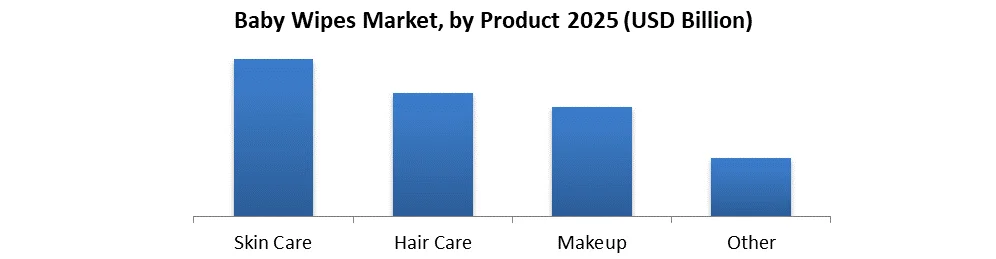
Wet Wipes currently represent the more commercially established and widely used product type, mainly because they are ready to use and fit easily into diaper changes, travel, feeding cleanup, and everyday infant hygiene. In 2025, wet wipes accounted for a strong majority of category revenue in several recent market assessments, although published estimates differ considerably by market definition. Dry Wipes, however, are gaining attention as parents look for products with fewer preservatives, longer shelf life, and greater flexibility to use with water or other cleansing solutions. Current industry data also identifies dry wipes as a faster-growing product area in some forecasts. For your report, Wet Wipes can be positioned as the leading segment in 2025, while Dry Wipes can be highlighted as an emerging growth segment driven by sensitive-skin care, newborn care, and sustainability preferences.
Baby Wipes Market, by distribution channel
Supermarkets & Hypermarkets is the leading distribution channel because parents can compare multiple brands, pack sizes, formulations, and prices while purchasing other baby-care essentials in the same shopping trip. E-commerce is currently the most important changing channel and is expected to record faster growth as parents increasingly use online platforms for home delivery, product reviews, subscription purchases, and bulk packs; one recent assessment estimates online retail at 29.07% in 2025, while other research identifies online purchasing as the fastest-growing channel. Specialty Stores continue to attract parents looking for premium, natural, sensitive-skin, and newborn-focused products, while Departmental Stores benefit from established physical retail networks and product visibility. Others, including convenience-oriented outlets and smaller general retailers, remain relevant for quick and repeat purchases, particularly when parents need wipes immediately rather than during planned shopping.
Baby Wipes Market Regional Insight
Asia Pacific is the leading region in the Baby Wipes Market, supported by a large infant population, rising awareness of infant hygiene, changing lifestyles, and growing demand for convenient childcare products. China, India, Japan, South Korea, and Southeast Asian countries are contributing to market growth through increasing adoption of baby wipes across different consumer segments. Growing supermarket networks, pharmacies, and e-commerce platforms are making baby wipes more accessible, while local and international brands are offering affordable multipacks, sensitive-skin products, and natural formulations. The region also presents strong growth opportunities as parents increasingly focus on product safety, convenience, and hygiene in everyday infant care.
North America has a well-established baby wipes purchasing culture supported by high product penetration, strong supermarket and pharmacy networks, and widespread online purchasing. Parents increasingly look for hypoallergenic, fragrance-free, plant-based, dermatologist-tested, and sensitive-skin products, allowing premium products to maintain strong value positioning. The United States accounts for the majority of regional demand, while Canada provides additional opportunities for natural and environmentally responsible baby-care products. The region's mature retail structure also supports frequent repeat purchases and subscription-based replenishment.
Europe is strongly influenced by environmental awareness, ingredient transparency, and product-safety expectations. Consumers are increasingly interested in biodegradable fibers, plastic-free substrates, natural formulations, and responsible packaging, encouraging manufacturers to redesign existing product lines rather than compete only through price. The United Kingdom, Germany, France, Italy, and Spain remain important consumption markets, while specialist retailers and pharmacies provide visibility for premium and sensitive-skin products. Regulatory attention toward single-use plastics is also influencing material choices and product communication.
South America is developing through greater access to organized retail, rising urban consumption, and increasing awareness of disposable infant-hygiene products. Brazil represents an important demand center, while Argentina, Chile, Colombia, and other markets provide additional opportunities for manufacturers. Consumers remain relatively price-conscious, making value packs, economical formulations, and locally competitive brands important for market penetration. At the same time, online shopping is giving parents access to a broader selection of imported and premium baby-care products.
Middle East and Africa remains smaller in revenue terms but offers considerable room for category penetration. Demand is supported by a young population, urbanization, improving modern retail infrastructure, and rising awareness of infant hygiene. Gulf countries such as Saudi Arabia and the United Arab Emirates are positioned toward premium and imported baby-care products, while South Africa and other African markets provide opportunities for affordable, everyday-use wipes. Distribution reliability and suitable price points remain important because purchasing behavior differs significantly between higher-income urban markets and price-sensitive developing markets. Recent industry estimates also identify the region as one of the faster-growing areas from a smaller base.
Baby Wipes Market Competitive Landscape:
The Baby Wipes Market is highly competitive and moderately fragmented, with multinational baby-care companies competing alongside regional manufacturers, premium specialists, and private-label brands. Procter & Gamble maintains a strong position through the Pampers brand, while Kimberly-Clark competes closely with Huggies by emphasizing skin-friendly formulations, product quality, and broad retail availability. Kenvue, Unicharm Corporation, and Hengan International Group strengthen competition through established baby-care portfolios and strong regional distribution, particularly across North America and Asia Pacific. Specialist brands such as WaterWipes are differentiating through water-based and sensitive-skin formulations, while companies such as Pigeon Corporation, The Honest Company, Himalaya Wellness Company, Cotton Babies, Babisil Products, and Farlin Corporation compete through natural ingredients, premium positioning, regional consumer preferences, and targeted product offerings. Current industry research indicates that the leading five companies account for a substantial portion of category revenue, but a significant share remains with regional brands, private-label manufacturers, and niche companies. Competition is increasingly centered on product formulation, biodegradable and plant-based materials, infant skin safety, packaging innovation, e-commerce availability, pricing, and brand trust, rather than relying only on traditional brand recognition. This creates opportunities for both established manufacturers and specialized brands to gain market share by addressing specific consumer needs.
Baby Wipes Market Recent Development
| Month/ Year | Company | Recent Development |
| January 2026 | Tubby Todd | Expanded nationwide availability through Target stores and Target online |
| March 2026 | Parasol Co | Expanded availability through Target stores nationwide and Target online |
| April 2026 | Millie Moon | Its 99 percent Pure Water Baby Wipes received recognition in the Parents 2026 Best for Baby Awards |
| May 2026 | Momcozy | Launched Momcozy Plus Baby Wipes with 99 percent purified water, coconut extract, larger dimensions and a moisture retaining closure |
| June 2026 | Pura | Relaunched its baby wipes with a softer three layer structure designed to release lotion while maintaining gentle cleaning performance |
Baby Wipes Market Scope: Inquire before buying
| Baby Wipes Market | |||
|---|---|---|---|
| Report Coverage | Details | ||
| Base Year: | 2025 | Forecast Period: | 2026-2034 |
| Historical Data: | 2020 to 2025 | Market Size in 2025: | US $ 6.28 Bn. |
| Forecast Period 2026 to 2034 CAGR: | 6.3% | Market Size in 2034: | US $ 10.88 Bn. |
| Segments Covered: | by Product | Dry Wipes Wet Wipes |
|
| by Distribution Channel | Supermarkets & Hypermarkets Departmental Stores Specialty Stores E-commerce Others |
||
| by Packaging | Pouch/Box Tubes/Tin |
||
Global Baby Wipes Market, by Region
Asia Pacific (China, South Korea, Japan, India, Australia, Indonesia, Malaysia, Vietnam, Taiwan, Bangladesh, Pakistan and Rest of APAC)
Europe (UK, France, Germany, Italy, Spain, Sweden, Austria and Rest of Europe)
North America (United States, Canada and Mexico)
Middle East and Africa (South Africa, GCC, Egypt, Nigeria and Rest of ME&A)
South America (Brazil, Argentina Rest of South America)
Global Baby Wipes Market Key Players
1. Procter and Gamble Co.
2. Kimberly Clark Corporation
3. Kenvue Inc.
4. Unicharm Corporation
5. Hengan International Group Company Limited
6. Pigeon Corporation
7. The Himalaya Wellness Company
8. WaterWipes
9. Johnson and Johnson
10. Cotton Babies Inc.
11. Babisil Products Ltd.
12. Farlin Corporation
13. Nice Pak Products Inc.
14. Rockline Industries
15. Albaad
16. American Hygienics Corporation
17. Diamond Wipes International Inc.
18. Essity AB
19. The Honest Company Inc.
20. Neva Global
21. Mega Disposables S.A.
22. Duex Group
23. Mama Bamboo
24. R B Hygiene Home GmbH
25. Medline Industries LP
26. Suominen Corporation
27. La Fresh Group Inc.
28. Pura
29. The Moms Co.
30. Honasa Consumer Limited
31. Godrej Consumer Products Limited
32. Dabur India Limited
33. Uniclan Healthcare Private Limited
34. Mother Sparsh
35. R for Rabbit Baby Products Private Limited
36. Universal Corporation Limited
37. Me N Moms Private Limited
38. Artsana Group
39. Hayat Kimya
40. Canopus Wet Wipes Private Limited
41. Core Clean Private Limited
42. Soothe Healthcare Private Limited
43. Romsons Group of Industries
44. Welspun India Limited
45. Trident Limited
46. CPMC Holdings Limited
47. John Dale Limited
48. Hangzhou C and S Paper Company Limited
49. The Clorox Company
50. Unilever PLC
Frequently Asked Questions:
1. Which region has the largest share in the Baby Wipes Market?
Ans: Asia Pacific region held the highest share in 2025.
2. What is the growth rate of the Baby Wipes Market?
Ans: The Baby Wipes Market is growing at a CAGR of 6.3% during the forecast period 2026-2034.
3. What is the scope of the Baby Wipes Market report?
Ans: The Baby Wipes Market report covers market segmentation, regional analysis, competitive landscape, market dynamics, and market estimation for the forecast period.
4. Who are the key players in the Baby Wipes Market?
Ans: The important key players include Procter and Gamble Co., Kimberly Clark Corporation, Kenvue Inc., Unicharm Corporation, Hengan International Group Company Limited, Pigeon Corporation, The Himalaya Wellness Company, WaterWipes, Nice Pak Products Inc., and Rockline Industries.
5. What is the study period of this Market?
Ans: The Baby Wipes Market is studied from 2020 to 2034.