
Global Babassu Oil Market size by Nature, Form, Product Type, Distribution and Applicatuin
Overview
The Global Babassu Oil Market was valued at USD 257.28 million in 2025 and is estimated to reach USD 430.99 million by 2034. The market is to grow at a 5.9% CAGR during the forecast period.
Global Babassu Oil Market Overview
Babassu oil is a vegetable oil extracted from the kernels of babassu palm fruits, primarily obtained from Attalea speciosa palms native to Brazil. The oil contains a high proportion of saturated fatty acids, particularly lauric and myristic acids, which gives it favorable oxidative stability and functional properties for personal care, cosmetics, food, soaps, detergents, and other industrial applications. Babassu oil is identified as an important emollient ingredient. Its fatty-acid composition and stability make it suitable for topical and cosmetic formulations.
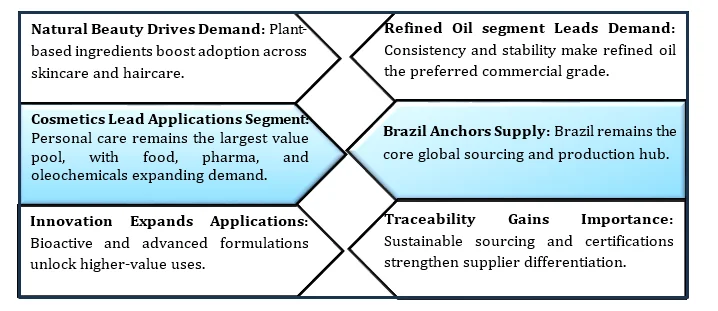
Demand for babassu oil is rising as manufacturers seek plant-derived ingredients for formulations centered on natural, functional, and renewable raw materials. Its composition also enables applications beyond cosmetics. Babassu oil is used in soaps, detergents, lubricants, glycerin, biofuels, and food products, allowing suppliers to address multiple end-use markets rather than relying on a single application. For example, research demonstrates the use of babassu oil in photoprotective nanoemulsions, indicating opportunities for higher-value cosmetic and pharmaceutical formulations.
Babassu Oil Market Growth Share Analysis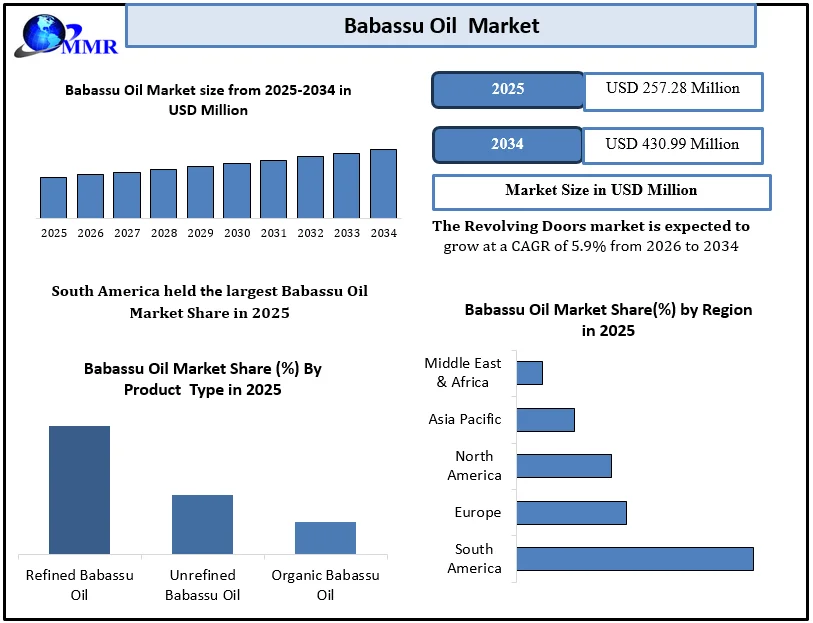
To know about the Research Methodology :- Request Free Sample Report
Brazil remains the central supply base for babassu, particularly across Maranhão, Piauí, Tocantins, and Pará. The Brazilian Institute of Geography and Statistics (IBGE) tracks babassu as a non-timber forest product, with its extraction supporting regional rural economies. Around 16,000 tonnes of babassu nuts are harvested from wild harvesting in the Amazon biome, demonstrating the scale of the underlying resource base.
Therefore, the market benefits from both growing demand for natural specialty oils and diversification into higher-value applications. The projected expansion from USD 257.28 million in 2025 to USD 430.99 million by 2034 indicates a steady growth trajectory, while continued innovation in cosmetics, personal care, bio-based products, and functional formulations is expected to strengthen the market's long-term outlook.
Global Babassu Oil Market - Brazil-to-Global Supply Chain Map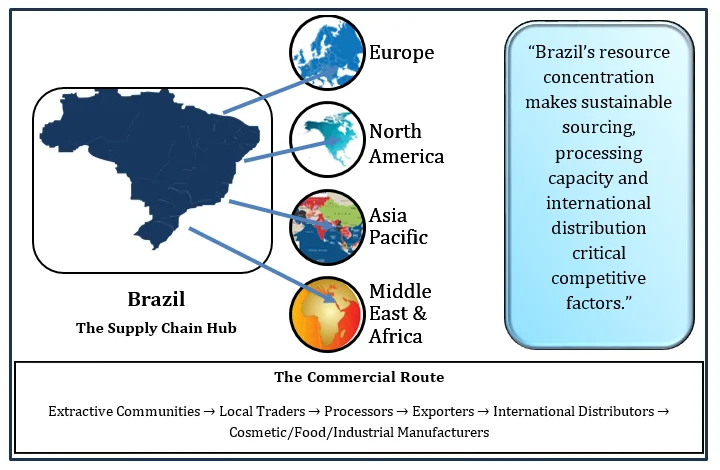
Why This Report?
This report provides a strategic assessment of the global babassu oil market, helping stakeholders understand where demand is emerging, which applications offer the strongest commercial potential, and how the industry is evolving across major regions. It evaluates market size, growth outlook, product types, applications, distribution channels, regional opportunities, competitive positioning, recent industry developments, market dynamics, and emerging trends to provide a comprehensive view of the value chain. The analysis distinguishes established demand in cosmetics and personal care from emerging opportunities across food, pharmaceuticals, soaps and detergents, and industrial applications, while assessing the growing importance of refined, organic, sustainable, and traceable babassu oil.
The report also examines key manufacturers, suppliers, distributors, sourcing structures, strategic initiatives, and competitive approaches across regional markets. By combining quantitative market assessment with qualitative industry analysis, the report enables manufacturers, investors, ingredient suppliers, distributors, formulators, and other stakeholders to identify high-growth opportunities, evaluate competitive risks, optimize market-entry strategies, and make informed investment and expansion decisions through 2034.
Babassu Oil Market Key Highlights
Global Babassu Oil Market Dynamics
Natural-Ingredient Demand Creates a Premium Route for Babassu Oil is to Drive the Market
Babassu oil benefits from increasing use of plant-derived oils in cosmetic and personal-care formulations. Its high lauric and myristic acid content provides oxidative stability and functional properties that support formulation applications. A peer-reviewed study developed stable babassu-based photoprotective nanoemulsions and reported an in-vitro SPF value of 35.5 ± 3.0 for one formulation, demonstrating the potential to move babassu oil beyond traditional commodity applications into higher-value cosmetic formulations.
This supports demand for cosmetic-grade and specialty babassu oil, particularly where brands seek naturally derived functional ingredients rather than conventional vegetable oils.
Supply Concentration Makes Babassu Oil Dependent on Brazil’s Extractive Chain
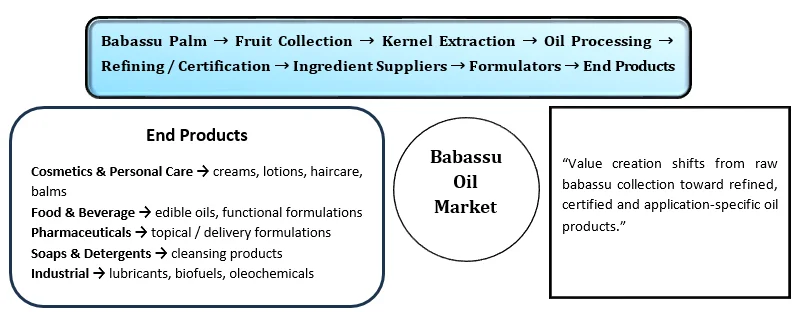
Babassu oil production remains closely linked to Brazil's traditional extractive economy, with collection largely performed manually by local communities. According to ICMBio, 6–8% of the babassu fruit consists of seeds, while those seeds yield 65–68% oil. Therefore, the supply chain depends on collection, breaking, kernel recovery, and local processing rather than a highly mechanized global plantation system.
This creates a structural constraint on large-scale, consistent international supply, particularly when buyers require standardized volumes and quality.
Sustainable and Traceable Babassu Creates Opportunities for Higher-Value Market Positioning
Babassu offers an opportunity to combine natural-ingredient demand with community-based and sustainable sourcing. Brazil's Amazon Fund supports the Babaçu Livre initiative in Maranhão with USD 2.56 million to strengthen the babassu value chain, invest in production units, restore degraded areas, and implement sustainable management plans. The project specifically identifies cosmetics and food as underdeveloped markets for babassu products. Investment in processing, traceability, certification, and community-based sourcing can help suppliers shift from selling basic oil toward premium sustainable babassu oil and higher-value cosmetic ingredients.
Protecting Babassu Resources While Expanding Commercial Extraction Challenges the Market
Commercial expansion must balance raw-material demand with protection of babaçuais and the livelihoods of extractive communities. In August 2026, Brazil's Ministry of Racial Equality established a working group specifically focused on protecting babassu forests and agro-extractive communities, including measures against irregular clearing, burning, and cutting of babassu clusters. The initiative also includes protection of babassu areas across the Caatinga, Cerrado, and Amazon biomes.
Environmental protection and community rights increasingly become part of the supply equation. Companies expanding babassu oil sourcing therefore need responsible procurement, traceability, sustainable harvesting, and community-inclusive supply models rather than focusing only on increasing extraction volumes.
Babassu Oil Value Chain
Global Babassu Oil Market Key Trends
• Formulators Shift Toward Babassu Oil-Based Delivery Systems - Babassu oil is increasingly investigated as a functional oil phase in advanced formulations rather than being used only as a conventional emollient. Recent research explores babassu oil in nanoemulsions and microemulsions, including work using predictive modeling to identify suitable formulation conditions. This indicates growing interest in using babassu oil as a functional component of sophisticated delivery systems for cosmetic, pharmaceutical, and food applications.
• Blended Botanical Oils Gain Traction in Product Formulation - Product developers increasingly combine babassu oil with other botanical oils to achieve specific texture, spreadability, stability, and sensory characteristics. A 2024 formulation study evaluated babassu oil alongside Cannabis sativa and Camelina sativa oils in cosmetic creams and found that oil selection and concentration materially affect the mechanical and rheological behavior of the final formulation. Babassu oil increasingly competes as a formulation-enhancing ingredient, rather than solely as a standalone natural oil.
• Research Expands Into Babassu-Derived Functional Ingredients - The market is seeing greater scientific interest in the bioactive compounds and by-products generated during babassu processing. A 2024 review identifies polyphenols, phytosterols, triterpenes, and other compounds in babassu-derived materials and examines their potential applications across food, biomedical, and other higher-value areas. This supports a broader shift toward full-value utilization of the babassu fruit, creating potential revenue streams beyond conventional oil extraction.
• Babassu Oil Moves into More Specialized Functional Applications - Innovation increasingly focuses on giving babassu oil a defined technical function within finished products. Research published in 2025 demonstrates its use in oil-in-water nanoemulsions and evaluates physical and oxidative stability under different formulation conditions. The study identifies babassu-oil nanoemulsions as a promising approach for cosmetic, pharmaceutical, and food applications.
Babassu Oil Market Segment Analysis
By Product Type
Refined Babassu Oil Dominated the Product Type Segment in 2025
Refined babassu oil accounted for the largest share of the product type segment in 2025, primarily due to its consistent quality, neutral sensory characteristics, improved stability, and suitability for standardized commercial formulations. These attributes make it relevant for cosmetics, personal care, soaps, conditioners, creams, lotions, balms, and other products manufactured at scale, where predictable raw-material performance is important. Unrefined babassu oil represents a smaller but differentiated segment, with demand concentrated in natural cosmetics, artisanal products, specialty soaps, and formulations that value minimal processing and the inherent characteristics of the oil. While refined oil benefits from broader industrial and formulation compatibility, unrefined oil has greater potential to capture premium and sustainability-oriented applications.
Refined babassu oil is expected to retain its leadership as manufacturers continue to prioritize standardized botanical ingredients, whereas unrefined oil is likely to register comparatively faster growth from a smaller base as natural-product brands and specialty formulators increase their use of minimally processed oils during 2025-34. Additional opportunities may also emerge from improved utilization of babassu processing residues, supporting greater value recovery across the extraction chain.
By Application
Cosmetics & Personal Care Dominated the Babassu Oil Market in 2025
Cosmetics & Personal Care dominated the application segment in 2025, supported by babassu oil's emollient properties, rapid absorption, skin-conditioning characteristics, and versatility across skin-care, hair-care, body-care, soap, and balm formulations. Its compatibility with emulsions and advanced delivery systems further strengthens its relevance in higher-value cosmetic products. Food & Beverage represents an established secondary application, supported by traditional edible use and opportunities in food emulsions and functional formulations, while Industrial Applications serve demand for soaps, detergents, lubricants, glycerin, and other oleochemical products. Pharmaceuticals remain an emerging application, with research exploring babassu oil in microemulsions, topical delivery systems, and lipid-based drug-delivery technologies.
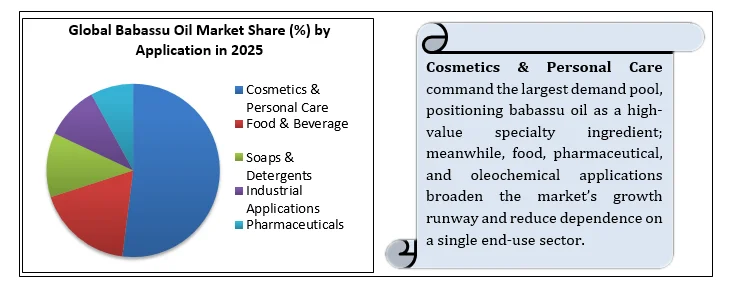
During the forecast period, Cosmetics & Personal Care is expected to maintain its dominant position as natural and botanical ingredients gain traction across premium skin and hair-care products. Food & Beverage and Industrial Applications are likely to expand steadily but remain more exposed to competition from established edible and oleochemical oils, while Pharmaceuticals could record stronger percentage growth from a smaller base as formulation research and delivery technologies advance, although regulatory and commercialization requirements continue to constrain near-term scale.
Global Babassu Oil Market – Regional Analysis
North America: Natural Personal-Care Formulations Create a Premium Demand Base
North America represents an attractive market for babassu oil, supported primarily by demand for natural, botanical, and specialty ingredients in skincare, haircare, and clean-label personal-care products. The U.S. provides the largest demand pool because of its extensive cosmetics and personal-care product ecosystem and strong adoption of specialty formulation ingredients. Regulatory requirements also favor suppliers that can provide consistent quality and safety documentation. Under the Modernization of Cosmetics Regulation Act (MoCRA), U.S. cosmetic manufacturers and processors face requirements covering facility registration, product listing, adverse-event reporting, and safety substantiation, increasing the importance of documented ingredient quality for commercial formulations.
Canada further supports regional demand through its established natural-health and personal-care product ecosystem. During the forecast period, North American demand is expected to shift toward refined, traceable, sustainably sourced, and specialty-grade babassu oil, particularly for premium skincare, haircare, and formulation applications.
Europe: Sustainability and Ingredient Compliance Strengthen Specialty-Oil Demand
Europe presents strong potential for babassu oil because the region combines high demand for botanical cosmetic ingredients with stringent product-safety and sustainability expectations. Germany, France, Italy, the UK, and Spain remain important markets for natural and premium personal-care formulations, creating opportunities for babassu oil as an emollient and specialty vegetable oil. The European Union regulates finished cosmetic products primarily through Regulation (EC) No. 1223/2009, which requires a product safety report before a cosmetic product is placed on the market and establishes requirements covering product safety and responsible operators. These requirements favor suppliers capable of providing reliable specifications, traceability, and safety documentation. European demand therefore increasingly favors premium and certified babassu oil rather than undifferentiated bulk material. Over 2026–2034, demand is expected to expand particularly through clean-beauty, natural skincare, haircare, and specialty formulation brands.
Asia Pacific: Increasing Beauty Manufacturing Creates the Fastest Commercial Opportunity
Asia Pacific offers significant growth potential as expanding beauty and personal-care manufacturing increases demand for functional botanical oils and specialty cosmetic ingredients. China, Japan, South Korea, and India represent important formulation and consumption markets, while Southeast Asian countries add opportunities through expanding beauty-product manufacturing and regional supply chains. China is particularly important because its cosmetics regulatory framework requires registration or notification of cosmetic products and establishes specific controls for cosmetic ingredients and product safety. China's revised Cosmetics Supervision and Administration Regulation took effect in January 2021, strengthening regulatory oversight of cosmetics and new cosmetic ingredients.
India also regulates imported cosmetics through the Cosmetics Rules, 2020, requiring registration before cosmetic products are imported and compliance with prescribed quality and safety standards. During the forecast period, the region is expected to create opportunities for babassu oil through premium skincare, haircare, natural cosmetics, and specialty formulations, particularly as manufacturers diversify botanical ingredient portfolios.
South America: Brazil Anchors Regional Supply and Domestic Demand
South America dominated the Babassu Oil Market in 2025. It remains strategically important because Brazil combines the region's largest babassu resource base with a substantial beauty and personal-care industry. This creates an advantage that other regions do not possess: proximity between raw-material collection, oil processing, ingredient manufacturing, and downstream consumption.
Brazil's beauty and personal-care sector generated USD 34.36 billion in revenue, equivalent to around 2% of national GDP, according to ABIHPEC's latest industry profile, illustrating the scale of the domestic market available for botanical ingredients. Brazil also has an established export-oriented beauty supply chain; the Beautycare Brazil program reported USD 116 million in international sales in 2024 among participating companies, with ingredients accounting for 23.4% of exported products. Consequently, South America is expected to remain the core supply and processing region, while domestic cosmetics, personal care, food, and oleochemical applications support demand growth through 2034.
Middle East & Africa: Premium Beauty and Natural Ingredients Open a Smaller but Emerging Market
Middle East & Africa represents a smaller babassu oil market but offers emerging opportunities through premium cosmetics, natural personal-care products, and specialty beauty formulations. Gulf countries, particularly the UAE and Saudi Arabia, provide attractive demand centers because of their premium beauty markets, while South Africa functions as an important commercial and regulatory hub for the wider region. South Africa regulates the manufacture, sale, and importation of cosmetics under the Foodstuffs, Cosmetics and Disinfectants Act, creating a formal regulatory framework for cosmetic products. The region's opportunity is therefore concentrated more in higher-value finished products and specialty formulations than in large-volume bulk babassu oil consumption. During 2026–2034, rising premium beauty consumption, expansion of international cosmetic brands, and increasing availability of natural-ingredient products are expected to gradually increase demand for specialty babassu oil.
Global Babassu Oil Market Recent Developments
| Date | Recent developments | Market impact |
| Aug. 2026 | Brazil’s Ministry of Agrarian Development and Family Farming (MDA) announced measures supporting babassu coconut breakers in Maranhão, including SociobioMais/CONAB support for 13 women extractivists and the creation of a working group focused on protecting babassu forests and agro-extractive communities. | Strengthens raw-material security and traceability. Greater institutional support for extractive communities can improve continuity of kernel collection while encouraging more structured and socially traceable sourcing. This is particularly relevant for cosmetic brands seeking responsible botanical ingredients. |
| Aug. 2026 | Brazil established a government working group for protection of babassu forests and agro-extractive communities, with measures addressing irregular clearing, burning, and cutting of entire babassu bunches. | Supports sustainable supply but may increase sourcing-compliance requirements. Stronger protection of babassu resources can improve long-term availability by protecting the underlying resource, while processors and exporters may face greater expectations for legal and traceable sourcing. |
| June 2026 | BNDES' “Quebradeiras” project entered an updated implementation stage, supporting socioeconomic inclusion of babassu-breaking families and community-based businesses across 16 communities in nine municipalities in Maranhão's Vale do Pindaré. | Improves commercialization potential. Strengthening community businesses and productive organization can help move the value chain beyond raw-kernel extraction toward higher-value products such as oil, soaps and other processed derivatives. |
| May 2026 | Brazil announced USD 29.45 million from the Amazon Fund for research, development and innovation across Amazon sociobiodiversity chains, explicitly including babassu. The program is expected to support at least 18 collaborative projects and nearly 600 research scholarships. | Creates an innovation pathway for babassu-derived products. Research funding can accelerate processing technologies, value-added ingredients and commercialization opportunities, potentially expanding babassu oil beyond conventional food and personal-care applications. |
| Nov. 2025 / updated May 2026 | BNDES, Sebrae and Brazilian government agencies launched Coopera+ Amazônia, with USD 21.04 million planned to strengthen 50 cooperatives across babassu, açaí, Brazil nut and cupuaçu value chains in five Amazonian states. The program focuses on innovation, productive modernization and market expansion. | Expands organized supply and market access. Modernization of cooperatives can improve processing, quality consistency, logistics and bargaining power, making babassu-derived products more commercially viable for domestic and export buyers. |
Global Babassu Oil Market – Competitive Analysis
The Babassu Oil Market remains fragmented, with competition spanning Brazilian-origin producers, specialty natural-ingredient suppliers, cosmetic ingredient distributors, and international botanical-oil companies. Key players include Hallstar, Citróleo, Gustav Heess, Greentech, O&3, Nature’s Natural India, Raasa Oils, and Aromaaz International, among others. Competition is primarily based on oil quality, refinement level, organic certification, traceability, formulation support, packaging flexibility, and supply reliability, rather than aggressive price competition. Hallstar, for example, differentiates through its Biochemica Ultra Refined and Refined Organic Babassu Oil grades, with technical specifications, regulatory approvals across the U.S., EU, China, Japan, Korea, Canada, and Australia, and formulation recommendations for creams, conditioners, balms, and soaps.
Distribution and pricing strategies vary according to target customer. Bulk-oriented suppliers compete through drums, pails, and customized wholesale quantities, while specialty suppliers use distributors and online channels to reach smaller formulators and natural-product brands. In Europe, established ingredient distributors such as Gustav Heess and IMCD provide an important route to cosmetic manufacturers, combining sourcing, quality control, storage, and regulatory documentation. Smaller suppliers increasingly use direct B2B sales, export platforms, private-label services, and technical documentation such as COA, MSDS, and TDS to penetrate international markets. Pricing remains grade- and volume-dependent: premium organic and refined grades command higher prices than conventional bulk oil, while suppliers seek differentiation through certification and formulation performance rather than competing solely on price.
Regionally, Brazil remains strategically important as the source market, while North America and Europe are targeted through specialty ingredient distributors and established cosmetic-ingredient portfolios. Asian suppliers increasingly participate through export-oriented bulk supply and private-label channels. Overall, companies are pursuing portfolio diversification, organic/refined grades, sustainable sourcing, application-specific positioning, distributor partnerships, and technical formulation support to penetrate the market. The competitive focus is consequently shifting from simply supplying babassu oil toward supplying a consistent, documented, application-ready specialty ingredient.
Babassu Oil Market Scope: Inquire before buying
| Babassu Oil Market | |||
|---|---|---|---|
| Report Coverage | Details | ||
| Base Year: | 2025 | Forecast Period: | 2026-2034 |
| Historical Data: | 2020 to 2025 | Market Size in 2025: | USD 257.28 Mn. |
| Forecast Period 2026 to 2034 CAGR: | 5.9% | Market Size in 2034: | USD 430.99 Mn. |
| Segments Covered: | by Nature | Conventional Organic |
|
| by Form | Liquid Solid |
||
| by Product Type | Refined Babassu Oil Unrefined Babassu Oil Organic Babassu Oil |
||
| by Distribution | Direct Sales (B2B) Distributors & Wholesalers Specialty Stores Supermarkets & Hypermarkets Online Retail |
||
| by Application | Cosmetics & Personal Care Food & Beverage Pharmaceuticals Soaps & Detergents Industrial Applications |
||
Global Babassu Oil Market by Region
North America (United States, Canada, and Mexico)
Europe (UK, France, Germany, Italy, Spain, Sweden, Austria, and the Rest of Europe)
Asia Pacific (China, South Korea, Japan, India, Australia, Indonesia, Malaysia, Vietnam, Taiwan, Bangladesh, Pakistan, and the Rest of APAC)
Middle East and Africa (South Africa, GCC, Egypt, Nigeria, and the Rest of ME&A)
South America (Brazil, Argentina Rest of South America)
Global Babassu Oil Market Key Players
North America
1. Hallstar — United States
2. Jedwards International — United States
3. Bulk Apothecary — United States
4. Westco Chemicals — United States
5. KIC Chemicals — United States
Europe
6. Gustav Heess — Germany
7. Greentech — France
8. O&3 — United Kingdom
9. IMCD — Netherlands / Europe
10. AOT GmbH — Germany
11. Manske GmbH — Germany
12. Royal Bio & Natural Ingredients — Spain
13. William Hodgson & Company — United Kingdom
14. BELA VIZAGO Nature — Spain
Asia Pacific
15. Nature's Natural India — India
16. Moksha Lifestyle Products — India
17. Raasa Oils — India
18. Aromaaz International — India
19. Kush Aroma Exports — India
20. Caldic — India / Southeast Asia
21. PT Lautan Luas — Indonesia
22. Fuji Kasei — Japan
23. Woojin Trading — South Korea
24. Hana Care — South Korea
25. Ingredients Plus — Malaysia
26. Summit Chemical — Thailand
27. WeChem — Taiwan
South America
28. Citróleo Group — Brazil
29. Hallstar — Brazil
30. QuantiQ — Brazil
31. Community and Cooperative Babassu Processors — Brazil
Middle East & Africa
32. Moksha Lifestyle Products — UAE / India
33. Kush Aroma Exports — India / Middle East
34. Rishichem MidEast — UAE
35. Millchem — South Africa
36. Redachem Egypt — Egypt
37. Redachem Tunisia — Tunisia
Frequently Asked Questions
1. What is babassu oil used for?
Ans. Babassu oil is widely used in cosmetics and personal care products, including moisturizers, creams, hair conditioners, soaps, lip balms, and body-care formulations. It is also used in food products, pharmaceuticals, detergents, lubricants, and other oleochemical applications.
2. What is driving the growth of the babassu oil market?
Ans. The babassu oil market is driven by rising demand for plant-based and natural ingredients, expanding applications in cosmetics and personal care, and growing interest in renewable and sustainably sourced oils.
3. Which product type dominates the babassu oil market?
Ans. Refined babassu oil dominates the market because its consistent quality, neutral sensory profile, improved stability, and standardized characteristics make it suitable for commercial cosmetic, personal care, soap, and other formulated products.
4. Which application dominates the babassu oil market?
Ans. Cosmetics and personal care represent the leading application segment because babassu oil provides emollient properties and is compatible with skincare, haircare, moisturizing, cleansing, and other topical formulations.
5. Which region dominates the babassu oil market?
Ans. South America represents the core regional market because Brazil is the principal source of babassu resources and has an established extractive and processing ecosystem. North America and Europe also represent important demand centers for specialty and cosmetic-grade babassu oil.
6. What is the outlook for the babassu oil market?
Ans. The babassu oil market is expected to grow steadily through 2034, supported by increasing use in natural cosmetics, personal care, functional formulations, and bio-based products, while sustainable sourcing and value-chain development create additional growth opportunities.