Automotive Tire Market Size by Vehicle Type, Tire Type, Rim Size and Region – Segment-Level Market Assessment, Growth Opportunity Analysis, Competitive Mapping & Forecast to 2032

5.6%
CAGR (2026-2032)
151.94 USD Bn.
Forecast Market Size
320
Report Pages
143
Market Tables

Overview

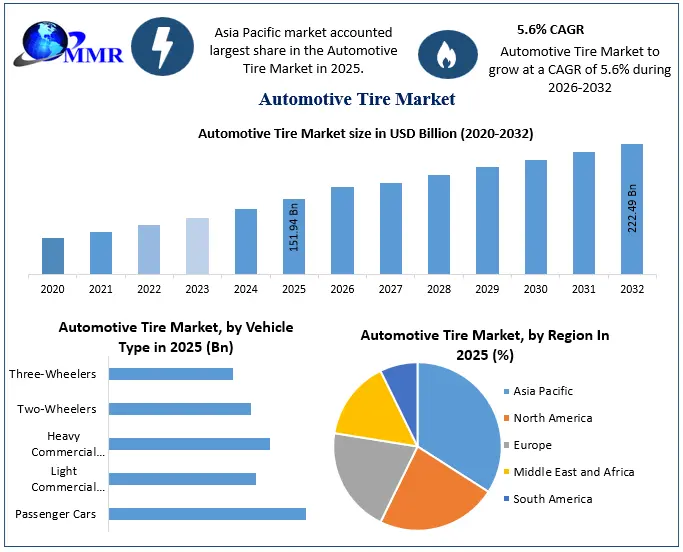
The Global Automotive Tire Market size was valued at USD 151.94 Bn. in 2025, and the market revenue is expected to reach USD 222.49 Bn. by 2032, at a CAGR of 5.6% over the forecast period.

Automotive Tire Market Overview

Automotive tires are flexible, ring-shaped components that cover the outermost part of a wheel, providing traction, supporting vehicle weight, absorbing road shocks, and ensuring safe mobility. Typically made from reinforced synthetic or natural rubber with layers of steel, fabric, and other materials, these tires are filled with pressurized air or gases to enhance durability and performance. Designed for various vehicles, including passenger cars, trucks, SUVs, and motorcycles, they cater to diverse road conditions, such as all-season, winter, and off-road use. Recent advancements focus on sustainability, with manufacturers introducing eco-friendly materials like recycled rubber and soybean oil, as well as airless tire concepts to reduce waste and improve longevity.

The global automotive tire market is driven by rising vehicle production, particularly in Asia-Pacific, where China and India account for over 50% of global tire demand. North America and Europe remain dominant in premium and high-performance tire segments, with leading players like Michelin, Bridgestone, and Goodyear investing heavily in fuel-efficient and low-rolling-resistance tires for electric vehicles (EVs). However, supply chain disruptions, such as rubber shortages and logistics delays, have occasionally led to market imbalances. Emerging markets in Latin America and Africa are gaining traction, with local manufacturing hubs expanding to meet regional demand. Recent trends include smart tires with embedded sensors for real-time pressure monitoring and self-healing technologies to extend tire life.

Competition in the tire industry is intense, with the top five players, Michelin, Bridgestone, Continental, Goodyear, and Pirelli, holding over 60% of the global market share. Innovation remains a key differentiator, as companies race to develop tires optimized for EVs, which require quieter and more durable designs due to higher torque and battery weight. Additionally, sustainability initiatives, such as Michelin’s goal to use 100% renewable materials by 2050, are reshaping R&D priorities. With increasing regulatory pressures for lower carbon emissions and advancements in autonomous driving, tire manufacturers are focusing on smarter, greener, and more adaptive solutions to stay ahead in this dynamic market.Automotive Tire Market Snapshot
To know about the Research Methodology :- Request Free Sample Report

Automotive Tire Market Dynamics

Growth in vehicle Production and Sales to boost the Automotive Tire Market growth

Due to increased OEM demand, the aftermarket or replacement tire market is influenced by vehicle production and sales. As vehicles age or experience wear and tear, the need for replacement tires arises. Consumers who purchase new or used vehicles contribute to the aftermarket segment, either by replacing tires due to wear or by customizing their vehicles with different tire types. The original equipment manufacturers (OEMs) play a pivotal role in the tire market. When automakers produce vehicles, they often equip them with tires as part of the original equipment. This OEM demand for tires directly depends on vehicle production. Tire manufacturers work closely with OEMs to develop tires that meet the specific requirements of particular vehicle models, ensuring safety and performance.

Economic factors drive not only vehicle sales but also the aftermarket or replacement tire market. Aging tires, wear and tear, punctures, and seasonal variations contribute to the continuous demand for replacement tires. Consumers in the aftermarket segment are influenced by factors like tire longevity, performance, and cost-effectiveness, contributing to the market's dynamics. The automotive tire market is also significantly shaped by original equipment manufacturers (OEMs) and their demands. Automotive Tire manufacturers often collaborate closely with OEMs to develop specialized tires that meet the specific requirements of particular vehicle models, ensuring a harmonious balance of safety, performance, and efficiency.

Competition is inherent in the tire industry. Numerous global and regional players compete vigorously, driving innovation, cost-efficiency, and product differentiation. Intense competition encourages tire manufacturers to focus on product quality and branding to gain a competitive edge and capture the Automotive Tire market share. The rise of digital platforms and e-commerce has transformed how consumers research and purchase tires. Online reviews, comparisons, and the ability to order tires online have altered consumer behaviour and marketing strategies in the tire industry, making digitalization and e-commerce influential drivers in the market.

Automotive Tire Market Segment Analysis

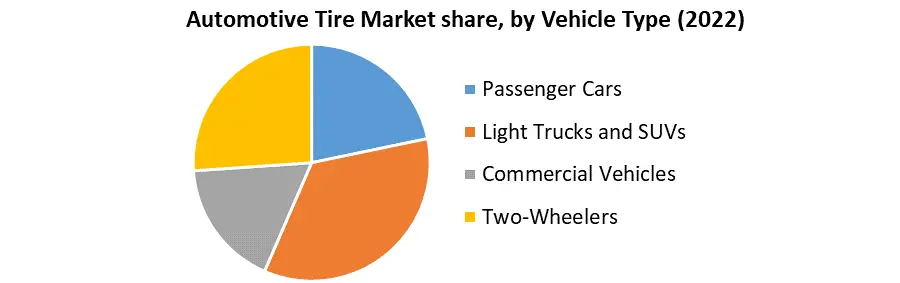
Based on Vehicle Type, the Automotive Tire Market is segmented into Passenger Cars, Light Trucks and SUVs, Commercial Vehicles, and Two-Wheelers. The Light Trucks and SUVs segment dominated the market in 2025 and is expected to hold the largest Automotive Tire Market share over the forecast period. Consumers choose SUVs and light trucks for their versatility, cargo capacity, and off-road capabilities. As a result, they seek tires that can complement these vehicle features. Many SUV owners and light truck users appreciate the option to go off-road. Some tires in this segment are designed with off-road capabilities, featuring deeper treads and rugged construction. Tires for SUVs and light trucks need to be durable and capable of withstanding the additional weight and load-bearing requirements of these vehicles. This durability is essential for both safety and longevity. Types of tires in this segment are engineered to provide all-season performance, which is expected to boost the Automotive Tires Market growth. They need to deliver good traction and control on both dry and wet roads, as well as in light snow.

Based on Tire Type, the Automotive Tire Market is segmented into Summer Tires, All-Season Tires, Winter Tires, Performance Tires, Run-Flat Tires, Off-Road Tires, and Specialty Tires. The All-Season Tires segment held the largest Automotive Tire Market share in 2025 and is expected to dominate the market over the forecast period. All-season tires are designed to perform adequately in different weather conditions, including dry, wet, and light snow. They strike a balance between various performance attributes, making them suitable for a wide range of driving scenarios and seasons. The tread pattern of All-Season Tires typically features a mix of tread blocks and grooves. This design allows for efficient water evacuation to reduce the risk of hydroplaning on wet roads while also providing decent traction on dry surfaces, which is expected to boost the Automotive Tire Market growth. These tires are designed for longer tread life compared to more specialized tire types, making them a cost-effective choice for many consumers. All-Season Tires are competitively priced and represent a good value for those looking for a tire that can handle a variety of driving conditions without the added cost of multiple tire sets.
Automotive Tire Market

Automotive Tire Market Regional Analysis

Expanding Middle Class population to boost the Asia Pacific Automotive Tire Market growth

The rising middle-class population in many Asia-Pacific countries has translated into higher vehicle ownership rates. A larger middle class can afford personal vehicles, which has a direct impact on tire sales. These consumers often seek reliable and long-lasting tires, creating demand for both original equipment manufacturers (OEM) and replacement tires. Government investments in infrastructure, including road construction and improvement, have spurred vehicle usage. The Asia-Pacific region has become a global automotive manufacturing hub, with numerous automakers establishing production facilities in countries like China, Japan, South Korea, and India.

The presence of these manufacturing centers generates substantial demand for OEM tires, which are installed on new vehicles at the factory. The Asia-Pacific region serves as a significant source of tire exports to other parts of the world. This is particularly evident in countries like China, which exports tires to various international markets. The competitive production costs in the region make it an attractive location for tire manufacturing and export. Consumer preferences and brand awareness play a vital role in the Asia-Pacific tire market.

As consumers become more brand-conscious and quality-focused, they tend to choose recognized and reputable tire brands. This preference for branded tires often drives innovation and competition among tire manufacturers. The Asia-Pacific tire market benefits from ongoing technological advancements. These innovations include the development of tires with improved traction, reduced rolling resistance, and longer lifespan. Moreover, innovations in manufacturing processes, such as automated production and smart tire monitoring systems, enhance the competitiveness of the market.

Tire manufacturers in India are investing in research and development to produce more fuel-efficient and environmentally friendly tires. They are also developing tires suited to specific Indian road and climate conditions. The market has seen innovations in tire technology, including run-flat tires, self-sealing tires, and smart tire monitoring systems. Indian consumers are becoming more brand-conscious and quality-focused. Recognized and reputable tire brands are preferred, pushing manufacturers to focus on brand building and product quality, which is expected to boost the Automotive Tire Market growth.

In North America, Canada's automotive tire market shares similarities with the United States and has unique regional conditions and regulatory considerations. The market is influenced by Canada's diverse climate, with significant demand for winter tires in colder regions. The growth in the number of vehicles on the road and the need for replacement tires drive the market. Major automotive tire manufacturers in Canada, such as Michelin, Bridgestone, and Continental, operate in the Canadian market, providing a range of tires suitable for both winter and all-season use. Mexico's automotive tire market benefits from a growing middle class and a surge in vehicle production. As an important manufacturing hub for global automakers, Mexico has a substantial demand for OEM tires.

Automotive Tire Market Competitive Landscape

Michelin and Bridgestone stand as the two dominant forces in the global automotive tire industry, each carving out distinct competitive advantages. Michelin, with annual revenue of USD 30.03 billion, has established itself as a leader in the premium segment through its high-performance tires and strong OEM partnerships with luxury automakers such as Porsche and Ferrari. The French company is at the forefront of sustainable tire innovation, pioneering airless tire technology and committing to incorporating 50% recycled materials in its tires by 2030.

Bridgestone, the industry's largest player with revenue of approximately USD 30 billion, maintains its dominance through massive scale and technological innovation. The company excels in smart tire solutions and eco-friendly technologies, including its ENLITEN lightweight tire platform. While Michelin leads in the development of premium and EV-specific tires, Bridgestone holds competitive advantages in commercial vehicle tires and connected tire technologies for fleet management.

The future of the Automotive tire market will be shaped by electric vehicle adoption, green manufacturing practices, and advancements in smart tire technologies. OEM partnerships and sustained investments in R&D will be critical in defining competitive positioning in this evolving industry.World Largest Tire Producers in 2024

Automotive Tire Market Key Developments,

In August 2024, Europe's automotive tire market sees Continental launch Taraxagum dandelion tires in Germany, backed by finalized EU green grants (Q2 2024). Sustainable production gains momentum with policy support.

In December 2024, in South Korea's Automotive Tire Market, Hankook Tire launches revolutionary self-healing tire technology using advanced polymer compounds that automatically repair punctures up to 6mm, targeting premium EV and passenger vehicle segments. This innovation extends tire lifespan by 30-40% and reduces maintenance costs, strengthening Hankook's position in the global high-performance tire market.

In November 2024, in Brazil's Automotive Tire Market, Pirelli inaugurates its first fully solar-powered tire factory in Bahia, featuring 100% renewable energy operations and AI-driven production systems. The facility cuts CO₂ emissions by 18,000 tons annually, reinforcing Pirelli's leadership in sustainable premium tires for Latin America's growing EV market.

Automotive Tire Market Key Trends,

Eco-Shift Trend in Europe's Tire Market:

The EU is accelerating its bio-materials transition with Continental's Taraxagum dandelion rubber tires (Germany, August 2024), backed by $38 million (€35M) in EU Green Deal funding. This innovation reduces synthetic rubber use by 50% in urban EV tires.

Innovation Race Trend in South Korea's Tire Market:

South Korea is leading smart tire innovation with Hankook's Self-Healing Tire Technology (December 2024), backed by $180 million in R&D investments.

Automotive Tire Industry Ecosystem

Automotive Tire Industry Ecosystem Snapshot

Automotive Tire Market Scope: Inquiry Before Buying

Automotive Tire Market
Report Coverage Details
Base Year: 2025 Forecast Period: 2026-2032
Historical Data: 2020 to 2025 Market Size in 2025: 151.94 USD Billion
Forecast Period 2026-2032 CAGR: 5.6% Market Size in 2032: 222.49 USD Billion
Segments Covered: by Tire Type Radial Tires
Bias (Cross-ply) Tires
Belted Bias Tires
by Vehicle Type Passenger Cars
Light Commercial Vehicles (LCV)
Heavy Commercial Vehicles (HCV)
Two-Wheelers
Three-Wheelers
by Season Type Summer Tires
All-Season Tires
by Rim Size Less than 15 Inches
15–20 Inches
Above 20 Inches
by Technology Conventional Tires
Run-Flat Tires
Self-Sealing Tires
Airless Tires
Smart / Connected Tires
by Load Index Up to 100
101–120
Above 120
by Material Type Natural Rubber
Synthetic Rubber
Silica-Based Compounds
Reinforced Materials (Steel, Polyester, Nylon)
by Sales Channel OEM (Original Equipment Manufacturer)
Replacement / Aftermarket
by End User Individual Consumers
Fleet Operators
Logistics & Transportation Companies

Automotive Tire Market, by Region

North America (United States, Canada, and Mexico)
Europe (UK, France, Germany, Italy, Spain, Sweden, Austria, and the Rest of Europe)
Asia Pacific (China, South Korea, Japan, India, Australia, Indonesia, Malaysia, Vietnam, Taiwan, Bangladesh, Pakistan, and Rest of APAC)
Middle East and Africa (South Africa, GCC, Egypt, Nigeria, and Rest of ME&A)
South America (Brazil, Argentina, Rest of South America)

Automotive Tire Key Players Include

1. North America
1. Goodyear Tire & Rubber Company
2. Hankook Tire America Corp.
3. Falken Tires
4. Nexen Tire Corporation

2. Europe
1. Michelin
2. Continental AG
3. Pirelli & C. S.p. A.
4. Nokian Tyres plc
5. Sumitomo Rubber Industries

3. Asia-Pacific
1. Yokohama Rubber Co., Ltd.
2. Toyo Tire Corporation
3. Hankook Tire Co. Ltd.
4. Kumho Tire Co., Inc.
5. MRF Ltd.
6. CEAT Ltd.
7. Apollo Tyres Ltd.
8. Maxxis International

4. Latin America and Africa
1. Michelin & Bridgestone
2. Apollo Tyres & CEAT
3. Pirelli & C. S.p. A.

Frequently Asked Questions:

1. What are the different types of automotive tires available in the market?
Ans: The automotive tire market offers various types, including Summer Tires, All-Season Tires, Winter Tires, Performance Tires, Run-Flat Tires, Off-Road Tires, and Specialty Tires. Each type is designed for specific conditions and performance requirements.

2. Which factors are expected to drive the Global Automotive Tire Market growth by 2032?
Ans. Growth in vehicle Production and Sales is expected to drive the Medical Device Testing Market growth over the forecast period.

3. What is the growth rate of the Global Automotive Tire Market?
Ans. The Global Automotive Tire Market is growing at a significant rate of 5.6% over the forecast period.

4. Which region is expected to dominate the Global Automotive Tire Market?
Ans. The Asia Pacific region is expected to dominate the Automotive Tire Market over the forecast period.

Table of Contents

1. Automotive Tire Market Introduction 1.1. Study Assumption and Market Definition 1.2. Scope of the Study 1.3. Executive Summary 2. Global Automotive Tire Market: Competitive Landscape 2.1. MMR Competition Matrix 2.2. Competitive Landscape 2.3. Key Players Benchmarking 2.3.1. Company Name 2.3.2. Business Segment 2.3.3. End-user Segment 2.3.4. Revenue (2025) 2.3.5. Company Locations 2.4. Leading Automotive Tire Market Companies, by market capitalization 2.5. Market Structure 2.5.1. Market Leaders 2.5.2. Market Followers 2.5.3. Emerging Players 2.6. Mergers and Acquisitions Details 3. Automotive Tire Market: Dynamics 3.1. Automotive Tire Market Trends by Region 3.1.1. North America Automotive Tire Market Trends 3.1.2. Europe Automotive Tire Market Trends 3.1.3. Asia Pacific Automotive Tire Market Trends 3.1.4. Middle East and Africa Automotive Tire Market Trends 3.1.5. South America Automotive Tire Market Trends 3.2. Automotive Tire Market Dynamics by Region 3.2.1. North America 3.2.1.1. North America Automotive Tire Market Drivers 3.2.1.2. North America Automotive Tire Market Restraints 3.2.1.3. North America Automotive Tire Market Opportunities 3.2.1.4. North America Automotive Tire Market Challenges 3.2.2. Europe 3.2.2.1. Europe Automotive Tire Market Drivers 3.2.2.2. Europe Automotive Tire Market Restraints 3.2.2.3. Europe Automotive Tire Market Opportunities 3.2.2.4. Europe Automotive Tire Market Challenges 3.2.3. Asia Pacific 3.2.3.1. Asia Pacific Automotive Tire Market Drivers 3.2.3.2. Asia Pacific Automotive Tire Market Restraints 3.2.3.3. Asia Pacific Automotive Tire Market Opportunities 3.2.3.4. Asia Pacific Automotive Tire Market Challenges 3.2.4. Middle East and Africa 3.2.4.1. Middle East and Africa Automotive Tire Market Drivers 3.2.4.2. Middle East and Africa Automotive Tire Market Restraints 3.2.4.3. Middle East and Africa Automotive Tire Market Opportunities 3.2.4.4. Middle East and Africa Automotive Tire Market Challenges 3.2.5. South America 3.2.5.1. South America Automotive Tire Market Drivers 3.2.5.2. South America Automotive Tire Market Restraints 3.2.5.3. South America Automotive Tire Market Opportunities 3.2.5.4. South America Automotive Tire Market Challenges 3.3. PORTER's Five Forces Analysis 3.4. PESTLE Analysis 3.5. Technology Roadmap 3.6. Regulatory Landscape by Region 3.6.1. North America 3.6.2. Europe 3.6.3. Asia Pacific 3.6.4. Middle East and Africa 3.6.5. South America 3.7. Key Opinion Leader Analysis For Automotive Tire Industry 3.8. Analysis of Government Schemes and Initiatives For Automotive Tire Industry 3.9. Automotive Tire Market Trade Analysis 3.10. The Global Pandemic Impact on Automotive Tire Market 4. Automotive Tire Market: Global Market Size and Forecast by Segmentation (in USD Billion) 2025-2032 4.1. Automotive Tire Market Size and Forecast, by Tire Type (2025-2032) 4.1.1. Radial Tires 4.1.2. Bias (Cross-ply) Tires 4.1.3. Belted Bias Tires 4.2. Automotive Tire Market Size and Forecast, by Vehicle Type (2025-2032) 4.2.1. Passenger Cars 4.2.2. Light Commercial Vehicles (LCV) 4.2.3. Heavy Commercial Vehicles (HCV) 4.2.4. Two-Wheelers 4.2.5. Three-Wheelers 4.3. Automotive Tire Market Size and Forecast, by Season Type (2025-2032) 4.3.1. Summer Tires 4.3.2. All-Season Tires 4.4. Automotive Tire Market Size and Forecast, by Rim Size (2025-2032) 4.4.1. Less than 15 Inches 4.4.2. 15–20 Inches 4.4.3. Above 20 Inches 4.5. Automotive Tire Market Size and Forecast, by Technology (2025-2032) 4.5.1. Conventional Tires 4.5.2. Run-Flat Tires 4.5.3. Self-Sealing Tires 4.5.4. Airless Tires 4.5.5. Smart / Connected Tires 4.6. Automotive Tire Market Size and Forecast, by Load Index (2025-2032) 4.6.1. Up to 100 4.6.2. 101–120 4.6.3. Above 120 4.7. Automotive Tire Market Size and Forecast, by Material Type (2025-2032) 4.7.1. Natural Rubber 4.7.2. Synthetic Rubber 4.7.3. Silica-Based Compounds 4.7.4. Reinforced Materials (Steel, Polyester, Nylon) 4.8. Automotive Tire Market Size and Forecast, by Region (2025-2032) 4.8.1. North America 4.8.2. Europe 4.8.3. Asia Pacific 4.8.4. Middle East and Africa 4.8.5. South America 5. North America Automotive Tire Market Size and Forecast by Segmentation (in USD Billion) 2025-2032 5.1. North America Automotive Tire Market Size and Forecast, by Tire Type (2025-2032) 5.1.1. Radial Tires 5.1.2. Bias (Cross-ply) Tires 5.1.3. Belted Bias Tires 5.2. North America Automotive Tire Market Size and Forecast, by Vehicle Type (2025-2032) 5.2.1. Passenger Cars 5.2.2. Light Commercial Vehicles (LCV) 5.2.3. Heavy Commercial Vehicles (HCV) 5.2.4. Two-Wheelers 5.2.5. Three-Wheelers 5.3. North America Automotive Tire Market Size and Forecast, by Season Type (2025-2032) 5.3.1. Summer Tires 5.3.2. All-Season Tires 5.4. North America Automotive Tire Market Size and Forecast, by Rim Size (2025-2032) 5.4.1. Less than 15 Inches 5.4.2. 15–20 Inches 5.4.3. Above 20 Inches 5.5. North America Automotive Tire Market Size and Forecast, by Technology (2025-2032) 5.5.1. Conventional Tires 5.5.2. Run-Flat Tires 5.5.3. Self-Sealing Tires 5.5.4. Airless Tires 5.5.5. Smart / Connected Tires 5.6. North America Automotive Tire Market Size and Forecast, by Load Index (2025-2032) 5.6.1. Up to 100 5.6.2. 101–120 5.6.3. Above 120 5.7. North America Automotive Tire Market Size and Forecast, by Material Type (2025-2032) 5.7.1. Natural Rubber 5.7.2. Synthetic Rubber 5.7.3. Silica-Based Compounds 5.7.4. Reinforced Materials (Steel, Polyester, Nylon) 5.8. North America Automotive Tire Market Size and Forecast, by Country (2025-2032) 5.8.1. United States 5.8.1.1. United States Automotive Tire Market Size and Forecast, by Tire Type (2025-2032) 5.8.1.1.1. Radial Tires 5.8.1.1.2. Bias (Cross-ply) Tires 5.8.1.1.3. Belted Bias Tires 5.8.1.2. United States Automotive Tire Market Size and Forecast, by Vehicle Type (2025-2032) 5.8.1.2.1. Passenger Cars 5.8.1.2.2. Light Commercial Vehicles (LCV) 5.8.1.2.3. Heavy Commercial Vehicles (HCV) 5.8.1.2.4. Two-Wheelers 5.8.1.2.5. Three-Wheelers 5.8.1.3. United States Automotive Tire Market Size and Forecast, by Season Type (2025-2032) 5.8.1.3.1. Summer Tires 5.8.1.3.2. All-Season Tires 5.8.1.4. United States Automotive Tire Market Size and Forecast, by Rim Size (2025-2032) 5.8.1.4.1. Less than 15 Inches 5.8.1.4.2. 15–20 Inches 5.8.1.4.3. Above 20 Inches 5.8.1.5. United States Automotive Tire Market Size and Forecast, by Technology (2025-2032) 5.8.1.5.1. Conventional Tires 5.8.1.5.2. Run-Flat Tires 5.8.1.5.3. Self-Sealing Tires 5.8.1.5.4. Airless Tires 5.8.1.5.5. Smart / Connected Tires 5.8.1.6. United States Automotive Tire Market Size and Forecast, by Load Index (2025-2032) 5.8.1.6.1. Up to 100 5.8.1.6.2. 101–120 5.8.1.6.3. Above 120 5.8.1.7. United States Automotive Tire Market Size and Forecast, by Material Type (2025-2032) 5.8.1.7.1. Natural Rubber 5.8.1.7.2. Synthetic Rubber 5.8.1.7.3. Silica-Based Compounds 5.8.1.7.4. Reinforced Materials (Steel, Polyester, Nylon) 5.8.2. Canada 5.8.2.1. Canada Automotive Tire Market Size and Forecast, by Tire Type (2025-2032) 5.8.2.1.1. Radial Tires 5.8.2.1.2. Bias (Cross-ply) Tires 5.8.2.1.3. Belted Bias Tires 5.8.2.2. Canada Automotive Tire Market Size and Forecast, by Vehicle Type (2025-2032) 5.8.2.2.1. Passenger Cars 5.8.2.2.2. Light Commercial Vehicles (LCV) 5.8.2.2.3. Heavy Commercial Vehicles (HCV) 5.8.2.2.4. Two-Wheelers 5.8.2.2.5. Three-Wheelers 5.8.2.3. Canada Automotive Tire Market Size and Forecast, by Season Type (2025-2032) 5.8.2.3.1. Summer Tires 5.8.2.3.2. All-Season Tires 5.8.2.4. Canada Automotive Tire Market Size and Forecast, by Rim Size (2025-2032) 5.8.2.4.1. Less than 15 Inches 5.8.2.4.2. 15–20 Inches 5.8.2.4.3. Above 20 Inches 5.8.2.5. Canada Automotive Tire Market Size and Forecast, by Technology (2025-2032) 5.8.2.5.1. Conventional Tires 5.8.2.5.2. Run-Flat Tires 5.8.2.5.3. Self-Sealing Tires 5.8.2.5.4. Airless Tires 5.8.2.5.5. Smart / Connected Tires 5.8.2.6. Canada Automotive Tire Market Size and Forecast, by Load Index (2025-2032) 5.8.2.6.1. Up to 100 5.8.2.6.2. 101–120 5.8.2.6.3. Above 120 5.8.2.7. Canada Automotive Tire Market Size and Forecast, by Material Type (2025-2032) 5.8.2.7.1. Natural Rubber 5.8.2.7.2. Synthetic Rubber 5.8.2.7.3. Silica-Based Compounds 5.8.2.7.4. Reinforced Materials (Steel, Polyester, Nylon) 5.8.3. Mexico 5.8.3.1. Mexico Automotive Tire Market Size and Forecast, by Tire Type (2025-2032) 5.8.3.1.1. Radial Tires 5.8.3.1.2. Bias (Cross-ply) Tires 5.8.3.1.3. Belted Bias Tires 5.8.3.2. Mexico Automotive Tire Market Size and Forecast, by Vehicle Type (2025-2032) 5.8.3.2.1. Passenger Cars 5.8.3.2.2. Light Commercial Vehicles (LCV) 5.8.3.2.3. Heavy Commercial Vehicles (HCV) 5.8.3.2.4. Two-Wheelers 5.8.3.2.5. Three-Wheelers 5.8.3.3. Mexico Automotive Tire Market Size and Forecast, by Season Type (2025-2032) 5.8.3.3.1. Summer Tires 5.8.3.3.2. All-Season Tires 5.8.3.4. Mexico Automotive Tire Market Size and Forecast, by Rim Size (2025-2032) 5.8.3.4.1. Less than 15 Inches 5.8.3.4.2. 15–20 Inches 5.8.3.4.3. Above 20 Inches 5.8.3.5. Mexico Automotive Tire Market Size and Forecast, by Technology (2025-2032) 5.8.3.5.1. Conventional Tires 5.8.3.5.2. Run-Flat Tires 5.8.3.5.3. Self-Sealing Tires 5.8.3.5.4. Airless Tires 5.8.3.5.5. Smart / Connected Tires 5.8.3.6. Mexico Automotive Tire Market Size and Forecast, by Load Index (2025-2032) 5.8.3.6.1. Up to 100 5.8.3.6.2. 101–120 5.8.3.6.3. Above 120 5.8.3.7. Mexico Automotive Tire Market Size and Forecast, by Material Type (2025-2032) 5.8.3.7.1. Natural Rubber 5.8.3.7.2. Synthetic Rubber 5.8.3.7.3. Silica-Based Compounds 5.8.3.7.4. Reinforced Materials (Steel, Polyester, Nylon) 6. Europe Automotive Tire Market Size and Forecast by Segmentation (in USD Billion) 2025-2032 6.1. Europe Automotive Tire Market Size and Forecast, by Tire Type (2025-2032) 6.2. Europe Automotive Tire Market Size and Forecast, by Vehicle Type (2025-2032) 6.3. Europe Automotive Tire Market Size and Forecast, by Season Type (2025-2032) 6.4. Europe Automotive Tire Market Size and Forecast, by Rim Size (2025-2032) 6.5. Europe Automotive Tire Market Size and Forecast, by Technology (2025-2032) 6.6. Europe Automotive Tire Market Size and Forecast, by Load Index (2025-2032) 6.7. Europe Automotive Tire Market Size and Forecast, by Material Type (2025-2032) 6.8. Europe Automotive Tire Market Size and Forecast, by Country (2025-2032) 6.8.1. United Kingdom 6.8.1.1. United Kingdom Automotive Tire Market Size and Forecast, by Tire Type (2025-2032) 6.8.1.2. United Kingdom Automotive Tire Market Size and Forecast, by Vehicle Type (2025-2032) 6.8.1.3. United Kingdom Automotive Tire Market Size and Forecast, by Season Type (2025-2032) 6.8.1.4. United Kingdom Automotive Tire Market Size and Forecast, by Rim Size (2025-2032) 6.8.1.5. United Kingdom Automotive Tire Market Size and Forecast, by Technology (2025-2032) 6.8.1.6. United Kingdom Automotive Tire Market Size and Forecast, by Load Index (2025-2032) 6.8.1.7. United Kingdom Automotive Tire Market Size and Forecast, by Material Type (2025-2032) 6.8.2. France 6.8.2.1. France Automotive Tire Market Size and Forecast, by Tire Type (2025-2032) 6.8.2.2. France Automotive Tire Market Size and Forecast, by Vehicle Type (2025-2032) 6.8.2.3. France Automotive Tire Market Size and Forecast, by Season Type (2025-2032) 6.8.2.4. France Automotive Tire Market Size and Forecast, by Rim Size (2025-2032) 6.8.2.5. France Automotive Tire Market Size and Forecast, by Technology (2025-2032) 6.8.2.6. France Automotive Tire Market Size and Forecast, by Load Index (2025-2032) 6.8.2.7. France Automotive Tire Market Size and Forecast, by Material Type (2025-2032) 6.8.3. Germany 6.8.3.1. Germany Automotive Tire Market Size and Forecast, by Tire Type (2025-2032) 6.8.3.2. Germany Automotive Tire Market Size and Forecast, by Vehicle Type (2025-2032) 6.8.3.3. Germany Automotive Tire Market Size and Forecast, by Season Type (2025-2032) 6.8.3.4. Germany Automotive Tire Market Size and Forecast, by Rim Size (2025-2032) 6.8.3.5. Germany Automotive Tire Market Size and Forecast, by Technology (2025-2032) 6.8.3.6. Germany Automotive Tire Market Size and Forecast, by Load Index (2025-2032) 6.8.3.7. Germany Automotive Tire Market Size and Forecast, by Material Type (2025-2032) 6.8.4. Italy 6.8.4.1. Italy Automotive Tire Market Size and Forecast, by Tire Type (2025-2032) 6.8.4.2. Italy Automotive Tire Market Size and Forecast, by Vehicle Type (2025-2032) 6.8.4.3. Italy Automotive Tire Market Size and Forecast, by Season Type (2025-2032) 6.8.4.4. Italy Automotive Tire Market Size and Forecast, by Rim Size (2025-2032) 6.8.4.5. Italy Automotive Tire Market Size and Forecast, by Technology (2025-2032) 6.8.4.6. Italy Automotive Tire Market Size and Forecast, by Load Index (2025-2032) 6.8.4.7. Italy Automotive Tire Market Size and Forecast, by Material Type (2025-2032) 6.8.5. Spain 6.8.5.1. Spain Automotive Tire Market Size and Forecast, by Tire Type (2025-2032) 6.8.5.2. Spain Automotive Tire Market Size and Forecast, by Vehicle Type (2025-2032) 6.8.5.3. Spain Automotive Tire Market Size and Forecast, by Season Type (2025-2032) 6.8.5.4. Spain Automotive Tire Market Size and Forecast, by Rim Size (2025-2032) 6.8.5.5. Spain Automotive Tire Market Size and Forecast, by Technology (2025-2032) 6.8.5.6. Spain Automotive Tire Market Size and Forecast, by Load Index (2025-2032) 6.8.5.7. Spain Automotive Tire Market Size and Forecast, by Material Type (2025-2032) 6.8.6. Sweden 6.8.6.1. Sweden Automotive Tire Market Size and Forecast, by Tire Type (2025-2032) 6.8.6.2. Sweden Automotive Tire Market Size and Forecast, by Vehicle Type (2025-2032) 6.8.6.3. Sweden Automotive Tire Market Size and Forecast, by Season Type (2025-2032) 6.8.6.4. Sweden Automotive Tire Market Size and Forecast, by Rim Size (2025-2032) 6.8.6.5. Sweden Automotive Tire Market Size and Forecast, by Technology (2025-2032) 6.8.6.6. Sweden Automotive Tire Market Size and Forecast, by Load Index (2025-2032) 6.8.6.7. Sweden Automotive Tire Market Size and Forecast, by Material Type (2025-2032) 6.8.7. Austria 6.8.7.1. Austria Automotive Tire Market Size and Forecast, by Tire Type (2025-2032) 6.8.7.2. Austria Automotive Tire Market Size and Forecast, by Vehicle Type (2025-2032) 6.8.7.3. Austria Automotive Tire Market Size and Forecast, by Season Type (2025-2032) 6.8.7.4. Austria Automotive Tire Market Size and Forecast, by Rim Size (2025-2032) 6.8.7.5. Austria Automotive Tire Market Size and Forecast, by Technology (2025-2032) 6.8.7.6. Austria Automotive Tire Market Size and Forecast, by Load Index (2025-2032) 6.8.7.7. Austria Automotive Tire Market Size and Forecast, by Material Type (2025-2032) 6.8.8. Rest of Europe 6.8.8.1. Rest of Europe Automotive Tire Market Size and Forecast, by Tire Type (2025-2032) 6.8.8.2. Rest of Europe Automotive Tire Market Size and Forecast, by Vehicle Type (2025-2032) 6.8.8.3. Rest of Europe Automotive Tire Market Size and Forecast, by Season Type (2025-2032) 6.8.8.4. Rest of Europe Automotive Tire Market Size and Forecast, by Rim Size (2025-2032) 6.8.8.5. Rest of Europe Automotive Tire Market Size and Forecast, by Technology (2025-2032) 6.8.8.6. Rest of Europe Automotive Tire Market Size and Forecast, by Load Index (2025-2032) 6.8.8.7. Rest of Europe Automotive Tire Market Size and Forecast, by Material Type (2025-2032) 7. Asia Pacific Automotive Tire Market Size and Forecast by Segmentation (in USD Billion) 2025-2032 7.1. Asia Pacific Automotive Tire Market Size and Forecast, by Tire Type (2025-2032) 7.2. Asia Pacific Automotive Tire Market Size and Forecast, by Vehicle Type (2025-2032) 7.3. Asia Pacific Automotive Tire Market Size and Forecast, by Season Type (2025-2032) 7.4. Asia Pacific Automotive Tire Market Size and Forecast, by Rim Size (2025-2032) 7.5. Asia Pacific Automotive Tire Market Size and Forecast, by Technology (2025-2032) 7.6. Asia Pacific Automotive Tire Market Size and Forecast, by Load Index (2025-2032) 7.7. Asia Pacific Automotive Tire Market Size and Forecast, by Material Type (2025-2032) 7.8. Asia Pacific Automotive Tire Market Size and Forecast, by Country (2025-2032) 7.8.1. China 7.8.1.1. China Automotive Tire Market Size and Forecast, by Tire Type (2025-2032) 7.8.1.2. China Automotive Tire Market Size and Forecast, by Vehicle Type (2025-2032) 7.8.1.3. China Automotive Tire Market Size and Forecast, by Season Type (2025-2032) 7.8.1.4. China Automotive Tire Market Size and Forecast, by Rim Size (2025-2032) 7.8.1.5. China Automotive Tire Market Size and Forecast, by Technology (2025-2032) 7.8.1.6. China Automotive Tire Market Size and Forecast, by Load Index (2025-2032) 7.8.1.7. China Automotive Tire Market Size and Forecast, by Material Type (2025-2032) 7.8.2. S Korea 7.8.2.1. S Korea Automotive Tire Market Size and Forecast, by Tire Type (2025-2032) 7.8.2.2. S Korea Automotive Tire Market Size and Forecast, by Vehicle Type (2025-2032) 7.8.2.3. S Korea Automotive Tire Market Size and Forecast, by Season Type (2025-2032) 7.8.2.4. S Korea Automotive Tire Market Size and Forecast, by Rim Size (2025-2032) 7.8.2.5. S Korea Automotive Tire Market Size and Forecast, by Technology (2025-2032) 7.8.2.6. S Korea Automotive Tire Market Size and Forecast, by Load Index (2025-2032) 7.8.2.7. S Korea Automotive Tire Market Size and Forecast, by Material Type (2025-2032) 7.8.3. Japan 7.8.3.1. Japan Automotive Tire Market Size and Forecast, by Tire Type (2025-2032) 7.8.3.2. Japan Automotive Tire Market Size and Forecast, by Vehicle Type (2025-2032) 7.8.3.3. Japan Automotive Tire Market Size and Forecast, by Season Type (2025-2032) 7.8.3.4. Japan Automotive Tire Market Size and Forecast, by Rim Size (2025-2032) 7.8.3.5. Japan Automotive Tire Market Size and Forecast, by Technology (2025-2032) 7.8.3.6. Japan Automotive Tire Market Size and Forecast, by Load Index (2025-2032) 7.8.3.7. Japan Automotive Tire Market Size and Forecast, by Material Type (2025-2032) 7.8.4. India 7.8.4.1. India Automotive Tire Market Size and Forecast, by Tire Type (2025-2032) 7.8.4.2. India Automotive Tire Market Size and Forecast, by Vehicle Type (2025-2032) 7.8.4.3. India Automotive Tire Market Size and Forecast, by Season Type (2025-2032) 7.8.4.4. India Automotive Tire Market Size and Forecast, by Rim Size (2025-2032) 7.8.4.5. India Automotive Tire Market Size and Forecast, by Technology (2025-2032) 7.8.4.6. India Automotive Tire Market Size and Forecast, by Load Index (2025-2032) 7.8.4.7. India Automotive Tire Market Size and Forecast, by Material Type (2025-2032) 7.8.5. Australia 7.8.5.1. Australia Automotive Tire Market Size and Forecast, by Tire Type (2025-2032) 7.8.5.2. Australia Automotive Tire Market Size and Forecast, by Vehicle Type (2025-2032) 7.8.5.3. Australia Automotive Tire Market Size and Forecast, by Season Type (2025-2032) 7.8.5.4. Australia Automotive Tire Market Size and Forecast, by Rim Size (2025-2032) 7.8.5.5. Australia Automotive Tire Market Size and Forecast, by Technology (2025-2032) 7.8.5.6. Australia Automotive Tire Market Size and Forecast, by Load Index (2025-2032) 7.8.5.7. Australia Automotive Tire Market Size and Forecast, by Material Type (2025-2032) 7.8.6. Indonesia 7.8.6.1. Indonesia Automotive Tire Market Size and Forecast, by Tire Type (2025-2032) 7.8.6.2. Indonesia Automotive Tire Market Size and Forecast, by Vehicle Type (2025-2032) 7.8.6.3. Indonesia Automotive Tire Market Size and Forecast, by Season Type (2025-2032) 7.8.6.4. Indonesia Automotive Tire Market Size and Forecast, by Rim Size (2025-2032) 7.8.6.5. Indonesia Automotive Tire Market Size and Forecast, by Technology (2025-2032) 7.8.6.6. Indonesia Automotive Tire Market Size and Forecast, by Load Index (2025-2032) 7.8.6.7. Indonesia Automotive Tire Market Size and Forecast, by Material Type (2025-2032) 7.8.7. Malaysia 7.8.7.1. Malaysia Automotive Tire Market Size and Forecast, by Tire Type (2025-2032) 7.8.7.2. Malaysia Automotive Tire Market Size and Forecast, by Vehicle Type (2025-2032) 7.8.7.3. Malaysia Automotive Tire Market Size and Forecast, by Season Type (2025-2032) 7.8.7.4. Malaysia Automotive Tire Market Size and Forecast, by Rim Size (2025-2032) 7.8.7.5. Malaysia Automotive Tire Market Size and Forecast, by Technology (2025-2032) 7.8.7.6. Malaysia Automotive Tire Market Size and Forecast, by Load Index (2025-2032) 7.8.7.7. Malaysia Automotive Tire Market Size and Forecast, by Material Type (2025-2032) 7.8.8. Vietnam 7.8.8.1. Vietnam Automotive Tire Market Size and Forecast, by Tire Type (2025-2032) 7.8.8.2. Vietnam Automotive Tire Market Size and Forecast, by Vehicle Type (2025-2032) 7.8.8.3. Vietnam Automotive Tire Market Size and Forecast, by Season Type (2025-2032) 7.8.8.4. Vietnam Automotive Tire Market Size and Forecast, by Rim Size (2025-2032) 7.8.8.5. Vietnam Automotive Tire Market Size and Forecast, by Technology (2025-2032) 7.8.8.6. Vietnam Automotive Tire Market Size and Forecast, by Load Index (2025-2032) 7.8.8.7. Vietnam Automotive Tire Market Size and Forecast, by Material Type (2025-2032) 7.8.9. Taiwan 7.8.9.1. Taiwan Automotive Tire Market Size and Forecast, by Tire Type (2025-2032) 7.8.9.2. Taiwan Automotive Tire Market Size and Forecast, by Vehicle Type (2025-2032) 7.8.9.3. Taiwan Automotive Tire Market Size and Forecast, by Season Type (2025-2032) 7.8.9.4. Taiwan Automotive Tire Market Size and Forecast, by Rim Size (2025-2032) 7.8.9.5. Taiwan Automotive Tire Market Size and Forecast, by Technology (2025-2032) 7.8.9.6. Taiwan Automotive Tire Market Size and Forecast, by Load Index (2025-2032) 7.8.9.7. Taiwan Automotive Tire Market Size and Forecast, by Material Type (2025-2032) 7.8.10. Rest of Asia Pacific 7.8.10.1. Rest of Asia Pacific Automotive Tire Market Size and Forecast, by Tire Type (2025-2032) 7.8.10.2. Rest of Asia Pacific Automotive Tire Market Size and Forecast, by Vehicle Type (2025-2032) 7.8.10.3. Rest of Asia Pacific Automotive Tire Market Size and Forecast, by Season Type (2025-2032) 7.8.10.4. Rest of Asia Pacific Automotive Tire Market Size and Forecast, by Rim Size (2025-2032) 7.8.10.5. Rest of Asia Pacific Automotive Tire Market Size and Forecast, by Technology (2025-2032) 7.8.10.6. Rest of Asia Pacific Automotive Tire Market Size and Forecast, by Load Index (2025-2032) 7.8.10.7. Rest of Asia Pacific Automotive Tire Market Size and Forecast, by Material Type (2025-2032) 8. Middle East and Africa Automotive Tire Market Size and Forecast by Segmentation (in USD Billion) 2025-2032 8.1. Middle East and Africa Automotive Tire Market Size and Forecast, by Tire Type (2025-2032) 8.2. Middle East and Africa Automotive Tire Market Size and Forecast, by Vehicle Type (2025-2032) 8.3. Middle East and Africa Automotive Tire Market Size and Forecast, by Season Type (2025-2032) 8.4. Middle East and Africa Automotive Tire Market Size and Forecast, by Rim Size (2025-2032) 8.5. Middle East and Africa Automotive Tire Market Size and Forecast, by Technology (2025-2032) 8.6. Middle East and Africa Automotive Tire Market Size and Forecast, by Load Index (2025-2032) 8.7. Middle East and Africa Automotive Tire Market Size and Forecast, by Material Type (2025-2032) 8.8. Middle East and Africa Automotive Tire Market Size and Forecast, by Country (2025-2032) 8.8.1. South Africa 8.8.1.1. South Africa Automotive Tire Market Size and Forecast, by Tire Type (2025-2032) 8.8.1.2. South Africa Automotive Tire Market Size and Forecast, by Vehicle Type (2025-2032) 8.8.1.3. South Africa Automotive Tire Market Size and Forecast, by Season Type (2025-2032) 8.8.1.4. South Africa Automotive Tire Market Size and Forecast, by Rim Size (2025-2032) 8.8.1.5. South Africa Automotive Tire Market Size and Forecast, by Technology (2025-2032) 8.8.1.6. South Africa Automotive Tire Market Size and Forecast, by Load Index (2025-2032) 8.8.1.7. South Africa Automotive Tire Market Size and Forecast, by Material Type (2025-2032) 8.8.2. GCC 8.8.2.1. GCC Automotive Tire Market Size and Forecast, by Tire Type (2025-2032) 8.8.2.2. GCC Automotive Tire Market Size and Forecast, by Vehicle Type (2025-2032) 8.8.2.3. GCC Automotive Tire Market Size and Forecast, by Season Type (2025-2032) 8.8.2.4. GCC Automotive Tire Market Size and Forecast, by Rim Size (2025-2032) 8.8.2.5. GCC Automotive Tire Market Size and Forecast, by Technology (2025-2032) 8.8.2.6. GCC Automotive Tire Market Size and Forecast, by Load Index (2025-2032) 8.8.2.7. GCC Automotive Tire Market Size and Forecast, by Material Type (2025-2032) 8.8.3. Nigeria 8.8.3.1. Nigeria Automotive Tire Market Size and Forecast, by Tire Type (2025-2032) 8.8.3.2. Nigeria Automotive Tire Market Size and Forecast, by Vehicle Type (2025-2032) 8.8.3.3. Nigeria Automotive Tire Market Size and Forecast, by Season Type (2025-2032) 8.8.3.4. Nigeria Automotive Tire Market Size and Forecast, by Rim Size (2025-2032) 8.8.3.5. Nigeria Automotive Tire Market Size and Forecast, by Technology (2025-2032) 8.8.3.6. Nigeria Automotive Tire Market Size and Forecast, by Load Index (2025-2032) 8.8.3.7. Nigeria Automotive Tire Market Size and Forecast, by Material Type (2025-2032) 8.8.4. Rest of ME&A 8.8.4.1. Rest of ME&A Automotive Tire Market Size and Forecast, by Tire Type (2025-2032) 8.8.4.2. Rest of ME&A Automotive Tire Market Size and Forecast, by Vehicle Type (2025-2032) 8.8.4.3. Rest of ME&A Automotive Tire Market Size and Forecast, by Season Type (2025-2032) 8.8.4.4. Rest of ME&A Automotive Tire Market Size and Forecast, by Rim Size (2025-2032) 8.8.4.5. Rest of ME&A Automotive Tire Market Size and Forecast, by Technology (2025-2032) 8.8.4.6. Rest of ME&A Automotive Tire Market Size and Forecast, by Load Index (2025-2032) 8.8.4.7. Rest of ME&A Automotive Tire Market Size and Forecast, by Material Type (2025-2032) 9. South America Automotive Tire Market Size and Forecast by Segmentation (in USD Billion) 2025-2032 9.1. South America Automotive Tire Market Size and Forecast, by Tire Type (2025-2032) 9.2. South America Automotive Tire Market Size and Forecast, by Vehicle Type (2025-2032) 9.3. South America Automotive Tire Market Size and Forecast, by Season Type (2025-2032) 9.4. South America Automotive Tire Market Size and Forecast, by Rim Size (2025-2032) 9.5. South America Automotive Tire Market Size and Forecast, by Technology (2025-2032) 9.6. South America Automotive Tire Market Size and Forecast, by Load Index (2025-2032) 9.7. South America Automotive Tire Market Size and Forecast, by Material Type (2025-2032) 9.8. South America Automotive Tire Market Size and Forecast, by Country (2025-2032) 9.8.1. Brazil 9.8.1.1. Brazil Automotive Tire Market Size and Forecast, by Tire Type (2025-2032) 9.8.1.2. Brazil Automotive Tire Market Size and Forecast, by Vehicle Type (2025-2032) 9.8.1.3. Brazil Automotive Tire Market Size and Forecast, by Season Type (2025-2032) 9.8.1.4. Brazil Automotive Tire Market Size and Forecast, by Rim Size (2025-2032) 9.8.1.5. Brazil Automotive Tire Market Size and Forecast, by Technology (2025-2032) 9.8.1.6. Brazil Automotive Tire Market Size and Forecast, by Load Index (2025-2032) 9.8.1.7. Brazil Automotive Tire Market Size and Forecast, by Material Type (2025-2032) 9.8.2. Argentina 9.8.2.1. Argentina Automotive Tire Market Size and Forecast, by Tire Type (2025-2032) 9.8.2.2. Argentina Automotive Tire Market Size and Forecast, by Vehicle Type (2025-2032) 9.8.2.3. Argentina Automotive Tire Market Size and Forecast, by Season Type (2025-2032) 9.8.2.4. Argentina Automotive Tire Market Size and Forecast, by Rim Size (2025-2032) 9.8.2.5. Argentina Automotive Tire Market Size and Forecast, by Technology (2025-2032) 9.8.2.6. Argentina Automotive Tire Market Size and Forecast, by Load Index (2025-2032) 9.8.2.7. Argentina Automotive Tire Market Size and Forecast, by Material Type (2025-2032) 9.8.3. Rest Of South America 9.8.3.1. Rest Of South America Automotive Tire Market Size and Forecast, by Tire Type (2025-2032) 9.8.3.2. Rest Of South America Automotive Tire Market Size and Forecast, by Vehicle Type (2025-2032) 9.8.3.3. Rest Of South America Automotive Tire Market Size and Forecast, by Season Type (2025-2032) 9.8.3.4. Rest Of South America Automotive Tire Market Size and Forecast, by Rim Size (2025-2032) 9.8.3.5. Rest Of South America Automotive Tire Market Size and Forecast, by Technology (2025-2032) 9.8.3.6. Rest Of South America Automotive Tire Market Size and Forecast, by Load Index (2025-2032) 9.8.3.7. Rest Of South America Automotive Tire Market Size and Forecast, by Material Type (2025-2032) 10. Company Profile: Key Players 10.1. North America 10.1.1. Company Overview 10.1.2. Business Portfolio 10.1.3. Financial Overview 10.1.4. SWOT Analysis 10.1.5. Strategic Analysis 10.1.6. Scale of Operation (small, medium, and large) 10.1.7. Details on Partnership 10.1.8. Regulatory Accreditations and Certifications Received by Them 10.1.9. Awards Received by the Firm 10.1.10. Recent Developments 10.2. Goodyear Tire & Rubber Company 10.3. Hankook Tire America Corp. 10.4. Falken Tires 10.5. Nexen Tire Corporation 10.6. Europe 10.7. Michelin 10.8. Continental AG 10.9. Pirelli & C. S.p. A. 10.10. Nokian Tyres plc 10.11. Sumitomo Rubber Industries 10.12. Asia-Pacific 10.13. Yokohama Rubber Co. 10.14. Ltd. 10.15. Toyo Tire Corporation 10.16. Hankook Tire Co. Ltd. 10.17. Kumho Tire Co. 10.18. Inc. 10.19. MRF Ltd. 10.20. CEAT Ltd. 10.21. Apollo Tyres Ltd. 10.22. Maxxis International 10.23. Latin America and Africa 10.24. Michelin & Bridgestone 10.25. Apollo Tyres & CEAT 11. Key Findings 12. Industry Recommendations 13. Automotive Tire Market: Research Methodology 14. Terms and Glossary

Custom Market Research Services

We Will Customise The Research For You, In Case The Report Listed Above Does Not Meet With Your Requirements