
Automotive Fire Suppression System Market – Industry Structure Evaluation, Demand Drivers Analysis, Regional Growth Analysis and Identification, Competitive Positioning Review & Global Market Size Forecast to 2032
Overview
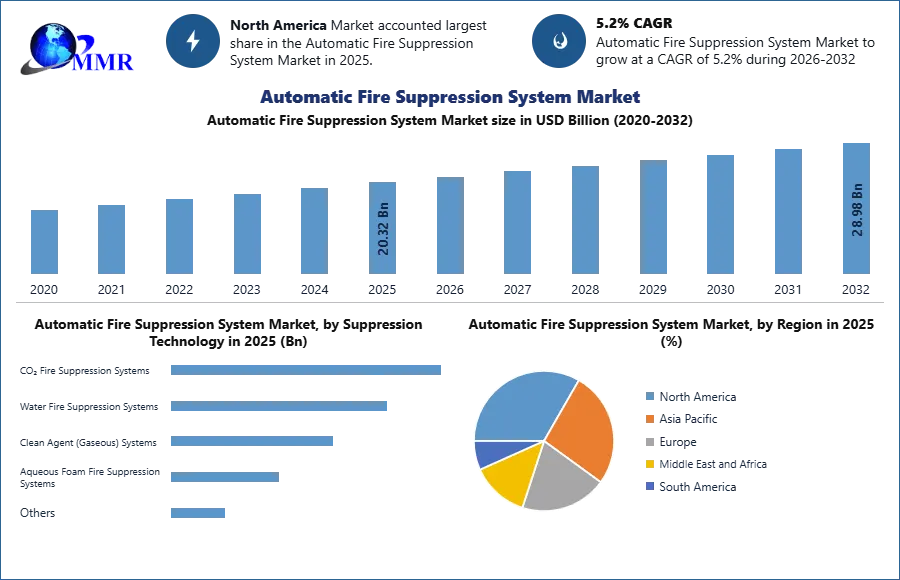
Automatic Fire Suppression System Market was valued at USD 20.32 Bn. in 2025 and the total Global Automatic Fire Suppression System Market revenue is Anticipated to grow at a CAGR of 5.2% from 2026 to 2032 reaching nearly USD 28.98 Bn. by 2032.
Automatic Fire Suppression System Market Overview:
Every organization and building requires a fire prevention system. A fire protection system is used to protect people in a building or institution from fire threats by controlling, detecting, and controlling the spread of fire. Automatic Fire Suppression System provides emergency function without human intervention in case of fire. An Automatic Fire Suppression System protects your high-value assets from fire and the effects of firefighting and gets your operation back to normal with minimal damage Automatic Fire Suppression System provides real-time monitoring information and programmed fire alarm. It presents the design of a low-cost, robust and secure fire protection system for buildings. The automatic Fire Suppression System sends an early alarm when the fire occurs and reduces the fire damage. During COVID-19 the majority of the manufacturing facilities were shut down. In the initial months of the lockdown, the industry experienced varying degrees of fluctuations to install Fire Suppression System; however, various fire incidents took place during the pandemic, and thus, the need for an Automatic Fire Suppression System is expected to witness growth.
To know about the Research Methodology :- Request Free Sample Report
Automatic Fire Suppression System Market Dynamics:
Driver: Increasing Demand for Fire Safety Standards and Regulations
One of the key drivers of the automatic fire suppression system market is the growing demand for stricter fire safety regulations and standards across industries. Governments and regulatory bodies around the world are increasingly enforcing stringent safety codes to prevent catastrophic losses due to fire hazards. For instance, in sectors such as oil & gas, mining, manufacturing, and commercial infrastructure, the implementation of automatic fire suppression systems is becoming mandatory due to the high risk of fire incidents. This is further amplified by industries like data centers and transportation, where even a small fire outbreak can result in significant financial losses, data breaches, and environmental damage.
The increasing implementation of fire protection laws and the need for certified fire suppression solutions push companies to invest in advanced fire suppression systems to ensure safety and compliance. For instance, the NFPA (National Fire Protection Association) codes require certain industries to install specific fire suppression solutions. These regulations ensure that companies adopt modern fire safety systems, thus driving the market growth globally.
Opportunity: Technological Advancements in Fire Suppression Systems
The market for automatic fire suppression systems is also driven by technological advancements, which provide opportunities for improved efficiency, reduced costs, and enhanced performance. Emerging technologies, such as gaseous suppression systems (like FM-200 or Novec 1230), water mist technologies, and advanced sensors, allow fire suppression systems to be more effective, quicker to deploy, and tailored for a wider range of applications. Innovations in IoT-based fire monitoring and smart systems also offer remote monitoring, real-time alerts, and integration with building management systems (BMS), making it easier to detect fires and suppress them before they spread.
These technologies also reduce maintenance costs by predicting failures and ensuring the system is always operational. This increases the adoption of automatic fire suppression systems across sectors such as data centers, retail, and transportation, where fast response times are critical. As these innovations evolve, they create growth opportunities for manufacturers to develop more sophisticated solutions that can cater to the evolving needs of various industries, further expanding market penetration.
Restraint: High Initial Costs and Installation Complexity
Despite the market's growth, one of the key restraints for automatic fire suppression systems is the high initial costs and installation complexity. The systems themselves can be expensive, particularly advanced technologies like clean agent systems or water mist systems. In addition, the installation process can be complex and requires expert assessment, engineering design, and installation, which adds to the overall cost. This can make it a barrier for smaller enterprises, startups, or those with limited budgets to implement these systems, especially in developing regions where fire safety awareness and regulations might be less stringent.
The need for continuous maintenance, testing, and certification also adds to the long-term costs associated with these systems. For industries operating on thin profit margins, the upfront investment and ongoing maintenance costs may deter them from adopting automatic fire suppression systems, despite the critical safety benefits they provide.
Segment Analysis
Based on Type, Water-Based Systems dominated the automatic fire suppression system market in 2025. Water-based systems are widely adopted due to their cost-effectiveness, simplicity, and long-standing use in fire suppression across various industries, including commercial, residential, and industrial sectors. These systems are particularly popular in large buildings, manufacturing facilities, and warehouses, where they provide a reliable solution for combating fires quickly and efficiently. The water mist systems, a subset of water-based solutions, have seen growth due to their ability to suppress fires with lower water usage, making them suitable for more sensitive environments like data centers and museums. Water-based suppression systems are typically the most affordable and offer ease of installation and maintenance. Their widespread use is also driven by global fire safety regulations, which often mandate the installation of water-based fire suppression solutions, especially in high-risk commercial and industrial spaces. This widespread regulation and familiarity with the system type make it the dominant choice for many businesses and organizations.
Based on Suppression Technology, CO₂ Fire Suppression Systems held the largest share in 2025. These systems are particularly preferred for their effectiveness in suppressing fires in enclosed spaces, such as data centers, server rooms, and electrical installations, where water-based systems would not be suitable due to the risk of equipment damage. CO₂ is an ideal agent for suppressing electrical fires and is favored in industries where sensitive equipment needs protection from water and other agents. CO₂ systems work by displacing oxygen in the affected area, thus suffocating the fire. They are efficient, fast-acting, and do not leave residue, making them an attractive option for environments where clean-up and minimal disruption are critical. As industries become more reliant on high-tech equipment and data infrastructure, the demand for CO₂-based fire suppression systems is growing, further driving their dominance in the market. The effectiveness of CO₂ systems in protecting high-value assets continues to solidify their place as a preferred solution across several sectors.
Region Analysis:
North America dominated the Automatic Fire Suppression System market in 2025. The Automatic Fire Suppression System Market in North America is driven by strong demand across various sectors such as commercial buildings, industrial facilities, data centers, and transportation. North America, particularly the United States and Canada, has stringent fire safety regulations and a high emphasis on life safety and property protection. The growing need for advanced fire protection systems is fueled by increased awareness of fire hazards, strict fire safety standards, and the integration of fire suppression systems into new infrastructure and industrial setups.
The water-based systems remain the dominant segment in North America. They are the most widely used, especially in commercial buildings, manufacturing plants, and warehouses. Water mist systems, a subset of water-based systems, are also seeing growing adoption due to their effectiveness in reducing water usage while still providing significant fire suppression capabilities. These systems are particularly suitable for sensitive environments like data centers, where minimizing water damage is crucial. Moreover, CO₂ fire suppression systems are experiencing significant growth in North America due to their effectiveness in protecting high-value assets and electronic equipment, commonly used in data centers, telecommunications, and industrial facilities. The demand for clean and efficient fire suppression solutions continues to grow as the region’s industries evolve and expand.
Recent Developments
In February 2026, Johnson Controls announced that it continues to lead the fire protection systems market as global demand grows, especially for integrated IoT-enabled fire monitoring and predictive maintenance solutions. The company’s fire suppression offerings include a wide range of sprinkler, foam, gaseous, and inert systems tailored for industrial, commercial, and critical infrastructure applications. Johnson Controls has been strengthening its portfolio with smart, connected fire safety solutions that support regulatory compliance and reduce operational risk. Recent investment in R&D, including expanded technologies for industrial fire suppression and enhanced system integration with building management platforms, shows the company’s strategic focus on innovation and comprehensive safety solutions in a market projected to grow strongly through 2030.
In October 2025, Honeywell announced a major update to its business structure in preparation for its 2026 spin-off of the Aerospace segment, allowing the company to concentrate more on its Building Automation division, which includes fire detection and suppression systems. This strategic restructuring aims to streamline Honeywell’s operations, enhance focus on building life safety technologies, and accelerate innovation in fire and life safety solutions. Honeywell’s fire suppression suite includes clean agent and electrical cabinet systems designed for protecting sensitive environments where water‑based approaches are unsuitable. The company also showcased its fire and life safety capabilities at industry events like ISC West 2026, highlighting its ongoing efforts to integrate advanced technology into its suppression solutions.
Automatic Fire Suppression System Market Report Scope: Inquire before buying
| Automatic Fire Suppression System Market | |||
|---|---|---|---|
| Report Coverage | Details | ||
| Base Year: | 2025 | Forecast Period: | 2026-2032 |
| Historical Data: | 2020 to 2025 | Market Size in 2025: | 20.32 USD Billion |
| Forecast Period 2026-2032 CAGR: | 5.2% | Market Size in 2032: | 28.98 USD Billion |
| Segments Covered: | by System Type | Engineered Fire Suppression Systems Pre Engineered Fire Suppression System |
|
| by Type | Water-Based Systems Foam-Based Systems Gas-Based Systems Chemical Agents Multi-Agent Systems |
||
| by Suppression Technology | CO₂ Fire Suppression Systems Water Fire Suppression Systems Clean Agent (Gaseous) Systems Aqueous Foam Fire Suppression Systems Others |
||
| by End-Use Industry | Oil & Gas Mining Manufacturing Automotive and Transportation Commercial & Residential Infrastructure Others |
||
Automatic Fire Suppression System Market, by Region
North America (United States, Canada, Mexico)
Europe (United Kingdom, France, Germany, Italy, Spain, Sweden, Russia, Poland, Belgium, Netherlands, Rest of Europe)
Asia Pacific (China, South Korea, India, Japan, Australia, Indonesia, Malaysia, Philippines, Thailand, Vietnam, Rest of Asia Pacific)
Middle East & Africa (South Africa, GCC, Egypt, Nigeria, Rest of MEA)
South America (Brazil, Argentina, Colombia, Chile, Rest of South America)
Key players/Competitors profiles covered in the Automatic Fire Suppression System Market report in a strategic perspective
- Johnson Controls
- Honeywell International
- Siemens
- Robert Bosch GmbH
- Eaton
- Amerex Corporation
- Firetrace
- Reacton Fire Suppression
- AFEX Fire Suppression Systems
- Dafo Vehicle Fire Protection
- Fogmaker International
- Rotarex Firetec
- Kidde
- Fike Corporation
- Ansul
- Tyco Fire Protection Products
- Badger Fire
- CeaseFire
- The Hiller Companies
- Western States Fire Protection
- JUAND
- Cease Fire & Electrical Services LLP
- Thermocool Engineering Pvt Ltd
- Safeguard Industries
- Axis Fire Protection
- Runfire & Security Systems
- Fire Engineering Technology
- Aankur Fire Systems & Consultants
- Universal Fire and Safety Solutions
- Asha Enterprise