
Global Atrophic Vaginitis Treatment Market Size by Treatment Type, Drug Class, Dosage Form and Patient Type
Overview
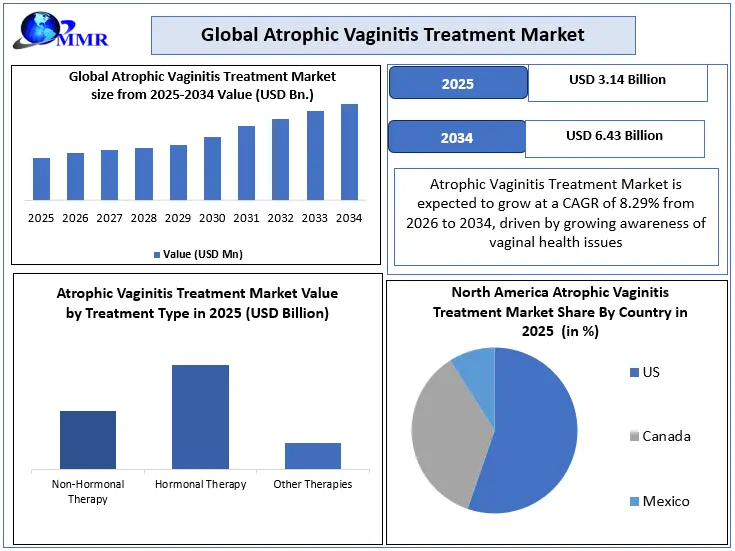
Global Atrophic Vaginitis Treatment Market size was valued at USD 3.14 Billion in 2025, and the total revenue is expected to grow at a CAGR of 8.29% from 2026 to 2034, reaching nearly 6.43 billion by 2034.
Atrophic Vaginitis Treatment Market Overview
The Global Atrophic Vaginitis Treatment Market includes hormonal and non-hormonal therapies for vaginal atrophy, primarily affecting postmenopausal women. Atrophic vaginitis treatment market selective estrogen receptor modulators (SERMs), includes estrogen-based therapies, vaginal DHEA (prasterone), vaginal moisturizers, lubricants, and other emerging treatment options. Rising availability of different formulations and treatment approaches is growing therapeutic choices for patients.
North America and Europe remain significant markets due to relatively high awareness and treatment penetration, whereas APAC presents significant growth potential as healthcare access and awareness of menopausal health continue to improve.
Atrophic Vaginitis Treatment Market Size and Share Analysis
To know about the Research Methodology :- Request Free Sample Report
Atrophic Vaginitis Treatment Market Key Highlights 2025-2034:
| Market Parameter | Value / Insight | Trend |
| Global Atrophic Vaginitis Treatment Market Size (2025) | USD 3.14 Billion | ↑ Strong Growth |
| Projected Market Size (2034) | USD 6.43 Billion | ↑ Sustained Expansion |
| Forecast CAGR (2026–2034) | 8.29% | ↑ High Growth |
| Dominant Treatment Type (2025) | Hormonal Therapy | ↑ Market Leader |
| Key Hormonal Therapy | Estrogen Therapy | ↑ Strong Adoption |
| Non-Hormonal Treatment | Vaginal Moisturizers & Lubricants | ↑ Increasing Adoption |
| Dominant Route of Administration | Vaginal | ↑ High Patient Preference |
| Primary Patient Group | Postmenopausal Women | ↑ Core Demand Base |
| Leading Distribution Channel | Retail Pharmacies | ↑ Strong Market Presence |
| Leading Region (2025) | North America | ↑ Market Leader |
| Fast-Growing Region | Asia Pacific | ↑ Rapid Growth |
Strategic Investments in Atrophic Vaginitis Treatment Market:
In 2025, strategic investments in the Atrophic Vaginitis Treatment Market are focussed across the United States, Germany, France, United Kingdom, Japan, India, China, Canada, and Australia, driven by increasing investment in women’s health and menopause care.
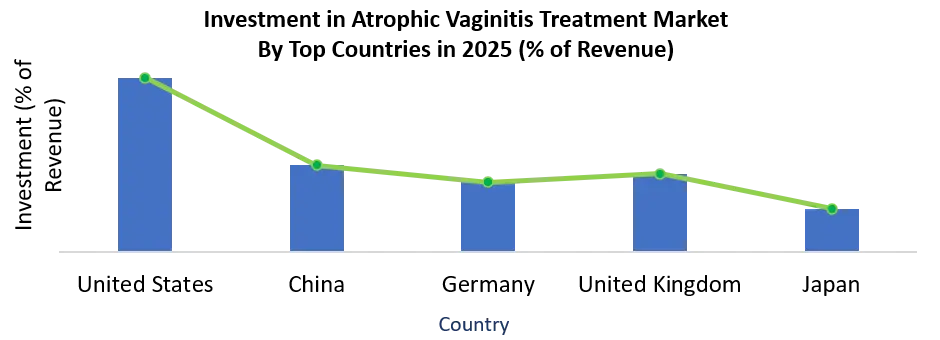
The U.S. and major European countries continue key investment hubs for novel hormonal, vaginal estrogen, DHEA, and non-hormonal therapies, while China, India, and Japan are gaining investment interest owing to aging female populations, expanding healthcare access, improving awareness, and growing demand for affordable and innovative menopause treatments.
Atrophic Vaginitis Treatment Market Dynamics:
Improved Healthcare Access and Treatment Availability:
Improved specialized women’s health services, healthcare infrastructure, digital healthcare platforms, pharmacy networks, and reimbursement coverage are growing patient access to atrophic vaginitis treatments. Wider availability of prescription and non-prescription therapies, together with convenient contained formulations, is supporting better treatment adherence, therapy continuity, and long-term patient outcomes.
Growing Postmenopausal Population and High Disease Burden:
The increasing number of postmenopausal and ageing women worldwide is growing the patient population requiring treatment for vaginal atrophy. The high prevalence of vaginal dryness, dyspareunia, irritation, and other GSM-related symptoms, combined with improving awareness and diagnosis, is consolidating demand for hormonal and non-hormonal therapies and driving growth of the atrophic vaginitis treatment market globally.

Major Barriers to Global Atrophic Vaginitis Treatment Market Growth:
• Safety Concerns Related to Hormonal Therapies – Concerns regarding estrogen exposure and potential adverse effects can limit hormonal therapy adoption among certain patient groups.
• Low Disease Awareness & Underdiagnosis – Many women do not report vaginal atrophy symptoms, resulting in low diagnosis and treatment rates.
• High Treatment Costs and Reimbursement Limitations – Limited insurance coverage and high out-of-pocket expenses for certain branded therapies can restrict treatment accessibility.
• Limited Access to Specialized Women’s Healthcare – Shortages of gynecologists and menopause specialists, mainly in rural and developing regions, can reduce diagnosis and treatment penetration.
Atrophic Vaginitis Treatment Market Investment Opportunity Assessment 2025-2026
| Investment Opportunity | Opportunity Level | Investment Focus | Growth Potential |
| Non-Hormonal Therapeutics | Very High 🔴 | Vaginal DHEA, SERMs, hormone-free formulations, symptom-relief therapies | Strong demand from patients seeking alternatives to estrogen-based treatments |
| Localized Vaginal Drug Delivery | Very High 🔴 | Vaginal tablets, rings, creams, inserts, sustained-release formulations | High potential for improved efficacy, convenience, and patient adherence |
| Next-Generation Hormonal Therapies | High 🟡 | Low-dose estrogen, tissue-selective therapies, improved safety profiles | Continued demand for effective localized hormone therapy |
| Emerging Market Commercialization | Medium–High 🟡 | China, India, Brazil, Southeast Asia, Middle East | Large untreated patient population and improving women’s healthcare access |
| Strategic Licensing & Partnerships | Medium–High 🟢 | Co-development, licensing, commercialization, regional distribution agreements | Supports faster market entry and broader geographic penetration |
Atrophic Vaginitis Treatment Market Segment Insight 2025
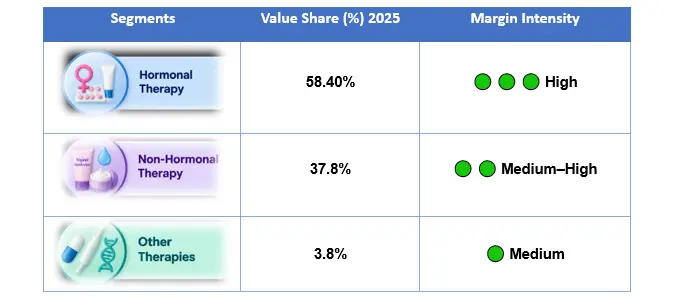
By Treatment Type – Hormonal Therapy Dominates 2025
• Largest segment based on Treatment Type: Hormonal Therapy dominated the Global Atrophic Vaginitis Treatment Market in 2025.
• 2025 Market Share: 58.4%
• CAGR (2026–2034): 9.13%
• Broad adoption due to established clinical efficacy and physician familiarity
• Availability across estrogen creams, vaginal rings, and systemic hormone therapies
• Strong demand from the growing postmenopausal population
Based on Drug/Therapy Class – Estrogen Therapy Dominated 2025
• Largest segment in 2025: Estrogen Therapy dominated the Global Atrophic Vaginitis Treatment Market with a 42.15% share in 2025.
• Strong clinical use for moderate-to-severe vaginal atrophy/GSM symptoms
• Directly addresses the underlying estrogen deficiency
• Broad availability through creams, tablets/inserts, and vaginal rings
• Established physician familiarity and long-term treatment use

Atrophic Vaginitis Treatment Market Regional Analysis 2025-2034
North America: Dominant Region
• Nearly 38.2% global atrophic vaginitis treatment market share in 2025
• The U.S. dominates regional treatment demand
• High diagnosis and awareness of GSM and menopausal health
• Strong adoption of vaginal estrogen, SERMs, DHEA, and non-hormonal therapies
• Well-established insurance coverage, gynecology networks, and retail pharmacy infrastructure
• 2025 clinical guidance supports local low-dose vaginal estrogen as an important GSM treatment option.

Europe: Established Treatment Market
• Germany, France, UK, and Italy are major atrophic vaginitis treatment markets
• Aging female population supports sustained treatment demand
• Strong public healthcare and reimbursement systems
• Increasing focus on low-dose estrogen and non-hormonal alternatives
• Advanced pharmaceutical R&D and menopause-care awareness support adoption.
Asia Pacific: High-Growth Opportunity
• Asia pacific expected to grow highest CAGR of 10.12% over 2026-2034.
• China, India, Japan, and South Korea are key markets
• Large and growing postmenopausal female population
• Improving awareness of menopause and vaginal health
• Growing healthcare expenditure and access to women's healthcare
• China is expected at 9.3% CAGR during 2026–2034, highlighting the region's growth potential.
Country-Wise Atrophic Vaginitis Treatment Market Position and Growth Opportunities, 2025:
| Country | Market Position | Key Demand Drivers | Major Growth Opportunities |
| United States | Global Leader | Strong prescription therapy adoption, High treatment penetration, advanced healthcare access | Non-hormonal therapies, digital menopause care, localized delivery, |
| Germany | European Leader | Aging female population, established menopause care, high healthcare spending, | Digital health, Low-dose estrogen, innovative formulations, |
| China | High-Growth Market | Large aging population, rising healthcare spending, improving awareness | Localized therapies, domestic drug development, wider treatment access |
| Japan | Mature Aging Market | Advanced healthcare system, large postmenopausal population, | Non-hormonal and localized therapies, patient education |
| United Kingdom | Established Market | Treatment accessibility, Strong menopause awareness, healthcare coverage, | Digital women’s health, Vaginal therapies, non-hormonal alternatives |
Atrophic Vaginitis Treatment Market Competitive Landscape
The Atrophic Vaginitis Treatment Market is characterized by a mix of world-wide pharmaceutical companies, women’s health specialists, and generic drug manufacturers competing over localized low-dose formulations, estrogen therapies, vaginal DHEA, SERMs, non-hormonal treatments, and improved vaginal drug-delivery systems. Competition is progressively focused on clinical efficacy, patient convenience, safety, affordability, and broader access to menopause care.
Leading companies with Novo Nordisk A/S, AbbVie Inc., Pfizer Inc., Duchesnay, Mayne Pharma/TherapeuticsMD, Bayer AG, Amneal Pharmaceuticals, and Theramex are strengthening their positions over strategic licensing, product innovation, generic competition, commercialization partnerships, and geographic atrophic vaginitis treatment market penetration. Established therapies like Premarin Vaginal Cream, Vagifem, Imvexxy, Osphena, Estring, and Intrarosa continue to shape competition, whereas emerging localized and non-hormonal therapies create opportunities for product differentiation.

Atrophic Vaginitis Treatment Market Recent Developments
| Year | Development Area | Key Development | Impact |
| 2025 | Clinical Guidelines | AUA/SUFU/AUGS released its 2025 GSM guideline, recommending local low-dose vaginal estrogen as an option for vaginal dryness, irritation, and dyspareunia. | Strengthens clinical acceptance of localized estrogen therapy |
| 2025 | Regulatory / Hormone Therapy | The U.S. FDA initiated changes to menopausal hormone therapy labeling, including proposed removal of several boxed-warning statements and more focused safety information for local vaginal estrogen products. | Could improve physician and patient confidence in hormone-based treatments |
What Competitors are Doing Right Now in Trophic Vaginitis Treatment Market
• Portfolio Strengthening- Competitors are consolidation vaginal estrogen, SERM, DHEA, and non-hormonal treatment portfolios.
• Product Innovation- Key Players are focusing on localized, low-dose, and patient-friendly drug delivery systems.
• Strategic Partnerships- Foremost players are partnerships, pursuing licensing, and geographic commercialization to increase Trophic Vaginitis Treatment Market penetration.
Atrophic Vaginitis Treatment Market Scope: Inquire before buying
| Atrophic Vaginitis Treatment Market | |||
|---|---|---|---|
| Report Coverage | Details | ||
| Base Year: | 2025 | Forecast Period: | 2026-2034 |
| Historical Data: | 2020 to 2025 | Market Size in 2025: | USD 3.14 Bn. |
| Forecast Period 2026 to 2034 CAGR: | 8.29% | Market Size in 2034: | USD 6.43 Bn. |
| Segments Covered: | by Treatment Type | Hormonal Therapy Non-Hormonal Therapy Other Therapies |
|
| by Drug/Therapy Class | Estrogen Therapy Selective Estrogen Receptor Modulators (SERMs) Vaginal DHEA (Prasterone) Vaginal Moisturizers Vaginal Lubricants Others |
||
| by Route of Administration | Vaginal Oral Transdermal Others |
||
| by Dosage Form | Creams Tablets & Inserts Vaginal Rings Gels Suppositories/Ovules Others |
||
| by Patient Type | Natural Postmenopausal Women Surgically Induced Menopause Patients Treatment-Induced Menopause Patients Others |
||
| by Distribution Channel | Hospital Pharmacies Retail Pharmacies Online Pharmacies |
||
Global Atrophic Vaginitis Treatment Market by Region
North America (United States, Canada and Mexico)
Europe (United Kingdom, France, Germany, Italy, Spain, Sweden, Russia and the Rest of Europe)
Asia Pacific (China, South Korea, Japan, India, Australia, Indonesia, Malaysia, Philippines, Thailand, Vietnam and the Rest of the Asia Pacific)
Middle East and Africa (MEA) (South Africa, GCC, Nigeria and the Rest of MEA)
South America (Brazil, Argentina, Colombia, Chile and the Rest of South America)
Global Atrophic Vaginitis Treatment Market Key Players
North America
1. Pfizer Inc.
2. TherapeuticsMD, Inc.
3. Duchesnay Inc.
4. AbbVie Inc.
5. Amneal Pharmaceuticals, Inc.
6. Viatris Inc.
7. Endoceutics, Inc.
8. Ascend Therapeutics, Inc.
9. Noven Pharmaceuticals, Inc.
10. Padagis LLC
11. Exeltis USA, Inc.
12. Prasco Laboratories
Europe
13. Novo Nordisk A/S
14. Theramex
15. Bayer AG
16. Gedeon Richter Plc
17. Sandoz Group AG
18. Ferring Pharmaceuticals
19. Hikma Pharmaceuticals PLC
20. Organon & Co.
Asia Pacific
21. Shionogi & Co., Ltd.
22. Teva Pharmaceutical Industries Ltd.*
23. Lupin Limited
24. Glenmark Pharmaceuticals Ltd.
25. Aurobindo Pharma Limited
26. Dr. Reddy's Laboratories Ltd.
27. Zydus Lifesciences Limited
Rest of World (RoW)
28. Adcock Ingram Holdings Ltd.
29. Aspen Pharmacare Holdings Limited
30. Eurofarma Laboratórios S.A.