
Aluminum Die Casting Market Size by Process, Application, Region, Industry-Wide Analysis, Competitive Landscape Assessment & Long-Term Forecast to 2032
Overview
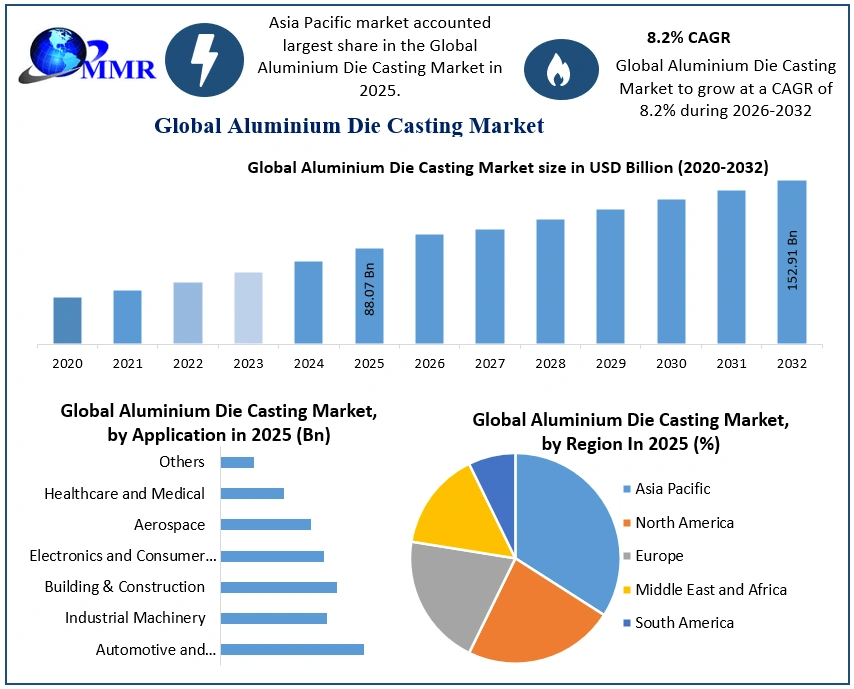
The Aluminium Die Casting Market size was valued at USD 88.07 Billion in 2025 and the total Aluminium Die Casting revenue is expected to grow at a CAGR of 8.2% from 2025 to 2032, reaching nearly USD 152.91 Billion by 2032.
Aluminium Die Casting Market Overview:
Aluminium die casting involves forcing molten aluminium into steel molds (dies) under high pressure to create complex shapes with excellent dimensional accuracy and surface finish. Its advantages include corrosion resistance, superior thermal and electrical conductivity, recyclability, and cost-efficiency for mass production. These qualities make aluminium die casting a preferred choice in automotive, aerospace, electronics, and industrial manufacturing applications, driving Aluminium Die Casting Market growth. The automotive and transportation sector is the largest consumer of aluminium die-cast parts, as manufacturers increasingly adopt lightweight materials to improve fuel efficiency, meet stringent emission regulations, and enhance vehicle performance. Aluminium die castings are used extensively in engine components, transmission housings, structural parts, and electric vehicle (EV) battery housings.
To know about the Research Methodology:- Request Free Sample Report
The industries such as electronics and consumer goods rely on aluminium die casting for enclosures, heat sinks, and intricate components, while aerospace and industrial machinery sectors benefit from its precision and durability. Developments in hot chamber aluminium die casting machines, servo-hydraulic systems, automation, and real-time process monitoring are improving production efficiency, consistency, and energy savings. For instance, innovations such as Dynacast’s A3 Al SIS machine highlight the shift towards more efficient, precise, and adaptable equipment capable of handling complex component requirements.
Aluminum Die Casting Market Dynamics:
Increasing Demand for Lightweight Automotive Components to Boost Aluminum Die Casting Market
Stricter emission regulations, such as Euro 7 in Europe and CAFE standards in North America, are compelling automakers to reduce vehicle weight without compromising safety or performance. Aluminum die casting offers the perfect solution by enabling the production of strong yet lightweight components such as engine blocks, transmission cases, and structural parts. These parts not only enhance fuel efficiency but also improve handling and acceleration, directly supporting manufacturers’ sustainability targets. With the global expansion of electric vehicle (EV) production, aluminum die casting plays an even more critical role, which boosts Aluminium Die Casting Market growth. EV battery housings, motor housings, and thermal management systems require materials that offer excellent heat dissipation and corrosion resistance qualities that aluminum die casting delivers exceptionally well. Coupled with advanced manufacturing technologies such as vacuum die casting and computer-aided process controls, manufacturers can now produce complex, thin-walled designs at high volumes with minimal waste.
Integration of Industry 4.0 and Automation Technologies is a lucrative opportunity for the Aluminum Die Casting Market
Advanced automation systems, real-time data analytics, and AI-driven quality control can significantly improve efficiency, consistency, and cost-effectiveness in die casting operations. For instance, automated robotic systems can handle mold preparation, metal pouring, trimming, and surface finishing with precision and minimal human intervention, reducing labor costs and workplace hazards. IoT-enabled sensors embedded within casting machines can monitor critical parameters such as mold temperature, injection pressure, and cooling rates in real time. This data is analyzed instantly to predict defects before they occur, enabling a shift from reactive to predictive maintenance. AI-powered process optimization can fine-tune casting cycles to minimize scrap rates, conserve energy, and extend tool life. These advancements not only enhance production efficiency but also allow manufacturers to adapt quickly to design changes and shorter product life cycles, boosting the Aluminium Die Casting Market share.
High Initial Capital Investment and Tooling Costs to Hamper Market Growth
The process demands specialized high-pressure die casting machines, sophisticated tooling, and advanced mold designs, which can represent millions of dollars in initial costs. For small- and medium-sized manufacturers, these expenses create significant barriers to entry, particularly in regions where access to financing is limited. Tooling for aluminum die casting is manufactured from high-grade steel and engineered to withstand repeated thermal cycling, increasing costs. These molds typically require extensive lead times for design, prototyping, and validation before full-scale production can commence, which hampers Aluminium Die Casting Market growth. while the per-unit cost becomes more competitive at higher production volumes, low-volume or niche applications may struggle to justify such investments, especially when alternative manufacturing methods such as sand casting or CNC machining offer lower entry costs.
Aluminum Die Casting Market Segment Analysis
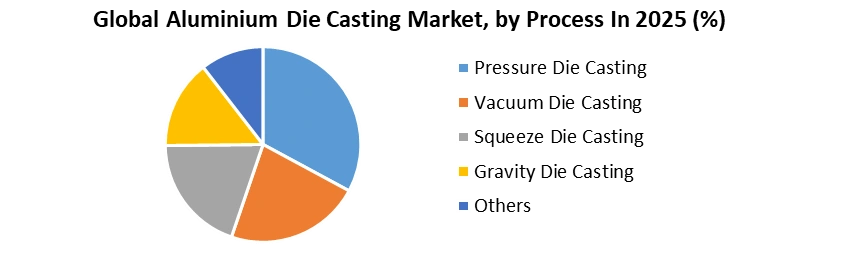
By Process, the market is categorized into Pressure Die Casting, Vacuum Die Casting, Squeeze Die Casting, Gravity Die Casting, and Others. Pressure Die Casting holds the dominant share due to its unmatched capability to produce large quantities of intricate, dimensionally accurate parts with tight tolerances and smooth finishes. In this process, molten aluminum is injected under high pressure into reusable steel molds, allowing for rapid production cycles and consistent quality. Its ability to minimize post-machining requirements makes it highly cost-efficient for mass production. Pressure die casting is especially valued in industries such as automotive, aerospace, and electronics, where precision, repeatability, and structural integrity are crucial. advancements in die design, automation, and alloy development have further improved the performance, durability, and corrosion resistance of pressure die-cast components. Compared to other processes, it supports a wide range of complex geometries, thin-walled parts, and lightweight designs without compromising strength. These advantages, combined with its suitability for large-scale manufacturing, ensure pressure die casting remains the most preferred method in the global Aluminum Die Casting Industry.
By Application, the market is segmented into the Automotive and Transportation, Industrial Machinery, Building and Construction, Electronics and Consumer Goods, Aerospace, Healthcare and Medical, and Others. The Automotive and Transportation segment leads the Aluminium Die Casting Market, driven by the industry's push for lightweight, high-strength materials to improve vehicle fuel efficiency, reduce CO₂ emissions, and meet stringent regulatory standards. Aluminum die casting enables the production of complex and durable components such as engine blocks, transmission housings, wheel hubs, chassis parts, and structural reinforcements. Its corrosion resistance and excellent strength-to-weight ratio make it ideal for both conventional and electric vehicles, where weight reduction directly enhances battery range and performance. The process also supports high-volume production at competitive costs, meeting the automotive sector’s demand for scalability and consistency. With the rise of electric mobility, aluminum die casting is becoming even more critical for manufacturing battery housings, motor components, and lightweight frames.
Aluminium Die Casting Market Regional Insights
Asia Pacific dominated the Aluminium Die Casting Market in 2025 and is expected to continue its dominance over the forecast period. The rapid industrialization, expanding automotive production, and substantial investments in manufacturing infrastructure across major economies such as China, India, and Japan. China, the world’s largest vehicle manufacturer, is a key growth engine, with the China Association of Automobile Manufacturers.
The region’s leadership is reinforced by strategic initiatives from major players, such as Endurance Technologies’ new low-pressure die-casting plant in India, Ningbo Xusheng Auto Technology’s high-precision aluminum-alloy die-casting facility for new energy vehicles in China, and Toyota Industries’ collaboration with Siemens in Japan to integrate AI for defect prediction in die casting. Asia-Pacific’s competitive edge lies in its ability to cater to the increasing global demand for lightweight automotive components to meet stringent emission standards and improve fuel efficiency. The surge in electric vehicle adoption is accelerating the need for die-cast battery housings, motor cases, and structural parts, boosting the Aluminium Die Casting Market growth. Manufacturers are aggressively pursuing geographic expansion, capacity enhancement, and advanced technology adoption, positioning the region as a hub for innovation and large-scale production.
Competitive Landscape of Aluminium Die Casting Market
The Aluminium Die Casting Market has a competitive landscape with both regional and global players competing for market share based on production capacity, technology, and cost. Major Aluminium Die Casting Market players include Ryobi Ltd, Nemak, GF Casting Solutions, Endurance Technologies, Dynacast, and Shiloh Industries. These companies have considerable market share, production facilities, and a strong customer base in the automotive and industrial sectors. These manufacturers have invested in advanced die casting technologies such as vacuum die casting and more advanced structural Aluminium parts die casting technology. Competition also exists from some regional players, particularly in the Asia Pacific region, as companies in this region have a low cost of labor and government incentives to keep pricing competitive in China and India. Companies within the market often use mergers and acquisitions, and partnerships to expand their global footprint and reach new customers and markets, while also expanding their product range.
Key developments in the Aluminium Die Casting Market
• May 7, 2024 – Ryobi Die Casting announced a USD 50 million investment to expand its Irapuato, Mexico, aluminum die casting facility, aiming to meet rising demand in the electric vehicle market. Scheduled to begin construction in June 2024 and complete by April 2025, add 91,500 sq. ft. of manufacturing space and install five new large high-pressure die-cast machines.
• In 2024, Dynacast’s Machine Building Center (DMB) in Germany achieved a milestone in aluminium die casting with the A3 Al SIS, its first hot chamber aluminium die casting machine. This innovation delivers higher efficiency, precision, and energy savings through Dynacast’s proprietary servo-hydraulic injection system (SIS), enabling consistent performance and faster cycle times. Building on this, Dynacast is developing the A340 project, an advanced version with servo-hydraulic axes and a 40-ton clamping force, adaptable for zinc, aluminium, or magnesium 4-slide machines. The A340 Al model is slated for production by late 2024, offering greater versatility for complex aluminium components.
Key Trends in the Aluminium Die Casting Market
| Trend | Description |
| Lightweight Automotive Components | Rising EV adoption and stricter emission standards are driving demand for lightweight aluminium parts in engines, chassis, and body structures. |
| Automation & Digital Manufacturing | Use of robotics, IoT sensors, and AI-driven quality control to improve precision, reduce defects, and shorten production cycles. |
| Sustainable & Recycled Aluminium | Adoption of recycled aluminium and eco-friendly production methods to align with circular economy goals and lower emissions. |
| Expansion in Aerospace Applications | Increasing use of aluminium die-cast components in aerospace for weight reduction, fuel efficiency, and improved performance, especially in commercial and defense aircraft. |
Aluminum Die Casting Market Scope: Inquire before buying
| Global Aluminum Die Casting Market | |||
|---|---|---|---|
| Report Coverage | Details | ||
| Base Year: | 2025 | Forecast Period: | 2026-2032 |
| Historical Data: | 2020 to 2025 | Market Size in 2025: | USD 88.07 Bn. |
| Forecast Period 2026 to 2032 CAGR: | 8.2% | Market Size in 2032: | USD 152.91 Bn. |
| Segments Covered: | by Process | Pressure Die Casting High Pressure Die Casting Low Pressure Die Casting Vacuum Die Casting Squeeze Die Casting Gravity Die Casting Others |
|
| by Application | Automotive and Transportation Industrial Machinery Building & Construction Electronics and Consumer Goods Aerospace Healthcare and Medical Others |
||
Aluminium Die Casting Market, by Region
North America (United States, Canada, and Mexico)
Europe (UK, France, Germany, Italy, Spain, Sweden, Austria, Turkey, Russia, and the Rest of Europe)
Asia Pacific (China, South Korea, Japan, India, Australia, Indonesia, Malaysia, Vietnam, Taiwan, Bangladesh, Pakistan, and Rest of APAC)
Middle East and Africa (South Africa, GCC, Egypt, Nigeria, and Rest of ME&A)
South America (Brazil, Argentina, Colombia, and the Rest of South America)
Aluminium Die Casting Market,Key Players
North America
1. Ryobi Die Casting
2. Pace Industries
3. Dynacast International
4. Walker Die Casting
5. RCM Industries
6. Tower International
7. Meridian Lightweight Technologies
8. Meridian Rapid Defense Group
Europe
1. Alcoa Corporation
2. Dynacast International
3. Gibbs Die Casting
4. Endurance Technologies Ltd
5. Mino Industry Co. Ltd
Asia-Pacific
1. Endurance Technologies Ltd
2. Rockman Industries
3. Mino Industry Co., Ltd
4. Nemak S.A.B. de C.V.
5. Dynacast International
Frequently Asked Questions:
1. Which region has the largest share in the Global Aluminium Die Casting Market?
Ans: The Asia Pacific region held the highest share in 2025.
2. What is the growth rate of the Global Aluminium Die Casting Market?
Ans: The Global Aluminium Die Casting Market is growing at a CAGR of 8.2% during the forecasting period 2026-2032.
3. What is the scope of the Global Aluminium Die Casting market report?
Ans: Global Aluminium Die Casting Market report helps with the PESTEL, PORTER analysis, Recommendations for Investors & Leaders, and market estimation of the forecast period.
4. Who are the key players in the Global Aluminium Die Casting market?
Ans: The important key players in the Global Aluminium Die Casting Market are Ryobi Ltd., Martinrea Honsel Germany GmbH, Gibbs Die Casting Corporation, Endurance Technologies Ltd., Dynacast International Inc., and Others.
5. What is the study period of this market?
Ans: The Global Aluminium Die Casting Market is studied from 2025 to 2032.