Algae Products Market Size by Source, Type, Form, Production Process, Application, Distribution Channel, Region – Revenue Pool Analysis, Margin Structure Assessment, Capital Flow Trends, Competitive Benchmarking & Forecast to 2032

6.3%
CAGR (2025-2032)
5.2 USD Bn.
Market Size
327
Report Pages
160
Market Tables

Overview

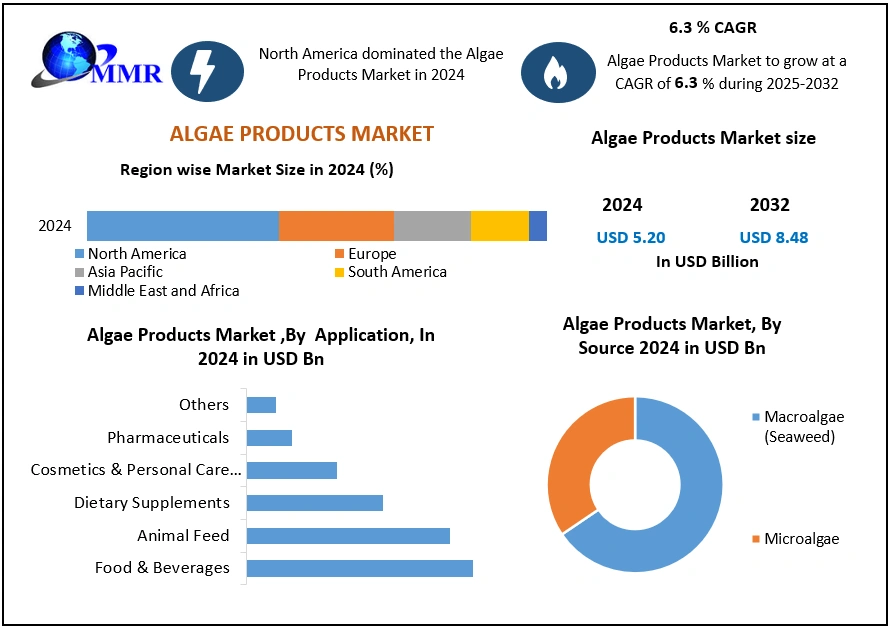
The Algae Products Market size was valued at USD 5.20 Billion in 2024, and the total revenue is expected to grow at CAGR of 6.3 % from 2025 to 2032, reaching nearly USD 8.48 Billion.

The MMR report delivers a comprehensive and integrated analysis of the global algae products market, covering the entire ecosystem from cultivation and production to consumption, and sustainability. It examines global and regional production volumes, with detailed segmentation by macroalgae and microalgae, cultivation systems such as open ponds, photobioreactors, and hybrid models, and the impact of climate, geography, water, CO₂, and energy inputs on production economics. The report provides in-depth insights into harvesting, dewatering, drying, extraction, refining, and quality control technologies, highlighting processing efficiencies, and cost implications. A dedicated section evaluates pricing and margin dynamics by region, including purity-based price differentiation, contract versus spot pricing, and the influence of energy, labor, and water costs. On the demand side, the study analyzes consumer behavior, clean-label and wellness trends, B2B procurement criteria, and application-wise demand–supply balances. It further covers global capacity, import–export flows, trade barriers, cold chain constraints, and supply chain risks. The report also assesses technology innovation, genetic strain development, automation, AI-driven monitoring, and bio-refinery models, alongside investment trends, startup activity, ESG impact, and regulatory frameworks. the MMR report offers a strategic, data-driven foundation for stakeholders to evaluate growth opportunities, risks, competitiveness, and long-term sustainability in the algae products industry.

Algae Products Market Overview

Algae have chlorophyll as their main photosynthetic pigment and lack sterile coverage of cells around their reproductive cells. Green algae are examples of algae that have primary chloroplasts derived from endosymbiosis cyanobacteria. The Algae Products Market is driven by increasing demand for algae from the pharmaceutical and nutraceutical industries, increase in the use of microalgae pigments due to stringent regulations on the use of synthetic dyes and flavors, and an increasing consumer preference for algae. In addition, the emergence of new areas of Source and the growing usage of algae in biofuel production offers significant opportunities in the global market.
Algae Products Market 2025-2032To know about the Research Methodology :- Request Free Sample Report

Algae Products Market Dynamics

Driver: Increasing Use in Cosmetic and Personal Care Industry

Algae products boast remarkable effectiveness and user-friendliness. They are enriched with vital minerals, including calcium, magnesium, iodine, zinc, and selenium, as well as essential trace elements such as niacin and folic acid. Additionally, they are a rich source of vitamins A, C, E, and B complex. This nutritional profile makes Algae Products not only valuable for dietary supplementation but also highly beneficial for skincare. The application of our Algae Products directly to the skin serves to stimulate the metabolism within the skin's surface and underlying structures. Algae, with their multifaceted effects, contribute to achieving wonderfully firm and smooth skin. Their versatility extends to providing nourishment and promoting overall skin health, making them a versatile and beneficial component in skincare routines. This is expected to result in the growth of Algae Products Market in the future.

The refreshing and briny fragrances emanating from algae wrap, mask, or peel instantly evoke memories of seaside holidays. The potent concentration of active agents guarantees immediate and tangible revitalization and rejuvenation through Algae Products. Algae treatments are widely embraced for their drainage and detoxification properties. Algae packs serve as an excellent complement during weight loss journeys, detox programs, diets, or fasting retreats. Their drainage and purifying effects contribute to weight loss, and the application of algae wraps not only boosts metabolism but also enhances the process of fat burning.

Opportunity: Increasing Use for Biofuel Production

With an increasing emphasis on renewable energy sources, the role of algae in biofuel production is presenting a significant opportunity. This is expected to drive the Algae Products Market during the forecast period. Algal biomass comprises three primary components: carbohydrates, proteins, and lipids/natural oils. Microalgae, in particular, are the exclusive focus in the algae-to-biodiesel field due to the predominant presence of the suitable oil form, tricylglycerol, ideal for biodiesel production. Beyond biodiesel, microalgae offer diverse energy-generation possibilities. Some algal species can produce hydrogen gas under specific growth conditions. Algal biomass can be utilized for energy production through combustion, akin to wood, or through anaerobic digestion to yield methane biogas for heat and electricity generation. Furthermore, algal biomass can undergo pyrolysis treatment, resulting in the production of crude bio-oil.

Challenge: Scalability and Production Costs

Scaling up cultivation of algae from laboratory or pilot plant settings to commercial production faces various complexities. Different cultivation systems, such as open ponds, photobioreactors, and closed systems, each come with unique challenges in terms of scalability. Optimizing these systems for large-scale production of Algae Products without compromising efficiency remains a significant hurdle for the Algae Products Market. The energy consumption associated with algae cultivation, especially in closed systems, contributes to production costs.

Algae Products Market Segment Analysis

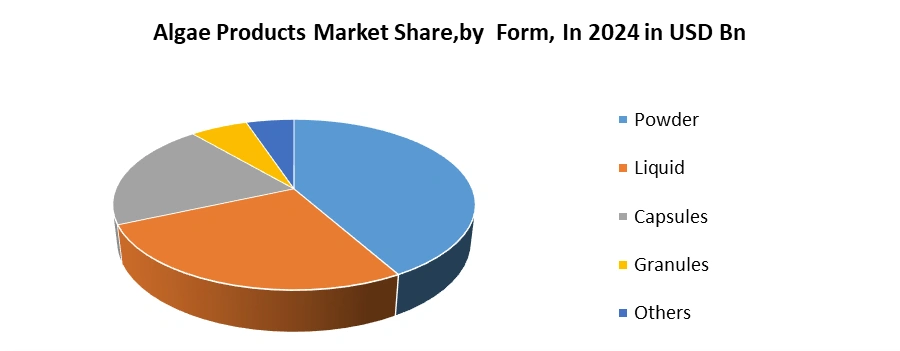
Based on Form, in 2024, Powder accounts for the largest share of the global Algae Products Market, driven by its wide use across food & beverages, dietary supplements, animal feed, and nutraceutical formulations due to ease of blending, longer shelf life, and cost efficiency. Liquid forms hold a significant share, particularly in beverages, pharmaceuticals, and cosmetics, supported by faster absorption and suitability for ready-to-drink and injectable applications. Capsules represent a steadily growing segment, fueled by rising consumer preference for convenient, dosage-controlled nutritional supplements such as spirulina and chlorella. Granules contribute a moderate share, mainly used in animal feed and specialty food applications where controlled release and texture are important. The Others segment, including tablets, flakes, and customized formulations, remains niche, catering to specific industrial and functional requirements. powdered algae products dominate volume demand, while liquid and capsule forms drive higher-value growth through health, wellness, and pharmaceutical applications.
Algae Products Market by Form
Based on Application, in 2024, Food & Beverages account for the largest share of the global Algae Products Market, driven by widespread use of algae-based ingredients as natural colorants, stabilizers, proteins, and omega-3 sources in beverages, bakery, dairy alternatives, and functional foods. Animal Feed represents a significant segment, supported by growing adoption of algae biomass and oils in aquaculture and livestock feed to enhance nutritional value, improve animal health, and support sustainable feed formulations. Dietary Supplements hold a notable share, particularly among health-conscious consumers seeking plant-based, clean-label nutrition, with spirulina, chlorella, and algal oil widely used for protein, vitamin, and omega-3 supplementation. Cosmetics & Personal Care Products contribute a moderate share, driven by demand for algae extracts in skincare and haircare applications due to their antioxidant, moisturizing, and anti-aging properties. Pharmaceuticals remain a smaller but steadily expanding segment, supported by ongoing research into algae-derived bioactives and therapeutic compounds. The Others segment, including specialty industrial and niche applications, contributes modestly, serving targeted and emerging use cases.

Algae Products Industry Ecosystem

Algae Products Industry Ecosystem

Algae Products Market Regional Insights

North American Algae Products Market is expected to grow rapidly during the forecast period. The regional market is driven by the rising recognition of the diverse applications and sustainability benefits of algae-derived products. Algae, including microalgae and seaweed are emerging as versatile resources, which is contributing to various industries across the region. Algae is playing a crucial role in the region in wastewater treatment that offers an eco-friendly solution for nutrient removal and water purification. The potential of the algae as a feedstock for bioplastics and biofuels is gaining traction. Companies are exploring ability of the algae to produce biofuels and biodegradable plastics, which is contributing to the region's efforts to reduce dependence on traditional fossil fuels and mitigate environmental impact.

Asia-Pacific Algae Products Market held the largest share in the global market in 2023 and is expected to experience significant growth over the forecast period. This is attributed to the growth of the health food industry, the pharmaceutical sector and the demand for personal care products. In addition to this, it is the high investments and the government initiatives for the production of micro-algae in the region that is further expected to boost the regional market growth.

Algae Products Market Scope: Inquire before buying

Global Algae Products Market
Report Coverage Details
Base Year: 2024 Forecast Period: 2025-2032
Historical Data: 2019 to 2024 Market Size in 2024: USD 5.20 Bn.
Forecast Period 2025 to 2032 CAGR: 6.3% Market Size in 2032: USD 8.48 Bn.
Segments Covered: by Source Macroalgae (Seaweed)
Brown Algae (Phaeophyceae)
         Ascophyllum
         Laminaria
         Macrocystis
         Others
    Red Algae (Rhodophyta)
Gracilaria
       Gelidium
       Porphyra (Nori)
       Others
Microalgae
  Green Algae (Chlorophyta)
        Chlorella
        Haematococcus
        Others
     Blue-Green Algae (Cyanobacteria)
        Spirulina
        Aphanizomenon Flos-Aquae
    Others (Yellow-Brown & Golden)
by Type Lipids
Carotenoids
Carrageenan
Alginates
Algal Proteins
Others
by Form Powder
Liquid
Capsules
Granules
Others
by Production Process Cultivation Method
 Open Ponds & Raceways
   Photobioreactors (PBR) (Closed Systems)
   Heterotrophic Fermentation
   Wild Harvest
Aquaculture / Seaweed Farming
Downstream Processing
 Drying (Spray, Drum, Freeze)
   Extraction (Supercritical CO2, Solvent, Mechanical)
   Purification
by Application Food & Beverages
Dairy & Dairy Alternatives
   Bakery & Confectionery Products
   Meat & Meat Alternatives
   Beverages
   Condiments & Sauces
   Snacks & Convenience Food
   Others
Animal Feed
 Poultry
   Ruminants
   Swine
   Aquatic Animals
   Others
Cosmetics & Personal Care Products
Dietary Supplements
Pharmaceuticals
Others
by Distribution Channel Business-to-Business (B2B)
Business-to-Consumer (B2C)
Hypermarkets/Supermarkets
  Specialty Health Stores
  Online Retail/E-commerce
  Direct Sales

Algae Products Market, by Region

North America (United States, Canada and Mexico)
Europe (UK, France, Germany, Italy, Spain, Sweden, Austria and Rest of Europe)
Asia Pacific (China, South Korea, Japan, India, Australia, Indonesia, Malaysia, Vietnam, Taiwan, Bangladesh, Pakistan and Rest of APAC)
Middle East and Africa (South Africa, GCC, Egypt, Nigeria and Rest of ME&A)
South America (Brazil, Argentina Rest of South America)

Algae Products Key Players

1. ADM
2. DSM-Firmenich AG
3. Cargill Incorporated
4. Cyanotech Corporation
5. Corbion N.V.
6. BASF SE
7. CP Kelco (Tate & Lyle PLC)
8. Algatechnologies Ltd.
9. Algenol Biotech LLC
10. Cellana Inc.
11. DIC Corporation
12. AstaReal Co., Ltd.
13. E.I.D. Parry (India) Limited
14. Earthrise Nutritionals LLC
15. Euglena Co., Ltd.
16. AlgaEnergy S.A.
17. AlgoSource Group
18. Algae Products International Ltd.
19. Pond Technologies Inc.
20. BlueBioTech GmbH
21. Aliga Microalgae
22. Phycom B.V.
23. Zhejiang Binmei Biotechnology Co., Ltd.
24. Tianjin Norland Biotech Co., Ltd.
25. TBK Manufacturing Corporation
26. HISPANAGAR S.A.
27. Compañía Española de Algas Marinas S.A.
28. SNAP Natural & Alginates Products Pvt Ltd
29. Karagen Indonesia CV
30. Heliae Development LLC
31. Others

Frequently Asked Questions:

1] What segments are covered in the Algae Products Market report?
Ans. The segments covered in the Algae Products Market report are based on Source, Type, Form, Production Process, Application, Distribution Channel and region

2] Which region is expected to hold the highest share of the Algae Products Market?
Ans. The North America region is expected to hold the highest share of the Algae Products Market.

3] What is the market size of the Algae Products Market by 2032?
Ans. The market size of the Algae Products Market by 2032 is USD 8.48 Bn.

4] What is the growth rate of the Algae Products Market?
Ans. The Global Algae Products Market is growing at a CAGR of 6.3 % during the forecasting period 2025-2032.

5] What was the market size of the Algae Products Market in 2024?
Ans. The market size of the Algae Products Market in 2024 was USD 5.20 Bn.

Table of Contents

1. Algae Products Market: Executive Summary 1.1. Executive Summary 1.1.1. Market Size (2024) & Forecast (2025-2032) 1.1.2. Market Size (Value in USD Billion, Volume in Tons) - By Segments, Regions, and Country 2. Algae Products Market: Competitive Landscape 2.1. MMR Competition Matrix 2.2. Competitive Positioning of Key Players 2.3. Key Players Benchmarking 2.3.1. Company Name 2.3.2. Headquarter 2.3.3. Product Portfolio 2.3.4. Market Share(%) by Region 2.3.5. Growth Rate (%) 2.3.6. Revenue 2024 2.3.7. Profit Margin (%) 2.3.8. R&D Investments 2.3.9. Patents 2.3.10. Distribution Reach & Channel Performance 2.3.11. Certification & Compliance 2.3.12. ESG / Sustainability Policies 2.3.13. Geographical Presence 2.4. Market Structure 2.4.1. Market Leaders 2.4.2. Market Followers 2.4.3. Emerging Players 2.5. Mergers and Acquisitions Details 2.6. Research and Development 3. Algae Products Market: Dynamics 3.1. Algae Products Market Trends 3.2. Algae Products Market Dynamics 3.2.1. Drivers 3.2.2. Restraints 3.2.3. Opportunities 3.2.4. Challenges 3.3. PORTER’s Five Forces Analysis 3.4. PESTLE Analysis 3.5. Key Opinion Leader Analysis for the Algae Products Market 3.6. Analysis of Government Schemes and Support for the Industry 4. Algae Products Production Analysis (2024) 4.1. Global and Regional Algae Production Volumes 4.2. Production Split by Macroalgae vs Microalgae 4.3. Key Cultivation Methods and Yield Efficiency Comparison 4.4. Algae Cultivation Systems and Production Models 4.4.1. Open Pond Cultivation Systems and Economics 4.4.2. Closed Photobioreactor Systems and Control 4.4.3. Hybrid Cultivation Models and Scalability 4.4.4. Freshwater vs Marine Cultivation Practices 4.4.5. Climate, Geography, and Resource Dependency 5. Harvesting, Processing, and Refining Technologies 5.1. Biomass Harvesting Techniques and Yield Impact 5.2. Dewatering and Drying Methods Efficiency 5.3. Extraction Technologies for High-Value Compounds 5.4. Refining, Purification, and Quality Control 5.5. Processing Losses and Cost Implications 6. Raw Material, Input, and Infrastructure Analysis 6.1. Water, Nutrient, and CO₂ Input Requirements 6.2. Energy Consumption and Utility Dependencies 6.3. Infrastructure Requirements and Capital Intensity 6.4. Input Cost Volatility and Supply Risks 6.5. Impact on Production Economics 7. Pricing & Margin Analysis by Region (2024) 7.1. Global Algae Product Price Trends (2019–2024) 7.2. Price Differentiation by Product Purity and Processing Level 7.3. Margin Comparison: Raw Biomass vs Extracted Compounds 7.4. Impact of Energy, Labor, and Water Costs on Margins 7.5. Regional Price Competitiveness and Export Pricing 7.6. Contract Pricing vs Spot Market Dynamics 7.7. Short-to-Medium-Term Price Outlook 8. Consumer Behaviour & End-User Insight Analysis 8.1. Consumer Awareness and Perception of Algae-Based Products 8.2. Functional Health and Wellness Purchase Drivers 8.3. Price Sensitivity and Willingness to Pay for Natural Ingredients 8.4. Clean-Label, Vegan, and Sustainability Influence 8.5. Adoption Barriers in Mainstream Food and Nutrition 8.6. B2B Buyer Preferences and Procurement Criteria 8.7. Emerging Consumer Trends Shaping Demand 9. Demand–Supply and Capacity Analysis 9.1. Global Production Capacity by Region 9.2. Demand Analysis by Application Segment 9.3. Supply Constraints and Capacity Gaps 9.4. Capacity Expansion and Investment Plans 9.5. Import–Export Dependency Assessment 10. Consumption Analysis of Algae Products by Region 10.1. Global Consumption Volume and Value Analysis (by Region) 10.2. Consumption Split by Application 10.3. Per Capita Algae Product Consumption Trends by Key Countries 10.4. Industrial vs Consumer-Level Consumption Patterns 10.5. Consumption Growth Hotspots and Demand Acceleration Regions 10.6. Consumption Outlook Based on Health, Sustainability, and Clean-Label Trends 11. Climate Sensitivity & Environmental Dependency Analysis 11.1. Impact of Climate Change on Seaweed Farming 11.2. Water Availability Risks for Microalgae 11.3. Ocean Warming and Acidification Effects 11.4. Extreme Weather Disruption Risks 11.5. Regional Climate Resilience Comparison 11.6. Adaptive Production Strategies 12. Technology & Manufacturing Innovation Analysis 12.1. Advances in Photobioreactors and Closed-System Cultivation 12.2. Yield Optimization through Genetic and Strain Engineering 12.3. Innovations in Extraction and Downstream Processing 12.4. Cost Reduction through Automation and AI Monitoring 12.5. Bio-Refinery Models and Multi-Product Valorization 12.6. Technology Adoption Barriers for Small Producers 12.7. Future Innovation Roadmap for Algae Processing 13. Import–Export & Trade Flow Analysis (2024) 13.1. Global Trade Flow Overview for Algae-Based Products 13.2. Major Exporting Countries and Cost Advantages 13.3. Key Importing Regions and Dependency Risks 13.4. Trade Barriers, Tariffs, and Quality Standards 13.5. Impact of Cold Chain and Shelf-Life Constraints 13.6. Role of Contract Manufacturing and Toll Processing 13.7. Export Competitiveness Outlook 14. Supply Chain & Distribution Analysis 14.1. End-to-End Algae Products Supply Chain Mapping 14.2. Raw Material Sourcing and Cultivation Logistics 14.3. Processing, Drying, and Extraction Infrastructure 14.4. Role of Intermediaries and Ingredient Distributors 14.5. B2B vs B2C Distribution Economics 14.6. Inventory Management and Shelf-Life Challenges 14.7. Supply Chain Risk Assessment 15. Value Chain and Industry Ecosystem Analysis 15.1. Upstream Input Suppliers and Cultivation Players 15.2. Midstream Processing and Refining Participants 15.3. Downstream Formulators and End-Use Industries 15.4. Distribution Channels and Route-to-Market 15.5. Value Addition and Margin Distribution 16. Investment, Funding & Startup Ecosystem Analysis 16.1. Venture Capital Trends in Algae Startups 16.2. Public Funding and Government Grants 16.3. Regional Investment Hotspots 16.4. Technology-Focused vs Application-Focused Funding 16.5. Exit Pathways: M&A vs IPO 16.6. Investment Risk–Return Profile 17. Sustainability & ESG Impact Analysis 17.1. Carbon Footprint of Algae Cultivation and Processing 17.2. Water and Land Use Efficiency Advantages 17.3. Role of Algae in Circular Bioeconomy Models 17.4. ESG Expectations from Food, Feed, and Pharma Buyers 17.5. Sustainability Certification and Traceability Trends 17.6. Cost Implications of Sustainable Production 17.7. Long-Term ESG Value Creation Potential 18. Regulatory & Compliance Framework by Region 18.1. Food, Feed, and Pharmaceutical Regulatory Pathways 18.2. Novel Food Approvals and Safety Assessments 18.3. Labeling, Purity, and Quality Compliance Standards 18.4. Environmental and Marine Harvest Regulations 18.5. Import–Export Compliance and Documentation 18.6. Regional Regulatory Risk Assessment 18.7. Future Regulatory Tightening Scenarios 19. Algae Products Market: Global Market Size and Forecast by Segmentation (by Value in USD Billion, Volume in Tons) (2024-2032) 19.1. Algae Products Market Size and Forecast, By Source (2024-2032) 19.1.1. Macroalgae (Seaweed) 19.1.1.1. Brown Algae (Phaeophyceae) 19.1.1.1.1. Ascophyllum 19.1.1.1.2. Laminaria 19.1.1.1.3. Macrocystis 19.1.1.1.4. Others 19.1.1.2. Red Algae (Rhodophyta) 19.1.1.2.1. Gracilaria 19.1.1.2.2. Gelidium 19.1.1.2.3. Porphyra (Nori) 19.1.1.2.4. Others 19.1.2. Microalgae 19.1.2.1. Green Algae (Chlorophyta) 19.1.2.1.1. Chlorella 19.1.2.1.2. Haematococcus 19.1.2.1.3. Others 19.1.2.2. Blue-Green Algae (Cyanobacteria) 19.1.2.2.1. Spirulina 19.1.2.2.2. Aphanizomenon Flos-Aquae 19.1.2.3. Others (Yellow-Brown & Golden) 19.2. Algae Products Market Size and Forecast, By Type (2024-2032) 19.2.1. Lipids 19.2.2. Carotenoids 19.2.3. Carrageenan 19.2.4. Alginates 19.2.5. Algal Proteins 19.2.6. Others 19.3. Algae Products Market Size and Forecast, By Form (2024-2032) 19.3.1. Powder 19.3.2. Liquid 19.3.3. Capsules 19.3.4. Granules 19.3.5. Others 19.4. Algae Products Market Size and Forecast, By Production Process (2024-2032) 19.4.1. Cultivation Method 19.4.1.1. Open Ponds & Raceways 19.4.1.2. Photobioreactors (PBR) (Closed Systems) 19.4.1.3. Heterotrophic Fermentation 19.4.1.4. Wild Harvest 19.4.2. Aquaculture / Seaweed Farming 19.4.3. Downstream Processing 19.4.3.1. Drying (Spray, Drum, Freeze) 19.4.3.2. Extraction (Supercritical CO2, Solvent, Mechanical) 19.4.3.3. Purification 19.5. Algae Products Market Size and Forecast, By Application (2024-2032) 19.5.1. Food & Beverages 19.5.1.1. Dairy & Dairy Alternatives 19.5.1.2. Bakery & Confectionery Products 19.5.1.3. Meat & Meat Alternatives 19.5.1.4. Beverages 19.5.1.5. Condiments & Sauces 19.5.1.6. Snacks & Convenience Food 19.5.1.7. Others 19.5.2. Animal Feed 19.5.2.1. Poultry 19.5.2.2. Ruminants 19.5.2.3. Swine 19.5.2.4. Aquatic Animals 19.5.2.5. Others 19.5.3. Cosmetics & Personal Care Products 19.5.4. Dietary Supplements 19.5.5. Pharmaceuticals 19.5.6. Others 19.6. Algae Products Market Size and Forecast, By Distribution Channel (2024-2032) 19.6.1. Business-to-Business (B2B) 19.6.2. Business-to-Consumer (B2C) 19.6.2.1. Hypermarkets/Supermarkets 19.6.2.2. Specialty Health Stores 19.6.2.3. Online Retail/E-commerce 19.6.2.4. Direct Sales 19.7. Algae Products Market Size and Forecast, By Region (2024-2032) 19.7.1. North America 19.7.2. Europe 19.7.3. Asia Pacific 19.7.4. Middle East and Africa 19.7.5. South America 20. North America Algae Products Market Size and Forecast by Segmentation (by Value in USD Billion, Volume in Tons) (2024-2032) 20.1. North America Algae Products Market Size and Forecast, By Source (2024-2032) 20.1.1. Macroalgae (Seaweed) 20.1.1.1. Brown Algae (Phaeophyceae) 20.1.1.1.1. Ascophyllum 20.1.1.1.2. Laminaria 20.1.1.1.3. Macrocystis 20.1.1.1.4. Others 20.1.1.2. Red Algae (Rhodophyta) 20.1.1.2.1. Gracilaria 20.1.1.2.2. Gelidium 20.1.1.2.3. Porphyra (Nori) 20.1.1.2.4. Others 20.1.2. Microalgae 20.1.2.1. Green Algae (Chlorophyta) 20.1.2.1.1. Chlorella 20.1.2.1.2. Haematococcus 20.1.2.1.3. Others 20.1.2.2. Blue-Green Algae (Cyanobacteria) 20.1.2.2.1. Spirulina 20.1.2.2.2. Aphanizomenon Flos-Aquae 20.1.2.3. Others (Yellow-Brown & Golden) 20.2. North America Algae Products Market Size and Forecast, By Type (2024-2032) 20.2.1. Lipids 20.2.2. Carotenoids 20.2.3. Carrageenan 20.2.4. Alginates 20.2.5. Algal Proteins 20.2.6. Others 20.3. North America Algae Products Market Size and Forecast, By Form (2024-2032) 20.3.1. Powder 20.3.2. Liquid 20.3.3. Capsules 20.3.4. Granules 20.3.5. Others 20.4. North America Algae Products Market Size and Forecast, By Production Process (2024-2032) 20.4.1. Cultivation Method 20.4.1.1. Open Ponds & Raceways 20.4.1.2. Photobioreactors (PBR) (Closed Systems) 20.4.1.3. Heterotrophic Fermentation 20.4.1.4. Wild Harvest 20.4.2. Aquaculture / Seaweed Farming 20.4.3. Downstream Processing 20.4.3.1. Drying (Spray, Drum, Freeze) 20.4.3.2. Extraction (Supercritical CO2, Solvent, Mechanical) 20.4.3.3. Purification 20.5. North America Algae Products Market Size and Forecast, By Application (2024-2032) 20.5.1. Food & Beverages 20.5.1.1. Dairy & Dairy Alternatives 20.5.1.2. Bakery & Confectionery Products 20.5.1.3. Meat & Meat Alternatives 20.5.1.4. Beverages 20.5.1.5. Condiments & Sauces 20.5.1.6. Snacks & Convenience Food 20.5.1.7. Others 20.5.2. Animal Feed 20.5.2.1. Poultry 20.5.2.2. Ruminants 20.5.2.3. Swine 20.5.2.4. Aquatic Animals 20.5.2.5. Others 20.5.3. Cosmetics & Personal Care Products 20.5.4. Dietary Supplements 20.5.5. Pharmaceuticals 20.5.6. Others 20.6. North America Algae Products Market Size and Forecast, By Distribution Channel (2024-2032) 20.6.1. Business-to-Business (B2B) 20.6.2. Business-to-Consumer (B2C) 20.6.2.1. Hypermarkets/Supermarkets 20.6.2.2. Specialty Health Stores 20.6.2.3. Online Retail/E-commerce 20.6.2.4. Direct Sales 20.7. North America Algae Products Market Size and Forecast, by Country (2024-2032) 20.7.1. United States 20.7.1.1. United States Algae Products Market Size and Forecast, By Source (2024-2032) 20.7.1.2. United States Algae Products Market Size and Forecast, By Type (2024-2032) 20.7.1.3. United States Algae Products Market Size and Forecast, By Form (2024-2032) 20.7.1.4. United States Algae Products Market Size and Forecast, By Production Process (2024-2032) 20.7.1.5. United States Algae Products Market Size and Forecast, By Application (2024-2032) 20.7.1.6. United States Algae Products Market Size and Forecast, By Distribution Channel (2024-2032) 20.7.2. Canada 20.7.2.1. Canada Algae Products Market Size and Forecast, By Source (2024-2032) 20.7.2.2. Canada Algae Products Market Size and Forecast, By Type (2024-2032) 20.7.2.3. Canada Algae Products Market Size and Forecast, By Form (2024-2032) 20.7.2.4. Canada Algae Products Market Size and Forecast, By Production Process (2024-2032) 20.7.2.5. Canada Algae Products Market Size and Forecast, By Application (2024-2032) 20.7.2.6. Canada Algae Products Market Size and Forecast, By Distribution Channel (2024-2032) 20.7.3. Mexico 20.7.3.1. Mexico Algae Products Market Size and Forecast, By Source (2024-2032) 20.7.3.2. Mexico Algae Products Market Size and Forecast, By Type (2024-2032) 20.7.3.3. Mexico Algae Products Market Size and Forecast, By Form (2024-2032) 20.7.3.3.1. 20.7.3.4. Mexico Algae Products Market Size and Forecast, By Production Process (2024-2032) 20.7.3.5. Mexico Algae Products Market Size and Forecast, By Application (2024-2032) 20.7.3.6. Mexico Algae Products Market Size and Forecast, By Distribution Channel (2024-2032) 21. Europe Algae Products Market Size and Forecast by Segmentation (by Value in USD Billion, Volume in Tons) (2024-2032) 21.1. Europe Algae Products Market Size and Forecast, By Source (2024-2032) 21.2. Europe Algae Products Market Size and Forecast, By Type (2024-2032) 21.3. Europe Algae Products Market Size and Forecast, By Form (2024-2032) 21.4. Europe Algae Products Market Size and Forecast, By Production Process (2024-2032) 21.5. Europe Algae Products Market Size and Forecast, By Application (2024-2032) 21.6. Europe Algae Products Market Size and Forecast, By Application (2024-2032) 21.7. Europe Algae Products Market Size and Forecast, By Distribution Channel (2024-2032) 21.8. Europe Algae Products Market Size and Forecast, By Country (2024-2032) 21.8.1. United Kingdom 21.8.2. France 21.8.3. Germany 21.8.4. Italy 21.8.5. Spain 21.8.6. Sweden 21.8.7. Russia 21.8.8. Rest of Europe 22. Asia Pacific Algae Products Market Size and Forecast by Segmentation (by Value in USD Billion, Volume in Tons) (2024-2032) 22.1. Asia Pacific Algae Products Market Size and Forecast, By Source (2024-2032) 22.2. Asia Pacific Algae Products Market Size and Forecast, By Type (2024-2032) 22.3. Asia Pacific Algae Products Market Size and Forecast, By Form (2024-2032) 22.4. Asia Pacific Algae Products Market Size and Forecast, By Production Process (2024-2032) 22.5. Asia Pacific Algae Products Market Size and Forecast, By Application (2024-2032) 22.6. Asia Pacific Algae Products Market Size and Forecast, By Application (2024-2032) 22.7. Asia Pacific Algae Products Market Size and Forecast, By Distribution Channel (2024-2032) 22.8. Asia Pacific Algae Products Market Size and Forecast, by Country (2024-2032) 22.8.1. China 22.8.2. S Korea 22.8.3. Japan 22.8.4. India 22.8.5. Australia 22.8.6. Indonesia 22.8.7. Malaysia 22.8.8. Philippines 22.8.9. Thailand 22.8.10. Vietnam 22.8.11. Rest of Asia Pacific 23. Middle East and Africa Algae Products Market Size and Forecast by Segmentation (by Value in USD Billion, Volume in Tons) (2024-2032) 23.1. Middle East and Africa Algae Products Market Size and Forecast, By Source (2024-2032) 23.2. Middle East and Africa Algae Products Market Size and Forecast, By Type (2024-2032) 23.3. Middle East and Africa Algae Products Market Size and Forecast, By Form (2024-2032) 23.4. Middle East and Africa Algae Products Market Size and Forecast, By Production Process (2024-2032) 23.5. Middle East and Africa Algae Products Market Size and Forecast, By Application (2024-2032) 23.6. Middle East and Africa Algae Products Market Size and Forecast, By Application (2024-2032) 23.7. Middle East and Africa Algae Products Market Size and Forecast, By Distribution Channel (2024-2032) 23.8. Middle East and Africa Algae Products Market Size and Forecast, By Country (2024-2032) 23.8.1. South Africa 23.8.2. GCC 23.8.3. Nigeria 23.8.4. Rest of ME&A 24. South America Algae Products Market Size and Forecast by Segmentation (by Value in USD Billion, Volume in Tons) (2024-2032) 24.1. South America Algae Products Market Size and Forecast, By Source (2024-2032) 24.2. South America Algae Products Market Size and Forecast, By Type (2024-2032) 24.3. South America Algae Products Market Size and Forecast, By Form (2024-2032) 24.4. South America Algae Products Market Size and Forecast, By Production Process (2024-2032) 24.5. South America Algae Products Market Size and Forecast, By Application (2024-2032) 24.6. South America Algae Products Market Size and Forecast, By Application (2024-2032) 24.7. South America Algae Products Market Size and Forecast, By Distribution Channel (2024-2032) 24.8. South America Algae Products Market Size and Forecast, By Country (2024-2032) 24.8.1. Brazil 24.8.2. Argentina 24.8.3. Colombia 24.8.4. Chile 24.8.5. Rest of South America 25. Company Profile: Key Players 25.1. ADM 25.1.1. Company Overview 25.1.2. Business Portfolio 25.1.3. Financial Overview 25.1.4. SWOT Analysis 25.1.5. Strategic Analysis 25.1.6. Recent Developments 25.2. DSM-Firmenich AG 25.3. Cargill Incorporated 25.4. Cyanotech Corporation 25.5. Corbion N.V. 25.6. BASF SE 25.7. CP Kelco (Tate & Lyle PLC) 25.8. Algatechnologies Ltd. 25.9. Algenol Biotech LLC 25.10. Cellana Inc. 25.11. DIC Corporation 25.12. AstaReal Co., Ltd. 25.13. E.I.D. Parry (India) Limited 25.14. Earthrise Nutritionals LLC 25.15. Euglena Co., Ltd. 25.16. AlgaEnergy S.A. 25.17. AlgoSource Group 25.18. Algae Products International Ltd. 25.19. Pond Technologies Inc. 25.20. BlueBioTech GmbH 25.21. Aliga Microalgae 25.22. Phycom B.V. 25.23. Zhejiang Binmei Biotechnology Co., Ltd. 25.24. Tianjin Norland Biotech Co., Ltd. 25.25. TBK Manufacturing Corporation 25.26. HISPANAGAR S.A. 25.27. Compania Espanola de Algas Marinas S.A. 25.28. SNAP Natural & Alginates Products Pvt Ltd 25.29. Karagen Indonesia CV 25.30. Heliae Development LLC 25.31. Others 26. Key Findings 27. Analyst Recommendations 28. Algae Products Market – Research Methodology

Custom Market Research Services

We Will Customise The Research For You, In Case The Report Listed Above Does Not Meet With Your Requirements