Aircraft Arresting System Market Size by Type, End Use, System, Platform, Region – Revenue Pool Analysis, Margin Structure Assessment, Capital Flow Trends, Competitive Benchmarking & Forecast to 2032

7.9%
CAGR (2026-2032)
960.49 USD Mn.
Market Size
307
Report Pages
126
Market Tables

Overview

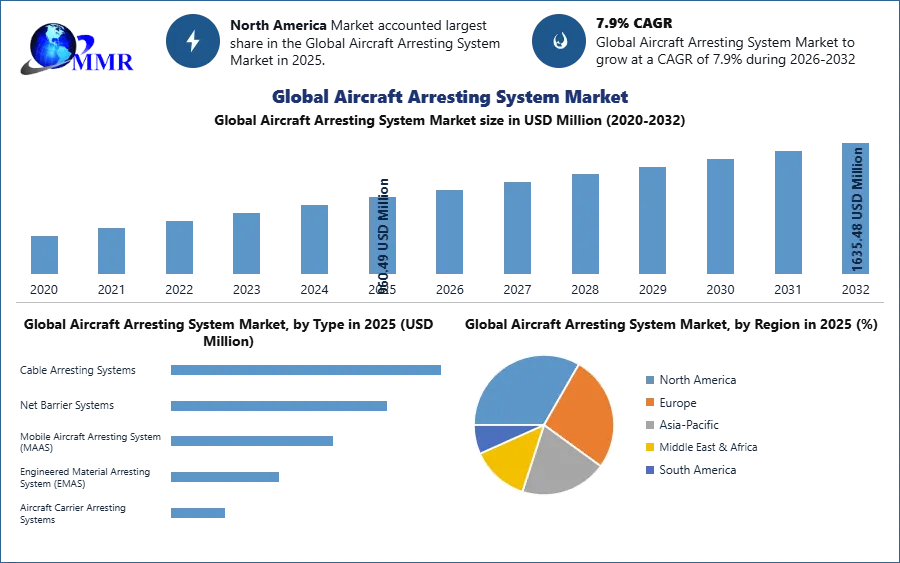
The Global Aircraft Arresting System Market size was valued at USD 960.49 Million in 2025 and the total Aircraft Arresting System revenue is expected to grow at a CAGR of 7.9% from 2026 to 2032, reaching nearly USD 1635.48Million By 2032.
Aircraft Arresting System Market Segment Analysis:

The Aircraft Arresting System market is primarily segmented by system type, installation, platform, and application, with cable arresting systems dominating due to their widespread use in military airbases and aircraft carriers, while engineered material arresting systems (EMAS) are growing rapidly in commercial aviation because of increasing runway safety requirements. Fixed systems hold the largest share compared to portable ones, as they are permanently installed in high-traffic military and commercial runways, whereas mobile systems are gaining traction for temporary or emergency operations. By platform, ground-based systems account for the majority of installations, while ship-based systems are essential for naval aviation. In terms of application, the military segment dominates the market, driven by continuous defense modernization and high procurement budgets, while commercial aviation and training airfields represent smaller but steadily growing segments.

Aircraft Arresting System Market Regional Insights

Regionally, North America leads the market due to strong defense spending and advanced infrastructure, supported by major players such as General Atomics and Honeywell International Inc., followed by Europe, where companies like Safran S.A. and QinetiQ Group plc play a significant role. The Asia-Pacific region is the fastest-growing market, driven by increasing defense budgets, airport expansion, and geopolitical developments, while the Middle East and Africa show moderate growth due to rising investments in aviation infrastructure, and South America remains a smaller but developing market.

Recent Industry Developments (2025–2026)

Exact Date Company Development Impact
07 February 2026 General Atomics The company secured a $43.35 million U.S. Navy contract modification to continue designing electromagnetic aircraft launch and arrested recovery systems for France’s next-generation aircraft carrier (PA-Ng). The project advances the transition from steam-powered systems to electromagnetic technology, aligning French naval recovery capabilities with U.S. Navy Gerald R. Ford-class standards.
13 February 2026 Safran Aerosystems Safran reported a 11.4% revenue increase in its Equipment & Defense division for FY2025, driven by high demand for aerosafety systems and landing gear services. Robust growth in aftermarket services (up 12.2%) highlights the increasing need for maintenance and modernization of safety-critical aircraft arresting and evacuation components.
18 January 2026 General Atomics Aeronautical Systems The company successfully demonstrated autonomous aerial intercepts with the MQ-20 Avenger, which is compatible with advanced arrested recovery and STOL (Short Take-Off and Landing) operations. This milestone facilitates the integration of unmanned combat aircraft into carrier-based and expeditionary environments requiring automated arresting gear.
26 August 2025 Runway Safe Group Philadelphia International Airport completed the installation of an $8.5 million Engineered Material Arresting System (EMAS) on Runway 8-26 to prevent aircraft overruns. The use of crushable concrete blocks provides a critical safety net in land-constrained airports, significantly reducing the risk of structural damage during emergency stops.
13 April 2025 U.S. Air Force (435th CTS) The 435th Construction and Training Squadron installed a Mobile Aircraft Arresting System (MAAS) at RAF Fairford for the Ramstein Flag 2025 exercise. This deployment demonstrates the growing importance of portable arresting solutions for expeditionary airbases and rapid-response military flight operations.
12 March 2025 Runway Safe AB The first EMASMAX system in the Australasia region was completed at Queenstown International Airport in New Zealand. The installation of arrestor beds at both ends of Runway 05/23 ensures compliance with international safety standards and safeguards operations in geographically challenging terrain.

Aircraft Arresting System Market Scope: Inquiry Before Buying  

Global Aircraft Arresting System Market
Report Coverage Details
Base Year: 2025 Forecast Period: 2026-2032
Historical Data: 2020 to 2025 Market Size in 2025: 960.49 USD Mn
Forecast Period 2026-2032 CAGR: 7.9% Market Size in 2032: 1635.47 USD Mn
Segments Covered: By Type Net Barrier
Cable
Mobile Aircraft Arresting System (MAAS)
Engineered Material Arresting System (EMAS)
Others
By Component Energy Absorber
Hook and Cable
Support Structure and Foundations
Control and Monitoring Unit
Others
By Platform Ground Based
Ship Based
By Fit New Installation
Retrofit
By System Fixed
Portable
By End User Military Airbase
Commercial Airport
Others

Aircraft Arresting System Market by Region:

North America (United States, Canada, and Mexico)
Europe (UK, France, Germany, Italy, Spain, Sweden, Austria, and the Rest of Europe)
Asia Pacific (China, South Korea, Japan, India, Australia, Indonesia, Malaysia, Vietnam, Taiwan, Bangladesh, Pakistan, and the Rest of APAC)
Middle East and Africa (South Africa, GCC, Egypt, Nigeria, and the Rest of ME&A)
South America (Brazil, Argentina Rest of South America)

Aircraft Arresting System Market Key Players:

  1. General Atomics
  2. Curtiss-Wright Corporation
  3. MacTaggart Scott and Company Limited
  4. Runway Safe Group AB
  5. SCAMA AB
  6. A-Tech Inc.
  7. QinetiQ Group plc
  8. QinetiQ North America
  9. Safran SA
  10. The Boeing Company
  11. Sojitz Aerospace Corporation
  12. Zodiac Aerospace
  13. John Galt International Engineering Limited
  14. SDT Space and Defence Technologies Inc.
  15. TEKJET A.S.
  16. Neometrix
  17. Sirba Technology and Defense Industry Inc.
  18. General Dynamics Corporation
  19. Northrop Grumman Corporation
  20. Moog Inc.
  21. Leonardo S.p.A.
  22. Textron Inc.
  23. Rheinmetall AG
  24. A-Laskuvarjo Oy
  25. Escribano Mechanical and Engineering S.L.
  26. Foster-Miller Inc.
  27. Victor Balata Belting Company
  28. Wire Rope Industries
  29. WireCo WorldGroup
  30. Aries S.A.

Table of Contents

1. Flare Gas Recovery System Market : Market Introduction 1.1. Executive Summary 1.2. Market Size (2025) & Forecast (2026-2032) 1.3. Market Size (Value USD Billion) and Market Share (%) - By Segments, Regions, and Country 2. Flare Gas Recovery System Market Competitive Landscape 2.1. MMR Competition Matrix 2.2. Competitive Positioning of Top Key Players 2.3. Key Players Benchmarking 2.3.1 Company Name 2.3.2 Headquarter 2.3.3 Product Portfolio 2.3.4 End-User Segment 2.3.5 Revenue Details in 2025 2.3.6 Market Share (%) 2025 2.3.7 Profit Margin (%) 2.3.8 Carbon Footprint Disclosure 2.3.9 Certifications 2.3.10 Technology Adoption 2.3.11 Maintenance & Support Capability 2.3.12 ESG / sustainability policies 2.3.13 Geographical Presence 2.4. Market Structure 2.4.1 Market Leaders 2.4.2 Market Followers 2.4.3 Emerging Players 2.5. Mergers and Acquisitions Details 3. Flare Gas Recovery System Market Dynamics 3.1. Flare Gas Recovery System Market Trends 3.2. Flare Gas Recovery System Market Dynamics 3.2.1 Drivers 3.2.2 Restraints 3.2.3 Opportunities 3.2.4 Challenges 3.3. PORTER’s Five Forces Analysis 3.4. PESTLE Analysis 3.5. Key Opinion Leader Analysis For the Global Industry 4. Regional Market Insights & Comparative Analysis 4.1 Regional Adoption Trends Of FGRS Across Americas, Europe, Asia-Pacific, Mea 4.2 Market Maturity And Growth Rate Comparison By Region 4.3 Regional Infrastructure Readiness And Gas Flaring Patterns 4.4 Regulatory And Policy Impact Across Regions 4.5 Key Regional Projects And Deployment Case Studies 4.6 Barriers To Adoption In Emerging Markets 4.7 Comparative Market Opportunity Assessment 5. End-User & Industry Application Insights 5.1 FGRS Adoption In Upstream, Downstream, LNG, And Gas Processing 5.2 Efficiency And Performance Benchmarks Across Industries 5.3 Pain Points And Unmet Needs Of End-Users 5.4 Customization And Technology Preferences By Industry 5.5 Economic Benefits Realized By Different End-User Segments 5.6 Emerging Applications In Gas Storage And Terminals 5.7 Decision Criteria Influencing FGRS Purchase 6. Pricing, Cost Structure & Economics 2025 6.1 Comparative Pricing Analysis By System Configuration 2020-2025 6.2 Pricing Trends By Capacity Range By Region In 2025 6.3 Cost-Benefit Comparison Versus Conventional Flaring Practices 6.4 Sensitivity Of Pricing To Raw Material And Component Cost Variations 6.5 Regional Pricing Differences And Market-Specific Trends 6.6 Influence Of Technology Type On System Cost (Compression, Membrane, Cryogenic, Etc.) 6.7 Pricing Impact Of Aftermarket Services, Maintenance, And Service Contracts 7. Supply Chain & Procurement Analysis 7.1 Key Suppliers And Vendor Landscape Mapping 7.2 Procurement Strategies Of Major Oil & Gas Operators 7.3 Lead Time And Delivery Challenges For Components 7.4 Supply Chain Risks And Mitigation Strategies 7.5 Vendor Consolidation Trends And Impact On Pricing 7.6 Cost Optimization Opportunities In Procurement 7.7 Strategic Sourcing For Technology Upgrades 8. Technology & Innovation Analysis 8.1 Evolution Of Flare Gas Recovery Technologies Over Time 8.2 Comparative Efficiency Analysis Of Recovery Technologies 8.3 Role Of Digital Monitoring And Automation In FGRS 8.4 Integration Of FGRS With Existing Gas Infrastructure 8.5 Technology Readiness And Maturity Assessment 8.6 Innovation Pipeline And Next-Generation Recovery Solutions 8.7 Challenges In Technology Deployment Across Asset Types 9. Value Chain & Ecosystem Analysis 9.1 End-To-End Value Chain Mapping Of The FGRS Market 9.2 Role Of EPC Contractors And System Integrators 9.3 Supplier Concentration And Sourcing Dynamics 9.4 Aftermarket Services And Maintenance Ecosystem 9.5 Bottlenecks And Inefficiencies Across The Value Chain 9.6 Margin Distribution Across Stakeholders 9.7 Opportunities For Value Addition And Optimization 10. Regulatory, Environmental & Compliance Analysis 10.1 Global Flaring Regulations And Emission Norms 10.2 Impact Of Methane Reduction Targets On FGRS Demand 10.3 Role Of Carbon Pricing And Emission Penalties 10.4 Compliance Challenges For Upstream And Downstream Operators 10.5 Alignment With Net-Zero And ESG Commitments 10.6 Government Incentives And Policy-Driven Adoption 10.7 Regional Regulatory Enforcement Intensity Comparison 11. Investment, Project & Deployment Analysis 11.1 Historical Investment Trends In Flare Gas Recovery Projects 11.2 Project Pipeline Analysis By Asset Type 11.3 Deployment Challenges In Brownfield Vs Greenfield Sites 11.4 Financing Models Used In FGRS Projects 11.5 Role Of Public–Private Partnerships 11.6 Investment Risk Assessment 11.7 Future Capital Flow Outlook 12. Sustainability, ESG & Carbon Monetization Analysis 12.1 Role Of Flare Gas Recovery In Reducing Methane And Co₂ Emissions 12.2 Contribution Of FGRS To Corporate ESG And Sustainability Goals 12.3 Carbon Credit Generation Potential From Recovered Flare Gas 12.4 Monetization Pathways For Recovered Gas (Power, LNG, Reinjection) 12.5 Alignment Of FGRS Adoption With Net-Zero Roadmaps 12.6 ESG-Driven Procurement Trends Among Oil & Gas Operators 12.7 Long-Term Sustainability Impact On Operational Efficiency 13. Aftermarket, Maintenance & Service Analysis 13.1 Lifecycle Maintenance Costs And Recurring Revenues 13.2 Spare Parts And Consumables Demand Trends 13.3 Service Contracts And Maintenance Models 13.4 Predictive Maintenance And Digital Monitoring Adoption 13.5 OEM Vs Third-Party Service Models 13.6 Cost-Benefit Of Aftermarket Services For Operators 13.7 Opportunities To Generate Recurring Revenue Through Services 14. Flare Gas Recovery System Market : Global Flare Gas Recovery System Market Size and Forecast by Segmentation (by Value in USD Billion) (2025-2032) 14.1. Global Flare Gas Recovery System Market Size and Forecast, by Technology 14.1.1 Compression-Only Systems 14.1.2 Membrane Separation 14.1.3 Cryogenic Condensation 14.1.4 Absorption / Adsorption 14.1.5 Hybrid (e.g., Compression + Membrane) 14.2. Global Flare Gas Recovery System Market Size and Forecast, By Component 14.2.1 Compressors and Blowers 14.2.2 Vapor Recovery Towers 14.2.3 Knock-Out Drums and Separators 14.2.4 Heat Exchangers / Chillers 14.2.5 Instrumentation and Control Systems 14.2.6 Others 14.3. Global Flare Gas Recovery System Market Size and Forecast, by Configuration 14.3.1 Modular 14.3.2 Skid Mounted 14.4. Global Flare Gas Recovery System Market Size and Forecast, By Capacity Range 14.4.1 Below 1 MMSCFD 1 to 5 MMSCFD 5 to 15 MMSCFD 5.1 Above 15 MMSCFD 14.5. Global Flare Gas Recovery System Market Size and Forecast, by Operating Pressure 14.5.1 Below 5 bar 5 to 10 bar 10 to 20 bar 20 to 60 bar 14.6. Global Flare Gas Recovery System Market Size and Forecast, by Application 14.6.1 Upstream (Onshore, Offshore) 14.6.2 Downstream (Refineries and Petrochemicals) 14.6.3 LNG and Gas Processing Plants 14.6.4 Others (Gas Storage Facilities, Terminals) 14.7. Global Flare Gas Recovery System Market Size and Forecast, by Region 14.7.1 North America 14.7.2 Europe 14.7.3 Asia Pacific 14.7.4 Middle East and Africa 14.7.5 South America 15. North America Flare Gas Recovery System Market Size and Forecast by Segmentation (by Value in USD Billion) (2025-2032) 15.1. North America Market Size and Forecast, by Technology 15.2. North America Market Size and Forecast, By Component 15.3. North America Market Size and Forecast, by Configuration 15.4. North America Market Size and Forecast, By Capacity Range 15.5. North America Market Size and Forecast, by Operating Pressure 15.6. North America Market Size and Forecast, by Application 15.7. North America Market Size and Forecast, by Country 15.7.1 United States 15.7.2 United States Market Size and Forecast, by Technology 15.7.3 United States Market Size and Forecast, By Component 15.7.4 United States Market Size and Forecast, by Configuration 15.7.5 United States Market Size and Forecast, By Capacity Range 15.7.6 United States Market Size and Forecast, by Operating Pressure 15.7.7 United States Market Size and Forecast, by Application 15.7.8 Canada 15.7.9 Mexico 16. Europe Flare Gas Recovery System Market Size and Forecast by Segmentation (by Value in USD Billion) (2025-2032) 16.1. Europe Market Size and Forecast, by Technology 16.2. Europe Market Size and Forecast, By Component 16.3. Europe Market Size and Forecast, by Configuration 16.4. Europe Market Size and Forecast, By Capacity Range 16.5. Europe Market Size and Forecast, by Operating Pressure 16.6. Europe Market Size and Forecast, by Application 16.7. Europe Market Size and Forecast, by Country 16.7.1 United Kingdom 16.7.2 France 16.7.3 Germany 16.7.4 Italy 16.7.5 Spain 16.7.6 Sweden 16.7.7 Russia 16.7.8 Rest of Europe 17. Asia Pacific Flare Gas Recovery System Market Size and Forecast by Segmentation (by Value in USD Billion) (2025-2032) 17.1. Asia Pacific Market Size and Forecast, by Technology 17.2. Asia Pacific Market Size and Forecast, By Component 17.3. Asia Pacific Market Size and Forecast, by Configuration 17.4. Asia Pacific Market Size and Forecast, By Capacity Range 17.5. Asia Pacific Market Size and Forecast, by Operating Pressure 17.5. Asia Pacific Market Size and Forecast, by Application 17.6. Asia Pacific Market Size and Forecast, by Country 17.6.1 China 17.6.2 S Korea 17.6.3 Japan 17.6.4 India 17.6.5 Australia 17.6.6 Indonesia 17.6.7 Malaysia 17.6.8 Philippines 17.6.9 Thailand 17.6.10 Vietnam 17.6.11 Rest of Asia Pacific 18. Middle East and Africa Flare Gas Recovery System Market Size and Forecast by Segmentation (by Value in USD Billion) (2025-2032) 18.1 Middle East and Africa Market Size and Forecast, by Technology 18.2.Middle East and Africa Market Size and Forecast, By Component 18.3 Middle East and Africa Market Size and Forecast, by Configuration 18.4.Middle East and Africa Market Size and Forecast, By Capacity Range 18.5.Middle East and Africa Market Size and Forecast, by Operating Pressure 18.6.Middle East and Africa Market Size and Forecast, by Application 18.7. Middle East and Africa Market Size and Forecast, by Country 18.7.1 South Africa 18.7.2 GCC 18.7.3 Egypt 18.7.4 Nigeria 18.7.5 Rest of ME&A 19. South America Flare Gas Recovery System Market Size and Forecast by Segmentation (by Value in USD Billion) (2025-2032) 19.1. South America Market Size and Forecast, by Technology 19.2. South America Market Size and Forecast, By Component 19.3. South America Market Size and Forecast, by Configuration 19.4. South America Market Size and Forecast, By Capacity Range 19.5. South America Market Size and Forecast, by Operating Pressure 19.6. South America Market Size and Forecast, by Application 19.7. South America Market Size and Forecast, by Country 19.7.1 Brazil 19.7.2 Argentina 19.7.3 Colombia 19.7.4 Chile 19.7.5 Peru 19.7.6 Rest Of South America 20. Company Profile: Key Players 20.01.John Zink Company, LLC. 20.01.1 Company Overview 20.01.2 Business Portfolio 20.01.3 Financial Overview 20.01.4 SWOT Analysis 20.01.5 Strategic Analysis 20.01.6 Recent Developments 20.02.Zeeco, Inc. 20.03.Honeywell International Inc. 20.04.Wärtsilä Corporation 20.05.Gardner Denver Nash (Ingersoll Rand) 20.06.Transvac Systems Ltd. 20.07.Aereon (Cimarron Energy) 20.08.MPR Industries plc 20.09.Movitherm 20.10.Aerzener Maschinenfabrik GmbH 20.11.Schlumberger Limited 20.12.Baker Hughes Company 20.13.Siemens Energy AG 20.14.ABB Ltd. 20.15.Schneider Electric 20.16.Atlas Copco AB 20.17.Ingersoll Rand Inc. 20.18.Koch Industries, Inc. 20.19.MAN Energy Solutions SE 20.20.Flowserve Corporation 20.21.Caltec Limited 20.22.Hijet Engineering Ltd. 20.23.Frames Group 20.24.Ramboll Group, Inc. 20.25.SoEnergy International Inc. 20.26.Petrogas Systems 20.27.Cool Sorption A/S 20.28.Allied Equipment, Inc. 20.29.BORSIG GmbH 20.30.Valerus 20.30.1 Others 21. Key Findings 22. Future Outlook & Analyst Recommendations 23. Flare Gas Recovery System Market : Research Methodology

Custom Market Research Services

We Will Customise The Research For You, In Case The Report Listed Above Does Not Meet With Your Requirements