
Plastic Waste Is No Longer Garbage — It’s Becoming the World’s Next Industrial Raw Material
BASF, LyondellBasell, and Dow are racing to turn recycled plastic into a premium manufacturing asset as the Plastic Pellets Market heads toward $12.98 billion.
For decades, plastic waste was treated like an environmental liability. Now global manufacturers are trying to turn it into a supply-chain advantage.
The shift is transforming the Global Plastic Pellets Market, valued at USD 9.1 billion in 2025, into a projected USD 12.98 billion market by 2032, growing at a 5.20% CAGR, according to Maximize Market Research.
And the companies moving fastest are not startups. They are some of the largest chemical giants on the planet.
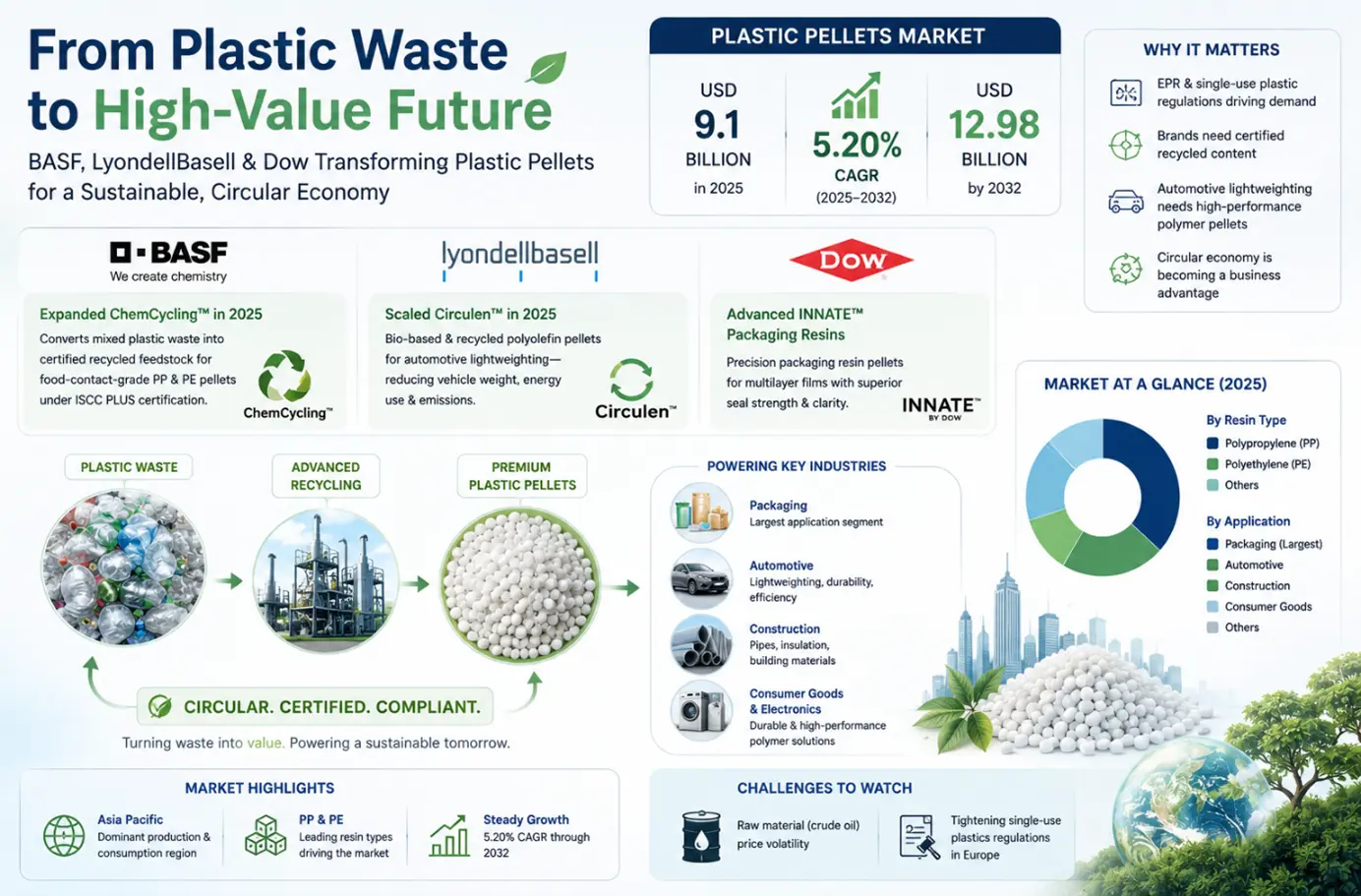
BASF and LyondellBasell Are Turning Recycling Into Big Industry
BASF expanded its ChemCycling™ platform in 2025, converting mixed plastic waste into certified recycled feedstock for food-contact-grade polymer pellets.
That matters because global packaging brands are under enormous pressure from:
- EU single-use plastic regulations
- EPR compliance mandates
- sustainability reporting requirements
Meanwhile, LyondellBasell accelerated its Circulen™ bio-based and recycled polyolefin pellet expansion targeting automotive lightweighting applications.
MMR Insight: The market is rapidly shifting from virgin plastic dependence toward certified recycled and bio-based polymer ecosystems as manufacturers prioritize compliance-ready raw materials.
Packaging Dominates — But Automotive Is Becoming the High-Value Growth Engine
Packaging currently remains the largest application segment globally, driven by:
- food packaging
- consumer goods
- personal care products
- flexible packaging demand
At the same time, automotive OEMs are increasingly replacing metal parts with lightweight polypropylene compounds to improve:
- fuel efficiency
- EV range
- manufacturing efficiency
This is making automotive one of the fastest-evolving end-use segments inside the market.
Asia-Pacific Quietly Controls the Industry
Asia-Pacific remains the largest production and consumption region globally due to:
- China’s manufacturing scale
- India’s packaging expansion
- Southeast Asia’s polymer processing ecosystem
Polypropylene and polyethylene continue dominating resin demand across:
- injection molding
- extrusion
- blow molding
- industrial manufacturing
But regulatory pressure in Europe is increasingly reshaping global sourcing behavior.
The Real Battle Is No Longer Cost — It’s Compliance
The industry’s biggest shift may not be technological.
It is regulatory.
Food brands, automakers, and packaging companies now need recycled-content certification without sacrificing product quality.
That is why mass-balance systems like BASF’s ISCC PLUS-certified recycled feedstock are becoming strategically important.
MMR Insight: The companies capable of supplying compliance-ready recycled pellets at industrial scale may ultimately dominate the next generation of global plastics manufacturing.
Final Take
Plastic pellets were once viewed as low-margin industrial commodities.
Now they are becoming:
- Sustainability infrastructure
- Regulatory compliance tools
- Automotive lightweighting materials
- Circular economy assets
And as governments tighten environmental mandates globally, the future of plastics may belong less to companies producing virgin polymers — and more to companies capable of industrializing recycling at scale.