
Wearable Biosensors Market- Industry Structure Evaluation, Demand Drivers Analysis, Regional Growth Analysis and Identification, Competitive Positioning Review & Global Market Size Forecast to 2032
Overview
Wearable Biosensors Market size was valued at USD 32.97 Billion in 2025 and the total Wearable Biosensors revenue is expected to grow at a CAGR of 8.1% from 2025 to 2032, reaching nearly USD 56.87 Billion.
Wearable Biosensors Market Overview
Wearable biosensors are devices designed to be worn on the body to monitor various physiological parameters, activities, and environmental factors in real-time. These sensors utilize biometric data collection technologies to track and analyze vital signs, movement patterns, and other health-related metrics. They typically come in the form of wristbands, patches, clothing, or smartwatches, and they often connect wirelessly to smartphones or other devices for data transmission and analysis.
The wearable biosensors market is driven by the increasingly growing potential for medical applications and at-home alternatives for patients. With growing applications and potential in remote patient monitoring, diagnosis, therapeutics and detection of disease, wearable sensors are attracting considerable interest due to their opportunities in better supporting patients, clinical outcomes and decisions. Also, AI and connected technologies are furthering the potential opportunities of the Wearable Biosensors industry.
 To know about the Research Methodology :- Request Free Sample Report
Wearable Biosensors Market Dynamics
Rising Health Consciousness to Increase the Adoption of Wearable Biosensors and Drive the Market
The growing emphasis on health consciousness and preventive healthcare practices is driving the wearable biosensors market growth. More than 1 billion people are obese, worldwide. Estimations have it that by 2025, approximately 167 million people, including children and adults, will be less healthy due to obesity. Cardiovascular diseases result in 17.9 million deaths every year globally. With an increasing awareness of the importance of monitoring health parameters regularly, consumers are turning to wearable biosensors as convenient tools for proactive health management. These devices empower individuals to track vital signs, activity levels, and other relevant metrics in real time, facilitating early detection of health issues and enabling timely intervention. Also, the integration of wearable biosensors into wellness programs and remote patient monitoring initiatives by healthcare providers is expected to fuel the Wearable Biosensors Industry growth.
Digital health and its subsectors mobile health, information technologies, wearable devices, telehealth, and telemedicine are revolutionizing the healthcare system. With advancements in artificial intelligence, medical apps and software are now playing a critical role in clinical decision-making. Wearable biosensors communicate with cloud computing platforms to create a powerful diagnostic system. The devices track and upload key health data so caregivers can get real-time information about patients, enhancing clinical outcomes and improving management efficiency.
As a result, patients better understand treatment options, get earlier diagnoses related to life-threatening diseases, and manage their health through non-traditional hospital settings from their homes or a remote clinic. As an example, wearable biosensors in phones and smartwatches keep track of our physical activity and improve people's lifestyles since such factors are expected to drive Wearable Biosensors Market growth. Also, digital technologies support better management through better tracking of wellness. Utilizing these systems in healthcare improves clinical efficiency, reduces costs, increases quality of care, and provides personalized care for patients.
The sports industry continues to be a hotbed of patent innovation. Activity is driven by consumer demand, competitive pressures, performance enhancement, injury prevention and tactical insights, and the growing importance of technologies such as sensor technology, machine learning & artificial intelligence (AI), energy harvesting, material science, augmented reality (AR), 3D printing, and biomechanics analysis. The innovation related to wearable biosensors in the sports industry is driven by the desire to enhance player’s performance, prevent injuries, and engage athletes and fans in more immersive and data-rich experiences. These technologies are continually evolving to meet the dynamic demands of the sports industry.
Examples of some of the technologies used in sports with wearable biosensors include GPS &GNSS, inertial measurement units (IMUs), heart rate monitors, smart fabrics, biometric sensors, AR glasses or visors, wearable cameras, pressure sensors, environmental sensors, and more. Samsung is one of the leading patent filers in wearable biosensors. Samsung recently filed a patent for a smartwatch featuring an integrated projector.
According to the patent, this upcoming smartwatch has the capability to duplicate the content displayed on the watch’s screen and project it directly onto the wearer’s wrist. Wearable biosensor manufacturer that produces next-generation sensors built to customer specifications. Typical applications for this medical device sector that produce include Electronic skin patches, Body sensors, Cardiac monitoring medical devices, Continuous blood glucose monitoring, CGM etc. With the emergence of wearable biosensors, there’s potential for a more proactive approach to healthcare.
Hudson Medical Innovations, a leading wearable medical device manufacturer, specializes in proactive healthcare solutions. They offer electronic skin patches, body sensors, cardiac monitoring, and continuous glucose monitoring devices. As a 3M Select Converter, they provide high-performance materials. Their services encompass development, materials, project management, manufacturing, assembly, and packaging. Contact them for cost-effective, technically competent wearable biosensor manufacturing solutions.
Rise of Incidence of Chronic Diseases to Influence the Market
The rising prevalence of chronic diseases such as diabetes, cardiovascular diseases, and cancer. Biosensors play a crucial role in the early diagnosis, monitoring, and management of these conditions by providing accurate and timely measurements of biomarkers in bodily fluids. The growing burden of chronic diseases worldwide, coupled with the escalating demand for personalized and point-of-care healthcare solutions, is driving the adoption of wearable biosensors in clinical settings.

As lifestyles become more sedentary and chronic diseases continue to rise globally, there is a heightened demand for wearable biosensors that offer continuous monitoring and actionable insights to support healthy living. healthcare to biomedical monitoring systems, wearable devices are becoming popular for non-invasive and continuous monitoring of health data. The future is bright for these tools due to their sophistication and miniaturization. Healthcare to biomedical monitoring systems, wearable devices are becoming popular for non-invasive and continuous monitoring of health data. The future is bright for these tools due to their sophistication and miniaturization. This trend is expected to drive sustained growth in the wearable biosensors market as it becomes an integral part of everyday healthcare management.
Government initiatives focused on the advancement of genomics and proteomics are expected to drive the growth of the biosensor market during the forecast period 2026-2032. National Information and Communication Technology Australia, for example, is expected to increase its data mining, networks, and embedded systems research in this subject. Besides, the Chinese government is investing substantially in its computing networks, which were launched by the Chinese Academy of Sciences and are funded by the Ministry of Science and Technology. The most IT companies are significantly investing in the biosensors sector. Wearable Biosensors Market growth is expected to be boosted by investments from major IT companies such as Infosys, TCS, and IBM.
Technological Advancements to Boost the Growth of the Wearable Biosensors Market
As technology evolves, wearable biosensors become more sophisticated, offering enhanced capabilities and functionalities. These advancements lead to the development of smaller, more accurate, and energy-efficient sensors, significantly expanding their applications across various sectors including healthcare, fitness, sports, and military.
For instance, the integration of advanced sensors with wireless connectivity enables real-time monitoring of vital signs such as heart rate, blood pressure, and blood glucose levels, empowering individuals to proactively manage their health. Also, the incorporation of artificial intelligence and machine learning algorithms enhances data analytics capabilities, allowing for more accurate diagnoses, personalized treatment plans, and preventive interventions.
Such continuous innovation in wearable biosensor technologies drives Wearable Biosensors Market growth by addressing evolving consumer demands for convenient, non-invasive, and reliable health monitoring solutions.
The Wearable Biosensors Market holds substantial growth potential through the expansion of applications in healthcare monitoring. Beyond traditional fitness tracking, biosensors are increasingly integrated into medical devices for continuous health monitoring. These devices offer real-time data on vital signs, such as heart rate, blood pressure, and glucose levels, empowering individuals and healthcare professionals to make informed decisions about patient care and disease management.
Furthermore, wearable biosensors enable remote patient monitoring, facilitating early detection of health issues and timely intervention, which can lead to improved patient outcomes and reduced healthcare costs. With advancements in sensor technology and data analytics, wearable biosensors are poised to revolutionize healthcare delivery by providing personalized and proactive health management solutions, thus driving significant growth opportunities in the market.
Integration with Internet of Things (IoT) and Artificial Intelligence (AI) to Create Lucrative Opportunity For Market
The Wearable Biosensors Market lies in the integration with IoT and AI technologies by connecting biosensor-equipped wearables to IoT platforms, data collected from these devices can be seamlessly transmitted, stored, and analyzed in real-time. AI algorithms can then interpret this data to provide valuable insights into users' health and behavior patterns, enabling personalized health recommendations and interventions. This integration not only enhances the functionality and utility of wearable biosensors but also fosters the development of innovative healthcare solutions, such as predictive analytics for disease prevention and early diagnosis.
Moreover, the proliferation of IoT-enabled devices and AI capabilities creates a fertile ecosystem for the expansion of wearable biosensor applications beyond healthcare into areas such as sports performance monitoring, workplace safety, and environmental monitoring, driving further market growth and adoption. However, challenges including flexibility of wearable devices, the collection of clinical-grade data and advanced battery technologies still remain for the industry to overcome.
Increasing Demand for Wearable Biosensors in the Food & Beverage Sector
Growth of the food & beverage sector has a significant impact on the market for wearable biosensors. The increasing number of food & beverage companies and rising demand for canned and packaged food are important factors driving market growth. Sensing devices are being increasingly used in the packaging sector to improve industrial efficiency, convenience, and precautions.
Furthermore, wearable biosensors help in improving the sensitivity, specificity, and detection limit of chemical analysis of food & beverages, thereby generating high demand for wearable biosensors in the food industry. The surge in consumer demand for convenient, health-conscious lifestyles has significantly impacted food and beverage retail sales in the United States. Throughout 2020 to 2025, sales across various formats have reflected this trend, with growth in online platforms, specialty stores, and health-focused outlets. This shift in consumer behavior towards wellness and convenience is paralleled in the Wearable Biosensors Market, where the emphasis on health monitoring aligns with broader lifestyle trends, driving the Wearable Biosensors Industry.
Wearable Biosensors Market Restraining Factors:

Wearable Biosensors Market Segment Analysis
By Product In 2025, the Optical Sensors segment accounted for the largest Wearable Biosensors Market share. The widespread utilization of optical biosensors in glucose monitoring devices, which are among the most prevalent wearable biosensors in use today. Optical biosensors leverage light to measure changes in the properties of biological molecules, offering high sensitivity, accuracy, and specificity. They are prominently featured in continuous glucose monitoring systems, providing real-time glucose data to individuals managing diabetes, thus enhancing their ability to effectively monitor and manage their condition. However, the Acoustic Wave Biosensors segment is forecasted to be the fastest-growing segment in the coming years. Acoustic wave biosensors utilize sound waves to detect alterations in the physical properties of biological molecules, boasting high sensitivity and specificity.
These biosensors find application in wearable devices for various purposes, including monitoring respiratory rates and identifying chemical contaminants in the environment. With the escalating demand for personalized healthcare solutions and the growing prevalence of remote patient monitoring initiatives, the acoustic wave biosensors segment is poised for substantial growth in the foreseeable future.
Based on application, the healthcare and medical segment dominated the largest Wearable Biosensors Market share in 2025. This dominance is attributed to the escalating emphasis on personal health and well-being, driving the popularity of fitness trackers and similar devices among consumers. These tools enable individuals to monitor vital health metrics like heart rate, activity levels, and calorie expenditure, empowering them to manage their overall health. 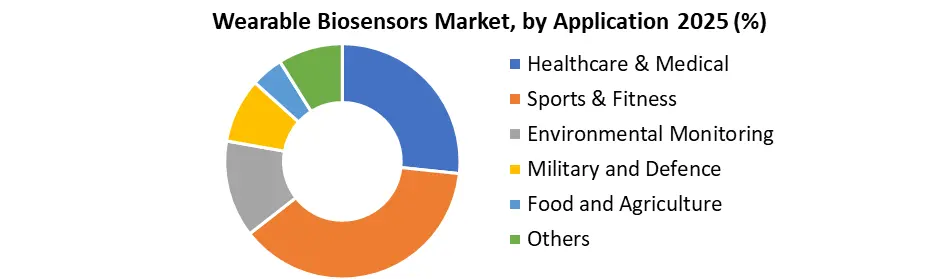
The Environmental Safety Monitoring and Home Rehabilitation segments are anticipated to witness substantial expansion in the foreseeable future. Within the Safety Monitoring sector, wearable biosensors have major role in detecting falls, monitoring vital signs, and tracking location, offering invaluable support to elderly individuals and those managing chronic conditions.
Wearable Biosensors Market Regional Insight
North America held the largest Wearable Biosensors Market share in 2025. The market growth is primarily due to the concentration of key industry players and a heightened prevalence of targeted diseases across the region. Looking ahead, advancements in technology, notably the emergence of compact diagnostic tools facilitating wider adoption of Electronic Medical Records (EMR) alongside swift and accurate diagnostics, are poised to drive market growth. Legislative frameworks such as the Clean Air Act, Clean Water Act, and National Environmental Policy Act in the U.S. are anticipated to unlock further growth opportunities for the regional Wearable Biosensor Industry.
Wearable Biosensors valued at $573,991 were imported, with an average import price of $1,078.77. Imports came from 5 countries including US, China, South Korea, Hong Kong and Spain. Hong Kong was the largest exporter of wearable biosensors accounting for 46.10% of the total imports of biosensors. United States was the second largest exporter of wearable biosensors accounting for 42.25% of the total imports of biosensors
Asia Pacific region is expected to hold the largest market share of xx% by 2032. The presence of a huge population base and the rising incidence of various lifestyle disorders are the major drivers of wearable biosensors market growth in Asia Pacific. In terms of foreign investment, China's healthcare industry has been gradually opening up to international participation, both in terms of things removed from the National Negative List and those added to the National Encouraged List.
In healthcare, biosensors offer unparalleled advantages in early disease detection, personalized medicine, and remote patient monitoring. These miniature devices can provide real-time data on various biomarkers, enabling timely interventions and improving patient outcomes.
In 2025, the National Encouraged List was updated to include new raw materials for vaccine production and medical institutions. This suggests that China is increasingly encouraging healthcare investment and providing possibilities for international investors to benefit from preferential regulations and tax rates. Such policies are expected to open up a slew of chances for the wearable biosensors market during the forecast period 2026-2032.
Leading players in the Asia Pacific wearable biosensors market include Huawei, Samsung, Fitbit, Xiaomi, Garmin, Apple, and Oura. These companies offer advanced health monitoring features in their wearable devices, catering to the region's growing demand for fitness and health tracking solutions.
Wearable Biosensors Industry Ecosystem 
Recent Industry Developments
| Exact Date | Company | Development | Impact |
|---|---|---|---|
| 19 February 2026 | Eli Lilly | The company agreed to acquire Orna Therapeutics for up to $2.4 billion to secure proprietary circular RNA platforms for advanced oncology biosensing and therapies. | This acquisition significantly strengthens integration between RNA-based diagnostics and wearable monitoring ecosystems. |
| 20 February 2025 | VitalConnect | Secured $100 million in financing to accelerate the commercial scale-up of its clinical-grade wearable biosensor technology for cardiac monitoring. | The funding provides the capital necessary to expand remote patient monitoring capabilities across global hospital-at-home programs. |
| 10 April 2025 | Dexcom | Received FDA clearance for the Dexcom G7 15-Day system, establishing it as the longest-lasting wearable CGM currently available in the US market. | The 50% increase in wear time per sensor reduces patient burden and lowers the long-term cost of continuous metabolic monitoring. |
| 22 May 2025 | Medtronic | Launched the Simplera Sync disposable all-in-one sensor, which received FDA approval for automated integration with insulin delivery systems. | This development enhances the competitive position of Medtronic in the "closed-loop" diabetes management market. |
| 15 September 2025 | Dexcom | Unveiled the Smart Basal titration module at EASD 2025, a new software feature designed to automate insulin dosing adjustments based on biosensor data. | This software-driven expansion increases the clinical utility of hardware sensors, moving the market toward more autonomous healthcare solutions. |
| 16 January 2025 | Abbott Laboratories | Showcased the Lingo biowearable at CES 2025, an over-the-counter sensor designed for non-diabetic consumers to track metabolic health. | This marks a major strategic pivot toward the consumer wellness segment, greatly expanding the addressable market for biosensing technology. |
Wearable Biosensors Market Scope: Inquire before buying
| Wearable Biosensors Market | |||
|---|---|---|---|
| Report Coverage | Details | ||
| Base Year: | 2025 | Forecast Period: | 2026-2032 |
| Historical Data: | 2020 to 2025 | Market Size in 2025: | 32.97 USD Billion |
| Forecast Period 2026-2032 CAGR: | 8.1% | Market Size in 2032: | 56.87 USD Billion |
| Segments Covered: | by Type | Wrist-Worn Biosensors Patch-Based Biosensors Smart Clothing / Textile Biosensors Others |
|
| by Product | Optical Biosensors Electrochemical Biosensors Thermal Biosensors Piezoelectric Biosensors Others |
||
| by Application | Healthcare & Medical Sports & Fitness Environmental Monitoring Military & Defense Food & Agriculture Others |
||
Wearable Biosensors Market, by Region
North America (United States, Canada and Mexico)
Europe (UK, France, Germany, Italy, Spain, Sweden, Austria, Turkey, Russia and Rest of Europe)
Asia Pacific (China, India, Japan, South Korea, Australia, ASEAN and Rest of APAC)
Middle East and Africa (South Africa, GCC, Egypt, Nigeria and Rest of ME&A)
South America (Brazil, Argentina, Columbia and Rest of South America)
Wearable Biosensors Market key players
- Abbott Laboratories
- Dexcom
- Medtronic
- Koninklijke Philips N.V.
- VitalConnect
- Eversense
- Butler Technologies
- NeuroSky
- Pkvitality
- Bio-Rad Laboratories
- Nova Biomedical
- Siemens Healthineers AG
- Pinnacle Technology
- Dynamic Biosensors GmbH
- ACON Laboratories
- Zimmer & Peacock AS
- LifeSignals
- Biolinq
- Sensirion AG
- Giant Medical
- Apple
- Garmin
- Omron Corporation
- Samsung Electronics
- Huawei Technologies