
Water Purifying Catalyst Market Size to Reach USD 5.47 Billion by 2035, Growing Global Water Stress and PFAS Remediation Demand to Drive Market Expansion
Overview
Water Purifying Catalyst Market — Overview
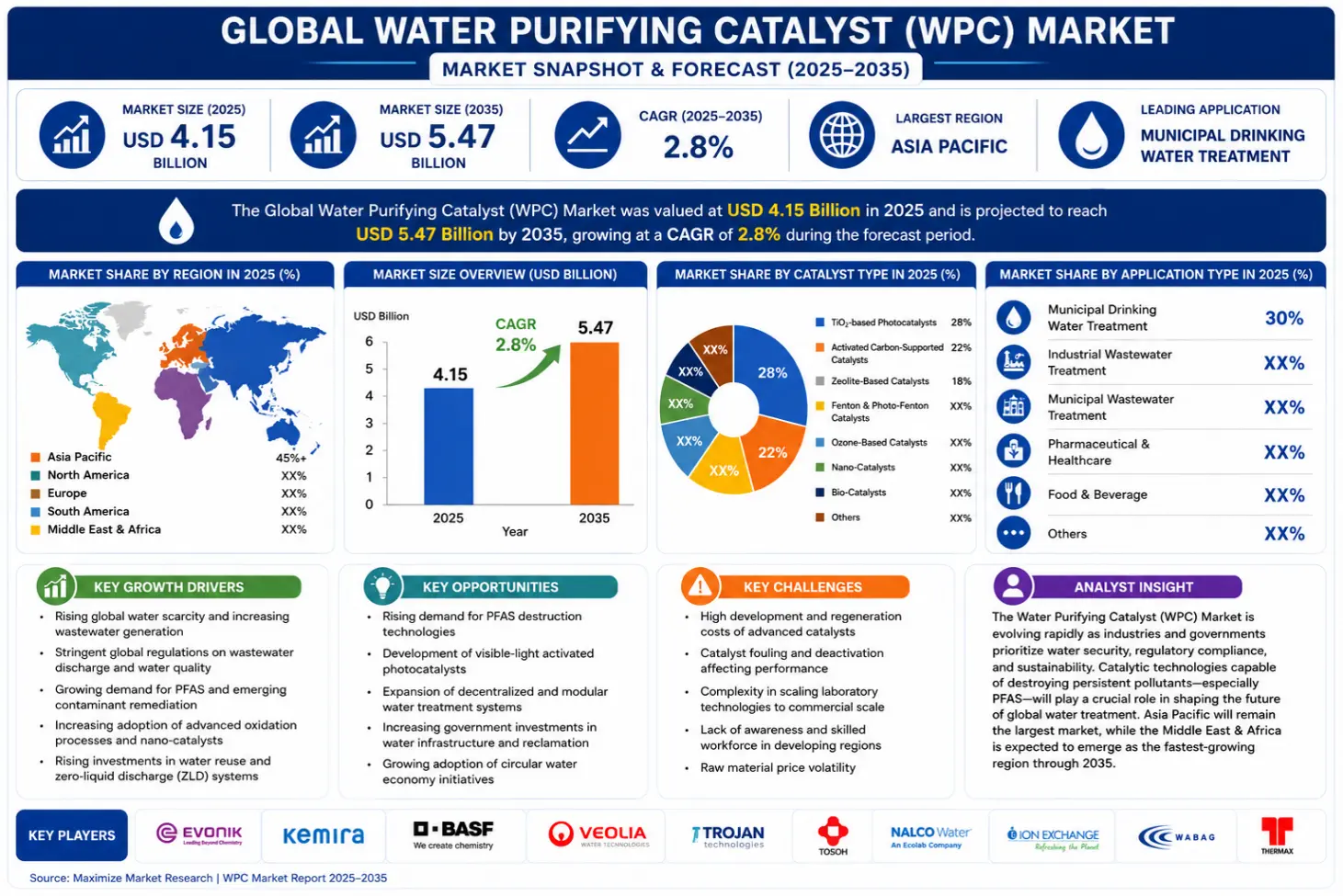
The Global Water Purifying Catalyst Market was valued at USD 4.15 Billion in 2025 and is projected to reach USD 5.47 Billion by 2035, growing at a CAGR of 2.8% during the forecast period. Water purifying catalysts are specialized chemical agents that accelerate the breakdown, neutralization, and complete mineralization of contaminants in water — including heavy metals, persistent organic pollutants (POPs), pharmaceuticals, endocrine-disrupting compounds (EDCs), industrial dyes, and emerging threats such as PFAS ('forever chemicals') — without being consumed in the reaction process.
The market is driven by the convergence of three irreversible global megatrends: escalating water scarcity, tightening environmental regulation, and the rapidly growing complexity of industrial wastewater. According to the World Health Organization, over 2 billion people worldwide lack access to safely managed drinking water, while industrial wastewater generation in Asia Pacific alone is projected to surpass 45 billion m³ annually by 2028. These structural pressures, compounded by stringent regulatory mandates such as the EU Water Framework Directive, US EPA PFAS National Primary Drinking Water Regulation (2024), and India's updated Bureau of Indian Standards drinking water standards (2024, covering 75 cities), are creating durable, non-cyclical demand for advanced catalytic water treatment.
Technological innovation is a key competitive differentiator in the WPC market. Nanostructured TiO2-based photocatalysts — which account for over 80% of global photocatalyst volume share — are being enhanced with graphene composites, carbon nanotube integration, and visible-light activation doping to extend their performance beyond UV-only applications. Non-hydroxyl radical AOP systems utilizing sulfate radicals, superoxide anions, and singlet oxygen are emerging as the fastest-growing technology sub-segment, offering superior selectivity for challenging industrial effluents. Simultaneously, bio-catalysts and enzyme-based systems are carving out sustainable niches in food & beverage, pharmaceutical, and agricultural water treatment sectors.
Key Highlights — Water Purifying Catalyst Market
• Market Size: The global Water Purifying Catalyst (WPC) Market was valued at USD 4.15 Billion in 2025 and is projected to reach USD 5.47 Billion by 2035, growing at a CAGR of 2.8% during the forecast period (2025–2035)
• Dominant Region: Asia Pacific leads the global WPC market with 45%+ revenue share in 2025, driven by China's Water Conservation Regulations, India's Jal Jeevan Mission, and rapid industrial wastewater generation across Southeast Asia
• Leading Segment: TiO₂-based Photocatalysts dominate the market with 28% share in 2025, accounting for over 80% of global photocatalyst volume — with nanostructured and visible-light activated variants driving next-generation adoption
• Top Application: Municipal Drinking Water Treatment holds the largest application share at 30% in 2025, supported by national water security programs including India's USD 50 Billion Jal Jeevan Mission and China's Water Ten Plan
• Fastest Growing: Industrial Wastewater Treatment is the fastest-growing application at 25% share, led by pharmaceutical, semiconductor, textile, and chemical sectors deploying advanced catalytic systems for complex effluent compliance
• Key Players: Market led by Evonik Industries, Kemira Oyj, BASF SE, Veolia Water Technologies, Trojan Technologies (Xylem), Tosoh Corporation, Nalco Water (Ecolab), Ion Exchange India, VA Tech Wabag, and Thermax Limited
Water Purifying Catalyst Market Snapshot (2025–2035) - Market Size Forecast (USD Billion)
To know about the Research Methodology :- Request Free Sample Report
Water Purifying Catalyst (WPC) Market Dynamics
Rising Global Water Scarcity is Creating Structural Demand for Advanced Water Treatment Technologies
Water scarcity has evolved from an environmental issue into a major economic, industrial, and public health challenge. Rapid population growth, urbanization, climate change, and industrial expansion are placing enormous pressure on freshwater resources across both developed and developing economies. According to global water agencies, billions of people continue to lack access to safe drinking water, while water demand is expected to increase significantly over the coming decades.
This growing water crisis is forcing governments and industries to invest heavily in advanced water treatment infrastructure. Water purifying catalysts are increasingly being adopted because they enable the removal of contaminants that traditional treatment systems struggle to address. Their ability to improve treatment efficiency while supporting water reuse and recycling objectives makes them an essential technology within modern water management strategies.
Countries across Asia Pacific, the Middle East, and Africa are investing aggressively in water security projects, wastewater recycling facilities, and desalination plants. These investments are expected to create long-term demand for advanced catalytic treatment technologies.
Stringent Environmental Regulations Accelerating Market Growth
Environmental regulations are becoming increasingly stringent across major economies. Governments are introducing tighter drinking water standards, industrial discharge limits, and wastewater treatment requirements to combat growing concerns regarding contamination and environmental degradation.
Particular attention is being given to emerging contaminants such as PFAS, pharmaceutical residues, microplastics, and industrial chemicals. Regulatory agencies are requiring utilities and industrial facilities to adopt more advanced treatment technologies capable of achieving higher purification standards.
Unlike conventional treatment methods that often transfer pollutants to another waste stream, water purifying catalysts facilitate the chemical destruction of contaminants. This capability makes them particularly attractive for regulatory compliance applications, supporting market growth across municipal and industrial sectors.
PFAS and Emerging Contaminants Represent a Multi-Billion-Dollar Opportunity
One of the most significant opportunities within the Water Purifying Catalyst Market is the growing demand for PFAS treatment solutions. PFAS compounds are commonly referred to as "forever chemicals" because of their extreme persistence in the environment and resistance to conventional treatment technologies.
As regulatory frameworks continue to tighten, utilities and industrial operators are seeking treatment technologies capable of effectively destroying PFAS compounds rather than merely concentrating them. Advanced oxidation processes, photocatalytic treatment systems, nano-catalysts, and electrocatalytic technologies are emerging as promising solutions for this challenge.
In addition to PFAS, growing concerns regarding pharmaceutical residues, endocrine disruptors, pesticide runoff, and industrial micropollutants are expanding the addressable market for advanced water purifying catalysts.
High Development Costs and Technology Complexity Remain Key Challenges
Despite strong growth opportunities, the market faces several challenges. Catalyst development often requires substantial research and development investments, particularly for advanced nano-catalysts, visible-light photocatalysts, and PFAS-specific treatment solutions.
Operational challenges such as catalyst fouling, deactivation, regeneration requirements, and performance variability under real-world conditions can increase total treatment costs. Many advanced catalyst technologies also face scalability challenges when transitioning from laboratory environments to commercial deployment.
Addressing these challenges will require continued innovation, process optimization, and collaboration between catalyst manufacturers, technology providers, utilities, and regulatory authorities.
Water Purifying Catalyst Market Segment Analysis
By Catalyst Type
TiO2-based Photocatalysts dominated the global WPC market in 2025, accounting for approximately 28% of total revenue (per infographic data). Titanium dioxide accounts for over 80% of global photocatalyst volume share, underpinned by its high oxidative efficiency, chemical stability, non-toxicity, established regulatory acceptance, and wide commercial availability. Doped and nanostructured TiO2 variants extending visible-light responsiveness are reducing energy dependency and expanding deployment viability beyond UV-only systems.
Activated Carbon-Supported Catalysts represent the second-largest type at 22% market share, widely used in industrial wastewater treatment for their effectiveness against organic pollutants and heavy metals in complex effluent environments. Fenton and Photo-Fenton Catalysts hold 12% share, particularly prominent in textile, pharmaceutical, and chemical sector effluent treatment where high oxidative power is required for recalcitrant organics.
Water Purifying Catalyst Market – Catalyst Type Landscape & Strategic Insights (2025)
| Segment | Share (2025) | Key Insight |
| TiO2-based Photocatalysts | 28% | Dominant type; >80% of photocatalyst volume globally. UV & visible-light variants expanding. |
| Activated Carbon-Supported | XX% | Second largest; strong in industrial wastewater for organic & heavy metal removal. |
| Zeolite-Based Catalysts | XX% | Stable demand from municipal water & pharmaceutical effluent treatment sectors. |
| Fenton & Photo-Fenton | XX% | High-growth in textile, pharma, and chemical sectors for recalcitrant organics. |
| Ozone-based Catalysts | XX% | Expanding use in municipal tertiary treatment and PFAS polishing applications. |
| Others (Nano, Bio, Metal Oxide) | XX% | Fastest growing; nano-catalysts at ~12% CAGR, driven by PFAS and micropollutant demand. |
By Application
Municipal Drinking Water Treatment is the dominant application segment, representing 30% of 2025 market revenue. This reflects the scale of global government-funded water infrastructure programs — India's Jal Jeevan Mission (USD 50 Billion), China's Water Ten Plan, US EPA PFAS infrastructure grants, and GCC desalination expansion — all driving large-volume procurement of advanced catalytic systems. Industrial Wastewater Treatment is the fastest-growing application at 25% share, led by pharmaceutical, textile, semiconductor, and chemical sector operators generating high-complexity effluents requiring catalytic degradation rather than conventional removal.
Water Purifying Catalyst Market – Application Segmentation & End-Use Demand Outlook (2025)
| Segment | Share (2025) | Key Insight |
| Municipal Drinking Water Treatment | 30% | Dominant application; driven by national water security programs globally. |
| Industrial Wastewater Treatment | XX% | Fastest growing; pharma, textile, semiconductor, chemical sectors leading. |
| Municipal Wastewater Treatment | XX% | Large volume; AOP and photocatalytic polishing at tertiary stage. |
| Pharmaceutical & Healthcare | XX% | High-value niche; strict API discharge standards driving catalytic adoption. |
| Food & Beverage | XX% | Bio-catalyst and enzyme systems gaining traction for sustainable processing. |
| Others | 10% | Includes electronics, agriculture, desalination pre-treatment, groundwater. |
Water Purifying Catalyst (WPC) Market Regional Insights
Asia Pacific Leads the Global Market
Asia Pacific represents the largest regional market for water purifying catalysts and is expected to maintain its leadership position throughout the forecast period. Rapid industrialization, urbanization, increasing water stress, and growing environmental awareness are driving substantial investments in water treatment infrastructure.
China and India remain the primary growth engines within the region. Both countries are implementing ambitious water conservation programs, wastewater treatment initiatives, and industrial pollution control strategies that support strong demand for advanced catalytic treatment technologies.
The region's expanding manufacturing base and rising wastewater generation volumes further reinforce long-term market growth prospects.
North America Driven by Regulatory Compliance and PFAS Treatment
North America continues to be a key market characterized by strong regulatory enforcement, technological innovation, and significant investment in water infrastructure. Increasing focus on PFAS remediation and emerging contaminant treatment is creating substantial opportunities for catalyst manufacturers and technology providers.
Municipal utilities, semiconductor manufacturers, pharmaceutical companies, and industrial operators are actively investing in advanced treatment solutions to meet evolving compliance requirements.
Europe Focused on Sustainability and Circular Water Economy
Europe remains one of the most technologically advanced markets for water treatment. Strong environmental regulations, sustainability initiatives, and circular economy objectives continue to drive investment in advanced catalytic treatment technologies.
Countries such as Germany, France, the Netherlands, and the Nordic nations are leading adoption of advanced oxidation processes, photocatalytic treatment systems, and water reuse technologies.
Middle East & Africa Emerging as a High-Growth Market
The Middle East & Africa region is expected to witness significant growth due to increasing water scarcity, desalination investments, and industrial development. Governments across the Gulf region are investing heavily in water security infrastructure, creating substantial opportunities for advanced treatment technologies.
Water reuse, desalination pre-treatment, and industrial wastewater recycling are expected to remain key growth drivers across the region.
Water Purifying Catalyst Market– Regional Demand Landscape & Growth Outlook (2025)
| Region | Share (2025) | CAGR | Growth Overview |
| Asia Pacific | 45%+ | ~X.2% | Dominant region. China (2024 Water Reuse Regulation), India (Jal Jeevan Mission, TADOX(R)), and ASEAN industrial expansion drive structural demand. China urban wastewater >69B liters/day; India >41B liters/day. |
| North America | X0% | ~X.1% | Mature, high-compliance market. US EPA PFAS NPDWR (2024) creates new catalytic demand wave. Trojan Technologies dominant in UV-AOP; pharma and semiconductor sectors leading industrial adoption. |
| Europe | XX% | ~X.8% | EU Water Framework Directive, REACH PFAS restrictions, and circular economy mandates drive consistent demand. Germany, France, Netherlands lead AOP adoption. Veolia Oslo Fjord upgrade flagship project (2026). |
| South America | XX% | ~X.3% | Brazil (municipal & agri), Chile (mining, copper sector acid drainage), Colombia and Argentina emerging. Growing regulatory alignment with international standards. |
| Middle East & Africa | XX% | ~X.4% | Fastest growing region. GCC desalination pre-treatment, Vision 2030 water security investments. VA Tech Wabag and Thermax expanding ME project pipelines significantly. |
Water Purifying Catalyst (WPC) Market Competitive Landscape
The Global Water Purifying Catalyst market is moderately consolidated, featuring a mix of diversified chemical conglomerates, specialty water technology firms, and high-growth regional specialists. Leading players compete on photocatalyst innovation, nano-material R&D, strategic municipal partnerships, PFAS treatment capability, and geographic expansion into high-growth APAC and MEA markets. M&A activity is intensifying — particularly targeting AOP technology specialists, activated carbon regeneration platforms, and modular treatment system developers. The green water treatment chemicals segment, led by Kemira, Veolia, Ecolab, Kurita, and BASF, is projected to grow from USD 1.7 Billion in 2025 to USD 2.25 Billion by 2029 at 7.2% CAGR (MarketsandMarkets, 2025).
Water Purifying Catalyst Market– Competitive Landscape & Strategic Positioning Analysis
| Company | HQ | Strategic Focus | Recent Development |
| Evonik Industries AG | Germany | Specialty catalysts, nano-engineered oxidation systems, precious metal catalysts | Launched Noblyst(R) F catalysts (2025); advancing electrodialysis for green water transformation across industrial clients. |
| Kemira Oyj | Finland | Water treatment chemicals, coagulants, performic acid-based catalytic systems | KemConnect(R) DEX used at Paris 2024 Olympics for Seine treatment; acquired Norit activated carbon reactivation operations. |
| BASF SE | Germany | Heterogeneous oxidation catalysts, specialty chemical water treatment | Expanding green chemistry WPC portfolio; strategic supply agreements with municipal authorities across Asia Pacific. |
| Veolia Water Technologies | France | End-to-end water treatment, AOP systems, catalytic ozonation at municipal/industrial scale | Oslo Fjord wastewater upgrade (2026); alliance with Everbright International for China industrial WPC (2024). |
| Trojan Technologies (Xylem) | Canada/USA | UV-AOP systems, photocatalytic municipal water treatment | Dominant in UV-AOP globally; expanding PFAS treatment pilot programs across North American utilities and industrial clients. |
| Tosoh Corporation | Japan | Zeolite-based catalysts, TiO2, specialty oxidants for water applications | Deepening APAC distribution; R&D into visible-light activated photocatalysts for tropical-climate market applications. |
| Nalco Water (Ecolab) | USA | Industrial water treatment, catalytic chemical programs for heavy industry | Integrated smart water management + catalytic treatment platform; major pharma and semiconductor sector partnerships. |
| Ion Exchange India Ltd. | India | Water purification resins, AOP modular systems, ZLD catalytic solutions | TADOX(R) UV-photocatalysis commercialization with TERI; modular AOP platforms gaining traction across Southeast Asia. |
| VA Tech Wabag | India/Austria | Municipal & industrial water, catalytic treatment plants, desalination pre-treatment | Expanding GCC project pipeline; executing multiple Jal Jeevan Mission-linked projects in India through 2025-2026. |
| Thermax Limited | India | Industrial wastewater, catalytic wet air oxidation (CWAO), ZLD systems | Expanding CWAO portfolio for chemical & pharma sectors; growing Middle East project pipeline in catalytic treatment. |
Water Purifying Catalyst (WPC) Market Recent Developments (2024–2026)
[2026] Veolia's advanced AOP technologies are driving a major wastewater upgrade to improve Oslo Fjord water quality, deploying catalytic ozonation at full municipal scale.
[2025] Kemira published the Kemira Water Index 2025; its KemConnect(R) DEX performic acid technology — a sustainable catalytic water purification system — gained international recognition after successfully treating the River Seine ahead of and during the Paris 2024 Olympics.
[2025] Evonik Industries launched the Noblyst(R) F catalyst series for flow applications, expanding its water treatment catalyst portfolio with two particle sizes optimized for continuous flow industrial treatment systems.
[2025] Kemira acquired Norit's reactivation operations, enhancing its market position with activated carbon catalyst regeneration services — directly addressing catalyst lifecycle cost, one of the market's key restraints.
[2024] China enacted its first national Water Conservation Regulations (May 2024), setting sector-specific water recycling quotas. High-consumption industries including electronics and automotive manufacturers are mandated to recycle approximately 80% of water usage, accelerating ZLD and catalytic treatment investment.
[2024] Veolia Water Technologies formed an alliance with Everbright International (China) to deploy advanced catalytic water treatment for industrial wastewater recycling at scale across Chinese manufacturing corridors.
[2024] TERI and Ion Exchange India partnered to commercialize TADOX(R) UV-photocatalysis technology, targeting cost-effective, energy-efficient ZLD solutions across APAC manufacturing and industrial water treatment markets.
[2024] India's Bureau of Indian Standards (BIS) implemented stricter drinking water quality standards across 75 major cities in 2024, compelling municipal infrastructure upgrades that directly increase WPC procurement at municipal treatment facilities.
[2024] Researchers at Skoltech, Boreskov Institute of Catalysis, and Tomsk Polytechnic University demonstrated WB5-x/WB2-TiO2 composite photocatalysts matching the performance of noble metal catalysts — a potential commercial breakthrough for cost-competitive visible-light activated water purification.
Scope of the Report: Inquire before buying
| Segment Dimension | Sub-Segments |
| By Catalyst Type | TiO2-based Photocatalysts, Visible-light Active Photocatalysts, Doped/Modified TiO2, Ozone-based Catalysts, Fenton & Photo-Fenton Catalysts, Heterogeneous Oxidation Catalysts, Activated Carbon-Supported Catalysts, Zeolite-Based Catalysts, Metal Oxide Catalysts, Nano-Catalysts, Bio-Catalysts / Enzyme-Based, Others (MOF, Graphene, Perovskite-Based) |
| By Technology Platform | Advanced Oxidation Processes (AOPs), Photocatalytic Oxidation, Catalytic Ozonation, Fenton Oxidation, Electrocatalytic Oxidation, Catalytic Wet Air Oxidation (CWAO), Biological-Catalytic Hybrid Treatment |
| By Application | Municipal Drinking Water Treatment, Municipal Wastewater Treatment, Industrial Wastewater Treatment, Pharmaceutical & Healthcare, Textile & Dye Industry, Chemical & Petrochemical, Food & Beverage, Electronics & Semiconductor, Groundwater Remediation, Agricultural Water Treatment, Desalination Pre-treatment, Others |
| By End User | Municipal Authorities, Chemical Industry, Pharmaceutical Industry, Food & Beverage Industry, Electronics & Semiconductor, Power Generation, Mining & Metals, Others |
| By Region | North America (US, Canada, Mexico), Europe (Germany, France, UK, Italy, Rest of Europe), Asia Pacific (China, India, Japan, South Korea, Southeast Asia, Rest of APAC), Middle East & Africa (GCC, South Africa, Rest of MEA), South America (Brazil, Chile, Rest of South America) |
Key Questions Answered_ Water Purifying Catalyst (WPC) Market
• What is the global Water Purifying Catalyst (WPC) market size in 2025 and what is the forecast value by 2035?
• What is the projected CAGR of the global WPC market during the 2025–2035 forecast period?
• Which catalyst type dominates global WPC market revenue and which sub-type is growing the fastest?
• Which technology platform — AOP, photocatalytic oxidation, catalytic ozonation, or hybrid systems — holds the largest market share?
• Which application segment leads WPC market demand and which is the fastest-growing application?
• How are PFAS and emerging contaminant regulatory mandates reshaping WPC technology adoption globally?
• Which region holds the largest share of the global WPC market and which region presents the highest growth opportunity?
• Who are the top 10 global competitors in the Water Purifying Catalyst market and what are their key recent strategic developments?
• What are the most significant emerging opportunities in nano-catalyst, visible-light photocatalyst, and bio-catalyst segments?
• How are hybrid MBR-AOP treatment systems changing the economics of large-scale catalytic water treatment?