
US Agricultural Microbials Market Size by Type, Function, Crop Type, Formulation, Mode of Application and End-user
Overview
The US Agricultural Microbials Market was valued at USD 3.15 billion in 2025 and is projected to reach USD 10.07 billion by 2032, registering a CAGR of 12.80% during the forecast period. The United States remains a leading market due to strong investments in advanced technologies, digital transformation, and innovation-driven industries.
The country accounts for over 35% of the North American market, supported by the presence of major technology companies and a highly developed digital infrastructure. Additionally, more than 94% of U.S. enterprises have adopted cloud-based solutions, while over 55% of organizations are actively integrating artificial intelligence into business operations, accelerating market demand. Rising investments in automation, cybersecurity, and data analytics, coupled with increasing government and private-sector spending on smart infrastructure, continue to strengthen market growth. These factors position the U.S. as a key revenue-generating region and a major contributor to global market expansion through 2032.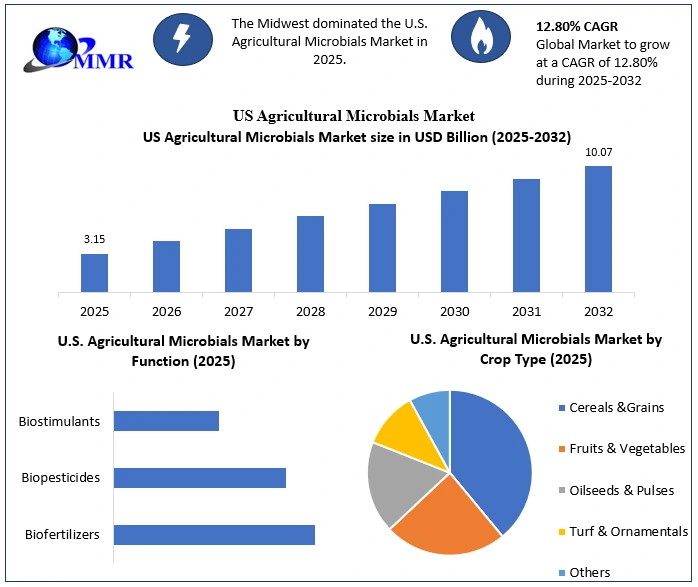
To know about the Research Methodology :- Request Free Sample Report
Key Dynamics Shaping the US Agricultural Microbials Market
The US Agricultural Microbials Market is witnessing robust growth, driven by the increasing adoption of sustainable farming practices, rising demand for organic food, and stringent regulations limiting the use of synthetic agrochemicals. The market is projected to grow from USD 3.15 billion in 2025 to USD 10.07 billion by 2032, registering a CAGR of 12.80%. The United States is home to over 2 million farms, with approximately 900 million acres of farmland, creating significant demand for biological crop protection and soil health solutions.
Furthermore, the U.S. organic farming sector spans more than 4.5 million certified organic acres, while retail sales of organic food have exceeded USD 70 billion annually, reflecting strong consumer preference for residue-free agricultural products. The adoption of precision agriculture has also accelerated, with over 70% of large U.S. farms utilizing advanced digital farming technologies that complement microbial-based inputs. Growing investments in agricultural biotechnology, increasing awareness of soil microbiome health, and continuous product innovations by leading agribusiness companies are further strengthening market expansion. Government support for sustainable agriculture, coupled with rising demand for biofertilizers and biopesticides, is expected to reinforce the USA's position as one of the fastest-growing agricultural microbials markets through 2032.
Emerging Trends in the US Agricultural Microbials Market
The US Agricultural Microbials Market is undergoing a significant transformation as growers increasingly adopt biological solutions to enhance crop productivity while reducing dependence on synthetic agrochemicals. The market is benefiting from the rapid expansion of regenerative agriculture, with over 70% of large U.S. farms utilizing precision agriculture technologies that improve the application efficiency of microbial products. The United States also has more than 4.5 million certified organic acres, driving demand for biofertilizers and biopesticides that comply with organic farming standards.
Additionally, the country's organic food market exceeds USD 70 billion annually, reflecting strong consumer preference for sustainably produced food. Advances in microbial strain development, seed treatment technologies, and soil microbiome research are enabling manufacturers to launch highly targeted products with improved efficacy. Strategic collaborations between biotechnology companies, agricultural input manufacturers, and research institutions are accelerating product innovation and commercialization. Furthermore, increasing investments in climate-smart agriculture and regenerative farming practices are encouraging wider adoption of agricultural microbials, positioning the U.S. market for sustained growth throughout the forecast period.
Competitive Landscape: Innovation and Strategic Partnerships Drive Market Leadership
The US Agricultural Microbials Market is highly competitive, with leading companies focusing on product innovation, strategic acquisitions, research collaborations, and portfolio expansion to strengthen their market positions. Major players are investing significantly in R&D to develop advanced microbial formulations that enhance crop yield, improve soil health, and provide sustainable alternatives to conventional agrochemicals. Companies are also leveraging biotechnology and precision agriculture technologies to introduce next-generation biofertilizers, biopesticides, and biostimulants with improved efficacy and longer shelf life. Strategic partnerships with seed companies, agricultural distributors, and research institutions have become increasingly common to expand product reach and accelerate commercialization.
Additionally, manufacturers are strengthening their presence through regional production facilities and distribution networks to meet the growing demand for biological crop protection solutions across the United States. Rising investments in regenerative agriculture and sustainable farming continue to encourage both established companies and emerging biotechnology firms to launch innovative microbial products, intensifying competition and fostering continuous technological advancements in the market.
US Agricultural Microbials Market Scope: Inquire before buying
| US Agricultural Microbials Market | |||
|---|---|---|---|
| Report Coverage | Details | ||
| Base Year: | 2025 | Forecast Period: | 2026-2032 |
| Historical Data: | 2020 to 2025 | Market Size in 2025: | USD 3.15 Bn. |
| Forecast Period 2026 to 2032 CAGR: | 12.8% | Market Size in 2032: | USD 10.07 Bn. |
| Segments Covered: | by Type | Bacteria Fungi Viruses Protozoa Others |
|
| by Function | Biofertilizers Biopesticides Biostimulants |
||
| by Crop Type | Cereals & Grains Fruits & Vegetables Oilseeds & Pulses Turf & Ornamentals Others |
||
| by Formulation | Liquid Dry |
||
| by Mode of Application | Seed Treatment Soil Treatment Foliar Spray Post-Harvest |
||
| by End User | Commercial Farms Organic Farms Greenhouses Research Institutions |
||
| by Distribution Channel | Direct Sales Agricultural Retailers Cooperatives Online Channels |
||
US Agricultural Microbials Key Players:
| Company Name | Headquarters (USA) | Core Competencies |
| Corteva Agriscience | Indianapolis, Indiana | Microbial seed treatments, biological crop protection, biofertility solutions, agricultural R&D |
| FMC Corporation | Philadelphia, Pennsylvania | Biological crop protection, microbial pesticides, integrated crop management, sustainable agriculture |
| Certis Biologicals | Columbia, Maryland | Biofungicides, bioinsecticides, bionematicides, microbial crop protection products |
| Pivot Bio | Berkeley, California | Nitrogen-fixing microbial fertilizers, synthetic nitrogen replacement, precision agriculture |
| Valent BioSciences LLC | Libertyville, Illinois | Microbial insecticides, biorational crop protection, fermentation technologies |
| Pro Farm Group Inc. | Davis, California | Biofungicides, bioherbicides, microbial crop protection, biological innovation |
| BioWorks Inc. | Victor, New York | Biological disease control, biofungicides, greenhouse and specialty crop solutions |
| Verdesian Life Sciences | Cary, North Carolina | Microbial inoculants, nutrient use efficiency, biofertilizers, seed enhancement |
| Gowan Company | Yuma, Arizona | Biological crop protection, biopesticides, crop nutrition, specialty agriculture |
| NewLeaf Symbiotics | St. Louis, Missouri | Pink-pigmented methylotroph (PPFM) microbial technology, plant health enhancement, biostimulants |
| AgBiome | Durham, North Carolina | Microbial discovery platform, biofungicides, biological crop protection, genomics-driven R&D |
| KALO Inc. | Overland Park, Kansas | Seed treatments, microbial inoculants, adjuvants, crop input technologies |
| Novonesis North America | Franklinton, North Carolina | Beneficial microbial solutions, biofertilizers, biological seed treatments, fermentation technologies |
| Indigo Ag | Boston, Massachusetts (U.S.) | Microbial seed treatments, biological crop enhancement, regenerative agriculture, carbon programs |
| Locus Agricultural Solutions | Solon, Ohio | Soil probiotics, microbial fertilizers, carbon farming solutions, soil health technologies |
Frequently Asked Questions:
1. What is the projected growth of the US Agricultural Microbials Market?
The US Agricultural Microbials Market is expected to grow from USD 3.15 billion in 2025 to USD 10.07 billion by 2032, registering a CAGR of 12.80% during the forecast period.
2. What are the primary factors driving the US Agricultural Microbials Market?
Key growth drivers include the increasing adoption of sustainable farming practices, rising demand for organic food, stringent regulations on synthetic agrochemicals, and growing investments in biological crop protection technologies.
3. Which product segment holds the largest share of the US Agricultural Microbials Market?
The bacteria-based agricultural microbials segment holds a significant market share due to its effectiveness in enhancing soil fertility, nutrient availability, nitrogen fixation, and crop productivity.
4. Which region dominates the US Agricultural Microbials Market?
The Midwest leads the market owing to its extensive cultivation of corn and soybeans, high adoption of precision agriculture, and increasing use of biological crop protection products.
5. Who are the major players in the US Agricultural Microbials Market?
Leading companies include Bayer AG, BASF SE, Corteva Agriscience, Syngenta Group, UPL Limited, Novonesis, FMC Corporation, Certis Biologicals, Valent BioSciences LLC, and Pivot Bio.