
U.S. Waste Management and Recycling Market Size by Waste Type, Service Type, and End-User – Segment-Level Market Assessment, Growth Opportunity Analysis, Competitive Landscape & Forecast to 2034
Overview
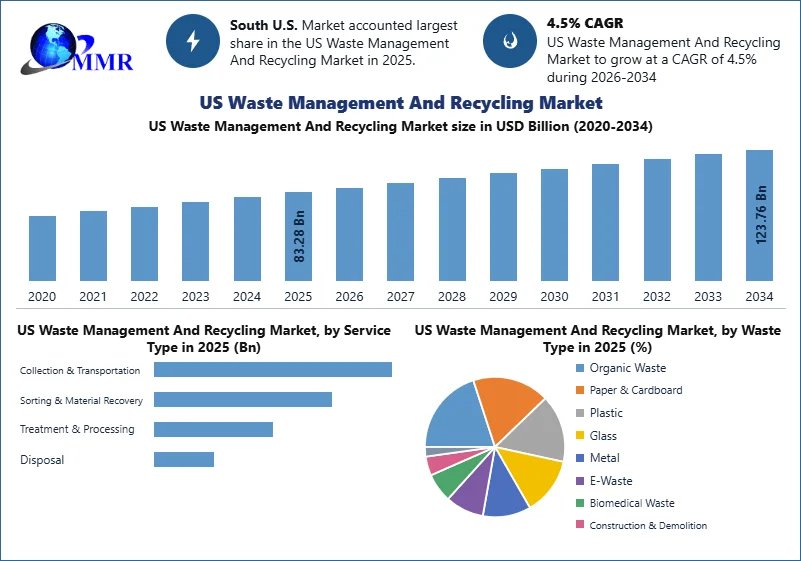
The U.S Waste Management and Recycling Market size was valued at USD 83.28 Billion in 2025 and the total U.S Waste Management and Recycling revenue is expected to grow at a CAGR of 4.5% from 2025 to 2034, reaching nearly USD 123.76 Billion by 2034.
 To know about the Research Methodology :- Request Free Sample Report
U.S Waste Management and Recycling Industry Analysis
The landscape of the US waste management and recycling market in the current scenario shows a mature but still expanding service industry driven by landfill management, recycling infrastructure upgrades, organics diversion, hazardous waste handling, and circular-economy programs. In 2025, the core waste management and remediation services segment generated about USD 162.7 billion in annual revenue, calculated from U.S. Census Bureau quarterly employer-firm revenue of USD 39.44 billion in Q1 2025, USD 41.72 billion in Q2 2025, USD 41.89 billion in Q3 2025, and USD 39.66 billion in Q4 2025. This shows that the market is no longer being defined only by waste volume, but increasingly by service revenues from collection, treatment, disposal, remediation, recycling, and recovery operations.
The market continues to be anchored by landfill and post-consumer waste infrastructure. EPA’s Landfill Methane Outreach Program database tracks more than 2,600 municipal solid waste landfills in the United States, covering landfills that are currently accepting waste or were closed in recent decades. This large landfill base keeps disposal, landfill gas management, methane capture, leachate control, and regulatory compliance as major revenue-generating activities within the US waste management and recycling market.
Recycling and circular-economy investment are becoming stronger market drivers in 2025, supported by federal funding and policy-backed infrastructure upgrades. EPA’s Solid Waste Infrastructure for Recycling program provides USD 275 million in funding, allocated at USD 55 million per year from FY2022 to FY2026, to improve recycling systems, collection infrastructure, and materials management capacity. In addition, EPA’s Recycling Education and Outreach Grant Program provides USD 75 million through FY2026, and on August 25, 2025, EPA awarded a cooperative agreement to a national coalition focused on recycling education and outreach.
The US waste management and recycling market is shifting from a disposal-led model toward a more integrated resource-management model. Market players are focusing on landfill optimization, advanced material recovery, organics recycling, composting, anaerobic digestion, contamination reduction, recycling education, and data-driven recycling measurement. EPA’s circular-economy implementation work also highlights ongoing actions around food waste prevention, organics recycling, composting expansion, anaerobic digestion, landfill methane tools, and improved recycling data collection, indicating that the market’s current growth is increasingly tied to sustainability compliance, methane reduction, and circular-economy infrastructure rather than traditional collection and disposal alone.
The Rising Promise of Waste-to-Energy Innovations
Waste-to-energy (WTE) solutions represent a ground-breaking frontline in addressing mounting waste challenges while harnessing renewable energy sources. These cutting-edge methods convert diverse waste streams into valuable energy forms like electricity, heat, and fuel driving the US waste management and recycling market.
Incineration, a fundamental process, significantly reduces waste volume by burning materials at high temperatures, generating heat for electricity production or direct heating, which results in producing electricity and tackling waste.
Anaerobic digestion transforms organic waste into biogas and fertilizer, offering renewable energy alternatives from food scraps and agricultural residues.
Gasification and pyrolysis technologies yield syngas, bio-oil, and char, enabling versatile energy applications and manufacturing feedstock.
Waste-to-energy technologies are being explored as alternatives to conventional waste disposal methods. Waste-to-energy solutions not only reduce the volume of waste sent to landfills but also contribute to sustainable energy production driving the US waste management and recycling market.
U.S Waste Management and Recycling Market Segment Analysis
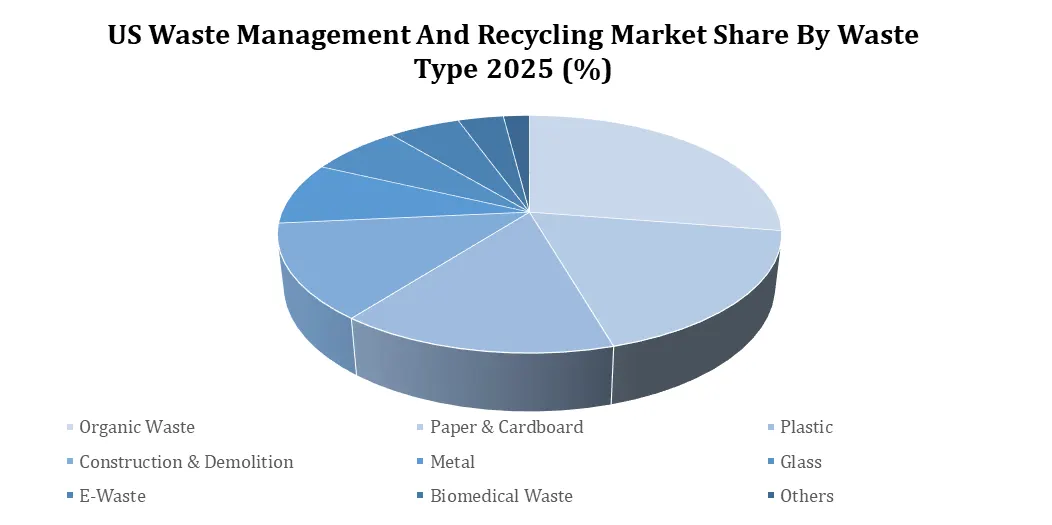
Based on Waste Type, the Organic Waste segment held the largest market share of about XX% in the U.S. Waste Management and Recycling Market in 2025. According to MMR analysis, the segment is further expected to grow at a CAGR of XX% during the forecast period, driven by increasing municipal solid waste generation, expanding food waste diversion programs, and rising investments in composting and anaerobic digestion facilities. Growing emphasis on reducing landfill dependence and lowering greenhouse gas emissions has further strengthened the adoption of organic waste recycling and recovery solutions across the United States.
- EPA's Food Recovery Hierarchy and Sustainable Materials Management (SMM) Program: The U.S. Environmental Protection Agency promotes food waste prevention, composting, and anaerobic digestion through its Sustainable Materials Management initiatives, supporting municipalities and businesses in diverting organic waste from landfills.
- State-Level Organic Waste Diversion Regulations: States such as California have implemented mandatory organic waste recycling regulations under SB 1383, requiring the diversion of organic waste from landfills to reduce methane emissions and expand composting and renewable natural gas production.
By Service Type
The waste management market is segmented by service type into collection & transportation, sorting & material recovery, treatment & processing, and disposal. Collection and transportation form the foundation of the waste management value chain by ensuring efficient movement of waste from generation points to processing facilities. Sorting and material recovery improve resource recovery through the separation of recyclable materials, while treatment and processing include recycling, composting & anaerobic digestion, and waste-to-energy (incineration), enabling waste valorization and reducing landfill dependency. Disposal services remain essential for handling residual waste that cannot be economically recovered or processed.
By Source
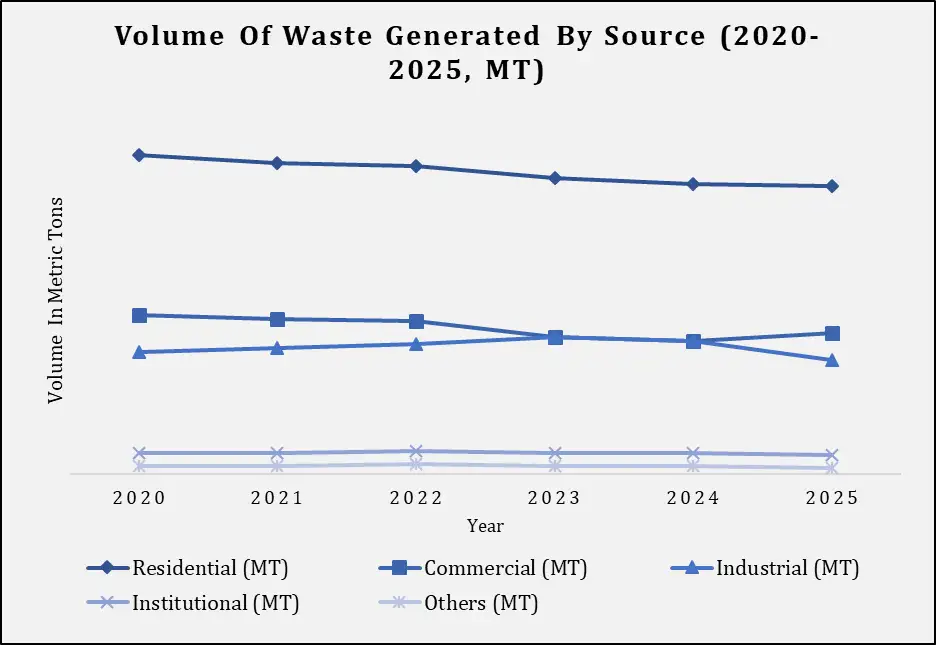
The market is further segmented by waste source into residential (municipal), commercial, industrial, institutional, and others. Residential waste remains the largest contributor owing to rapid urbanization and population growth, while the commercial segment includes waste generated from retail, offices, hospitality, healthcare facilities, and other business establishments. Industrial waste originates from manufacturing, construction & demolition, agriculture, medical, and other industrial activities, requiring customized collection and treatment solutions. Institutional waste generated by educational institutions, government offices, and public facilities further contributes to market demand, driving the adoption of integrated waste management systems across diverse end-use sectors.
Recent Development
September 2025 – Aurubis started production at its Aurubis Richmond multimetal recycling plant in Georgia, marking one of the most important recent recycling-capacity investments in the US market. The facility represents an investment of about USD 800 million, creates more than 240 jobs, and is designed to process up to 180,000 tons of complex recycling material annually, including printed circuit boards, copper cable, and other metal-bearing materials. This development strengthens the US recycling market by expanding domestic recovery of copper, nickel, tin, and precious metals, reducing dependence on imported strategic metals, and supporting demand from energy infrastructure, data centers, AI applications, and defense industries.
February 2026 – Clean Harbors announced an agreement to acquire certain businesses of Depot Connect International for about USD 130 million, covering five locations in Ohio, Louisiana, and Texas that provide waste handling, tank cleaning, railcar cleaning, wastewater treatment, and solidification capabilities. The company also announced a USD 50 million strategic investment to expand its vacuum truck fleet over two years. This strengthens the hazardous and industrial waste management segment in the US by expanding technical services capacity, improving field-service reach, and supporting higher demand from PFAS, remediation, reshoring, and industrial project activity.
April 2026 – GFL Environmental completed the acquisition of Frontier Waste Solutions, a vertically integrated solid waste platform across 24 sites in Texas, supported by more than 650 vehicles and nearly 1,000 employees. Along with Frontier, GFL also completed seven other tuck-in acquisitions since the start of 2026, with the combined deals expected to contribute USD 425 million to USD 450 million in annualized revenue. This development increases consolidation in the US waste management market, strengthens GFL’s position in the fast-growing Texas Triangle, and improves route density, collection scale, and disposal-network efficiency.
April 2026 – Casella Waste Systems completed the acquisition of Star Waste Systems, a privately held waste collection company operating in eastern Massachusetts, the Greater Boston area, and southern New Hampshire. The transaction is expected to generate about USD 100 million in annualized revenue and includes three solid waste collection locations plus a construction and demolition processing and transfer station. This acquisition strengthens Casella’s New England footprint, increases collection density in the Boston market, and expands its ability to serve residential, commercial, roll-off, and C&D waste streams.
April 2026 – WM completed three recycling growth projects during the first quarter of 2026, beginning operations at new recycling facilities in Ontario and Detroit and completing a recycling automation project in South Florida, now its largest single-stream facility. Together, these projects added nearly 300,000 tons of processing capacity. This development supports the US recycling market by increasing material recovery capacity, improving automation-led sorting efficiency, and helping produce cleaner recyclable commodities for downstream end markets.
Competitive Analysis
The U.S. Waste Management and Recycling Market is highly consolidated at the national level, with WM, Republic Services, Waste Connections, GFL Environmental, and Casella Waste Systems competing through scale, route density, landfill ownership, transfer stations, recycling assets, pricing discipline, and acquisition-led expansion. WM remains the largest integrated player, supported by its expanding renewable energy and recycling asset portfolio, while Republic Services continues to strengthen its recycling, solid waste, special waste, hazardous waste, and field services portfolio. Waste Connections maintains a strong margin-led model, reporting USD 9.47 billion revenue in 2025, while GFL continues to expand through acquisitions and operational efficiency. Casella is a strong regional competitor in the Northeast, supported by USD 1.84 billion revenue in 2025, and Rumpke and Recology compete as strong private/regional players, with Rumpke focused on Midwest landfill and recycling infrastructure and Recology positioned around West Coast zero-waste, composting, and resource recovery services.
Competition is also intensifying in specialized waste streams, where Clean Harbors, Veolia North America, and Reworld hold strong positions in hazardous waste, industrial services, wastewater treatment, PFAS destruction, energy-from-waste, and circular waste solutions. Clean Harbors reported USD 6.03 billion revenue in 2025, strengthening its leadership in environmental and industrial services, while Veolia significantly expanded its U.S. hazardous waste position through the Clean Earth acquisition, which doubled its U.S. hazardous waste footprint. Reworld competes through waste-to-energy, landfill diversion, metals recovery, wastewater recycling, and alternative fuel solutions, supported by more than 90 facilities and over 3,000 vehicles. The competitive landscape is shifting from traditional collection and landfill services toward integrated environmental solutions, recycling automation, circular economy infrastructure, hazardous waste treatment, and sustainability-driven service contracts.
U.S Waste Management and Recycling Market Scope: Inquire Before Buying
| U.S Waste Management and Recycling Market | |||
|---|---|---|---|
| Report Coverage | Details | ||
| Base Year: | 2025 | Forecast Period: | 2026-2034 |
| Historical Data: | 2020 to 2024 | Market Size in 2025: | US $ 83.28 Bn. |
| Forecast Period 2026 to 2034 CAGR: | 4.5% | Market Size in 2034: | US $ 123.76 Bn. |
| Segments Covered: | by Waste Type | Organic Waste Paper & Cardboard Plastic Glass Metal E-Waste Biomedical Waste Construction & Demolition Others |
|
| by Service Type | Collection & Transportation Sorting & Material Recovery Treatment & Processing Recycling Composting & Anaerobic Digestion Waste-to-Energy (Incineration) Disposal |
||
| By Source | Residential (Municipal) Commercial Retail Offices Hospitality Healthcare Facilities Others Industrial Manufacturing Construction & Demolition Agriculture Medical Others Institutional Others |
||
U.S Waste Management and Recycling Market Key Players
The Leading key Players in the U.S Waste Management and Recycling Market are,
- WM (Waste Management, Inc.)
- Republic Services, Inc.
- Waste Connections, Inc.
- Clean Harbors, Inc.
- GFL Environmental Inc.
- Veolia North America
- Casella Waste Systems, Inc.
- Reworld
- Rumpke Waste & Recycling
- Recology
Others
Frequently Asked Questions:
1.. What is the growth rate of U.S Waste Management And Recycling Market?
Ans: The U.S Waste Management And Recycling Market is growing at a CAGR of 4.5% during forecasting period 2026-2034.
2.. What is scope of the U.S Waste Management And Recycling Market report?
Ans: The U.S. Waste Management and Recycling Market report provides an analytical assessment of PESTEL, Porter’s Five Forces, circular economy trends, AI-enabled recycling technologies, investor and leadership recommendations, and market size estimation for the forecast period.
3. Who are the key players in U.S Waste Management And Recycling Market?
Ans: The important key players in the U.S Waste Management And Recycling Market are – Waste Management, WM Recycle America, Progressive Waste Solutions, Waste Connections, Sims Metal Management, OmniSource, American Iron & Metal, Sonoco Recycling, Rexam, Greenstar, AMP Robotics, National Waste & Recycling Association, Environmental Protection Agency, RecycleMatch.
4. What is the study period of this Market?
Ans: The U.S Waste Management And Recycling Market is studied from 2025 to 2034.