
TV Gateway Device Market Size by Type, End-User, Applications, Region – Segment-Level Market Assessment, Growth Opportunity Analysis, Competitive Mapping & Forecast to 2032
Overview
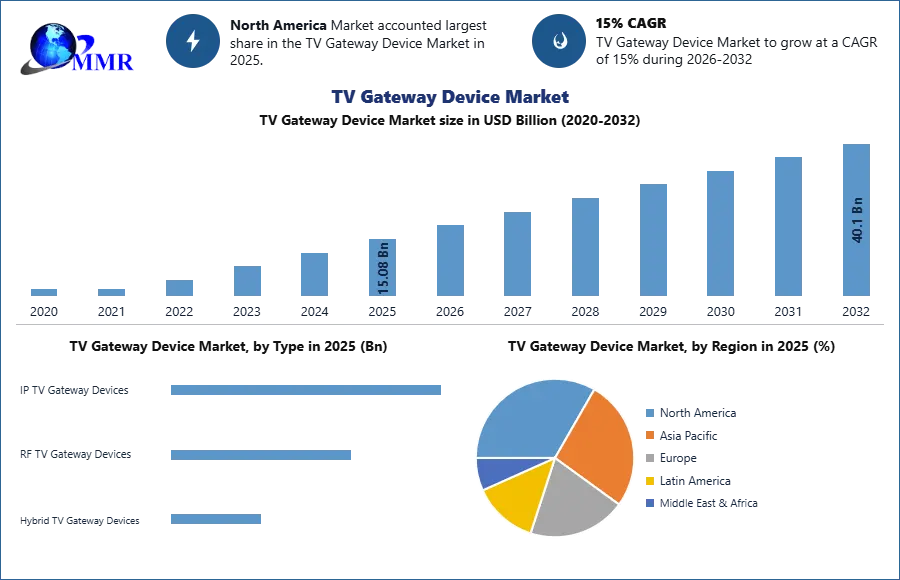
The Global TV Gateway Device Market was valued at USD 15.08 Billion in 2025 and is projected to reach USD 40.1 Billion by 2032, growing at a CAGR of 15%, driven by OTT growth, smart TV adoption, and 5G expansion.
A TV Gateway Device is a networking device that connects television services with broadband networks, enabling the delivery of digital TV, IPTV, OTT content, and other multimedia services through a single integrated platform. It acts as a central hub within residential or commercial environments, managing video streaming, internet connectivity, and communication services across multiple devices.
The TV Gateway Device Market is experiencing steady growth due to increasing demand for high-speed internet, rising adoption of smart TVs, and expansion of IPTV and OTT platforms. Consumers are seeking seamless access to high-definition and on-demand content across multiple screens, which has accelerated the deployment of advanced gateway solutions by telecom and broadband service providers.
The market is segmented based on type, application, end-user, and region. Growth is further supported by the expansion of fiber-optic infrastructure, increasing penetration of connected home ecosystems, and integration of cloud-based service management systems.
 To know about the Research Methodology :- Request Free Sample Report
The report provides a detailed analysis of market trends, technological advancements, competitive landscape, and regional outlook. It evaluates historical performance and current industry developments to offer strategic insights into the evolving TV Gateway Device market.
TV Gateway Device Market Dynamics
The TV Gateway Device market is driven by the increasing demand for high-speed internet connectivity and advanced home entertainment solutions. Growing adoption of smart TVs, over-the-top (OTT) platforms, and integrated digital services has accelerated the need for gateway devices that can efficiently manage video streaming, broadband connectivity, and multi-device integration within households.
Rising penetration of fiber-optic networks and expansion of IPTV services are further supporting market growth. Service providers are increasingly deploying advanced gateway devices to deliver bundled services such as internet, voice, and television through a single platform. The growing trend of connected homes and IoT-enabled devices also strengthens demand for high-performance TV gateway systems capable of handling multiple data streams simultaneously.
Technological advancements, including improved Wi-Fi standards, cloud-based management systems, and enhanced security protocols, are enhancing device efficiency and user experience. Increasing consumer preference for seamless content access across multiple screens is another key growth driver.
However, high installation and upgrade costs, rapid technological obsolescence, and cybersecurity concerns may restrain market expansion. Despite these challenges, continuous innovation in broadband infrastructure and increasing digitalization across residential and commercial sectors are expected to create significant growth opportunities for the TV Gateway Device market.
TV Gateway device Market Segment Analysis
The market is divided into 4 major segments to forecast the market size by value.
Based on Type
In 2025, IP TV gateway devices held the largest share of roughly 57% in the TV Gateway Device Market. This segment led as content consumption increasingly shifted to internet-protocol networks rather than traditional broadcast systems. IP TV gateways enable operators to deliver live and on-demand video to multiple screens, including smart TVs, smartphones, and set-top boxes, aligning with modern consumer viewing habits. Telecom companies and cable providers expanded IPTV services to compete with OTT platforms, further driving IP gateway adoption. The flexibility, scalability, and integration capabilities of IP solutions made them more attractive than RF-only devices. Hybrid devices also gained ground, but IP-centric systems remained dominant.
Based on Deployment Mode
The cloud-based deployment segment accounted for about 62% share in 2025, making it the leading mode of implementation. Cloud-based TV gateway solutions provided service providers with superior scalability, lower upfront infrastructure costs, and easier remote management compared to on-premise systems. With the rise of virtualization and edge computing, telecom and media companies preferred cloud deployments to support multiple video services, analytics, and content delivery workflows. Cloud gateways also enabled simpler integration with OTT platforms and advanced features like personalization and real-time monitoring. These benefits made cloud-based setups the preferred choice for large operators.
TV Gateway device Market Regional Analysis
North America led the TV Gateway Device Market in 2025 with about 39% share. High broadband penetration, early adoption of IPTV and OTT services, and extensive investments in cloud-based video infrastructure supported regional dominance. Major telecom operators and cable providers in the U.S. and Canada aggressively deployed advanced gateway solutions to compete with global streaming platforms. Consumer demand for high-quality video, multiscreen content, and integrated services further boosted regional uptake. Europe and Asia Pacific showcased strong growth, but North America’s mature digital ecosystem and high per-capita video consumption sustained its leading position.
Asia Pacific accounted for nearly 30% of the global market in 2025, positioning it as the second-largest region. Rapid broadband expansion, growing middle-class population, and strong smart TV adoption supported gateway demand. Countries like China, India, Japan, and South Korea expanded IPTV and hybrid TV services significantly.
The objective of the report is to present a comprehensive analysis of the TV gateway device market to the stakeholders in the industry. The past and current status of the industry with forecasted market size and trends are presented in the report with the analysis of complicated data in simple language. The report covers all the aspects of the industry with a dedicated study of key players that includes market leaders, followers, and new entrants. PORTER, SVOR, PESTEL analysis with the potential impact of micro-economic factors of the market has been presented in the report. External as well as internal factors that are supposed to affect the business positively or negatively have been analyzed, which will give a clear futuristic view of the industry to the decision-makers.
The report also helps in understanding TV gateway device market dynamics, structure by analyzing the market segments and projects the TV gateway device market size. Clear representation of competitive analysis of key players by product, price, financial position, product portfolio, growth strategies, and regional presence in the TV gateway device market make the report investor’s guide.
Scope of TV Gateway device Market: Inquire before Buying
| TV Gateway Device Market | |||
|---|---|---|---|
| Report Coverage | Details | ||
| Base Year: | 2025 | Forecast Period: | 2026-2032 |
| Historical Data: | 2020 to 2025 | Market Size in 2025: | 15.08 USD Billion |
| Forecast Period 2026-2032 CAGR: | 15% | Market Size in 2032: | 40.1 USD Billion |
| Segments Covered: | by Type | IP TV Gateway Devices RF TV Gateway Devices Hybrid TV Gateway Devices |
|
| by Application | Live TV Streaming Time-Shifted TV / DVR Multiscreen & OTT Integration Advertisement Delivery & Analytics |
||
| by End-User | Residential Commercial Broadcasting & Media Telecommunication Providers |
||
TV Gateway device Market, by Region
North America (United States, Canada and Mexico)
Europe (UK, France, Germany, Italy, Spain, Sweden, Austria, Turkey, Russia and Rest of Europe)
Asia Pacific (China, India, Japan, South Korea, Australia, ASEAN and Rest of APAC)
Middle East and Africa (South Africa, GCC, Egypt, Nigeria and Rest of ME&A)
South America (Brazil, Argentina, Columbia and Rest of South America)
Key Players/Competitors Profiles Covered in Brief TV Gateway Device Market Report in Strategic Perspective
- Antik Technology
- Geniatech Inc.
- iBall
- AirTV L.L.C
- VBox Communications
- Shaw Communications
- MaxLinear
- Gira
- Exterity (a VITEC company)
- Grande Communications
- Virgin Media
- Wave Broadband
- Infinity dish
- CableLabs
- Hauppauge Computer Works
- SiliconDust
- Plex, Inc.
- Tablo (Nuvyyo, Inc.)
- Technicolor SA (Vantiva)
- Humax Co., Ltd.
- Sagemcom
- CommScope (ARRIS)
- Kaonmedia Co., Ltd.
- Zanthion