
Turf Care Equipment Market Size by Equipment Type, Fuel, End-Use, Region – Revenue Pool Analysis, Margin Structure Assessment, Capital Flow Trends, Competitive Benchmarking & Forecast to 2032
Overview
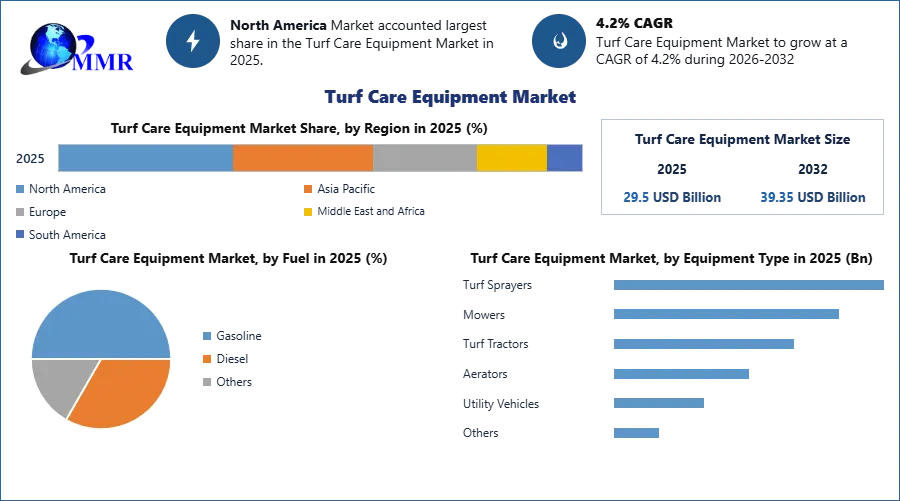
Turf Care Equipment Market was valued at USD 29.5 Bn in 2025, and the global Turf Care Equipment Market is expected to reach USD 39.35 Bn by 2032, growing at a CAGR of 4.2% during the forecast period.
Turf Care Equipment Market Overview:
Turf care equipment is utilized to aid in the conservation activities of the golf courses. Major turf care equipment includes sprayer, roller, top dressers, aerators, and the bunker rake machines. The maintenance of the big golf course sites has been greatly simplified using the turf care equipment and saving time taken in carrying out the activities.
The Turf Care Equipment Market exhibits a range of significant market trends. Key market drivers include the growing demand for lawn and garden maintenance in residential and commercial settings, as well as increasing concerns over environmental sustainability.
The Turf Care Equipment Market is experiencing growth fueled by the rising popularity of golf, with 208 countries practicing the sport in 2025 (NGF), and over 15,000 golf courses in the US alone. Increasing environmental concerns also shape the market, pushing for eco-friendly equipment that reduces water, fertilizer, and pesticide use.
Diesel fuel segment dominated in 2025 due to its efficiency and cost-effectiveness for commercial use, though demand for electric, hybrid, and propane alternatives is rapidly growing. The Commercial Lawn & Turf segment held the largest revenue share in 2025, serving extensive green spaces. North America leads regional growth, driven by its high concentration of golf courses.
 To know about the Research Methodology:- Request Free Sample Report
Turf Care Equipment Market Dynamics:
Rising in the number of golf courses to driving the demand for turf care equipment Market
National Golf Foundation (NGF), in 2025, indicated that 208 countries practise golf out of the international total of 251 countries and dependent territories. According to the NGF records, the numbers within the period extending from 2010 to 2025 have grown by almost 44 percent. Further, according to the ASIAN Golf, there had been approximately 5,000 golf courses established in the Asian continent as of March 2025, and among them, 196 were registered in India. Thus, the increasing trends among the population in liking the golf game and the increasing passion to play this game will be the propelling factors for the market of turf care equipment until the forecast period.
Increasing Environmental Concerns help to drive the turf care equipment Market
Demand for turf care equipment is also growing due to the increasing environmental concerns. Uncontrolled watering and fertilizing turf using conventional techniques may be negative to the environment. It is increasingly required to have turf care equipment that is less harmful to the environment. This will comprise equipment that requires less water and fertilizer, and equipment that runs on renewable sources of energy, and lastly, there will be a demand for turf care equipment that could be used to reduce the utilization of pesticides and herbicides in turf. This has been because of the growing knowledge of the adverse effects of these chemicals on human health as well as the environment.
Cost decreases and improved energy density of EV batteries create challenges in the turf care equipment Market
The need to care about the environment is also pushing the demand for turf care equipment. Uncontrolled watering and fertilizing turf using conventional techniques may be negative to the environment. Consequently, it is increasingly required to have turf care equipment that is less harmful to the environment. This will comprise equipment that requires less water and fertilizer, and equipment that runs on renewable sources of energy, and lastly, there will be a demand for turf care equipment that could be used to reduce the utilization of pesticides and herbicides in turf. This has been because of the growing knowledge of the adverse effects of these chemicals on human health as well as the environment.
Turf Care Equipment Market Segment Analysis:
Based on Fuel, the Diesel segment dominated the product type segment in 2025 and is expected to be the fastest-growing segment during the forecast period. Diesel is utilized primarily and commands a significant share in the Turf Care Equipment market by volume and value in commercial lawn care equipment. Diesel provides more energy per unit of volume and gives higher performance and efficiency. Diesel is widely used by both producers and users of lawn care equipment since it is less expensive than gasoline .A small quantity of ethanol, which can be corrosive and absorb water, is included in gasoline.
This ethanol may make it difficult to start or run a lawn mower and, in certain situations, may even harm the fuel system. Due to the numerous benefits, alternative fuels have over conventional fuels, demand for other fuels, including electric, hybrid, and propane, is expected to rise quickly.
Compared to electric-powered equivalents, gas-powered equipment has a greater operational range and a higher power output. Gas-powered equipment is the best option for the extended operations needed in commercial environments. Businesses all around the world are already investigating the benefits of gas-powered machinery and are constantly creating new variants.
Based on End Use, the Commercial Lawn & Turf segment dominated the applications segment in terms of Turf Care Equipment Market revenue share in 2025. Turf care equipment has a significant Turf Care Equipment industry share in commercial lawns and sports fields. In terms of value, Commercial Lawn & Turf segment holds up to half of the market share. Companies, industrial complexes, public lands, parks, private school grounds, along roadside berms, and other service locations all have lawns. Because they preserve open spaces, offer recreation, raise property values, and enhance environmental protection, lawns and other grass areas are valuable resources. Sports lawns and turfs are another market segment that is influencing the turf care equipment industry's increasing demand.
Turf Care Equipment Market Regional Insights:
Rising Sports Trends create a North America-dominated Turf Care Equipment Market
The North America region held the largest market share during the forecast period. The Turf Care Equipment industry demand is expected to increase as there are more golf courses in the North American region. A significant portion of the Turf Care Equipment market growth is attributed to the high regional concentration of golf courses, which includes Shinnecock Hills, Pine Valley, National Golf Links of America, Oakmont, Sand Hills, Merion (East), Augusta National, Pebble Beach, and Bandon Dunes (Pacific Dunes). Equipment for turf care is used to mow the grass and pull weeds for better sporting enjoyment. Retirement communities or other planned communities are the main consumers attracted by golf courses.
The significant growth drivers of turf care equipment consumption are the high density of golf courses and the rapidly growing course maintenance operations. MMR analyst estimates that the United States has over 15,000 golf courses, or more than 40% of all golf courses worldwide, making it the country with the most golf courses in the world. In terms of the number of people per golf course or hole, it comes in seventh place and has a big impact on the growth of the sector.
It is expected that the volume share of turf care equipment would increase due to golfers' increasing involvement in sporting events. Tournaments that necessitate regular golf course maintenance would be stimulated by the age group of older adults, which is growing. In North America, where disposable expenditures are higher than in other places, using turf care equipment for activities at golf courses and country clubs will be greatly encouraged. One of the highest rates of household net-adjusted disposable income per capita is seen in the United States.
Turf Care Equipment Market Competitive Landscape:
Top Key Players: The Toro Company (USA), John Deere (USA), Cub Cadet (USA), AriensCo (USA), Exmark Manufacturing (USA).
The Toro Company, a global leader, holds a strong position, especially with its professional-grade equipment and its ownership of Exmark Manufacturing, which dominates the zero-turn mower segment. Toro continuously invests in R&D, as evidenced by its announced $100 million expansion of biologicals R&D (May 2025), reflecting a broader push into sustainable solutions that align with turf care. John Deere leverages its extensive agricultural machinery expertise to offer robust and technologically advanced turf care solutions. Their recent focus includes significant advancements in autonomous mowing technology for commercial landscaping, as showcased at CES 2025 (January 2025), and earning multiple AE50 Awards for engineering innovation (March 2025). This emphasizes their commitment to precision and efficiency, as these companies reshape the competitive landscape, with these firms at the forefront of innovation.
Key Trends:
• Electrification and Sustainable Solutions (2024-2025)
A monumental change is occurring in the direction of the means of electric and battery-powered turf care supplies. This is motivated by the growing concern about the environment such as the need to have fewer carbon emissions, noise pollution etc. As an example, the installed base of battery-powered equipment among consumers in 2024 was already one-third of the consumer outdoor power equipment installed base, and 44 percent of consumers thought they will buy battery-powered equipment in the future. The manufacturers are also spending in battery technology providing near identical power to the usual petrol options with less maintenance.
• Growing Emphasis on Eco-Friendly Practices and Water Conservation
Beyond merely electric equipment, there also is a more general shift towards sustainable turf management as a whole. This not just involving zero-concern machinery but additionally some improvement to modern irrigation used where real-time data and moisture channels in the ground acerbate a situation of maximally utilizing water, wasting less. Artificial turf technology is also catching up as they innovate with the use of environmentally friendly materials and improved drainage just to save on water and avoid problems like molds as shown in the developments that are expected in 2025.
Key Development:
• May 24, 2024: Autonomous Turf Tracer with XiQ Technology
The Toro Company launched the autonomous Exmark Turf Tracer with XiQ Technology. This innovative development integrates cloud services, mobile applications, and autonomous control software, enabling landscape professionals to manage turf care more efficiently and effectively by automating mowing tasks.
• Jan 22, 2025: Expansion of Autonomous Machines & AI
John Deere unveiled a broader range of autonomous equipment, adding an increasing twist on their first autonomous tractor. This involves self-driving commercial mower with use of state-of-the-art camera and artificial intelligence, where the personnel can perform another job as the mower completes its work and accurately cuts the grass. This is a major milestone towards the attainment of full autonomy of various turf and landscape applications.
• Aug 11 2024: Strategic Acquisitions for Smart Solutions
Investments Husqvarna has had strategic growth by acquisition of smart solution. In March 2024 they purchased the smart irrigation manager firm ETwater to enhance the commercial portfolio of its Gardena Division. Two months later, in August 2024, they acquired InCeres a digital platform to manage light agriculture, which further shows their focus is to implement digital services and smart technology in the process of caring about the turf and gardens.
• October 15 2024: Accelerated Battery Transformation & Production Investment
In 2024, STIHL went much faster with its so-called battery transformation and battery-powered products amounted to 25 percent of the total units sold. These strategic moves are supported by significant investments, where the building of a new 7,800 sq. meter battery production plant in Virginia Beach, USA and a new plant in Oradea, Romania is scheduled to open in October 2025, being a key location to produce batteries products and packs
Turf Care Equipment Market Scope: Inquire before buying
| Turf Care Equipment Market | |||
|---|---|---|---|
| Report Coverage | Details | ||
| Base Year: | 2025 | Forecast Period: | 2026-2032 |
| Historical Data: | 2020 to 2025 | Market Size in 2025: | 29.5 USD Billion |
| Forecast Period 2026-2032 CAGR: | 4.2% | Market Size in 2032: | 39.35 USD Billion |
| Segments Covered: | by Equipment Type | Turf Sprayers Mowers Turf Tractors Aerators Utility Vehicles Others |
|
| by Fuel | Gasoline Diesel Others |
||
| by Propulsion Type | Gas-Powered Electric Battery-Powered Hybrid |
||
| by End-Use | Commercial Lawn & Turf Sports Lawn & Turf Golf Turf Other Turfs |
||
Turf Care Equipment Market, by Region
North America (United States, Canada and Mexico)
Europe (UK, France, Germany, Italy, Spain, Sweden, Austria and Rest of Europe)
Asia Pacific (China, South Korea, Japan, India, Australia, Indonesia, Malaysia, Vietnam, Taiwan, Bangladesh, Pakistan and Rest of APAC)
Middle East and Africa (South Africa, GCC, Egypt, Nigeria and Rest of ME&A)
South America (Brazil, Argentina Rest of South America)
Turf Care Equipment Market Key Players:
North America
1. The Toro Company (USA)
2. John Deere (USA)
3. Cub Cadet (USA)
4. AriensCo (USA)
5. Exmark Manufacturing (USA)
Europe
1. STIHL (Germany)
2. Husqvarna (Sweden)
3. Etesia (France)
4. Viking (Austria)
5. CLAA (Germany)
Asia Pacific
1. Kubota Corporation (Japan)
2. Yanmar Co., Ltd. (Japan)
3. Iseki & Co., Ltd. (Japan)
4. Honda Power Equipment (Japan)
5. Foton Lovol International Heavy Industry (China)
Middle East & Africa
1. Bell Equipment (South Africa)
2. Adama Ltd. (Israel)
3. Al-Ghurair Iron & Steel (Dubai)
4. Cimcoop Holding Ltd. (Bulgaria)
5. BMC Industrial (Dubai)
South America
1. Jacto (Brazil)
2. Stara S.A. (Brazil)
3. Agrale S.A. (Brazil)
4. Civemasa (Brazil)
5. Maschio Gaspardo (Italy)