Global Transhumanism Market by Technology (Biotechnology, Nanotechnology, Cognitive Enhancement, AI and Robotics, Virtual Reality and Augmented Reality, Other), Application (Healthcare & Medical, Technology and Electronics, Research and Development, Consumer Goods, Others) - Forecast to 2032

22.8%
CAGR (2026-2032)
55.45 USD Bn.
Market Size
329
Report Pages
139
Market Tables

Overview

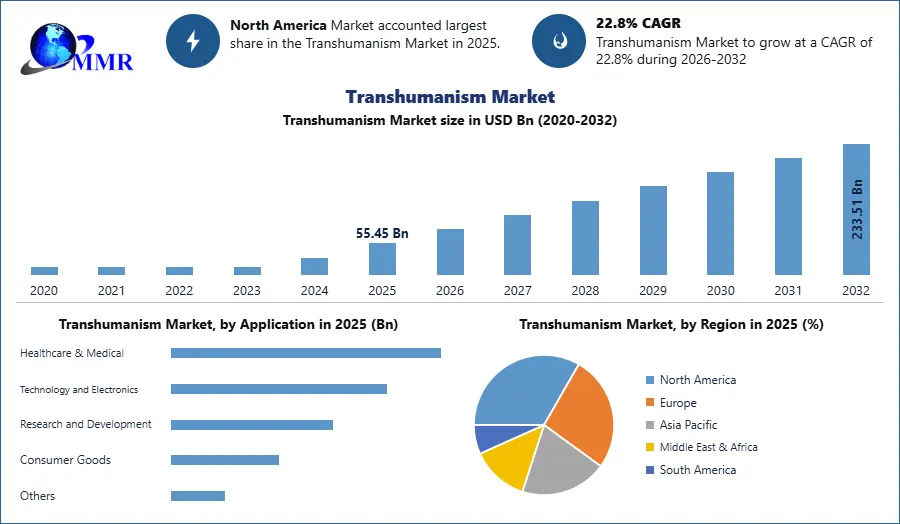
Global Transhumanism Market was valued at USD 55.45 Billion in 2025 and the total revenue is expected to grow at a CAGR of 22.8% from 2026 to 2032, reaching nearly USD 233.51 Billion.

Transhumanism Market Overview:

Transhumanists advocate the improvement of human capacities over advanced technology. Transhumanism stands as a philosophical and intellectual movement that champions the progression of human existence through the creation and widespread access to advanced technologies capable of significantly augmenting longevity and cognitive abilities. This movement emphasizes an interdisciplinary perspective that delves into the possibilities of elevating the human state and form through technological advancements. It encompasses existing innovations like genetic engineering and information technology, as well as expected future breakthroughs such as molecular nanotechnology and artificial intelligence (AI).
Transhumanism MarketTo know about the Research Methodology :- Request Free Sample Report

4th Industrial Revolution- Increase of Transhumanism

The 4th Industrial Revolution marks a transformative era categorized by the convergence of digital, biological, and physical technologies, reshaping the way we live and work. Central to this revolution is the emergence of transhumanism, a concept gaining traction as technology evolves to a point where it can directly develop human capabilities.

Transhumanism predicts a future where advancements in fields like biotechnology, artificial intelligence (AI), and nanotechnology lead to profound alterations in human physiology and cognition. It envisions brain-computer interfaces seamlessly integrating our minds with machines, genetic enhancements enabling us to overcome biological limitations, and a merging of digital and organic realms. However, the rise of transhumanism is accompanied by profound ethical and societal questions, including concerns about inequality, loss of privacy, and the very essence of human identity.

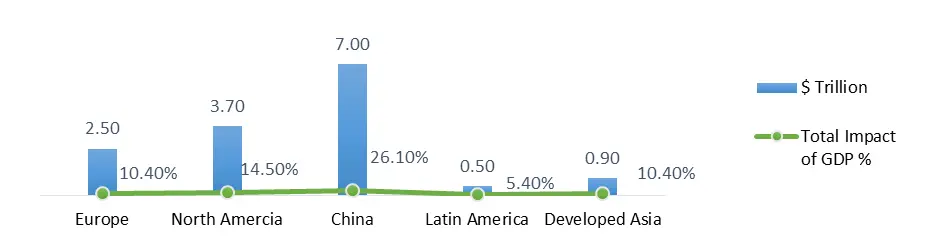
AI and the Global Economy: Which Region Will Benefit the Most by 2030
Transhumanism Market

Transhumanism Market Dynamics:

Transhumanism Market dynamics are thoroughly studied and explained in the MMR report, which helps reader to understand emerging transhumanism market trends, drivers, restraints, opportunities, and challenges at global and regional level for the Transhumanism Market.

People Are Increasingly Interested in Improving Their Physical and Cognitive Abilities:

Transhumanist technologies such as brain-computer interfaces and gene editing, have the potential to make people smarter, stronger, and faster. Brain-computer interfaces (BCIs) are devices that allow people to control machines with their minds. This technology has the potential to be used to improve cognitive abilities, such as memory & attention. For example, BCIs could be used to help people with cognitive impairments, like Alzheimer's disease. They could also be used to enhance the cognitive abilities of healthy people for instant improving their memory or focus.

Gene editing is the process of changing the DNA of an organism. This technology has the potential to be used to improve physical abilities, such as strength and speed. For example, gene editing could be used to create athletes who are stronger and faster than ever before. It could also be used to treat genetic diseases that affect physical abilities, such as muscular dystrophy. The desire to improve human performance is a complex issue. There are ethical and moral considerations that need to be taken into account. However, transhumanist technologies offer the potential to help to achieve the goals and live better lives.

Advancement Of Technology Is Opening Up New Possibilities for Transhumanist Technologies:

The rapid advancement of technology is fundamentally reshaping our world and has a profound impact on various fields, including transhumanism. This unparalleled rate of technological progress is unveiling novel opportunities and horizons for the development and integration of transhumanist technologies and is expected to drive the Transhumanism Market growth. One notable area where this transformation is evident is in the convergence of technology and biology, where artificial intelligence (AI) is playing a pivotal role.
AI is becoming increasingly powerful, and it is being used to develop a variety of transhumanist technologies, such as brain-computer interfaces and autonomous robots. For example, AI is being used to develop brain-computer interfaces that can translate thoughts into text or control machines with the mind. AI is also being used to develop autonomous robots that can perform tasks that are dangerous or difficult for humans, such as bomb disposal or surgery.

Growing Interest in Funding R&D into Transhumanist Technologies to Influence the Transhumanism Market:

The increasing availability of funding signifies a rising interest and willingness to allocate financial resources towards the research and development of transhumanist technologies. This trend is driven by the recognition of the substantial potential that these technologies hold in addressing some of the most significant challenges faced by society. Some governments are also supporting transhumanist research, as they see the potential for these technologies to improve the lives of their citizens. For example, the US government is funding research into gene editing and bionic implants.

Transhumanism Market Challenges:

Transhumanist technologies are still in their early stages of development, and they are often very expensive. This makes them inaccessible to many people. The regulatory challenges surrounding transhumanist technologies. There are currently no clear regulations governing the development and use of transhumanist technologies. This could lead to safety concerns and could also make it difficult to get these technologies approved for use.

Financial barriers also affect the development and accessibility of transhumanist technologies. The costs related to research, development, and implementation can limit equitable access, creating disparities between those who can afford enhancements and those who cannot. Addressing these economic challenges is vital to prevent exacerbating existing societal differences. Societal acceptance and awareness present additional hurdles. The concept of transhumanism can be met with skepticism or fear due to concerns about the loss of human identity, privacy breaches in cognitive augmentation, or the blurring of boundaries between humans and machines. Bridging the gap between technological advancement and public understanding is important to foster informed discussions and alleviate concerns.

Transhumanism Market Trends:

1. Technology is advancing at an unprecedented rate, and this is opening up new possibilities for transhumanist technologies. For example, the development of artificial intelligence is making it possible to create machines that can think and act like humans.
2. AI is becoming increasingly powerful, and it is being used to develop a variety of transhumanist technologies, such as brain-computer interfaces and autonomous robots.
3. VR and AR are technologies that create immersive experiences that allow people to interact with virtual worlds. These technologies are being used to develop a variety of transhumanist technologies, such as training simulators and prosthetics that can be controlled by thought.
4. Chronic diseases are a major problem in the world, and they are a major cause of death and disability. Transhumanist technologies, such as gene editing and bionic implants, have the potential to treat and even cure chronic diseases.

Transhumanism Market Segment Analysis:

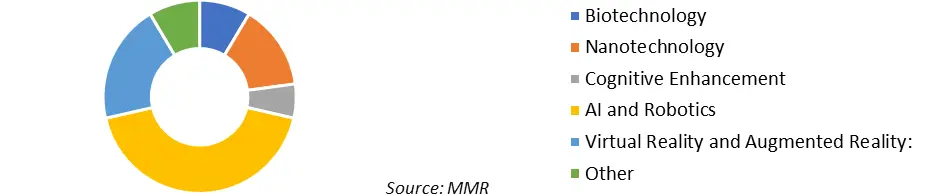
Based on Technology, AI and Robotics are expected to grow at the highest CAGR of 23.2% over the forecast period. Artificial Intelligence and robotics play a significant role in the transhumanism movement, offering the potential to enhance human capabilities, extend human lifespans, and address various challenges associated with human existence.

Transhumanism Market Share by Technology(%) by 2029
Transhumanism Market

AI-powered brain-computer interfaces establish direct communication between the human brain and external devices, fostering the potential to enhance cognitive functions and restore sensory abilities. Robotics plays a role in exoskeletons and prosthetics, creating devices that not only aid individuals with disabilities but enhance their physical capabilities beyond normal limits. Longevity research benefits from AI's data analysis capabilities, shedding light on aging processes and interventions for extended healthy lifespans. Socially, AI-powered companion robots provide companionship and support to the elderly, addressing issues of loneliness and isolation. Educational experiences are revolutionized by AI-driven virtual reality, offering personalized and immersive learning environments.

Transhumanism Market Regional Insights:

North America is the leading transhumanism market, with an expected share of 35% by 2032. This is attributed to the early adoption of new technologies in the region, as well as the high level of investment in research and development.

The United States has emerged as a major player in the transhumanism market, attributed to its robust research institutions and a regulatory environment that encourages innovation. An epicentre of technological progress, Silicon Valley in California has stood as a crucible for pioneering advancements in AI, biotechnology, and robotics. A significant number of the world's preeminent technology firms call North America home, actively spearheading the development and integration of transhumanist technologies.

Various European countries have been actively involved in transhumanist R&D. Countries like Germany, the UK, France, and the Netherlands have strong biotechnology and research sectors, which contribute to advancements in human enhancement technologies. Europe's emphasis on research and its commitment to ethical considerations play a role in shaping the development of transhumanist technologies in the region.

Global Transhumanism Market Competitive Analysis

Major companies today are strategizing about future investments and technologies like AI and IoT, or growth around new business models. While a multitude of these trends are poised to yield substantial returns over the upcoming 5-10 years, a smaller fraction of enterprises is engaging with the profound amalgamation of disparate trends hailing from technology, shifts in behaviour and society, and advancements in the medical realm. This contemplation aims to unravel how these diverse threads will intricately merge, culminating in a transformative force that reshapes society.

The Transhumanism Market is competitive with global, regional and emerging brands competing for market share. Companies invest in R&D to innovate products and meet consumer demands to stay ahead of competition. Some of the company illustrate below:

1. Neuralink: Neuralink is a neurotechnology company founded by Elon Musk that is developing brain-computer interface (BCI) technology. BCI technology can be used to record and stimulate brain activity, and it has the potential to treat neurological disorders, improve cognitive function, and even merge human consciousness with artificial intelligence.

2.OpenAI: OpenAI is a non-profit research company that is developing artificial general intelligence (AGI). AGI is a type of artificial intelligence that is as intelligent as a human being. OpenAI's goal is to ensure that AGI is developed safely and responsibly.

3.Biohack.me: Biohack.me is an online community and platform that is dedicated to do-it-yourself (DIY) transhumanist projects and body modifications. The community provides resources and support for individuals who are interested in using technology to enhance their bodies and minds.

4.Alcor Life Extension Foundation: Alcor is a cryonics company that offers cryopreservation services. Cryonics is the practice of preserving human bodies or brains at extremely low temperatures after death. The goal of cryonics is to potentially revive individuals in the future when advanced medical technologies are available.

5.Google: Google is a technology company that is not exclusively focused on transhumanism. However, Google has invested in various technologies and research areas that align with transhumanist ideas. This includes projects related to artificial intelligence, life extension, and biotechnology.

Transhumanism Market Recent Industry Developments (2025–2026)

 Date Company Development Impact
23 January 2026 NVIDIA CEO Jensen Huang announced advanced Agentic AI frameworks designed to interface directly with biological computing systems. The move accelerates the development of real-time cognitive augmentation and human-AI symbiosis.
10 February 2026 hVIVO The company secured a major Phase III contract for bacterial challenge trials, diversifying its Human Challenge Trials (HCT) portfolio. This strengthens the clinical pipeline for advanced life-extension therapies and immunology research.
18 March 2026 Ropes & Gray LLP Published a new project analysis on the security implications of brain-computer interfaces (BCIs) in the digital age. It establishes a regulatory framework for the ethical and secure integration of transhumanist hardware.
22 January 2026 Neuralink Elon Musk demonstrated a next-generation chip at a global summit, highlighting progress in telepathic control of devices. The demonstration validates the commercial viability of implantable neurotechnology for mainstream consumers.

Transhumanism Market Scope: Inquire Before Buying

Transhumanism Market
Report Coverage Details
Base Year: 2025 Forecast Period: 2026-2032
Historical Data: 2020 to 2025 Market Size in 2025: 55.45 USD Bn
Forecast Period 2026-2032 CAGR: 22.8% Market Size in 2032: 233.51 USD Bn
Segments Covered: by Technology Biotechnology
Nanotechnology
Cognitive Enhancement
AI and Robotics
Other
by Component Hardware
Software
Services
by Product Type Wearable Devices
Implantable Devices
Exoskeletons
Brain-Computer Interfaces
Smart Prosthetics
Neural Implants
by Application Healthcare & Medical
Technology and Electronics
Research and Development
Consumer Goods
Others
by End-User Hospitals & Clinics
Research Institutes
Military & Defense
Individual Consumers
Rehabilitation Centers

Transhumanism Market, by Region

North America (United States, Canada and Mexico)
Europe (UK, France, Germany, Italy, Spain, Sweden, Austria and the Rest of Europe)
Asia Pacific (China, South Korea, Japan, India, Australia, Indonesia, Malaysia, Vietnam, Taiwan, Bangladesh, Pakistan and the Rest of APAC)
South America (Brazil, Argentina Rest of South America)
Middle East & Africa (South Africa, GCC, Egypt, Nigeria and the Rest of ME&A)

Transhumanism Market key players

  1. Neuralink
  2. OpenAI
  3. Biohack.me
  4. Alcor Life Extension Foundation
  5. Google
  6. Medtronic
  7. Boston Scientific Corporation
  8. Abbott
  9. Synchron
  10. Blackrock Neurotech
  11. Kernel
  12. Paradromics
  13. Cala Health
  14. Nevro Corp
  15. LivaNova
  16. NeuroPace, Inc.
  17. Integra LifeSciences
  18. BrainGate
  19. Emotiv Inc.
  20. Bitbrain Technologies
  21. NextMind (Snap Inc.)
  22. Flow Neuroscience
  23. Humanity Inc
  24. Life Extension Foundation
  25. Verily Life Sciences

Table of Contents

1. Transhumanism Market Introduction
1.1. Study Assumption and Market Definition
1.2. Scope of the Study
1.3. Executive Summary
2. Global Transhumanism Market: Competitive Landscape
2.1. MMR Competition Matrix
2.2. Competitive Landscape
2.3. Key Players Benchmarking
2.3.1. Company Name
2.3.2. Business Segment
2.3.3. End-user Segment
2.3.4. Revenue (2025)
2.3.5. Company Locations
2.4. Leading Transhumanism Market Companies, by market capitalization
2.5. Market Structure
2.5.1. Market Leaders
2.5.2. Market Followers
2.5.3. Emerging Players
2.6. Mergers and Acquisitions Details
3. Transhumanism Market: Dynamics
3.1. Transhumanism Market Trends by Region
3.1.1. North America Transhumanism Market Trends
3.1.2. Europe Transhumanism Market Trends
3.1.3. Asia Pacific Transhumanism Market Trends
3.1.4. Middle East and Africa Transhumanism Market Trends
3.1.5. South America Transhumanism Market Trends
3.2. Transhumanism Market Dynamics by Region
3.2.1. North America
3.2.1.1. North America Transhumanism Market Drivers
3.2.1.2. North America Transhumanism Market Restraints
3.2.1.3. North America Transhumanism Market Opportunities
3.2.1.4. North America Transhumanism Market Challenges
3.2.2. Europe
3.2.2.1. Europe Transhumanism Market Drivers
3.2.2.2. Europe Transhumanism Market Restraints
3.2.2.3. Europe Transhumanism Market Opportunities
3.2.2.4. Europe Transhumanism Market Challenges
3.2.3. Asia Pacific
3.2.3.1. Asia Pacific Transhumanism Market Drivers
3.2.3.2. Asia Pacific Transhumanism Market Restraints
3.2.3.3. Asia Pacific Transhumanism Market Opportunities
3.2.3.4. Asia Pacific Transhumanism Market Challenges
3.2.4. Middle East and Africa
3.2.4.1. Middle East and Africa Transhumanism Market Drivers
3.2.4.2. Middle East and Africa Transhumanism Market Restraints
3.2.4.3. Middle East and Africa Transhumanism Market Opportunities
3.2.4.4. Middle East and Africa Transhumanism Market Challenges
3.2.5. South America
3.2.5.1. South America Transhumanism Market Drivers
3.2.5.2. South America Transhumanism Market Restraints
3.2.5.3. South America Transhumanism Market Opportunities
3.2.5.4. South America Transhumanism Market Challenges
3.3. PORTER's Five Forces Analysis
3.4. PESTLE Analysis
3.5. Technology Roadmap
3.6. Regulatory Landscape by Region
3.6.1. North America
3.6.2. Europe
3.6.3. Asia Pacific
3.6.4. Middle East and Africa
3.6.5. South America
3.7. Key Opinion Leader Analysis For Transhumanism Industry
3.8. Analysis of Government Schemes and Initiatives For Transhumanism Industry
3.9. Transhumanism Market Trade Analysis
3.10. The Global Pandemic Impact on Transhumanism Market
4. Transhumanism Market: Global Market Size and Forecast by Segmentation (in USD Bn) 2025-2032
4.1. Transhumanism Market Size and Forecast, by Technology (2025-2032)
4.1.1. Biotechnology
4.1.2. Nanotechnology
4.1.3. Cognitive Enhancement
4.1.4. AI and Robotics
4.1.5. Other
4.2. Transhumanism Market Size and Forecast, by Component (2025-2032)
4.2.1. Hardware
4.2.2. Software
4.2.3. Services
4.3. Transhumanism Market Size and Forecast, by Product Type (2025-2032)
4.3.1. Wearable Devices
4.3.2. Implantable Devices
4.3.3. Exoskeletons
4.3.4. Brain-Computer Interfaces
4.3.5. Smart Prosthetics
4.3.6. Neural Implants
4.4. Transhumanism Market Size and Forecast, by Application (2025-2032)
4.4.1. Healthcare & Medical
4.4.2. Technology and Electronics
4.4.3. Research and Development
4.4.4. Consumer Goods
4.4.5. Others
4.5. Transhumanism Market Size and Forecast, by End-User (2025-2032)
4.5.1. Hospitals & Clinics
4.5.2. Research Institutes
4.5.3. Military & Defense
4.5.4. Individual Consumers
4.5.5. Rehabilitation Centers
4.6. Transhumanism Market Size and Forecast, by Region (2025-2032)
4.6.1. North America
4.6.2. Europe
4.6.3. Asia Pacific
4.6.4. Middle East and Africa
4.6.5. South America
5. North America Transhumanism Market Size and Forecast by Segmentation (in USD Bn) 2025-2032
5.1. North America Transhumanism Market Size and Forecast, by Technology (2025-2032)
5.1.1. Biotechnology
5.1.2. Nanotechnology
5.1.3. Cognitive Enhancement
5.1.4. AI and Robotics
5.1.5. Other
5.2. North America Transhumanism Market Size and Forecast, by Component (2025-2032)
5.2.1. Hardware
5.2.2. Software
5.2.3. Services
5.3. North America Transhumanism Market Size and Forecast, by Product Type (2025-2032)
5.3.1. Wearable Devices
5.3.2. Implantable Devices
5.3.3. Exoskeletons
5.3.4. Brain-Computer Interfaces
5.3.5. Smart Prosthetics
5.3.6. Neural Implants
5.4. North America Transhumanism Market Size and Forecast, by Application (2025-2032)
5.4.1. Healthcare & Medical
5.4.2. Technology and Electronics
5.4.3. Research and Development
5.4.4. Consumer Goods
5.4.5. Others
5.5. North America Transhumanism Market Size and Forecast, by End-User (2025-2032)
5.5.1. Hospitals & Clinics
5.5.2. Research Institutes
5.5.3. Military & Defense
5.5.4. Individual Consumers
5.5.5. Rehabilitation Centers
5.6. North America Transhumanism Market Size and Forecast, by Country (2025-2032)
5.6.1. United States
5.6.1.1. United States Transhumanism Market Size and Forecast, by Technology (2025-2032)
5.6.1.1.1. Biotechnology
5.6.1.1.2. Nanotechnology
5.6.1.1.3. Cognitive Enhancement
5.6.1.1.4. AI and Robotics
5.6.1.1.5. Other
5.6.1.2. United States Transhumanism Market Size and Forecast, by Component (2025-2032)
5.6.1.2.1. Hardware
5.6.1.2.2. Software
5.6.1.2.3. Services
5.6.1.3. United States Transhumanism Market Size and Forecast, by Product Type (2025-2032)
5.6.1.3.1. Wearable Devices
5.6.1.3.2. Implantable Devices
5.6.1.3.3. Exoskeletons
5.6.1.3.4. Brain-Computer Interfaces
5.6.1.3.5. Smart Prosthetics
5.6.1.3.6. Neural Implants
5.6.1.4. United States Transhumanism Market Size and Forecast, by Application (2025-2032)
5.6.1.4.1. Healthcare & Medical
5.6.1.4.2. Technology and Electronics
5.6.1.4.3. Research and Development
5.6.1.4.4. Consumer Goods
5.6.1.4.5. Others
5.6.1.5. United States Transhumanism Market Size and Forecast, by End-User (2025-2032)
5.6.1.5.1. Hospitals & Clinics
5.6.1.5.2. Research Institutes
5.6.1.5.3. Military & Defense
5.6.1.5.4. Individual Consumers
5.6.1.5.5. Rehabilitation Centers
5.6.2. Canada
5.6.2.1. Canada Transhumanism Market Size and Forecast, by Technology (2025-2032)
5.6.2.1.1. Biotechnology
5.6.2.1.2. Nanotechnology
5.6.2.1.3. Cognitive Enhancement
5.6.2.1.4. AI and Robotics
5.6.2.1.5. Other
5.6.2.2. Canada Transhumanism Market Size and Forecast, by Component (2025-2032)
5.6.2.2.1. Hardware
5.6.2.2.2. Software
5.6.2.2.3. Services
5.6.2.3. Canada Transhumanism Market Size and Forecast, by Product Type (2025-2032)
5.6.2.3.1. Wearable Devices
5.6.2.3.2. Implantable Devices
5.6.2.3.3. Exoskeletons
5.6.2.3.4. Brain-Computer Interfaces
5.6.2.3.5. Smart Prosthetics
5.6.2.3.6. Neural Implants
5.6.2.4. Canada Transhumanism Market Size and Forecast, by Application (2025-2032)
5.6.2.4.1. Healthcare & Medical
5.6.2.4.2. Technology and Electronics
5.6.2.4.3. Research and Development
5.6.2.4.4. Consumer Goods
5.6.2.4.5. Others
5.6.2.5. Canada Transhumanism Market Size and Forecast, by End-User (2025-2032)
5.6.2.5.1. Hospitals & Clinics
5.6.2.5.2. Research Institutes
5.6.2.5.3. Military & Defense
5.6.2.5.4. Individual Consumers
5.6.2.5.5. Rehabilitation Centers
5.6.3. Mexico
5.6.3.1. Mexico Transhumanism Market Size and Forecast, by Technology (2025-2032)
5.6.3.1.1. Biotechnology
5.6.3.1.2. Nanotechnology
5.6.3.1.3. Cognitive Enhancement
5.6.3.1.4. AI and Robotics
5.6.3.1.5. Other
5.6.3.2. Mexico Transhumanism Market Size and Forecast, by Component (2025-2032)
5.6.3.2.1. Hardware
5.6.3.2.2. Software
5.6.3.2.3. Services
5.6.3.3. Mexico Transhumanism Market Size and Forecast, by Product Type (2025-2032)
5.6.3.3.1. Wearable Devices
5.6.3.3.2. Implantable Devices
5.6.3.3.3. Exoskeletons
5.6.3.3.4. Brain-Computer Interfaces
5.6.3.3.5. Smart Prosthetics
5.6.3.3.6. Neural Implants
5.6.3.4. Mexico Transhumanism Market Size and Forecast, by Application (2025-2032)
5.6.3.4.1. Healthcare & Medical
5.6.3.4.2. Technology and Electronics
5.6.3.4.3. Research and Development
5.6.3.4.4. Consumer Goods
5.6.3.4.5. Others
5.6.3.5. Mexico Transhumanism Market Size and Forecast, by End-User (2025-2032)
5.6.3.5.1. Hospitals & Clinics
5.6.3.5.2. Research Institutes
5.6.3.5.3. Military & Defense
5.6.3.5.4. Individual Consumers
5.6.3.5.5. Rehabilitation Centers
6. Europe Transhumanism Market Size and Forecast by Segmentation (in USD Bn) 2025-2032
6.1. Europe Transhumanism Market Size and Forecast, by Technology (2025-2032)
6.2. Europe Transhumanism Market Size and Forecast, by Component (2025-2032)
6.3. Europe Transhumanism Market Size and Forecast, by Product Type (2025-2032)
6.4. Europe Transhumanism Market Size and Forecast, by Application (2025-2032)
6.5. Europe Transhumanism Market Size and Forecast, by End-User (2025-2032)
6.6. Europe Transhumanism Market Size and Forecast, by Country (2025-2032)
6.6.1. United Kingdom
6.6.1.1. United Kingdom Transhumanism Market Size and Forecast, by Technology (2025-2032)
6.6.1.2. United Kingdom Transhumanism Market Size and Forecast, by Component (2025-2032)
6.6.1.3. United Kingdom Transhumanism Market Size and Forecast, by Product Type (2025-2032)
6.6.1.4. United Kingdom Transhumanism Market Size and Forecast, by Application (2025-2032)
6.6.1.5. United Kingdom Transhumanism Market Size and Forecast, by End-User (2025-2032)
6.6.2. France
6.6.2.1. France Transhumanism Market Size and Forecast, by Technology (2025-2032)
6.6.2.2. France Transhumanism Market Size and Forecast, by Component (2025-2032)
6.6.2.3. France Transhumanism Market Size and Forecast, by Product Type (2025-2032)
6.6.2.4. France Transhumanism Market Size and Forecast, by Application (2025-2032)
6.6.2.5. France Transhumanism Market Size and Forecast, by End-User (2025-2032)
6.6.3. Germany
6.6.3.1. Germany Transhumanism Market Size and Forecast, by Technology (2025-2032)
6.6.3.2. Germany Transhumanism Market Size and Forecast, by Component (2025-2032)
6.6.3.3. Germany Transhumanism Market Size and Forecast, by Product Type (2025-2032)
6.6.3.4. Germany Transhumanism Market Size and Forecast, by Application (2025-2032)
6.6.3.5. Germany Transhumanism Market Size and Forecast, by End-User (2025-2032)
6.6.4. Italy
6.6.4.1. Italy Transhumanism Market Size and Forecast, by Technology (2025-2032)
6.6.4.2. Italy Transhumanism Market Size and Forecast, by Component (2025-2032)
6.6.4.3. Italy Transhumanism Market Size and Forecast, by Product Type (2025-2032)
6.6.4.4. Italy Transhumanism Market Size and Forecast, by Application (2025-2032)
6.6.4.5. Italy Transhumanism Market Size and Forecast, by End-User (2025-2032)
6.6.5. Spain
6.6.5.1. Spain Transhumanism Market Size and Forecast, by Technology (2025-2032)
6.6.5.2. Spain Transhumanism Market Size and Forecast, by Component (2025-2032)
6.6.5.3. Spain Transhumanism Market Size and Forecast, by Product Type (2025-2032)
6.6.5.4. Spain Transhumanism Market Size and Forecast, by Application (2025-2032)
6.6.5.5. Spain Transhumanism Market Size and Forecast, by End-User (2025-2032)
6.6.6. Sweden
6.6.6.1. Sweden Transhumanism Market Size and Forecast, by Technology (2025-2032)
6.6.6.2. Sweden Transhumanism Market Size and Forecast, by Component (2025-2032)
6.6.6.3. Sweden Transhumanism Market Size and Forecast, by Product Type (2025-2032)
6.6.6.4. Sweden Transhumanism Market Size and Forecast, by Application (2025-2032)
6.6.6.5. Sweden Transhumanism Market Size and Forecast, by End-User (2025-2032)
6.6.7. Austria
6.6.7.1. Austria Transhumanism Market Size and Forecast, by Technology (2025-2032)
6.6.7.2. Austria Transhumanism Market Size and Forecast, by Component (2025-2032)
6.6.7.3. Austria Transhumanism Market Size and Forecast, by Product Type (2025-2032)
6.6.7.4. Austria Transhumanism Market Size and Forecast, by Application (2025-2032)
6.6.7.5. Austria Transhumanism Market Size and Forecast, by End-User (2025-2032)
6.6.8. Rest of Europe
6.6.8.1. Rest of Europe Transhumanism Market Size and Forecast, by Technology (2025-2032)
6.6.8.2. Rest of Europe Transhumanism Market Size and Forecast, by Component (2025-2032)
6.6.8.3. Rest of Europe Transhumanism Market Size and Forecast, by Product Type (2025-2032)
6.6.8.4. Rest of Europe Transhumanism Market Size and Forecast, by Application (2025-2032)
6.6.8.5. Rest of Europe Transhumanism Market Size and Forecast, by End-User (2025-2032)
7. Asia Pacific Transhumanism Market Size and Forecast by Segmentation (in USD Bn) 2025-2032
7.1. Asia Pacific Transhumanism Market Size and Forecast, by Technology (2025-2032)
7.2. Asia Pacific Transhumanism Market Size and Forecast, by Component (2025-2032)
7.3. Asia Pacific Transhumanism Market Size and Forecast, by Product Type (2025-2032)
7.4. Asia Pacific Transhumanism Market Size and Forecast, by Application (2025-2032)
7.5. Asia Pacific Transhumanism Market Size and Forecast, by End-User (2025-2032)
7.6. Asia Pacific Transhumanism Market Size and Forecast, by Country (2025-2032)
7.6.1. China
7.6.1.1. China Transhumanism Market Size and Forecast, by Technology (2025-2032)
7.6.1.2. China Transhumanism Market Size and Forecast, by Component (2025-2032)
7.6.1.3. China Transhumanism Market Size and Forecast, by Product Type (2025-2032)
7.6.1.4. China Transhumanism Market Size and Forecast, by Application (2025-2032)
7.6.1.5. China Transhumanism Market Size and Forecast, by End-User (2025-2032)
7.6.2. S Korea
7.6.2.1. S Korea Transhumanism Market Size and Forecast, by Technology (2025-2032)
7.6.2.2. S Korea Transhumanism Market Size and Forecast, by Component (2025-2032)
7.6.2.3. S Korea Transhumanism Market Size and Forecast, by Product Type (2025-2032)
7.6.2.4. S Korea Transhumanism Market Size and Forecast, by Application (2025-2032)
7.6.2.5. S Korea Transhumanism Market Size and Forecast, by End-User (2025-2032)
7.6.3. Japan
7.6.3.1. Japan Transhumanism Market Size and Forecast, by Technology (2025-2032)
7.6.3.2. Japan Transhumanism Market Size and Forecast, by Component (2025-2032)
7.6.3.3. Japan Transhumanism Market Size and Forecast, by Product Type (2025-2032)
7.6.3.4. Japan Transhumanism Market Size and Forecast, by Application (2025-2032)
7.6.3.5. Japan Transhumanism Market Size and Forecast, by End-User (2025-2032)
7.6.4. India
7.6.4.1. India Transhumanism Market Size and Forecast, by Technology (2025-2032)
7.6.4.2. India Transhumanism Market Size and Forecast, by Component (2025-2032)
7.6.4.3. India Transhumanism Market Size and Forecast, by Product Type (2025-2032)
7.6.4.4. India Transhumanism Market Size and Forecast, by Application (2025-2032)
7.6.4.5. India Transhumanism Market Size and Forecast, by End-User (2025-2032)
7.6.5. Australia
7.6.5.1. Australia Transhumanism Market Size and Forecast, by Technology (2025-2032)
7.6.5.2. Australia Transhumanism Market Size and Forecast, by Component (2025-2032)
7.6.5.3. Australia Transhumanism Market Size and Forecast, by Product Type (2025-2032)
7.6.5.4. Australia Transhumanism Market Size and Forecast, by Application (2025-2032)
7.6.5.5. Australia Transhumanism Market Size and Forecast, by End-User (2025-2032)
7.6.6. Indonesia
7.6.6.1. Indonesia Transhumanism Market Size and Forecast, by Technology (2025-2032)
7.6.6.2. Indonesia Transhumanism Market Size and Forecast, by Component (2025-2032)
7.6.6.3. Indonesia Transhumanism Market Size and Forecast, by Product Type (2025-2032)
7.6.6.4. Indonesia Transhumanism Market Size and Forecast, by Application (2025-2032)
7.6.6.5. Indonesia Transhumanism Market Size and Forecast, by End-User (2025-2032)
7.6.7. Malaysia
7.6.7.1. Malaysia Transhumanism Market Size and Forecast, by Technology (2025-2032)
7.6.7.2. Malaysia Transhumanism Market Size and Forecast, by Component (2025-2032)
7.6.7.3. Malaysia Transhumanism Market Size and Forecast, by Product Type (2025-2032)
7.6.7.4. Malaysia Transhumanism Market Size and Forecast, by Application (2025-2032)
7.6.7.5. Malaysia Transhumanism Market Size and Forecast, by End-User (2025-2032)
7.6.8. Vietnam
7.6.8.1. Vietnam Transhumanism Market Size and Forecast, by Technology (2025-2032)
7.6.8.2. Vietnam Transhumanism Market Size and Forecast, by Component (2025-2032)
7.6.8.3. Vietnam Transhumanism Market Size and Forecast, by Product Type (2025-2032)
7.6.8.4. Vietnam Transhumanism Market Size and Forecast, by Application (2025-2032)
7.6.8.5. Vietnam Transhumanism Market Size and Forecast, by End-User (2025-2032)
7.6.9. Taiwan
7.6.9.1. Taiwan Transhumanism Market Size and Forecast, by Technology (2025-2032)
7.6.9.2. Taiwan Transhumanism Market Size and Forecast, by Component (2025-2032)
7.6.9.3. Taiwan Transhumanism Market Size and Forecast, by Product Type (2025-2032)
7.6.9.4. Taiwan Transhumanism Market Size and Forecast, by Application (2025-2032)
7.6.9.5. Taiwan Transhumanism Market Size and Forecast, by End-User (2025-2032)
7.6.10. Rest of Asia Pacific
7.6.10.1. Rest of Asia Pacific Transhumanism Market Size and Forecast, by Technology (2025-2032)
7.6.10.2. Rest of Asia Pacific Transhumanism Market Size and Forecast, by Component (2025-2032)
7.6.10.3. Rest of Asia Pacific Transhumanism Market Size and Forecast, by Product Type (2025-2032)
7.6.10.4. Rest of Asia Pacific Transhumanism Market Size and Forecast, by Application (2025-2032)
7.6.10.5. Rest of Asia Pacific Transhumanism Market Size and Forecast, by End-User (2025-2032)
8. Middle East and Africa Transhumanism Market Size and Forecast by Segmentation (in USD Bn) 2025-2032
8.1. Middle East and Africa Transhumanism Market Size and Forecast, by Technology (2025-2032)
8.2. Middle East and Africa Transhumanism Market Size and Forecast, by Component (2025-2032)
8.3. Middle East and Africa Transhumanism Market Size and Forecast, by Product Type (2025-2032)
8.4. Middle East and Africa Transhumanism Market Size and Forecast, by Application (2025-2032)
8.5. Middle East and Africa Transhumanism Market Size and Forecast, by End-User (2025-2032)
8.6. Middle East and Africa Transhumanism Market Size and Forecast, by Country (2025-2032)
8.6.1. South Africa
8.6.1.1. South Africa Transhumanism Market Size and Forecast, by Technology (2025-2032)
8.6.1.2. South Africa Transhumanism Market Size and Forecast, by Component (2025-2032)
8.6.1.3. South Africa Transhumanism Market Size and Forecast, by Product Type (2025-2032)
8.6.1.4. South Africa Transhumanism Market Size and Forecast, by Application (2025-2032)
8.6.1.5. South Africa Transhumanism Market Size and Forecast, by End-User (2025-2032)
8.6.2. GCC
8.6.2.1. GCC Transhumanism Market Size and Forecast, by Technology (2025-2032)
8.6.2.2. GCC Transhumanism Market Size and Forecast, by Component (2025-2032)
8.6.2.3. GCC Transhumanism Market Size and Forecast, by Product Type (2025-2032)
8.6.2.4. GCC Transhumanism Market Size and Forecast, by Application (2025-2032)
8.6.2.5. GCC Transhumanism Market Size and Forecast, by End-User (2025-2032)
8.6.3. Nigeria
8.6.3.1. Nigeria Transhumanism Market Size and Forecast, by Technology (2025-2032)
8.6.3.2. Nigeria Transhumanism Market Size and Forecast, by Component (2025-2032)
8.6.3.3. Nigeria Transhumanism Market Size and Forecast, by Product Type (2025-2032)
8.6.3.4. Nigeria Transhumanism Market Size and Forecast, by Application (2025-2032)
8.6.3.5. Nigeria Transhumanism Market Size and Forecast, by End-User (2025-2032)
8.6.4. Rest of ME&A
8.6.4.1. Rest of ME&A Transhumanism Market Size and Forecast, by Technology (2025-2032)
8.6.4.2. Rest of ME&A Transhumanism Market Size and Forecast, by Component (2025-2032)
8.6.4.3. Rest of ME&A Transhumanism Market Size and Forecast, by Product Type (2025-2032)
8.6.4.4. Rest of ME&A Transhumanism Market Size and Forecast, by Application (2025-2032)
8.6.4.5. Rest of ME&A Transhumanism Market Size and Forecast, by End-User (2025-2032)
9. South America Transhumanism Market Size and Forecast by Segmentation (in USD Bn) 2025-2032
9.1. South America Transhumanism Market Size and Forecast, by Technology (2025-2032)
9.2. South America Transhumanism Market Size and Forecast, by Component (2025-2032)
9.3. South America Transhumanism Market Size and Forecast, by Product Type (2025-2032)
9.4. South America Transhumanism Market Size and Forecast, by Application (2025-2032)
9.5. South America Transhumanism Market Size and Forecast, by End-User (2025-2032)
9.6. South America Transhumanism Market Size and Forecast, by Country (2025-2032)
9.6.1. Brazil
9.6.1.1. Brazil Transhumanism Market Size and Forecast, by Technology (2025-2032)
9.6.1.2. Brazil Transhumanism Market Size and Forecast, by Component (2025-2032)
9.6.1.3. Brazil Transhumanism Market Size and Forecast, by Product Type (2025-2032)
9.6.1.4. Brazil Transhumanism Market Size and Forecast, by Application (2025-2032)
9.6.1.5. Brazil Transhumanism Market Size and Forecast, by End-User (2025-2032)
9.6.2. Argentina
9.6.2.1. Argentina Transhumanism Market Size and Forecast, by Technology (2025-2032)
9.6.2.2. Argentina Transhumanism Market Size and Forecast, by Component (2025-2032)
9.6.2.3. Argentina Transhumanism Market Size and Forecast, by Product Type (2025-2032)
9.6.2.4. Argentina Transhumanism Market Size and Forecast, by Application (2025-2032)
9.6.2.5. Argentina Transhumanism Market Size and Forecast, by End-User (2025-2032)
9.6.3. Rest Of South America
9.6.3.1. Rest Of South America Transhumanism Market Size and Forecast, by Technology (2025-2032)
9.6.3.2. Rest Of South America Transhumanism Market Size and Forecast, by Component (2025-2032)
9.6.3.3. Rest Of South America Transhumanism Market Size and Forecast, by Product Type (2025-2032)
9.6.3.4. Rest Of South America Transhumanism Market Size and Forecast, by Application (2025-2032)
9.6.3.5. Rest Of South America Transhumanism Market Size and Forecast, by End-User (2025-2032)
10. Company Profile: Key Players
10.1. Neuralink
10.1.1. Company Overview
10.1.2. Business Portfolio
10.1.3. Financial Overview
10.1.4. SWOT Analysis
10.1.5. Strategic Analysis
10.1.6. Scale of Operation (small, medium, and large)
10.1.7. Details on Partnership
10.1.8. Regulatory Accreditations and Certifications Received by Them
10.1.9. Awards Received by the Firm
10.1.10. Recent Developments
10.2. OpenAI
10.3. Biohack.me
10.4. Alcor Life Extension Foundation
10.5. Google
10.6. Medtronic
10.7. Boston Scientific Corporation
10.8. Abbott
10.9. Synchron
10.10. Blackrock Neurotech
10.11. Kernel
10.12. Paradromics
10.13. Cala Health
10.14. Nevro Corp
10.15. LivaNova
10.16. NeuroPace Inc.
10.17. Integra LifeSciences
10.18. BrainGate
10.19. Emotiv Inc.
10.20. Bitbrain Technologies
10.21. NextMind (Snap Inc.)
10.22. Flow Neuroscience
10.23. Humanity Inc
10.24. Life Extension Foundation
10.25. Verily Life Sciences
11. Key Findings
12. Industry Recommendations
13. Transhumanism Market: Research Methodology
14. Terms and Glossary

Custom Market Research Services

We Will Customise The Research For You, In Case The Report Listed Above Does Not Meet With Your Requirements