
Three-Wheeler Market - Industry Structure Evaluation, Demand Drivers Analysis, Regional Growth Analysis and Identification, Competitive Positioning Review & Global Market Size Forecast to 2032
Overview
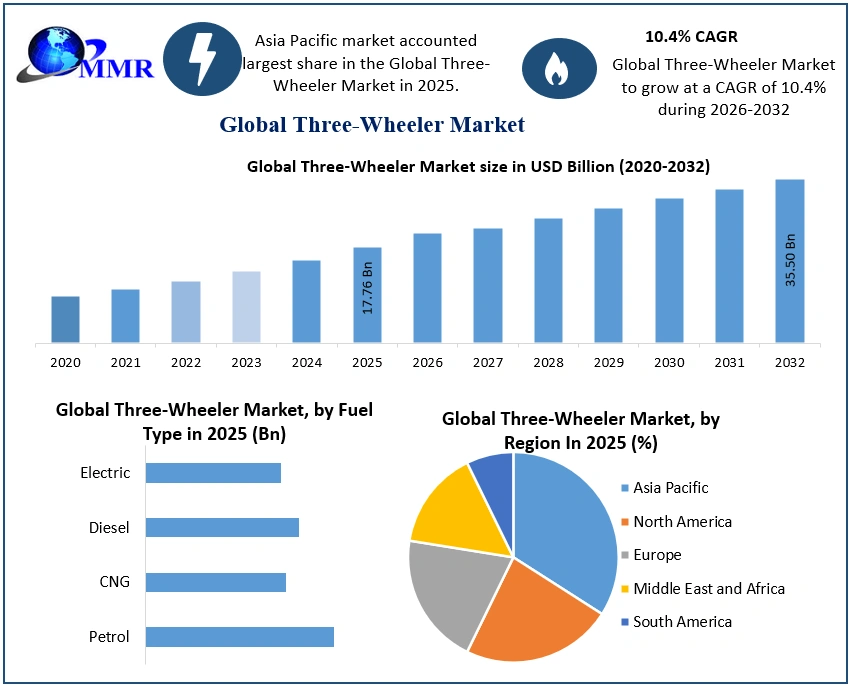
The Three-Wheeler Market size was valued at USD 17.76 Billion in 2025 and the total Three-Wheeler revenue is expected to grow at a CAGR of 10.4% from 2026 to 2032, reaching nearly USD 35.50 Billion by 2032.
This growth is primarily driven by the increasing demand for affordable last-mile transportation solutions and rapid adoption of electric three-wheelers to reduce urban emissions.
Three-Wheeler Market Overview
The global three-wheeler market is a rapidly growing industry, driven primarily by factors such as increasing urbanization, a rising need for affordable transportation options, and increasing demand for eco-friendly vehicles. The Asia-Pacific region dominates the global market, accounting for the majority of the market share. This is attributed to the region's high population density, increasing urbanization, and the presence of a large number of manufacturers. In addition, the demand for three-wheelers in the region is driven by their affordability, fuel efficiency, and manoeuvrability in congested urban areas. The electric three-wheeler segment is rapidly gaining traction, driven by the increasing focus on reducing emissions and promoting sustainable transportation. Governments worldwide are offering incentives and subsidies to promote the adoption of electric three-wheelers, leading to a surge in demand for these vehicles.
The three-wheeler market is witnessing significant technological advancements, with manufacturers investing heavily in research and development to produce more efficient and eco-friendly vehicles. Advanced features such as GPS tracking, telematics, and connected technologies are becoming increasingly popular, enabling fleet owners to optimize their operations and improve efficiency. However, the market also faces challenges such as the lack of adequate charging infrastructure for electric three-wheelers, and the need for stricter safety regulations. Manufacturers are addressing these challenges by developing innovative solutions such as swappable batteries, which can be quickly replaced, and incorporating advanced safety features. The global market is witnessing rapid growth, driven by various factors such as increasing urbanization, affordability, and the need for sustainable transportation. The market is also witnessing significant technological advancements, which are expected to drive further growth in the coming years.
To know about the Research Methodology :- Request Free Sample Report
Three-Wheeler Market Report Scope
The aim of this report is to provide stakeholders in the three-wheeler market with a comprehensive analysis of the industry's current and past state, as well as a projected market size and trends in a clear and concise language. The report covers all essential aspects of the market, including an in-depth examination of key players, such as market leaders, followers, and new entrants. The report features a PORTER and PESTEL analysis, taking into account micro-economic factors that may have an impact on the industry. Internal and external factors that could have a positive or negative effect on the market have been scrutinized to provide decision-makers with a clear understanding of the market's future outlook.
Furthermore, the report assists in comprehending the market dynamics and structure by analysing market segments and forecasting the market size. The report provides investors with a competitive analysis of key players based on product offerings, pricing, financial position, product portfolio, growth strategies, and regional presence.
Three-Wheeler Market Dynamics
One key factor is economic conditions. In developing countries, where three-wheelers are often used as a form of transportation, economic growth can lead to an increase in demand for these vehicles. On the other hand, economic downturns can lead to a decrease in demand. Government regulations also play a crucial role in the market. Regulations related to safety, emissions, and other factors can impact the design and production of three-wheelers, as well as their cost and availability. As a market researcher, it's important to keep up with any changes in these regulations.
Consumer preferences are another key factor to consider. Cost, convenience, and cultural norms all play a role in determining the popularity of three-wheelers. For example, in some countries, three-wheelers are preferred over cars because they are more affordable and easier to maneuver in crowded urban areas. Technological advancements can also impact the market. Electric powertrains and advanced safety systems are just a couple of examples of technological advancements that could impact the three-wheeler market. Competition is a significant factor in the market. Multiple manufacturers are vying for market share, and changes in pricing, marketing strategies, and product offerings can all impact the competitive landscape of the market.
Three-Wheeler Market Drivers
One of the significant drivers of the market is affordability. In developing countries with lower income levels, three-wheelers are more affordable than four-wheelers or other modes of transportation. Thus, affordability is one of the key drivers of the market in these regions. Urbanization is another crucial driver of the three-wheeler market. As cities become more crowded, there is an increasing demand for compact and manoeuvrable vehicles. Three-wheelers are a popular choice for urban transportation as they can navigate through traffic more easily than larger vehicles. The demand for eco-friendly transportation options is also a significant driver of the market. Governments worldwide are implementing stricter emission regulations, and consumers are seeking sustainable modes of transportation.
Electric three-wheelers market growth is exponential as they offer a clean and efficient mode of transportation, and their demand is increasing. Convenience is another driver of the three-wheeler market. Three-wheelers are more convenient than other modes of transportation, particularly in areas with limited infrastructure. They are used for both passenger and cargo transportation, making them a versatile option. Government incentives and subsidies impact the market. In some countries, governments offer tax incentives or subsidies for the purchase of electric three-wheelers, encouraging consumers to make the switch to more sustainable transportation options.
Three-Wheeler Market Challenges
One of the significant challenges is safety concerns. Three-wheelers are more prone to tipping over, which pose a safety risk to passengers and drivers, especially in developing countries where safety regulations are not as stringent. Another challenge facing the three-wheeler industry is the lack of standardization, particularly concerning safety and emissions regulations. Consumers may be hesitant to purchase three-wheelers if they are unsure about their safety or environmental impact. Therefore, standardization of safety and emissions regulations is essential to build trust and confidence in the three-wheeler market.
Three-wheelers also face stiff competition from other modes of transportation, including motorcycles, bicycles, and ride-sharing services. As more people adopt these alternatives, the demand for three-wheelers may decrease, affecting the growth of the market. Electric three-wheelers, although eco-friendly, have a limited range and lower speed compared to traditional gasoline-powered vehicles. This can limit their appeal to consumers who require longer-range transportation or faster speeds. Additionally, infrastructure challenges, such as limited charging or maintenance facilities for electric three-wheelers, can hamper their adoption and growth in certain regions.
Three-Wheeler Market Trends
The market is experiencing a significant trend towards electrification. As electric three-wheelers become increasingly popular due to their eco-friendliness and low operating costs, governments worldwide are promoting electric mobility, leading to an increase in demand for electric three-wheelers. Another significant trend in the three-wheeler market is technology advancements. Manufacturers are incorporating advanced features such as GPS, remote diagnostics, and digital meters in three-wheelers, enhancing the riding experience and convenience for passengers. Consumers are increasingly looking for personalized and customized three-wheelers to meet their specific needs and preferences.
Manufacturers are offering customization options such as colour, seating capacity, and cargo-carrying capacity to cater to the diverse needs of consumers. The sharing economy is having an impact on the three-wheeler market as well. Ride-sharing and last-mile delivery services are increasingly using three-wheelers due to their affordability and manoeuvrability in congested urban areas. Health and safety features are becoming critical concerns for consumers due to the ongoing COVID-19 pandemic. Manufacturers are incorporating features such as partitions, contactless payment systems, and sanitization measures to ensure the safety and well-being of passengers and drivers.
Three-Wheeler Market Segment Analysis
Based on Usage, the Three-Wheeler Market is segmented into Passenger carrier and Load carrier. The Passenger Carrier segment has dominated the Three-Wheeler market in 2025. This is largely because three-wheelers are a critical part of affordable public transport in many emerging markets, especially across Asia and Africa. They are widely used for short-distance urban and semi-urban commuting, serving millions of daily riders thanks to their low fares, compact size for navigating crowded streets, and quick turnaround times. The essential role of passenger three-wheelers in last-mile connectivity and their strong demand in densely populated regions ensures this segment maintains the largest market share over load carriers.
Based on Fuel Type, the Three-Wheeler Market is segmented into Petrol, CNG, Diesel and Electric. Among these the Diesel segment has dominated the Three-Wheeler market in 2025. This is primarily because diesel three-wheelers offer higher fuel efficiency and greater torque, making them especially suitable for heavy-load and long-distance commercial applications. In many emerging markets particularly across Asia and Africa diesel-powered three-wheelers remain the preferred choice for goods transport and shared passenger services, thanks to their relatively lower running costs over longer routes and robust performance in demanding conditions. This sustained demand keeps diesel as the leading segment despite the rising interest in electric alternatives.
Three-Wheeler Market Regional Analysis
The market is not uniform across different regions, with each region having distinct trends and dynamics that impact the market. In the Asia-Pacific region, the market is the largest in the world, with countries such as India, China, and Thailand being major players. Affordability and convenience are key factors driving demand, and there is also an increasing demand for electric three-wheelers. The three-wheeler market in Europe is relatively small, with a focus on eco-friendly transportation options driving some growth. Manufacturers from Italy, France, and the UK dominate the market. North America's three-wheeler market is niche, with a focus on recreational vehicles such as motorcycles and trikes.
However, there has been some interest in electric three-wheelers as a sustainable transportation option. In Latin America, three-wheelers are a popular mode of transportation, particularly in countries such as Brazil, Colombia, and Peru. Demand is driven by affordability and suitability for urban environments. Local manufacturers dominate the market. The market in the Middle East and Africa is relatively small, with demand driven by affordability and convenience in urban areas. India is a major exporter of three-wheelers to this region, and local manufacturers dominate the market.
Three-Wheeler Market Competitive Landscape
The market is highly competitive, with a wide range of global and regional players vying for market share. Bajaj Auto Limited is a major player in the market, known for its fuel-efficient and low-maintenance three-wheelers. Piaggio & C. SpA is a European manufacturer that offers a variety of passenger and commercial three-wheelers and has a strong presence in several markets worldwide. Mahindra & Mahindra Ltd is a leading Indian manufacturer, known for its rugged and reliable three-wheelers.
TVS Motor Company Limited offers a range of passenger and commercial three-wheelers and has a strong presence in several markets worldwide. Atul Auto Limited is another major Indian manufacturer, known for its fuel-efficient and low-maintenance three-wheelers. Other notable players in the three-wheeler market include Kinetic Green Energy and Power Solutions Limited, Scomadi Ltd, Terra Motors Corporation, and Qiangsheng Electric Tricycle Factory. The competition in the market is expected to intensify due to increasing demand and technological advancements, driving manufacturers to innovate and offer differentiated products and services to stay competitive.
Three-Wheeler Market Scope: Inquire before buying
| Global Three-Wheeler Market | |||
|---|---|---|---|
| Report Coverage | Details | ||
| Base Year: | 2025 | Forecast Period: | 2026-2032 |
| Historical Data: | 2020 to 2025 | Market Size in 2025: | USD 17.76 Bn. |
| Forecast Period 2026 to 2032 CAGR: | 10.4% | Market Size in 2032: | USD 35.50 Bn. |
| Segments Covered: | by Fuel Type | Petrol CNG Diesel Electric |
|
| by Usage | Passenger carrier Load carrier |
||
| by Configuration | Two Front Wheels Two Rear Wheels |
||
| by Engine Location | Front Engine Rear Engine |
||
| by Power Output | Less than 4 kW 4.1 kW to 6 kW 6.1 kW to 9 kW More than 9 kW |
||
Global Three-Wheeler Market, by Region
North America (United States, Canada and Mexico)
Europe (UK, France, Germany, Italy, Spain, Sweden, Austria and Rest of Europe)
Asia Pacific (China, South Korea, Japan, India, Australia, Indonesia, Malaysia, Vietnam, Taiwan, Bangladesh, Pakistan and Rest of APAC)
Middle East and Africa (South Africa, GCC, Egypt, Nigeria and Rest of ME&A)
South America (Brazil, Argentina Rest of South America)
Three-Wheeler Market, Key Players
1. Bajaj Auto Limited (India)
2. Piaggio & C. SpA (Italy)
3. TVS Motor Company Limited (India)
4. Atul Auto Limited (India)
5. Mahindra & Mahindra Ltd (India)
6. Polaris Inc. (USA)
7. BRP Inc. (Canada)
8. Campagna Motors (Canada)
9. T-Rex Vehicle (USA)
10. Peugeot SA (France)
11. Yamaha Motor Co., Ltd. (Japan)
12. Aixam-Mega (France)
13. Arcimoto Inc. (USA)
14. Bajaj Auto Limited (India)
15. Piaggio & C. SpA (Italy)
16. TVS Motor Company Limited (India)
17. Atul Auto Limited (India)
18. Motocar SA (Brazil)
19. Fênix Electric Vehicles (Brazil)
20. E-Moving Technologies (Brazil)
21. Grupo Piaggio (Brazil)
22. Auteco Mobility (Colombia)
FAQ's
1: What are the key drivers of the three-wheeler market?
Ans: The key drivers of the three-wheeler market include increasing demand for affordable and fuel-efficient transportation, growing urbanization, and the need for efficient last-mile connectivity.
2: What are the major challenges faced by the three-wheeler market?
Ans: The major challenges faced by the three-wheeler market include regulatory challenges, increasing competition, and technological advancements leading to the introduction of new and innovative vehicles.
3: What are the current trends in the three-wheeler market?
Ans: The current trends in the three-wheeler market include the adoption of electric and hybrid three-wheelers, increasing use of technology to enhance safety and performance, and the growing popularity of shared mobility solutions.
4: Who are the key players in the three-wheeler market?
Ans: The key players in the three-wheeler market include Bajaj Auto Limited, Piaggio & C. SpA, Mahindra & Mahindra Ltd, TVS Motor Company Limited, and Atul Auto Limited, among others.
5: What is the outlook for the three-wheeler market?
Ans: The three-wheeler market is expected to grow significantly in the coming years, driven by increasing demand for affordable and fuel-efficient transportation solutions in developing economies, along with the introduction of new and innovative three-wheelers that offer enhanced safety and performance.