
Tebufenozide Market Size by Formulation Type, Mode of Application, End-User, Sales Channel, Region, Industry-Wide Analysis, Competitive Landscape Assessment & Long-Term Forecast to 2032
Overview
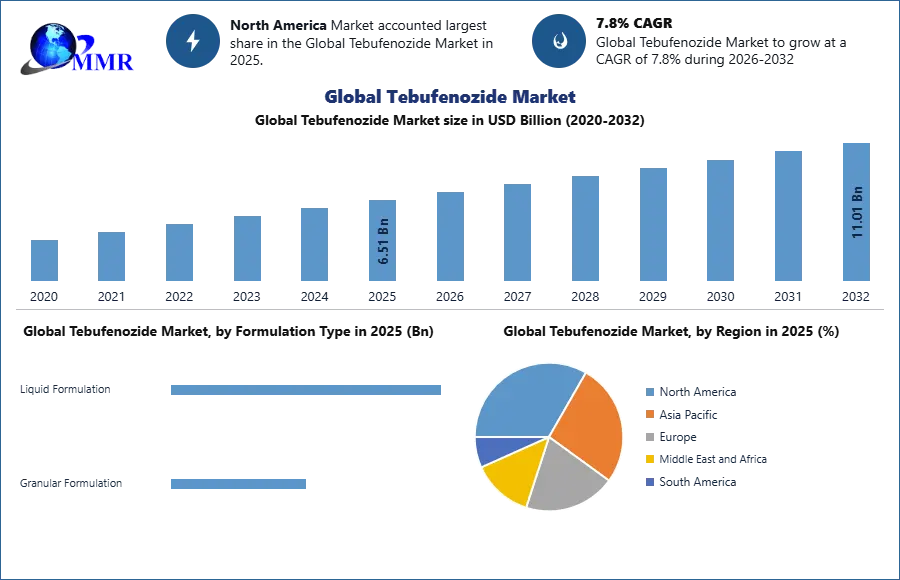
Global Tebufenozide Market size was valued at USD 6.51 Bn in 2025 and Tebufenozide market revenue is expected to reach USD 11.02 Bn by 2032, at a CAGR of 7.8% over the forecast period.
Tebufenozide Market Overview
Tebufenozide is a synthetic insect growth regulator (IGR) that is used as a pesticide to control various insect pests, particularly in agriculture. It is known for its selective action against specific insect species while being less harmful to beneficial insects and other non-target organisms. Tebufenozide belongs to the chemical class of benzoylureas and is categorized as a chitin synthesis inhibitor.
To know about the Research Methodology :- Request Free Sample Report
Tebufenozide is commonly used in agriculture to protect a variety of crops from Lepidopteran pests. It is effective against pests that damage fruits, vegetables, tree nuts, and field crops. Some of the key crops where tebufenozide is applied include apples, pears, grapes, cabbage, corn, soybeans, and cotton. Tebufenozide has a selective mode of action, targeting only certain types of insect pests while being less harmful to beneficial insects and non-target species. The Tebufenozide market growth is closely tied to the prevalence of Lepidopteran pest species in agricultural regions. Increased pest pressure drives demand for effective solutions like tebufenozide. Several agrochemical companies manufacture and market tebufenozide-based products. These companies compete for market share by offering effective formulations and support to farmers.
Tebufenozide Market Dynamic
Selective Pest control with Resistance Management to boost the Tebufenozide Market growth
The tebufenozide market is driven by a combination of factors that contribute to the growth and demand for this insect growth regulator (IGR) in the field of agriculture. Tebufenozide is an effective tool in pest management, particularly against Lepidopteran pests, and its popularity is influenced by several key drivers. Tebufenozide is highly selective in its mode of action, primarily targeting the larvae of Lepidopteran pests while posing minimal risk to beneficial insects, mammals, and humans. This selectivity is a significant driver as it allows for effective pest control without causing harm to non-target organisms. The development of pest resistance to chemical pesticides is a pressing concern in agriculture. Tebufenozide offers an alternative to conventional insecticides, making it an important component of resistance management strategies. Farmers rotate or integrate tebufenozide with other pesticides to mitigate resistance issues. The primary purpose of using tebufenozide is to protect crops from Lepidopteran pests, which cause significant damage to agricultural yields, which is expected to boost the Tebufenozide Market growth. The ability to safeguard crops from pest-related losses is a key driver for its adoption. Ensuring a consistent and reliable food supply is a global priority. By effectively managing pest populations, tebufenozide contributes to food security by preventing crop losses due to insect damage.
The registration and approval of tebufenozide-based products by regulatory authorities play a crucial role in market growth. As long as it remains registered for use on specific crops, farmers have access to this tool for pest control. The adoption of integrated pest management practices is a driving factor for tebufenozide. IPM emphasizes the use of multiple pest control strategies, including biological, cultural, and chemical methods. Tebufenozide compatibility with IPM strategies makes it a preferred choice for many farmers. The prevalence of Lepidopteran pests in different agricultural regions, as well as the types of crops grown, influences the demand for tebufenozide. Areas with high pest pressure and vulnerable crops are more likely to adopt this IGR. The presence of several agrochemical companies manufacturing and marketing tebufenozide-based products fosters competition and drives market growth. These companies invest in research and development to improve formulations and deliver effective solutions to farmers. The application of tebufenozide lead to improved crop yield and quality by protecting crops from pest damage. This, in turn, contributes to increased revenue for farmers, motivating the adoption of tebufenozide.
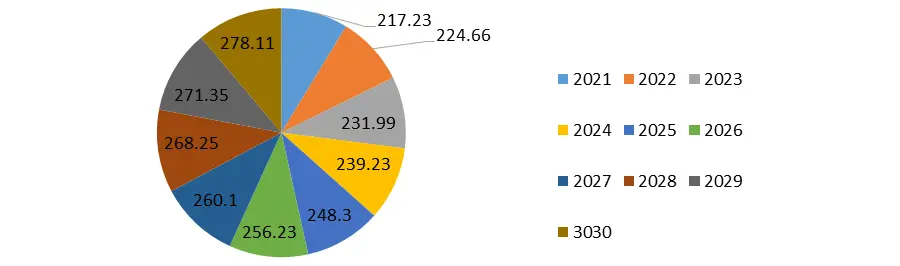
Agricultural Chemicals Market Value in 2021 to 2023(in USD Bn.)
Regulatory Hurdles to limit the Tebufenozide Market growth
The complex and stringent regulatory environment governing the use of pesticides is expected to restrain the Tebufenozide Market growth. Pesticides, including tebufenozide, must undergo rigorous testing and registration processes before they it is approved for use on specific crops. The regulatory process is time-consuming and costly, often requiring extensive safety and environmental assessments. This slow down the introduction of new tebufenozide products and limit their availability to farmers. Pest resistance is a significant concern in the use of pesticides, including tebufenozide. Over time, repeated and widespread use of tebufenozide can lead to the development of resistant pest populations. Once pests become resistant, the effectiveness of tebufenozide diminishes, and farmers need to resort to alternative control methods. This challenge necessitates careful pest management strategies and rotations of different pesticides to delay the development of resistance.
Tebufenozide is highly selective in its mode of action, primarily targeting Lepidopteran pests. While this selectivity is an advantage in terms of reducing harm to non-target organisms, it is restraint. The product's limited spectrum of action means that it is not effective against a broader range of agricultural pests. Farmers still require additional pesticides to manage other types of pests, increasing the complexity of pest management. The development and adoption of alternative pest control methods, such as biological control, organic farming, and the use of genetically modified crops with built-in pest resistance, can pose a restraint on the demand for tebufenozide. Farmers opt for these alternative methods to reduce their reliance on chemical pesticides, impacting the market for tebufenozide. The cost of applying tebufenozide and the availability of the product is restraint, particularly for small-scale and resource-constrained farmers. The cost of pesticides, application equipment, and the need for trained personnel can be significant barriers, limiting access to tebufenozide.
Tebufenozide Market Segment Analysis
Based on Formulation Type, the market is segmented into Liquid Formulation, and Granular Formulation. Liquid Formulation segment dominated the market in 2025 and is expected to hold the largest Tebufenozide Market share over the forecast period. Liquid formulations are generally easier to apply. They are able to be mixed with water and sprayed directly onto the crops, allowing for even coverage. This ease of application is especially important when dealing with pests that primarily affect the foliage of plants. Liquid formulations offer better control over the dosage and distribution of the pesticide, which can be critical in integrated pest management (IPM) practices, where precision is essential to minimize environmental impact. Many of the crops that benefit from Tebufenozide application, such as fruits and vegetables, are often treated with foliar sprays. Liquid formulations are well-suited for this purpose. Liquid formulations are designed to target specific pests more effectively, which is a key consideration in the Tebufenozide market where lepidopteran pests are the primary focus.
Tebufenozide Market Share, by Formulation Type(2025)

Based on End user, the market is segmented into Farmers, Agricultural Cooperatives, and Greenhouse & Nursery Operators. The farmers segment hold the largest Tebufenozide Market share in 2025 and is expected to dominate the market over the forecast period. Row crops like corn, soybeans, and cotton are highly susceptible to lepidopteran pests, which Tebufenozide is particularly effective against. These crops are staples in North American agriculture, and the need for pest control in these crops is significant, which is significantly acts as Tebufenozide Crop Protection and contribute for the Tebufenozide Market growth. Row crop farming often involves large-scale cultivation, covering extensive acreage. As a result, the volume of Tebufenozide required is substantial, making row crop farmers a significant market for this pesticide. Tebufenozide is often approved for use on row crops, and there is an established track record of its effectiveness in this context. This regulatory support further encourages its use by row crop farmers. Some cooperatives are involved in a wide range of crops, including both row crops and specialty crops, making them important customers for Tebufenozide manufacturers.
Tebufenozide Market Regional Insight
Resistance Management in North America to boost the Tebufenozide Market growth
The North America tebufenozide market is a significant segment of the global agrochemical industry. Tebufenozide is an insect growth regulator (IGR) widely used in North America for pest control in agriculture. The Tebufenozide market dynamics in this region are shaped by several key factors, including the need for effective pest management, regulatory considerations, technological advancements, and the growing interest in sustainable agriculture. Resistance management is a growing concern in North American agriculture. The repeated and widespread use of conventional pesticides has led to the development of pest resistance. Tebufenozide's unique mode of action as an IGR allows it to be an important component of resistance management strategies. Farmers can rotate or integrate tebufenozide with other pest control methods to mitigate resistance issues. North America is known for its diverse range of crops, from field crops like corn and soybeans to specialty crops like apples and pears. Tebufenozide's versatility in controlling Lepidopteran pests across various crops contributes to its wide adoption. It offers growers a reliable solution for pest control, regardless of the type of crops they cultivate.
Insecticide resistance is a persistent concern in agriculture. Tebufenozide offers an effective solution to this problem. Its unique mode of action against target pests minimizes the likelihood of resistance development, making it a preferred choice among farmers. Precision agriculture is on the rise in North America, with farmers adopting technology-driven solutions to maximize crop yields. Tebufenozide integrates well into precision agriculture practices, enabling targeted and efficient pest control. The pricing of Tebufenozide has become more competitive due to economies of scale, increased production, and the presence of multiple suppliers. This has made it more accessible to a broader range of farmers.
Tebufenozide Market Competitive Landscape
The competitive landscape in the Tebufenozide market is characterized by the presence of several key players, each striving to gain a competitive edge in this growing industry. Market competition is intense, driven by factors such as product innovation, market expansion, regulatory compliance, and customer service. Competition in the Tebufenozide market often revolves around product differentiation. Companies strive to develop innovative formulations, delivery systems, and packaging to stand out from their competitors. For instance, developing Tebufenozide formulations that offer longer residual activity or are more environmentally friendly can be a competitive advantage. Pricing plays a significant role in market competition. While Tebufenozide is considered a reduced-risk pesticide, competitive pricing can still be a crucial factor in gaining market share. Companies often engage in price wars to attract price-sensitive customers or offer discounts and incentives to large-volume buyers. Collaborative efforts, such as partnerships with agricultural cooperatives or research institutions, can enhance a company's position in the market. These partnerships lead to the development of new products or expanded market access. Tebufenozide manufacturing companies focus on expanding their market reach, both geographically and across different crop types. Expanding into new regions or targeting niche markets is competitive strategy.
Tebufenozide Market Report Scope : Inquire Before Buying
| Global Tebufenozide Market | |||
|---|---|---|---|
| Report Coverage | Details | ||
| Base Year: | 2025 | Forecast Period: | 2026-2032 |
| Historical Data: | 2020 to 2025 | Market Size in 2025: | 6.51 USD Billion |
| Forecast Period 2026-2032 CAGR: | 7.8% | Market Size in 2032: | 11.01 USD Billion |
| Segments Covered: | by Formulation Type | Liquid Formulation Granular Formulation |
|
| by Mode of Application | Foliar Spray Soil Drench Seed Treatment Aerial Application Other Modes |
||
| by End-User | Farmers Agricultural Cooperatives Greenhouse and Nursery Operators |
||
| by Sales Channel | Direct Sales Distributors/Dealers E-Commerce/Online Platforms Retail Stores |
||
6.51Tebufenozide Market by Region
North America (United States, Canada and Mexico)
Europe (UK, France, Germany, Italy, Spain, Sweden, Austria and Rest of Europe)
Asia Pacific (China, South Korea, Japan, India, Australia, Indonesia, Malaysia, Vietnam, Taiwan, Bangladesh, Pakistan and Rest 5.2of APAC)
South America (Brazil, Argentina Rest of South America)
Middle East & Africa (South Africa, GCC, Egypt, Nigeria and the Rest of ME&A)
Tebufenozide Key Players include
1. Dow AgroSciences
2. Syngenta
3. BASF
4. Bayer CropScience
5. FMC Corporation
6. Nufarm
7. Adama Agricultural Solutions
8. Corteva Agriscience
9. UPL Limited
10. Sumitomo Chemical
11. Arysta LifeScience
12. Valent BioSciences
13. ISK Biosciences Corporation
14. Gowan Company
15. Certis USA
16. Cheminova
17. Mitsui Chemicals
18. OHP, Inc.
19. AMVAC Chemical Corporation
20. Sipcam Agro
Frequently Asked Questions:
1] What is the growth rate of the Global Tebufenozide Market?
Ans. The Global Tebufenozide Market is growing at a significant rate of 7.8 % over the forecast period.
2] Which region is expected to dominate the Global Tebufenozide Market?
Ans. North America region is expected to dominate the Tebufenozide Market over the forecast period.
3] What is the expected Global Tebufenozide Market size by 2032?
Ans. The market size of the Tebufenozide Market is expected to reach USD 11.02 Bn by 2032.
4] Who are the top players in the Global Tebufenozide Industry?
Ans. The major Global Tebufenozide Market key players are Dow AgroSciences, Syngenta, BASF, and Bayer CropScience
5] Which factors are expected to drive the Global Tebufenozide Market growth by 2032?
Ans. Selective Pest control with Resistance Management is expected to drive the Tebufenozide Market growth over the forecast period.