
Social Commerce Market Size by Business Model, Product Type, Platform/Sales Channel, Device Type and Region – Segment-Level Market Assessment, Growth Opportunity Analysis, Competitive Mapping & Forecast to 2030
Overview
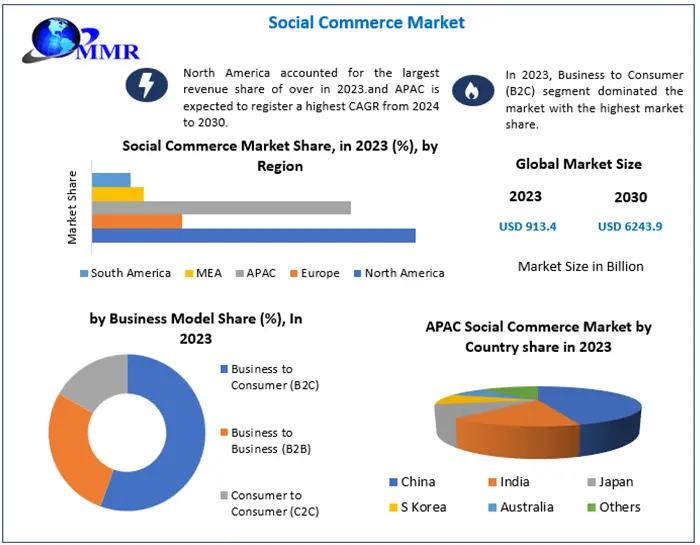
The Social Commerce Market size was valued at USD 913.4 Billion in 2023 and the total Social Commerce Market revenue is expected to grow at a CAGR of 31.60% from 2024 to 2030, reaching nearly USD 6243.9 Billion.
Social Commerce Market Overview:
Social commerce is a rapidly growing sector within e-commerce that leverages social networks and digital media to facilitate transactions between businesses and consumers. Social commerce encompasses various activities, including product discovery, reviews, ratings, sharing, recommendations, transactions, and loyalty programs. The adoption of social media by social commerce market companies as a marketing and sales channel aims to establish direct connections between brands and their customers, fostering meaningful conversations across different social platforms. Utilizing user-generated content (UGC) like photos, videos, and customer reviews enables businesses to establish deeper relationships with customers compared to traditional e-commerce strategies. This emotional connection aids companies in engaging with potential customers and achieving higher sales conversions through social media platforms.
To know about the Research Methodology :- Request Free Sample Report
The growth of the social commerce market is driven by shifts in consumer preferences and attitudes. As mobile technology advances and the demand for immediate customer service rises, consumers seek innovative ways to interact with brands through technology. Notably, younger generations, such as millennials and Gen Z, are at the forefront of the social commerce market, contributing to over 60% of purchases conducted through social media platforms.
Social Commerce Market Dynamic:
The global internet landscape is currently undergoing a social revolution, with 57% of the world's 4.8 billion internet users actively engaging in social media. On average, users dedicate nearly 2.5 hours daily to social media platforms. The escalating use of social media emerges as a pivotal driver for the social commerce market, leveraging a vast user base, fostering engagement, enabling influencer marketing, enhancing visual appeal, and seamlessly integrating shopping features. These elements collectively fuel the growth and success of social commerce as a robust sales channel. Social commerce endeavours to consolidate people's online activities, combining shopping, social interactions, news consumption, and video watching in one convenient space. This transformative shift is anticipated to reshape consumer shopping behaviour significantly. In essence, the increasing utilization of social media emerges as a potent force propelling the success of the social commerce market.
Sustainability stands out as a key catalyst for the social commerce industry, responding to the rising consumer emphasis on environmental and social concerns. Social commerce platforms empower businesses to showcase their sustainable offerings and demonstrate a commitment to ethical practices, appealing to environmentally conscious consumers and securing a competitive advantage. Significantly, transparency and traceability become imperative for businesses to share comprehensive information about their supply chains, production processes, and sustainability initiatives. Education and awareness campaigns play a vital role for social commerce businesses in disseminating information and promoting sustainability. Collaborative efforts and partnerships between brands, influencers, and sustainable organizations further amplify the impact of social commerce initiatives. In summary, sustainability emerges as a pivotal factor in the social commerce market, attracting environmentally conscious consumers and contributing to a more sustainable future.
The growth of social commerce market presence into emerging regions such as Indonesia, Thailand, Southeast Asia, the United States, the United Kingdom, India, and China is expected to stimulate the overall growth of the social commerce market. A study reveals that over 424 million Chinese individuals aged 14 and above are projected to engage in at least one social commerce transaction. The Chinese social commerce market experienced substantial sales, reaching USD 351.65 billion in 2021, driven by a diverse user base making purchases on social commerce platforms.
Social Commerce Market Segmentation:
Based on Business Model, Business to Consumer (B2C) segment held the majority social commerce market share in 2023, accounting for over 55% of the total social commerce market revenue. B2C social commerce platforms offer a variety of resources and tools to support businesses in promoting and marketing their products to consumers. Under the B2C business model, services include features like product listings, reviews, opinions, social media sharing options, and payment processing systems. Moreover, businesses can leverage these technologies to create enjoyable and immersive shopping experiences for potential customers, contributing to both customer retention and the growth of sales.
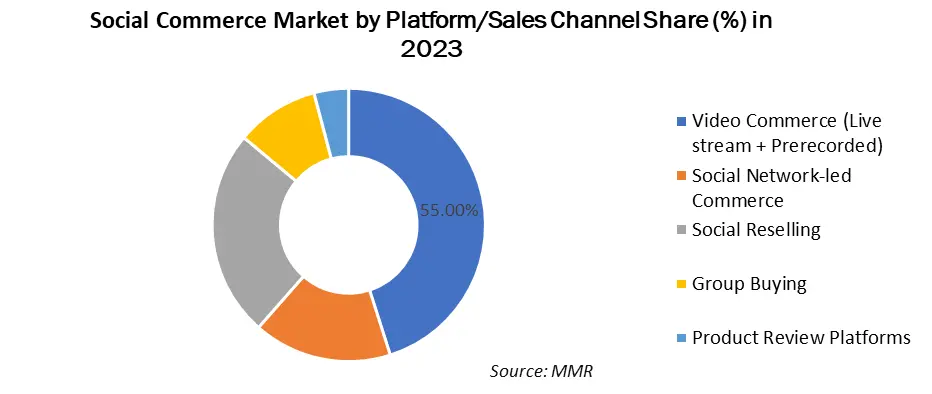
By Platform/Sales Channel, in 2023, the video commerce segment, encompassing both live stream and pre-recorded content, emerged as the dominant sales channel and is expected to maintain its social commerce market dominance throughout the forecast period. Live commerce, in particular, stands out for its engaging nature, capturing and retaining viewers' interest, consequently increasing overall watch time during live streaming. This approach not only captivates the audience but also streamlines the customer decision-making process, guiding them from understanding a product to making a purchase. Additionally, live commerce seamlessly combines swift product transactions with audience interaction through features like chat functionality or reaction icons. As a result, social commerce enterprises employing time-limited techniques have achieved an impressive conversion rate of 30%, a figure up to 10 times higher than that of traditional e-commerce.
Social Commerce Market Regional Overview:
In 2023, North America commanded a major share of the revenue of the social commerce market, with the United States playing a dominant role in the region. Notably, Express, a US-based apparel business, is innovatively empowering influencers and regular shoppers to become "Style Editors." These Style Editors can curate their own Express storefronts and earn rewards based on their ability to attract new customers and drive sales, contributing to the region's market growth in the forecast period. The increasing prevalence of smartphones and tablets is expected to further bolster social commerce market growth in the region.
Asia-Pacific is poised to exhibit the fastest CAGR during the forecast period. Mirroring the rapid surge of e-commerce in countries like India and China, where they held sway over the regional social commerce market in 2023, social commerce is anticipated to witness substantial growth in China. By 2025, it is estimated that social commerce will represent nearly one-third of China's e-commerce industry. Social commerce in China leverages the widespread popularity of social media, with research indicating that consumers spend over 48% of their time on social media apps.
Social Commerce Market Recent Development:
Prominent companies are adopting both organic and inorganic growth strategies, including launching new solutions/products, growing geographically, engaging in mergers and acquisitions, and forming partnerships. These initiatives are aimed at maintaining a competitive edge in the dynamic market environment.
In April 2023, eBay introduced a social sharing integration within their Seller Hub. This functionality enables eBay sellers to connect their social media accounts to their Shops from the Seller Hub, streamlining the process of sharing listings on platforms such as Facebook, Instagram, Twitter, and Pinterest.
During the same month, Pinterest disclosed its plan to allow third-party ad demand on its platform, with Amazon being the inaugural partner for these advertisements. This collaboration is designed to broaden the exposure of brands and pertinent products to Pinterest users, aiming to create a seamless purchasing experience for consumers and deliver robust performance for advertisers.
Social Commerce Market Scope and Research Methodology:
The scope of the Social Commerce Market is extensively covered with in-depth analysis and market estimations. These reports encompass a comprehensive overview of industry trends, market dynamics, and growth prospects. They often provide insights into Social Commerce Market segmentation, competitive landscapes, and regional analysis. Methodologies employed involve extensive primary and secondary research, encompassing qualitative and quantitative assessments, including interviews with key industry participants, Social Commerce Market breakdowns by region, and growth rate analysis. Forecast parameters and impact analysis, such as COVID-19 impact, contribute to a holistic understanding of Social Commerce market trends.
Social Commerce Market Scope: Inquire before buying
| Global Social Commerce Market | |||
|---|---|---|---|
| Report Coverage | Details | ||
| Base Year: | 2023 | Forecast Period: | 2024-2030 |
| Historical Data: | 2018 to 2023 | Market Size in 2023: | US $ 913.4 Bn. |
| Forecast Period 2024 to 2030 CAGR: | 31.60% | Market Size in 2030: | US $ 6243.9 Bn. |
| Segments Covered: | by Business Model | Business to Consumer (B2C) Business to Business (B2B) Consumer to Consumer (C2C) |
|
| by Product Type | Personal and Beauty Care Apparel Accessories Home Products Health Supplements Food and Beverage Others |
||
| by Platform/Sales Channel | Video Commerce (Live stream + Prerecorded) Social Network-led Commerce Social Reselling Group Buying Product Review Platforms |
||
| by Device Type | Smartphone Laptop Tablets |
||
Social Commerce Market Key players:
North America Social Commerce Market Top Players:
1. eBay (USA)
2. Facebook (USA)
3. Twitter (USA)
4. Pinterest (USA)
5. PayPal (USA)
6. Instagram (USA)
7. Verizon Communications Inc. (USA)
8. Poshmark Inc. (USA)
9. Etsy Inc (USA)
10. Poshmark Inc. (USA)
11. Amazon (USA)
Asia Pacific Social Commerce Market Top Players:
1. Flipkart (India)
2. Myntra (India)
3. Meesho (India)
4. Shopclues (India)
5. Souled Store (India)
6. Snapdeal (India)
7. Payments Private Limites (India)
8. Tata CLiQ (India)
9. Taobao (Alibaba Group Holding Limited)
10. Reddit Inc. (India)
11. SINA Corp. (China)
12. Alibaba Group Holding Limited (China)
13. Douyin (TikTok, ByteDance) ( China)
FAQs:
1. What are the growth drivers for the Market?
Ans. Increasing Social Media Usage, Rise of Influencer Marketing factors are expected to be the major drivers for the market.
2. What is the major restraint for theMarket growth?
Ans. Dependence on social media platforms is expected to be the major restraining factor for the market growth.
3. Which region is expected to lead the global Market during the forecast period?
Ans. North America is expected to lead the global social commerce market during the forecast period.
4. What is the projected market size & and growth rate of the Market?
Ans. The Market size was valued at USD 913.4 Billion in 2023 and the total Market revenue is expected to grow at a CAGR of 31.60% from 2024 to 2030, reaching nearly USD 6243.9 Billion.
5. What segments are covered in the Market report?
Ans. The segments covered in the market report are Business Model, Product Type, and Platform/Sales Channel and Device Type.