
Smart Sensor Market - Industry Structure Evaluation, Demand Drivers Analysis, Regional Growth Analysis and Identification, Competitive Positioning Review & Global Market Size Forecast to 2032
Overview
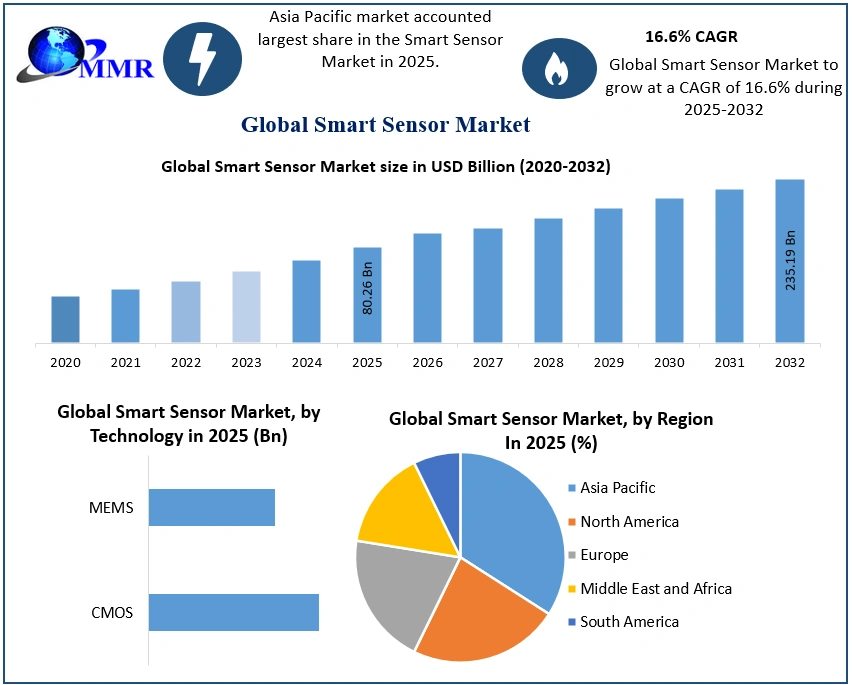
The Smart Sensor Market size was valued at USD 80.26 Billion in 2025 and the total Smart Sensor revenue is expected to grow at a CAGR of 16.6% from 2025 to 2032, reaching nearly USD 235.19 Billion by 2032.
Smart Sensor Market Overview:
Smart sensors are smart devices that integrate sensors, actuators and electronic circuits, or devices that integrate sensing elements and microprocessors, and have monitoring and processing functions. The Smart Sensor Market is driven by advancements in technology and research, the increasing use of the Internet of Things (IoT) across all industries, and the rising adoption of AI and machine learning. The increased adoption of gyroscopes and accelerometers in consumer electronics, along with innovative components like gesture recognition, biometrics, and motion sensing, have opened up new opportunities in the smart sensor market. Additionally, the presence of Original Equipment Manufacturers (OEMs), low manufacturing costs, and access to cheap labour have positively influenced the sensor market in developing economies.
Leading key players in the Smart Sensor industry, including Texas Instruments, Honeywell, and Bosch, are setting the standard for sophisticated sensor solutions that work with IoT platforms. Smart Sensor companies are focusing on innovation, enhancing sensor precision, energy economy, and connection to satisfy the increasing demands of the consumer electronics, automotive, and healthcare industries.
Globally, the top three exporters of sensors are China, Germany, and Japan. China leads the world in Sensor exports with 1,709,193 shipments, followed by Germany with 1,158,773 shipments, and Japan taking the third spot with 1,050,248 shipments.
 To know about the Research Methodology :- Request Free Sample Report
Smart Sensor Market Dynamics:
Smart Sensor Market Growth Driven by Rising Demand in Automation, Healthcare, and Smart Technologies
The smart sensor industry is rapidly growing owing to increasing demand across various sectors. The growth is reflected in the rising smart sensor market share and size, driven by the need for more advanced and numerous sensors in technology, healthcare, automotive, and industrial Components. Overall, the Smart sensor market is booming as these devices become crucial for automation, data collection, and smart technologies.
In June 2022, Texas Instruments launched a new line of smart sensors for environmental monitoring Components, including air quality and gas sensing, to address the growing demand for smart sensing solutions.
The rapid rate of digitization and the increase in requirement for industrial automation is one of the key factors which drive the growth of the market. For instance, smart sensors are widely used in automobiles for auto-braking systems, blind-spot detection mechanisms, lane departure notifications, and safety errors. The increase in deployment of smart grids, smart cities and automated forest fire control systems, snow level monitoring, and early earthquake detection mechanisms, provide a thrust to the smart sensor market growth. Simultaneously, the widespread use of smart sensors in wearable devices also contributes to the growth of the smart sensor Industry. Smart sensors enhance operational efficiency and safety in mining processes, driving significant value addition. This growing adoption highlights the crucial role of innovation in transforming traditional industries.
Emerging Trends and Future Technologies
| IoT Integration |
| Smart sensors are increasingly integrated with the Internet of Things (IoT), allowing for real-time data exchange and connectivity between devices. |
| AI-driven Sensors |
| The use of Artificial Intelligence (AI) in smart sensors is making them more intelligent and capable of complex decision-making. |
| AI-driven sensors analyse data on the edge, reducing the need for constant connectivity and enabling faster responses to changes. |
| Energy-Efficient Designs |
| Energy-efficient sensors operate in remote locations, powered by renewable energy sources or batteries for longer periods. |
Smart Sensor Market Segment Analysis:
By Technology, CMOS Sensors held the largest share in 2025 for the Smart Sensor Market. The rising demand for high-definition image-capturing devices in various industries has spurred a significant adoption of CMOS (Complementary Metal-Oxide-Semiconductor) technology. This technology not only provides faster shutter speeds but also ensures high-quality images. The demand for CMOS image sensors in the automotive and transportation sectors is rapidly increasing owing to the increasing adoption of advanced driver-assistance systems (ADAS) across various categories of vehicles. The integration of high-performance protective functions into automotive systems has influenced the widespread adoption of camera sensor systems, particularly in the context of upcoming driverless autonomous vehicles globally.
In April 2023, the UK announced the approval of hands-free driving technology through Ford’s advanced driver-assistance system (ADAS), BlueCruise, set to lead the way on the country’s motorways.
The increasing use of image sensor devices in biometrics, medical, and film cameras by vehicle driver assistance systems, security, and surveillance devices is expected to have a substantial Smart Sensor market through the forecast Period.

Most of the Image Sensor from India are exported to Germany, the United States, and Russia.
Vietnam, Japan, and China are the leading global exporters of Image Sensor. Vietnam is the top exporter of image sensors globally with 23,257 shipments, while Japan comes in second with 18,548 shipments, and China is third with 17,005 shipments.
January 2023: Canon Inc. announced the development of a 1.0-inch, back-illuminated stacked CMOS sensor for monitoring Components. This sensor achieves an effective pixel count of approximately 12.6 million pixels (4,152 x 3,024) and provides a dynamic range of 148 decibels. Notably, the new sensor divides the image into 736 areas and autonomously determines the best exposure settings for each area.
Smart Sensor Market Regional Insight:
Asia Pacific held xx % share in 2025 for the Smart Sensor Market. The increasing demand for smart grids, smart cities, and IoT-enabled devices across the region is boosting market growth. In automotive Components, smart sensors are used for advanced driver-assistance systems (ADAS) and autonomous driving technologies, which are seeing growing adoption in Asia-Pacific. Smart sensor development is being led by companies in South Korea, Japan, and China. For example, Sony and Panasonic are major players in the CMOS image sensor market, while Bosch and STMicroelectronics are key suppliers of MEMS-based sensors. China's manufacturing sector has experienced considerable growth, serving as a major centre for the production of items like household appliances, cellphones, laptops, and peripheral devices in industries like semiconductors and automotive.
Intelligent sensors based on MEMS technology represent the main development direction of sensors. The advancement in technology not only improves the level of product intelligence but also promotes the development of Chinese manufacturing. The Chinese government attaches great importance to the development of the manufacturing industry. For instance, the Made in China 2025 initiative, represents the initial move towards strengthening the country's manufacturing sector. Smart manufacturing is highlighted as the focal point of Chinese manufacturing, in response to German Industry 4.0 and the US Industrial Internet.


Smart Sensor Market Competitive Landscape:
The smart sensor market is highly competitive, with major players including Texas Instruments, Bosch, Honeywell and STMicroelectronics leading the way. Texas Instruments focuses on integrating advanced measurement with robust computing. Bosch offers a wide range of sensors for mechanical and industrial Components that emphasize innovation and reliability. Honeywell offers a wide range of smart sensors for various industries and uses its extensive experience. STMicroelectronics excels by combining sensor technology and connectivity solutions for smart devices. These companies compete with innovation, technology integration and Smart Sensor market growth to capture the growing demand in the automotive, industrial and consumer sectors.
STMicroelectronics- STMicroelectronics, a European electronics company, creates key solutions for smart cars, homes, cities, and industries. They offer a variety of sensors, including low-power ones for IoT devices, Industry 4.0, AR/VR, and smartphones.
In 2019, they made $9.56 billion revenue. In 2020, they teamed up with TSMC to develop Gallium Nitride technology. Earlier, in 2016, they partnered with Valencell to create advanced biometric sensors for wearables and IoT devices.
NXP Semiconductors- NXP Semiconductors, a company based in the U.S. and the Netherlands, makes software and semiconductors for mobile devices, cars, consumer electronics, and more. They produce various sensors, including motion, capacitive, pressure, touch, and magnetic sensors.
In 2019, their revenue was USD 8.88 billion. In January 2019, they partnered with Momenta to develop driver monitoring systems for cars. In May 2018, they teamed up with Tata Consultancy Services to create Components for the automotive, security, and IoT sectors.
In January 2023, Samsung Electronics launched its newest camera sensor, the ISOCELL HP2, which has a resolution of 200-megapixels. This sensor uses improved pixel technology and larger full-well capacity to produce high-quality mobile photos for top-of-the-line smartphones. Containing 200 million 0.6-micrometer (μm) pixels in a 1/1.3” optical format commonly found in 108MP primary smartphone cameras, the ISOCELL HP2 allows users to enjoy greater resolutions in newer top-tier smartphones without increased camera bumps.
In March 2023, Infineon Technologies partnered with Motion Gestures, a developer of touchless gesture recognition software, to integrate motion-sensing capabilities into Infineon's smart sensor solutions.
In November 2022, Quanergy Systems, Inc., a manufacturer of smart sensors such as LiDAR sensors and smart 3D solutions, announced enhancements to its QORTEX DTC and Q-View software solutions, which support the company's Flow Management portfolio, which includes its smart sensors MQ-8 family of LiDAR sensors.
Smart Sensor Market Scope: Inquire before buying
| Global Smart Sensor Market | |||
|---|---|---|---|
| Report Coverage | Details | ||
| Base Year: | 2025 | Forecast Period: | 2026-2032 |
| Historical Data: | 2020 to 2025 | Market Size in 2025: | USD 80.26 Bn. |
| Forecast Period 2026 to 2032 CAGR: | 16.6% | Market Size in 2032: | USD 235.19 Bn. |
| Segments Covered: | by Type | Humidity Position Pressure Motion Others |
|
| by Technology | CMOS MEMS |
||
| by Component | Analogue To Digital Converters (ADCs) Digital To Analogue Converters (DACs) Transceivers, Amplifiers Microcontrollers Others |
||
| by End-Use Industry | Automation Consumer Electronics Aerospace And Defence Healthcare Others |
||
Smart Sensor Market, by Region
Asia Pacific (China, South Korea, Japan, India, Australia, Indonesia, Malaysia, Vietnam, Taiwan, Bangladesh, Pakistan and Rest of APAC)
Europe (UK, France, Germany, Italy, Spain, Sweden, Austria and Rest of Europe)
North America (United States, Canada and Mexico)
Middle East and Africa (South Africa, GCC, Egypt, Nigeria and Rest of ME&A)
South America (Brazil, Argentina Rest of South America)
Smart Sensor Market, Key Players
Asia-Pacific
1. Panasonic Corporation (Japan)
2. Sony Semiconductor Solutions Corporation (Japan)
3. Omron Corporation (Japan)
4. Murata Manufacturing (Japan)
5. Seiko Epson Corporation (Japan)
6. ROHM Semiconductor (Japan)
7. Samsung Electronics (South Korea)
8. Renesas Electronics (Japan)
9. Keyence Corporation (Japan)
10. Sensirion AG (Switzerland)
11. Melexis NV (Belgium)
12. ABB Ltd. (Switzerland)
North America
1. Honeywell International (USA)
2. Texas Instruments (USA)
3. Rockwell Automation (USA)
4. Analog Devices, Inc. (USA)
5. General Electric (USA)
6. Sensata Technologies (USA)
Europe
1. Bosch Sensortec GmbH (Germany)
2. STMicroelectronics (Switzerland)
3. Infineon Technologies (Germany)
4. TE Connectivity (Switzerland)
5. NXP Semiconductors (Netherlands)
FAQ:
1. What is driving the growth of the smart sensor market?
Ans: The smart sensor market is driven by increasing demand for automation, IoT integration, and smart devices in industries like automotive, healthcare, and consumer electronics. Advances in AI and machine learning are further enhancing sensor capabilities, pushing market growth.
2. What is the growth rate of the Smart Sensor Market?
Ans. The Smart Sensor Market is growing at a significant rate of 16.6 % during the forecast period.
3. What is the expected Smart Sensor Market size by 2032?
Ans. Smart Sensor Market size is expected to reach USD 235.19 Billion by 2032.
4. What segments are covered in the Market report?
Ans. The segments covered in the market report are Type, Technology, Component, and End-Use Industry.
5. Who are the key players in the smart sensor market?
Ans: Key players include Texas Instruments, Bosch Sensortec, Honeywell, STMicroelectronics, and Infineon Technologies, all known for innovation in sensor technology and IoT solutions.
6. What are the key trends shaping the smart sensor market?
Ans: Key trends include increasing adoption of IoT, AI-based sensor systems, miniaturization of sensors, and the growing demand for energy-efficient and wireless sensors in various applications.