
Small Modular Reactor Market – Global Market Size, Strategic Growth Drivers, Risk Assessment Framework, Regulatory Landscape Review, Competitive Intensity Mapping & Long-Term Industry Outlook to 2032
Overview
The Small Modular Reactor Market size was valued at USD 6.08 Billion in 2024, and the total Small Modular Reactor revenue is expected to grow at a CAGR of 3.2 % from 2025 to 2032, reaching nearly USD 7.82 Billion.
Small Modular Reactor Market Overview
Small Modular Reactors (Small modular reactor) are compact, factory-fabricated nuclear reactors designed for scalable deployment. They offer flexible power generation, lower capital investment, and enhanced safety. Applications include electricity generation, district heating, desalination, and hydrogen production. End-use industries include energy utilities, chemical processing, remote mining operations, and military and marine propulsion systems. The Small Modular Reactor Market has been growing due to the rising demand for clean, flexible, and reliable energy solutions. Small modular reactor present a cost-effective and safer alternative to traditional large-scale nuclear plants.
Their modular nature allows for reduced on-site construction time and scalability, ideal for remote locations and industrial use. Governments worldwide are investing in SMR projects to achieve decarbonization goals and energy security. The Small Modular Reactor market is driven by advancements in reactor design, supportive regulatory frameworks, and public-private partnerships. North America and Europe are early adopters, while Asia-Pacific is expected to witness rapid growth due to industrialization and energy diversification efforts. Key players Small Modular Reactor Industry include NuScale Power, Rolls-Royce SMR, Terrestrial Energy, and GE Hitachi. In 2024, GE Hitachi partnered with Ontario Power Generation to advance the BWRX-300 SMR, marking a pivotal step toward commercial deployment and grid integration in Canada.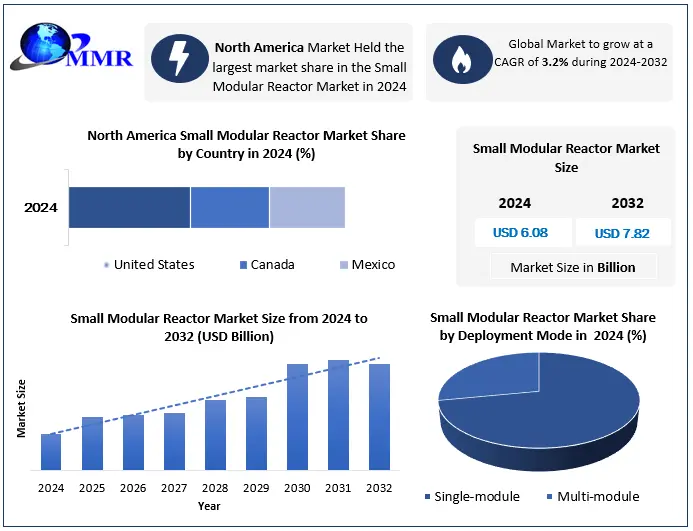 To know about the Research Methodology :- Request Free Sample Report
Small Modular Reactor Market Dynamics
Increasing Demand for Clean, Reliable Energy to Drive the Small Modular Reactor (SMR) Market
The increasing global demand for clean, reliable, and flexible power generation has been driving the Small Modular Reactor Market growth. As countries strive to meet ambitious decarbonization targets and reduce dependence on fossil fuels, Small modular reactors offer a compelling solution. The conventional nuclear plants, Small modular reactors, are designed with smaller footprints, enhanced safety features, and modular scalability, making them suitable for remote locations, off-grid areas, and integration with renewable energy sources.
Governments and utility providers are recognizing Small modular reactors as a low-carbon alternative that can operate consistently, regardless of weather conditions, unlike solar or wind. This makes Small modular reactor ideal for stabilizing power grids and supporting industrial and district heating applications. The international efforts, such as the U.S. Department of Energy’s Advanced Reactor Demonstration Program and support from countries such as Canada, the UK, and Japan, have accelerated the commercialization of SMR technologies. As the world moves toward achieving net-zero goals by mid-century, the ability of Small modular reactor to deliver zero-emission baseload power with economic and siting flexibility positions them as a central driver in the future of global energy systems.
Global Rising Momentum in Small Modular Reactor Deployment to Drive Decarbonization and Industrial Energy Transition
Small Modular Reactors (Small modular reactor) are emerging as a pivotal solution in the global energy transition, addressing both the urgent need for decarbonization and increasing electricity demand. With compact designs offering outputs between 10–300 MWe, Small modular reactor is gaining traction due to their modular, standardized, and factory-built nature, enabling faster, more predictable deployments. More than 50 SMR concepts are currently under development, demonstrating the growing confidence in their technological maturity and versatility. A critical driver is the demand from heavy industries, data centers, and global tech companies such as Microsoft and Google, all seeking reliable, zero-emission energy sources that fit existing infrastructure.
Small modular reactor is uniquely positioned to repower decommissioned coal sites or integrate with chemical, steel, and hydrogen facilities, offering cogeneration of electricity, heat, and steam. Unlocking their full potential hinges on building a global Small Modular Reactor market, supported by fit-for-purpose licensing, financing innovations, and international collaboration. The World Economic Forum’s new framework aims to accelerate this process by aligning stakeholders on standardized design, delivery, and regulatory pathways. As countries commit to tripling nuclear capacity by 2050, Small modular reactors play a transformative role in reshaping global energy systems and industrial decarbonization.
Decentralized Energy Access in Remote Regions to Create a Lucrative Opportunity for Market Growth
The traditional large-scale nuclear power plants, Small modular reactor offer flexible deployment with lower capital requirements and a smaller footprint, making them ideal for isolated communities, island nations, and mining operations. Addressing energy access gaps in remote and off-grid regions is expected to boost the Small Modular Reactor market growth. With modular design and factory fabrication, these reactors have been transported to locations that are otherwise inaccessible to conventional energy infrastructure. This presents governments and private entities with the chance to provide clean, reliable power while reducing dependency on diesel or coal-based generation. As global attention intensifies on energy equity and decarbonization, Small modular reactor uniquely position themselves as scalable solutions to electrify the underserved.
Technological innovation is a cornerstone of the Small Modular Reactor market, with developments focusing on advanced reactor types such as pressurized water reactors (PWRs), high-temperature gas-cooled reactors (HTGRs), and molten salt reactors (MSRs). PWR-based Small modular reactor, such as NuScale’s VOYGR design, emphasize passive safety features and scalability. The MSRs explored by Terrestrial Energy offer high thermal efficiency and fuel flexibility, enabling long-duration operation with minimal refuelling. Additionally, lead-cooled fast reactors and sodium-cooled reactors are being researched for their potential in waste reduction and superior performance. These technologies are pushing the boundaries of nuclear energy by enabling safer, more adaptable, and proliferation-resistant designs.
Types of Small Modular Reactor (SMR) Technologies
Major players in the Small Modular Reactor market are channelling substantial resources into research and development to gain a technological edge. NuScale Power, a pioneer in PWR-based Small modular reactor, has attracted over $1.4 billion in funding, including substantial support from the U.S. Department of Energy (DOE). Rolls-Royce is spearheading the UK’s SMR program with a vision to deploy its reactors by the early 2030s, investing over USD 586.51 million into modular reactor design and manufacturing. In Canada, Terrestrial Energy and Moltex Energy are advancing MSR technologies, supported by funding from Sustainable Development Technology Canada (SDTC). China’s CNNC is actively working on its ACP100 SMR and recently began construction of a demonstration plant. These investments underscore the accelerating momentum and confidence in Small modular reactor as next-generation clean energy sources.
Small Modular Reactor Market Segment Analysis
Based on product type, the heavy water reactors segment held the largest Small Modular Reactor Market share at xx% in 2024 and is expected to grow during the forecast period. This dominance is due to their ability to use natural uranium efficiently, eliminating the need for costly enrichment processes, an advantage particularly appealing to regions with abundant natural uranium but limited enrichment infrastructure. Additionally, heavy water reactors offer superior neutron economy, enabling higher fuel burn-up rates and extended operational cycles, which enhance fuel efficiency and minimize nuclear waste. The demand for light water Small modular reactor is expected to grow at the fastest rate between 2024 and 2032. Their compatibility with existing nuclear infrastructure and established global fuel supply chains supports seamless integration. Their proven safety record and mature regulatory frameworks further accelerate adoption.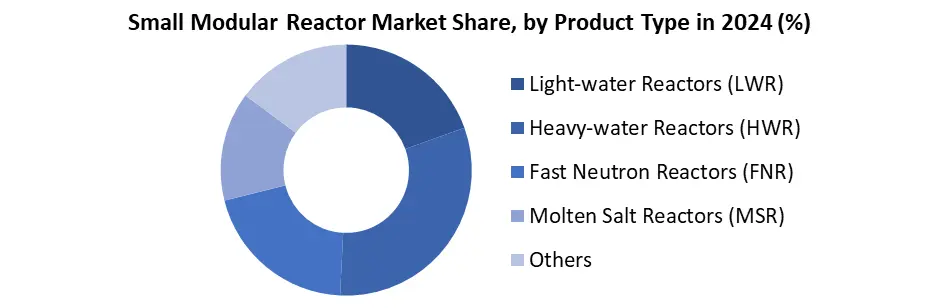
Small Modular Reactor Market Regional Analysis
North America held the largest Small Modular Reactor Market share in 2024. The region's push for clean energy and decarbonization is the primary driving factor of market growth. Small Modular Reactors are gaining traction as a viable replacement for aging fossil fuel infrastructure. The U.S. Small Modular Reactor Industry is expected to grow at a CAGR of xx%, fueled by supportive federal and state policies, significant R&D funding, and net-zero emission goals. The strong government initiatives and the presence of leading SMR developers are expected to boost the segment. The U.S. is home to several private enterprises that have secured regulatory and R&D approvals, accelerating commercialization. The growth is moderated by factors such as complex licensing procedures, high upfront costs, long deployment timelines, and public skepticism about nuclear safety. Despite these, the region remains pivotal to global SMR advancements due to its innovation ecosystem and policy support.
Small Modular Reactor Market Competitive Landscape:
The Small Modular Reactor Market is moderately consolidated, dominated by a few key players leveraging strong technological expertise and robust capital backing. Notable players include NuScale Power, Rolls-Royce SMR, GE Hitachi Nuclear Energy, Rosatom, and Terrestrial Energy. NuScale currently holds a leading position due to its early design approvals and partnerships with U.S. and international utilities. Rolls-Royce SMR is aggressively expanding in Europe with government backing, while GE Hitachi benefits from mature nuclear technology integration with digital systems. Rosatom dominates in Russia and emerging economies through state-funded initiatives and export deals. Market share remains dynamic, as commercial deployment is still nascent, but competitive positioning is being shaped by regulatory approvals, intellectual property, strategic alliances, and supply chain readiness. The landscape is further influenced by national energy policies, geopolitical alliances, and innovation in reactor safety and modularization. Players with scalable models and first-mover advantages are likely to secure long-term dominance.
Recent Developments in the Small Modular Reactor
| Date | Recent Developments |
| June 2024 – KEPCO Engineering & Construction Co., Inc. and Rwanda | KEPCO Engineering & Construction signed a Memorandum of Understanding (MoU) with the Government of Rwanda during the Korea-Africa Summit. The agreement focuses on collaboration in the development of Small Modular Reactors (Small modular reactor) and Used Battery Energy Storage Systems (UBESS). Both parties committed to technical cooperation, personnel exchange, and business collaboration to support Rwanda’s energy infrastructure development and address its growing electricity demand. |
| July 2023 – X-energy and Energy Northwest (USA) | X-energy entered into a joint development agreement with Energy Northwest to deploy up to 12 Xe-100 advanced Small modular reactor in central Washington State. These reactors are expected to generate a total of 960 megawatts of carbon-free electricity by 2030. The initiative aims to enhance the region’s clean energy grid, meet rising energy demands, and create new job opportunities in the clean energy sector. |
Small Modular Reactor Market Scope: Inquire before buying
| Small Modular Reactor Market | |||
|---|---|---|---|
| Report Coverage | Details | ||
| Base Year: | 2024 | Forecast Period: | 2025-2032 |
| Historical Data: | 2019 to 2024 | Market Size in 2024: | USD 6.08 Bn. |
| Forecast Period 2025 to 2032 CAGR: | 3.2% | Market Size in 2032: | USD 7.82 Bn. |
| Segments Covered: | by Product Type | Light-water Reactors (LWR) Heavy-water Reactors (HWR) Fast Neutron Reactors (FNR) Molten Salt Reactors (MSR) Others |
|
| by Deployment Mode | Single-module Multi-module |
||
| by Location | Onshore Offshore |
||
| by Application | Power Generation Desalination District Heating Hydrogen Production Others |
||
Small Modular Reactor Market, by Region
North America (United States, Canada and Mexico)
Europe (UK, France, Germany, Italy, Spain, Sweden, Russia and Rest of Europe)
Asia Pacific (China, South Korea, Japan, India, Australia, Indonesia, Malaysia, Vietnam, Taiwan, Thailand, Philippines, and Rest of APAC)
South America (Brazil, Argentina, Rest of South America)
Middle East and Africa (South Africa, GCC, Egypt, Nigeria, Rest of MEA)
Small Modular Reactor Market Key Players
1. NuScale Power
2. TerraPower
3. GE Hitachi Nuclear Energy
4. X-energy
5. Fluor Corporation
6. ARC Energy LLC
7. Westinghouse Electric Company
8. Holtec International
9. Kairos Power
10. BWX Technologies, Inc.
11. Ultra Safe Nuclear Corporation (USNC)
12. General Atomics
13. Rolls-Royce SMR Ltd
14. Moltex Energy
15. LeadCold Reactors
16. EDF (Électricité de France)
17. Rosatom (JSC Afrikantov OKBM)
18. Korea Atomic Energy Research Institute (KAERI)
19. Samsung Heavy Industries
20. Mitsubishi Heavy Industries
21. Toshiba Energy Systems & Solutions Corp.
22. Hitachi Ltd.
23. Seaborg Technologies
24. Newcleo
25. Copenhagen Atomics
26. China National Nuclear Corporation
27. Others
Frequently Asked Questions:
1) What is the Small Modular Reactor market size, and what is the expected growth?
Ans: The Small modular reactor market was valued at USD 6.08 Billion in 2024 and is projected to reach nearly USD 7.82 Billion by 2032, growing at a CAGR of 3.2%.
2) What makes Small Modular Reactors attractive compared to conventional nuclear plants?
Ans: Small modular reactor offer modular construction, enhanced safety, lower capital investment, and quicker deployment, making them ideal for remote areas and industrial applications.
3) Which regions are expected to lead the Small Modular Reactor market growth?
Ans: North America and Europe are early adopters, while Asia-Pacific is expected to experience rapid growth due to industrial expansion and clean energy goals.
4) Who are the major players in the global Small Modular Reactor market?
Ans: Key players include NuScale Power, Rolls-Royce SMR, GE Hitachi Nuclear Energy, Terrestrial Energy, and Rosatom, all leading in development, partnerships, and regulatory approvals.
5) What are the key challenges facing Small Modular Reactor commercialization?
Ans: The Small Modular Reactor Market faces hurdles such as complex licensing frameworks, high upfront costs, long construction timelines, and public concerns regarding nuclear safety.