
Single Use Bioreactor Market Size – Industry Structure Evaluation, Demand Drivers Analysis, Regional Growth Analysis and Identification, Competitive Positioning Review & Global Market Size Forecast to 2030
Overview
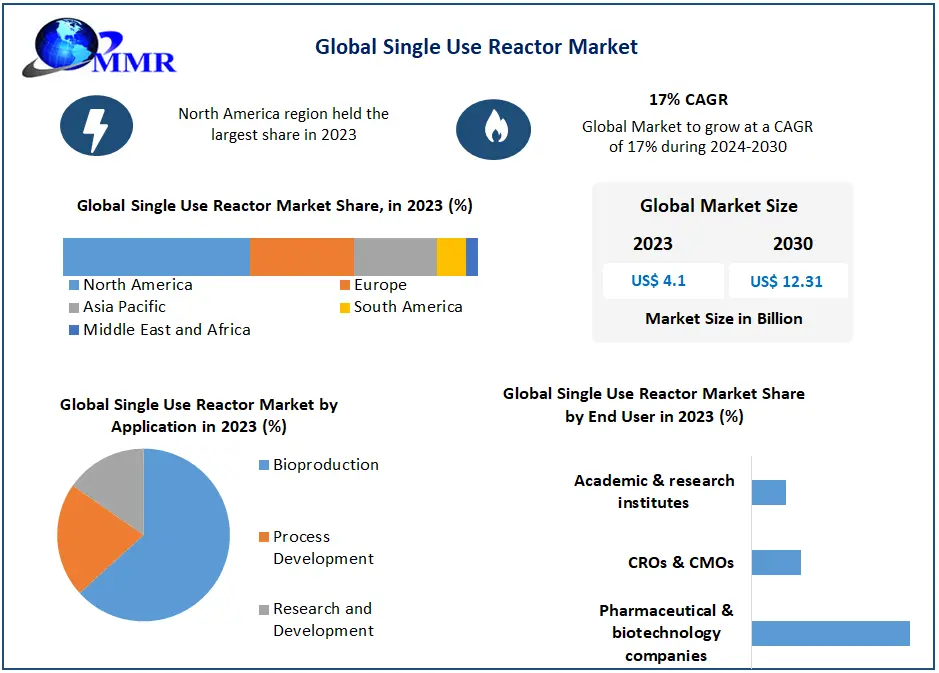
The Global Single Use Bioreactor Market was valued at USD 4.1 billion in 2023. The market is projected to grow at a compound annual growth rate (CAGR) of around 17% from 2024 to 2030. The Single Use Bioreactor market is expected to witness substantial growth in the coming years due to the increasing adoption of single-use technologies across the biopharmaceutical industry.
Single Use Bioreactor Market Overview
This growth can be attributed to the growing demand for biopharmaceuticals, increasing investments in R&D activities, and the expanding biotechnology and biopharmaceutical industries globally. The rising trend of outsourcing bioproduction activities to contract manufacturing organizations (CMOs) is also expected to contribute to Single Use Bioreactor Market growth. Single Use Bioreactor provide CMOs with the flexibility to scale up or down production based on demand, leading to improved operational efficiency and cost savings. Geographically, North America and Europe have been the major markets for Single Use Bioreactors, primarily driven by established biopharmaceutical industries, advanced healthcare infrastructure, and favourable government initiatives. However, emerging economies in the Asia Pacific region, such as China and India, are witnessing rapid growth in the biopharmaceutical sector, which is expected to propel the demand for Single Use Bioreactor in the region.
 To know about the Research Methodology :- Request Free Sample Report
Single Use Bioreactor Market Research Methodology:
The research methodology for the Single Use Bioreactor market involves a combination of quantitative and qualitative elements. The market is extensively researched using primary and secondary data sources, with a focus on understanding market trends, customer preferences, and industry challenges specific to Single Use Bioreactors.
Primary research for the Single Use Bioreactor market involves collecting data through surveys, interviews, and focus groups with key stakeholders such as industry experts, bioreactor manufacturers, biopharmaceutical companies, and end-users. These primary research methods help gather insights on market dynamics, customer needs, industry challenges, and emerging trends in single-use bioreactor manufacturing. The primary research data provides a first-hand understanding of the current market landscape, growth potential, and customer requirements.
Secondary research for the Single Use Bioreactor market involves gathering data from published industry reports, company websites, annual reports, trade journals, scientific papers, and databases related to bioreactor manufacturing. Additionally, information on technology developments, market trends, and advancements in Single Use Bioreactors is collected from various sources such as industry and government websites, blogs, magazines, conference proceedings, and association publications. Paid sources like Questel Orbit, Factiva, Bloomberg, and other relevant databases are also utilized to gather comprehensive information.
To estimate the market size, growth potential, and forecast for the Single Use Bioreactor market, a bottom-up approach is used. The market size for top-level markets and sub-segments is normalized, taking into account various factors such as economic conditions, regulatory changes, and market dynamics. Multiple data triangulation methodologies are applied to ensure accurate estimation of market size and forecasts. The percentage splits, market shares, and breakdowns of the Single Use Bioreactor market segments are derived based on weights assigned to each segment, considering factors such as their utilization rate and average selling price. This information is obtained through a combination of primary research and secondary data analysis. The data is then analysed and synthesized to provide a comprehensive view of the market structure and segment-wise distribution.
Country-wise analysis of the overall market and its sub-segments is conducted based on the percentage adoption or utilization of Single Use Bioreactors in each region or country. This analysis takes into account factors such as regulatory frameworks, government initiatives, and market maturity in different geographical regions. It provides insights into regional variations and helps in identifying growth opportunities and potential challenges specific to each market.
The report includes a comprehensive competitive analysis of key players in the Single Use Bioreactor market. Major players are identified through secondary research based on indicators such as market revenue, pricing, product offerings, technological advancements, mergers and acquisitions, and partnerships. The report presents a clear representation of the competitive landscape, considering factors such as pricing, financial position, growth strategies, and regional presence of key players in the Single Use Bioreactor market, catering to the needs of potential investors.
The market dynamics and factors affecting the growth of the Single Use Bioreactor market, both external and internal, are analysed in the report. These factors include technological advancements, research and development activities, government regulations, industry collaborations, and market demand. The analysis helps in understanding the drivers, restraints, opportunities, and challenges influencing the market growth. It also provides insights into the future prospects and potential risks associated with the Single Use Bioreactor market.
Scope:
The report provides a comprehensive analysis of the global Single Use Bioreactor market, covering the current market size, future growth prospects, key drivers, restraints, and opportunities influencing the market. It offers an in-depth analysis of the competitive landscape, market trends, and product innovations within the Single Use Bioreactor market. The scope of the report includes a detailed segmentation analysis of the market based on product type, end-user, and region.
The market for Single Use Bioreactors serves a wide range of end-users. Biopharmaceutical companies are major consumers, utilizing Single Use Bioreactors for the production of biologics, biosimilars, and personalized medicines. Other industries such as food and beverages, agriculture, and environmental biotechnology also utilize Single Use Bioreactors in their bioprocessing applications.
The report provides market size and forecast data for each product type and end-user segment, along with a market share analysis of key players in each segment. It also includes regional analysis, covering market trends, challenges, and opportunities that are likely to shape market growth in the forecast years.
The growth of the Single Use Bioreactor market is driven by increasing demand for biopharmaceuticals, advancements in bioprocessing technologies, and the need for flexible and cost-effective manufacturing solutions. Single Use Bioreactors offer advantages such as ease of use, reduced cleaning and validation requirements, and faster turnaround times compared to traditional stainless-steel bioreactors. However, challenges related to scalability, limited capacity, and concerns regarding leachable and extractables in single-use systems may impact market growth.
The report aims to assist stakeholders, including biopharmaceutical companies, CDMOs, research institutions, and investors, in making informed decisions and formulating effective strategies to capitalize on the opportunities in the Single Use Bioreactor market and expand their business. By providing comprehensive insights into market trends, competitive landscape, and regional dynamics, the report enables stakeholders to navigate the evolving market landscape and drive their growth in this rapidly expanding industry.
Single Use Bioreactor market Dynamics:
Single Use Bioreactor market is influenced by various drivers, restraints, opportunities, and trends. Understanding these dynamics is crucial for stakeholders in making informed decisions and capitalizing on market growth potential.
Single Use Bioreactor market Drivers:
Growing Demand for Biopharmaceuticals: The increasing demand for biopharmaceuticals, such as monoclonal antibodies, vaccines, and recombinant proteins, is a significant driver for the Single Use Bioreactor market. These bioreactors offer advantages in terms of flexibility, reduced cross-contamination risks, and cost-effectiveness, making them an attractive choice for biopharmaceutical manufacturers.
Advancements in Bioprocessing Technologies: Continuous advancements in bioprocessing technologies have improved the efficiency and scalability of Single Use Bioreactors. The integration of advanced features, such as real-time monitoring, automation, and process control, enhances productivity and accelerates the manufacturing process, driving the adoption of single-use systems.
Cost Savings and Operational Efficiency: Single Use Bioreactors eliminate the need for time-consuming cleaning, sterilization, and validation processes associated with traditional stainless-steel bioreactors. They enable rapid turnaround times between batches, reducing downtime and increasing overall operational efficiency. Additionally, the elimination of capital-intensive cleaning and maintenance processes leads to cost savings for biopharmaceutical manufacturers.
Single Use Bioreactors Market Opportunities:
The Single Use Bioreactor market presents several opportunities for growth and expansion:
Expansion of Biopharmaceutical Pipeline: The increasing focus on developing biologic drugs and personalized medicines presents significant opportunities for the Single Use Bioreactor market. As more biopharmaceuticals move through the development pipeline, the demand for efficient and flexible manufacturing solutions provided by Single Use Bioreactors is expected to rise.
Rise in Contract Manufacturing Services: The outsourcing of biopharmaceutical manufacturing to Contract Development and Manufacturing Organizations (CDMOs) is on the rise. CDMOs are adopting Single Use Bioreactors to enhance their manufacturing capabilities and meet the growing demand from biopharmaceutical companies. This trend creates opportunities for Single-Use Bioreactor manufacturers and suppliers to cater to the increasing demand from CDMOs.
Technological Advancements and Product Innovation: Continued advancements in single-use technologies, such as improved sensor systems, disposable sensors, and biocompatible materials, present opportunities for product innovation in the Single Use Bioreactor market. Manufacturers that develop novel features and enhancements to improve process control, monitoring, and scalability can gain a competitive advantage.
Single Use Bioreactors Market Trends:
Shift toward Single-Use Systems: The industry is witnessing a gradual shift from traditional stainless-steel bioreactors to Single Use Bioreactors. The flexibility, reduced cleaning requirements, and operational advantages offered by single-use systems are driving this trend. Biopharmaceutical manufacturers are increasingly incorporating single-use technologies into their manufacturing processes.
Rapid Adoption of Continuous Bioprocessing: Continuous bioprocessing is gaining traction in the biopharmaceutical industry due to its potential for improved productivity and reduced manufacturing costs. Single Use Bioreactors play a crucial role in continuous bioprocessing, as they allow for seamless integration and efficient handling of continuous operations.
Growing Emphasis on Quality Control: With the increasing importance of product quality and safety, there is a growing emphasis on implementing robust quality control measures in Single indUse Bioreactor manufacturing. Manufacturers are focusing on ensuring consistent performance, integrity, and traceability of single-use systems to meet regulatory requirements and maintain product quality.
Single Use Bioreactor Market Restraints:
Scalability Limitations: Scaling up the production of biopharmaceuticals using Single Use Bioreactors can be challenging. Scaling from small-scale to large-scale production requires careful optimization of process parameters and system design to ensure consistent. Single Use Bioreactors typically have a limited working volume compared to traditional stainless-steel bioreactors. This limitation can restrict the production capacity, especially for large-scale manufacturing of biopharmaceuticals. Manufacturers may need to use multiple single-use systems in parallel or invest in larger-scale Single Use Bioreactors to meet the growing demand, which can add complexity and cost to the manufacturing process. This acts as a restraint for Single Use Bioreactor Market growth.
Concerns Regarding Leachable and Extractables: Single Use Bioreactors are made from polymeric materials, and there are concerns about potential leaching of chemicals from these materials into the product during the manufacturing process.
Single Use Bioreactor market segmentation:
Based on Product: The market is segmented into single use bioreactor systems, single use media bags, single use filtration assemblies and Others. The single use bioreactor systems segments held the largest Single Use Bioreactor market share in 2023. This is because it provides benefits such as reduced capital investment, decreased operating costs, and a smaller environmental impact.
Based on Type of Cell: The market is segmented into Mammalian cells, Bacterial cells, Yeast cells and Others. The Mammalian cells segment held the largest Single Use Bioreactor market share in 2023. The extensive utilization of mammalian cells in producing biopharmaceutical therapies and the successful commercialization of recombinant proteins from such cells has led to their predominant role in the field. Meanwhile, yeasts, as eukaryotic hosts, stand out for their reliability in synthesizing heterologous proteins, offering distinct advantages for generating therapeutic recombinants. The increasing interest from scientists and research institutions in employing yeast cells for clinical or therapeutic purposes is poised to fuel market growth in the foreseeable future.
Single Use Bioreactor Market Regional analysis:
The report provides a comprehensive analysis of the growth, trends, and opportunities in the Single Use Bioreactor market across different regions. The market is segmented by region, product type, and end-use industry.
North America dominates the Single Use Bioreactor market, benefiting from major players, advanced research infrastructure, and a high demand for Single Use Bioreactors in the biopharmaceutical and biotechnology industries. The region has well-established sectors that require efficient and flexible bioreactor systems for the production of biologics, vaccines, and other therapeutic products. Additionally, the presence of stringent regulatory guidelines and a focus on reducing contamination risks further drives the adoption of Single Use Bioreactors in North America.
Europe holds a significant share in the market, driven by its strong biopharmaceutical industry and the presence of key market players. The region's emphasis on personalized medicine, advancements in biotechnology, and increasing investments in biopharmaceutical research contribute to the demand for Single Use Bioreactors. Additionally, the favourable regulatory environment and guidelines supporting the use of single-use technologies further stimulate market growth in Europe.
The Asia-Pacific region emerges as a rapidly growing market for Single Use Bioreactors, fuelled by the expansion of the biopharmaceutical and biotechnology industries, increasing investments in healthcare infrastructure, and a rising demand for biologics and biosimilars. Countries like China, India, and South Korea are witnessing significant growth in the adoption of Single Use Bioreactors due to their cost-effectiveness, ease of use, and ability to accelerate manufacturing processes. Furthermore, the presence of a large patient population, increasing healthcare expenditure, and government initiatives to promote biopharmaceutical research and development contribute to market growth in the region.
Latin America and the Middle East and Africa experience moderate growth rates in the Single Use Bioreactor market. These regions are gradually investing in healthcare infrastructure, fostering collaborations with global biopharmaceutical companies, and increasing awareness about the benefits of single-use technologies. The growing demand for biopharmaceuticals and the need for cost-effective and scalable manufacturing solutions drive the adoption of Single Use Bioreactors in these regions.
The global Single Use Bioreactor market presents diverse growth prospects, driven by the expanding biopharmaceutical and biotechnology industries, increasing demand for biologics and biosimilars, and advancements in research and development activities across different regions. The market is expected to continue its growth trajectory as manufacturers focus on developing innovative and technologically advanced Single Use Bioreactors to meet the rising demand for efficient and flexible bioprocessing solutions.
Competitive landscape:
The market report offers an in-depth analysis of the competitive landscape of the Single Use Bioreactor market, including the major players and their strategies.
The Single Use Bioreactor market is highly competitive, and several key players dominate the industry. Among these players, Sartorius AG stands out as a leading company in the market. Sartorius offers a diverse range of bioreactor systems and disposable bioreactor bags. The company's focus on continuous innovation and technological advancements has allowed it to maintain a competitive edge. Additionally, Sartorius emphasizes strategic collaborations and partnerships to expand its market presence.
Thermo Fisher Scientific Inc. is another prominent player in the Single Use Bioreactor market. The company provides comprehensive bioprocessing solutions and is committed to developing advanced single-use technologies and integrated bioprocessing systems. Thermo Fisher Scientific invests in research and development activities and strategic acquisitions to strengthen its product portfolio and enhance its market position.
Merck KGaA is also a significant player in the Single Use Bioreactor market, offering a range of bioreactors and related technologies. The company focuses on product innovation and customization to meet the specific needs of its customers. Merck KGaA actively engages in collaborations and partnerships with biopharmaceutical companies and research institutions to drive technological advancements and expand its market reach.
Danaher Corporation's Pall Corporation is recognized as a key player in the Single Use Bioreactor market. Pall Corporation provides a broad range of single-use bioreactor systems, filtration, and purification technologies. The company continuously strives to enhance its product offerings through research and development efforts and strategic acquisitions. Pall Corporation places a strong emphasis on providing excellent customer support and service.
GE Healthcare is a notable player in the Single Use Bioreactor market, offering a comprehensive portfolio of bioreactor solutions. Their range includes bioreactor bags, mixing systems, and control systems. GE Healthcare focuses on developing innovative technologies and solutions to address the evolving needs of the bioprocessing industry. The company also establishes strategic collaborations and partnerships to strengthen its market position and expand its product offerings.
Applikon Biotechnology B.V. is a leading player that provides a wide range of bioreactor systems and accessories for the Single Use Bioreactor market. The company's emphasis on continuous innovation and product development allows them to offer state-of-the-art solutions. Applikon Biotechnology also places importance on strategic collaborations and partnerships to enhance its market presence and customer base.
Cellexus Ltd. specializes in the development and manufacturing of single-use bioreactor systems for microbial and cell culture applications. The company is dedicated to providing innovative and user-friendly solutions that facilitate efficient bioprocessing. Cellexus focuses on customer satisfaction and offers comprehensive technical support and training.
Pierre Guérin, a subsidiary of Sartorius Stedim Biotech, is a significant player in the Single Use Bioreactor market. The company offers a range of single-use bioreactor systems, mixing systems, and disposable bags. Pierre Guérin's focus on technological advancements and customization enables them to meet the specific requirements of their customers.
competitive landscape of the Single Use Bioreactor market is characterized by intense competition among key players. These companies focus on product innovation, technological advancements, and strategic collaborations to gain a competitive edge. They invest in research and development activities to enhance their product offerings and meet the increasing demand for efficient and cost-effective bioprocessing solutions. Expanding their geographical presence and ensuring excellent customer service are also key strategies employed by these companies to maintain and expand their market share.
Single Use Bioreactor Scope: Inquire before buying
| Global Single Use Bioreactor Market | |||
|---|---|---|---|
| Report Coverage | Details | ||
| Base Year: | 2023 | Forecast Period: | 2024-2030 |
| Historical Data: | 2018 to 2023 | Market Size in 2023: | US $ 4.1 Bn. |
| Forecast Period 2024 to 2030 CAGR: | 17% | Market Size in 2030: | US $ 12.31 Bn. |
| Segments Covered: | by Product | single use bioreactor systems Up to 10 L 11–100 L 101–500 L 501–1500 L Above 1500 L single use media bags 2D Bags 3D Bags Other bags single use filtration assemblies Others |
|
| by Type of Molecule | Stirred-tank single use bioreactors Wave-induced single use bioreactors Bubble-column single use bioreactors Others |
||
| by Type of Cell | Mammalian cells Bacterial cells Yeast cells Others |
||
| by Application | Bioproduction Process Development Research and Development |
||
| by End User | Pharmaceutical & biotechnology companies CROs & CMOs Academic & research institutes |
||
Single Use Bioreactor Market, by Region
North America (United States, Canada and Mexico)
Europe (UK, France, Germany, Italy, Spain, Sweden, Austria and Rest of Europe)
Asia Pacific (China, South Korea, Japan, India, Australia, Indonesia, Malaysia, Vietnam, Taiwan, Bangladesh, Pakistan and Rest of APAC)
Middle East and Africa (South Africa, GCC, Egypt, Nigeria and Rest of ME&A)
South America (Brazil, Argentina Rest of South America)
Single Use Bioreactor Key Players
The report has in detail information about the Single Use Bioreactors strategies adopted by the following key players to sustain and grow in the market. These players covered in the report are selected on the basis of certain criteria.
1. Thermo Fisher Scientific, Inc. (North America)
2. Sartorius AG (Europe)
3. Merck KGaA (Europe)
4. Danaher Corporation (North America)
5. GE Healthcare (North America)
6. Applikon Biotechnology B.V. (Europe)
7. Eppendorf AG (Europe)
8. Cellexus Ltd. (Europe)
9. Pall Corporation (North America)
10. PBS Biotech, Inc. (North America)
11. Distek, Inc. (North America)
12. Celltainer Biotech B.V. (Europe)
13. Parker Hannifin Corporation (North America)
14. Finesse Solutions, LLC (North America)
15. CESCO Bioengineering Co., Ltd. (Asia)
16. Pierre Guérin Technologies (Europe)
17. Solida Biotech GmbH (Europe)
18. Bionet Engineering (Europe)
19. ATMI LifeSciences (North America)
20. CerCell ApS (Europe)
21. ABEC, Inc. (North America)
22. Xcellerex, Inc. (North America)
23. Infors AG (Europe)
24. Stobbe Tech A/S (Europe)
25. Celltainer Biotech B.V. (Europe)
Frequently Asked Questions:
1] What segments are covered in the Single Use Bioreactor market report?
Ans. The segments covered in the Single Use Bioreactor market report are based on product, type of Molecule, type of Cell, application, end-user, and geography.
2] Which region is expected to hold the highest share in Single Use Bioreactor market?
Ans. The North America region is expected to hold the highest share in Single Use Bioreactor market.
3] What is the market size of the Single Use Bioreactor market by 2030?
Ans. The market size of the Single Use Bioreactors Market by 2030 is expected to reach US $ 12.31 billion.
4] What is the forecast period for the Single Use Bioreactor market?
Ans. The Forecast period for the Single Use Bioreactor market is 2024-2030.
5] What was the market size of the Single Use Bioreactor market in 2023?
Ans. The market size of Single Use Bioreactor market in 2023 was US $ 4.1 billion.