
Short Read Sequencing Market by Product, Technology, Work, Application, End-User, and Region - Global Market Size Estimation, Industry-Wide Analysis, Competitive Landscape Assessment & Long-Term Forecast to 2032
Overview
Global Short Read Sequencing Market size was valued at USD 9.05 Bn in 2025 and is expected to reach USD 30.24 Bn by 2032, at a CAGR of 18.8 %.
Short Read Sequencing Market Overview
Short-read sequencing is a powerful tool for generating genomic data. With short-read sequencing, DNA or RNA is sequenced in a short amount of time period at a lower cost than the traditional method. This technology has revolutionized biomedical research and led to important discoveries in genomics, evolution, and disease. It has also been used to assemble whole genomes, providing valuable information about the structure and function of genes.Short Read Sequencing Market is growing considerably thanks to recent discoveries and increasing demand in clinical research. 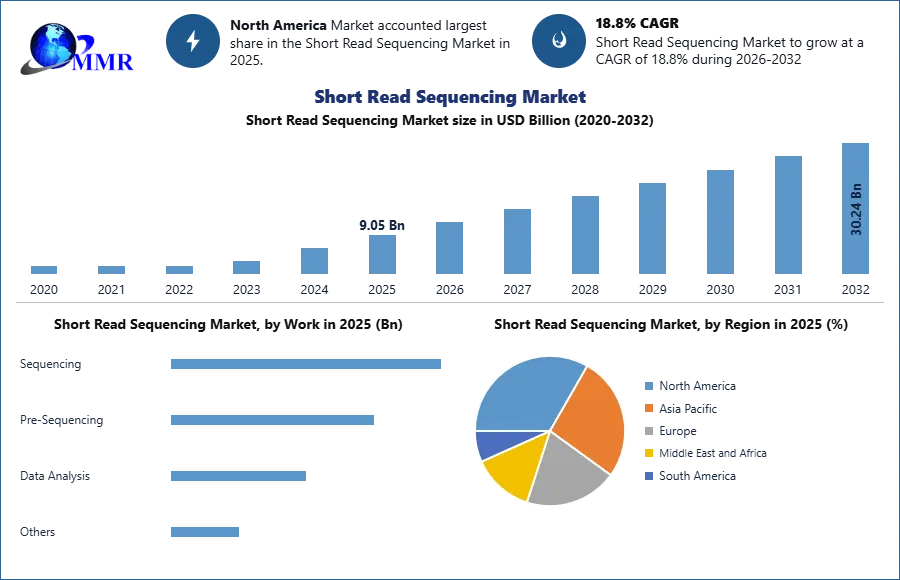 To know about the Research Methodology :- Request Free Sample Report
Short Read Sequencing Market Trends
As technology is emerging, the process is getting simplified each day. Thus, it shows a great and positive trend towards the short read sequencing market. The market is dominate by US and European firms, where 2-3 established firm holds a significant percent of share. As the research is in the field to achieve more from lesser DNA, the short read sequencing will have an edge over long read sequencing. Also, investments and acquisitions have helped big companies regain their share. Qiagen acquired N-of-One and Illumina acquired Pacific Biosciences (PacBio) are some examples of consolidate by the bigger players. Yet new companies are entering this market, looking at its growth and competition. MGI Tech (Recently founded) develops and markets a range of NGS platforms and applications. Also, if we focus on short read sequencing counter options (long-read sequencing and nanopore sequencing), the short read sequencing offers a better solution and is very cost effective. So, it’s evident that short read sequencing will outrun and develop better in future, which indicates why companies are looking forward to short read sequencing market. Thus, indicating how much potential does the Short Read Sequencing Market have.
Short Read Sequencing Market Dynamics
R&D Activities to Create Lucrative Opportunity for the Short Read Sequencing Market Growth
The Short Read Sequencing Market is growing, with new technologies and developments across the market. The upcoming platforms are highly efficient, accurate and scalable which offers huge advantage. Cancer therapies and drug discoveries have made the Short Read Sequencing Market demanding because of its increasing use. The Short Read Sequencing Market drivers have relied on technological advancements and advanced tools to sequence the short segments. Thus, with these advancements, the cost of sequencing is declining and is also accessible to wide range of applications, like the use of short - read sequencing in genomics research is expanding rapidly, as researchers seek to uncover new insights into genetic variation and disease mechanisms. The expanding applications of short-read sequencing across various sectors, including agriculture, environmental research, and forensics. The ability to rapidly sequence and analyze DNA has revolutionized these industries, allowing for better crop management, environmental monitoring, and criminal investigations. As these sectors continue to recognize the value of short-read sequencing and is expected to boost the market growth.
The regulatory environment for short read sequencing market is complex, thus different regions have different requirements and specific guidelines. The market is highly competitive, with few key players holding the majority of the market. The established players like Illumina, QIAGEN and Thermo Fischer are dominant players in the market and the entry barrier is considerably high for the new players. The collaborations and acquisitions have helped established players regain their market share. Example - Oxford Nanopore Technologies and Roche, collaborated to develop a new generation of nanopore-based sequencing platforms that could be used for a wide range of applications, including clinical diagnostics, drug discovery, and environmental monitoring. The applications of short read sequencing industry are also gaining attraction for the identification of treatable genetic disorders to avoid disability and further complications. For example, the U.K. government announced the new-born Genomes Program which aims at using whole genome sequencing analysis for the detection of rare diseases in new-born individuals.
Short Read Sequencing market Restrain and Challenges
There are many challenges which govern the short read sequencing market, like accuracy. Even after using most reliable tools, there are many cases of false positive results which brings a question mark upon accuracy and reliability. Data analysis is another problem, which makes it difficult to analyse complex data and also can cause huge repercussions, if the technology is not adequately built enough to withstand all the function of bioinformatics. Along with technology, standardization can cause significant harm to the entire process. Thus, SOPs can reduce variabilities and establish a common ground. The cost of sequencing can also act as a challenge as the reduced cost is still high enough and needs to be deducted in future. Addressing these considerations will be important to ensure the responsible and ethical use of short read such as data privacy, informed consent.
Advancements in sequencing technologies and bioinformatics tools are creating new opportunities for the short-read sequencing market. These innovations are improving the speed, accuracy, and cost-effectiveness of sequencing processes, making it more accessible to researchers and clinicians. Additionally, the integration of artificial intelligence and machine learning algorithms with sequencing data analysis is opening up new possibilities for data interpretation and discovery, further driving market growth.
Short Read Sequencing Market Segmentation
Short Read Sequencing Market Segmentation by Products
Consumables are one of the leading products in the short read sequencing market as they are short-lived and offer more utilization than others. Wide range of applications and usefulness in nearly all processes makes the consumable retain its share. With increase in research, the needs for laboratories have also increased. Example - GENEWIZ provides custom short-read amplicon sequence analysis using Illumina platforms for antibody profiling Also, instruments have least amount of share, as with new technology, is evolving and changing continuously, the newer instruments have to be replaced with the old ones
Short Read Sequencing Market Segmentation by Work
Sequencing is leading in this segmentation, as more research is progressing. Sequencing nearly accounts for 60% of the total and has established a good market share in short - read sequencing market. High competition in the market has led to the launch of platforms that can be easily used to sequence DNA. These platforms include MiSeq, iSeq. Data Analysis is projected to be the fastest-growing segment in the short-read sequencing industry and is expected to grow at a CAGR of nearly 21%. Data analysis enables gene expression analysis which can be used to study disease progression and diagnosis. It has prime importance in clinical research studies.
Short Read Sequencing Market Segmentation by End User
The academic & research institutes segment held for the largest market share of 48.67% in 2025 due to the increase in the research infrastructure and funding by the pharmaceutical & biotechnology companies to enhance the proteomics, genomics, and biotechnology markets. Thus, academic and research institutes nearly half of the entire market share. Also, biotech and pharma companies are increasing their use of short read sequences and showing a better year on year growth and are likely to gain higher market share by 2032.
Short Read Sequencing Market Segmentation by Applications
Whole Genome Sequencing, Whole Exome Sequencing, Targeted Sequencing & Resequencing, DNA-base and RNA-based are the classifications of the short read sequencing market. Targeted sequence analysis becomes easier, reduces burden of complex data, becomes specific in analysis and improves accuracy. The market with huge potential for future is Whole genome sequencing market, as it has shown huge demand because of government and non-government institutions are adopting the technique for the detection of rare & rare diseases in new-borns and young children.
Short Read Sequencing Market Segment Analysis by Technology
Next gen sequencing and Sanger sequencing can be the 2 factors of segmentation in short read sequencing market. Next gen sequencing is significantly cheaper, quicker, needs significantly less DNA and is more accurate and reliable than Sanger sequencing. Thus, NGS edges over Sanger sequencing a bit. NGS can produce millions of short reads in a single run, making it ideal for applications which Sanger cannot produce. Sanger sequencing reads long bp, that are typically several hundred to several thousand base pairs in length.
Short Read Sequencing Market Regional Insights:
North America Held the largestShort Read Sequencing Market share in 2025. North America has been traditionally a dominant player because of well-developed infrastructure and huge companies residing there. The United States, in particular, has a significant share in the Short Read Sequencing Market due to the presence of a large number of biotechnology and pharmaceutical companies, academic research institutes, and government initiatives promoting short - read sequencing research. Also, the presence of advanced healthcare infrastructure and the availability of funding for research and development has contributed to the growth of the Short Read Sequencing Market in the United States. Huge financial backing and increased demand have often helped North America sustain a huge market share over others.
The work on cancer therapeutics has been a prominent reason for such a significant growth. Not just cancer, but also genetic abnormalities can be detected using short read sequencing. Some other contributing factors are new drug discovery, huge investments in R&D, personalised medicine and increased demand for consumer genomics. The research studies like 100000 Genomes Project have also used short read sequencing. Example – Jan 2023, QIAGEN digital Insights launched NGS data analysis platform for conducting whole genome analysis for research in 25 minutes.
The short read sequencing market in Asia Pacific is significantly showing rapid growth which is a result of a huge population and two strong countries - India and China. Increased investments in biotechnology, rising healthcare spending, and the occurrence of the virus, all have contributed to a rapid surge of the industry in the Asia Pacific region. Both India and China have well-developed resources and techniques to enlarge their short read sequencing market share. Chinese government in past decade has splashed huge cash in their R&D to develop a sequencing market which is sustainable and profitable, several Chinese companies, such as BGI and MGI Tech, have become major players in the global sequencing market. Irrespective of these two, even Japan and South Korea have emerged as upcoming markets due to their high investment in life sciences and overall R&D
Europe is another dominant player in the short read sequencing market, where Germany and UK lead the way in the short read sequencing market. The intact healthcare market and growing investments have helped Europe dominate this industry. The government have invested heavily in several projects like 100000 Genomes Project, which aims to sequence the genomes of 100,000 UK patients. The UK is home to several prominent short - read sequencing companies and research institutions which has helped itself gain a huge market share along with Germany and France. Even Germany has well established companies like QIAGEN and Eurofins Genomics, which are prominent players in the short read sequencing market. All the countries have relied on huge investments, and proper facilities which have made them one of the most prominent leaders in the market
The Short Read Sequencing Market in South America is growing steadily, Brazil and Argentina are emerging as the dominant players. Both countries have spent huge amounts of dollars to sustain this short read sequencing market. Brazilian Agricultural Research Corporation (EMBRAPA) and the Centre for Genomics and Applied Biotechnology (CBGA) have worked to attain a significant hold over the short - read sequencing market. Along with these two, even Chile, and Peru are emerging markets that have the potential to compete with the two main players of the South American continent. Centre for Genome Regulation (CRG) in Chile is working on genomics research related to human health and agriculture.
Short Read Sequencing Market Competitive Landscape
The short read sequencing market is competitive and consists of many small and big companies contesting for a small share in short - read sequencing industry. Well established players have gained a good control over the market and usually reply on mergers and acquisitions to regain their share. Qiagen acquired N-of-One is one such example of such an acquisition. The main companies with high % share - Illumina, Thermo Fischer, QIAGEN and BGI Group who dominate the short read sequencing market. Illumina is leading player and acts as near monopoly with more than 50% of Short Read Sequencing Market share. Thermo Fisher follows Illumina as 2nd largest company in short - read sequencing industry. Recently Oxford Nanopore Technologies has gained significant market share with its nanopore sequencing technology and also BCI group has leveraged Similarly, BGI Group has become a major player in the market with its cost-effective sequencing platforms. Thus, with increasing demand, more companies are bound to form to fulfil this higher demand, which would make the Short Read Sequencing Market even more competitive.
Short Read Sequencing Market Scope: Inquire before buying
| Short Read Sequencing Market | |||
|---|---|---|---|
| Report Coverage | Details | ||
| Base Year: | 2025 | Forecast Period: | 2026-2032 |
| Historical Data: | 2020 to 2025 | Market Size in 2025: | 9.05 USD Billion |
| Forecast Period 2026-2032 CAGR: | 18.8% | Market Size in 2032: | 30.24 USD Billion |
| Segments Covered: | by Product | Consumables Services Instruments |
|
| by Technology | Next gen sequencing Sanger sequencing |
||
| by Work | Sequencing Pre-Sequencing Data Analysis Others |
||
| by Application | Whole Genome Sequencing Whole Exome Sequencing Targeted Sequencing & Resequencing DNA-base RNA-based Others |
||
| by End-User | Pharma companies Research institutions Clinical Laboratories Others |
||
Short Read Sequencing Market, by Region
North America (United States, Canada and Mexico)
Europe (UK, France, Germany, Italy, Spain, Sweden, Austria and Rest of Europe)
Asia Pacific (China, South Korea, Japan, India, Australia, Indonesia, Malaysia, Vietnam, Taiwan, Bangladesh, Pakistan and Rest of APAC)
Middle East and Africa (South Africa, GCC, Egypt, Nigeria and Rest of ME&A)
South America (Brazil, Argentina Rest of South America)
Key Players/Competitors Profiles Covered in the Short Read Sequencing Market Report in a Strategic Perspective
1. Agilent Technologies – USA
2.10x Genomics – USA
3.Bio-Rad Laboratories - USA
4.Bionano Genomics – USA
5. Thermo Fisher Scientific - USA
6. GenapSys - USA
7. Illumina - USA
8. Natera, Inc. – USA
9. Pacific Biosciences - USA
10. Partek Incorporated - USA
11. Roche Sequencing Solutions - USA
12. SeqLL, LLC - USA
13. Eurofins Scientific - Luxembourg
14. F. Hoffmann-La Roche AG - Switzerland
15. Intrexon Bioinformatics Germany GmbH – Germany
16. NRGene - Israel
17. Oxford Nanopore Technologies- UK
18. QIAGEN - Germany
19. Macrogen - South Korea
20. MGI Tech Co., Ltd. - China
21. Takara Bio Inc. – Japan
22. BGI Genomics – China
23. DNA Link - South Korea
24. MGI Tech Co., Ltd. - China
25. DASA – Brazil
26. G42 Healthcare – Abu Dhabi
27. Thermo Fisher Scientific, Inc.
28. Oxford Nanopore Technologies Ltd.
29. Pacific Biosciences of California, Inc.
30. BGI Group
31. Roche Sequencing Solutions
32. Qiagen N.V.