Semiconductor Components Market Size by Type of Component, Industry, Application, Region – Segment-Level Market Assessment, Growth Opportunity Analysis, Competitive Mapping & Forecast to 2032

7%
CAGR (2026-2032)
722.78 USD Bn.
Market Size
300
Report Pages
137
Market Tables

Overview

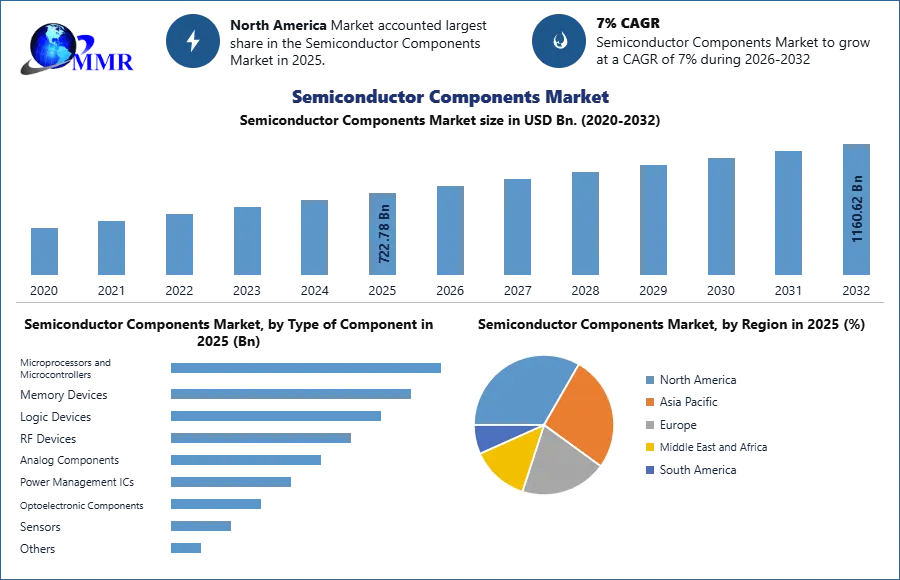
Global Semiconductor Components Market size was valued at USD 722.78 Bn in 2025 and is expected to reach USD 1160.62 Bn by 2032, at a CAGR of 7% over the forecast period.

Semiconductor Components Market Overview

Semiconductor components exhibit an intermediate level of electrical conductivity, falling between that of conductors and insulators. They play a pivotal role in enabling a wide array of electronic functionalities, including amplification, switching, signal processing, and beyond. Improvements in the semiconductor industry have historically followed Moore's Law, which predicts that the number of transistors on a microchip double approximately every two years, leading to continuous advancements in performance, efficiency, and cost reduction.
The companies are engaged in the design and fabrication of semiconductors and Semiconductor Components, such as power devices, sensors, ICs, transistors, and many more. The Semiconductor Components Market is dominated by the companies from U.S., Europe, Taiwan, South Korea, China, and Japan; in the recent years India is also trying to make a mark in this market. The market is based on the foundry model, which consists of semiconductor fabrication plants each belonging to separate companies or subsidiaries.
Semiconductor Components Market

To know about the Research Methodology :- Request Free Sample Report

Semiconductor Components Market Dynamics

Technological Advancements in the Semiconductor industry to boost the Semiconductor Components Market growth

Advances in semiconductor technology, including smaller process nodes, improved power efficiency, and increased integration, drive demand for newer and more powerful components. These advancements lead to more capable and efficient electronic devices and is expected to boost the Semiconductor Components Market growth. Consumers consistently seek better performance, enhanced features, and more connectivity in their devices. The rollout of 5G networks requires substantial investment in semiconductor components for base stations, mobile devices, and network infrastructure to enable higher data speeds and low latency. AI and ML applications, including deep learning, natural language processing, and computer vision, rely on powerful processors and specialized hardware accelerators, boosting demand for specific semiconductor components.

The growth of renewable energy technologies and the adoption of electric vehicles require power management and control of semiconductor components to efficiently convert and manage energy, which significantly contributes to the growth of the Semiconductor Components industry. Medical devices and equipment increasingly incorporate semiconductor components for diagnostics, imaging, patient monitoring, and treatment.

Supply Chain Disruptions to limit the Semiconductor Components Market growth

The semiconductor industry's complex global supply chain is vulnerable to disruptions, such as natural disasters, geopolitical tensions, and unexpected pandemic such as COVID-19. These disruptions lead to shortages of critical components and impact production and delivery schedules. As semiconductor technology advances, designs become more intricate and challenging to manufacture. This complexity leads to yield issues, longer development cycles, and increased production costs. The semiconductor industry often experiences cyclical patterns of high demand followed by periods of oversupply, which is expected to restrain the semiconductor components Market growth. These cycles lead to volatile pricing and financial instability for companies that heavily rely on semiconductor sales.

Building new fabrication facilities or upgrading existing ones takes years. Due to this the semiconductor components industry face production constraints during periods of high demand, leading to supply shortages. The semiconductor component manufacturing process involves the use of various chemicals and materials that have environmental impacts. Stricter environmental regulations and concerns about sustainability increase compliance costs and affect operations and directly affect the Semiconductor Components Manufacturers. Trade disputes, tariffs, and geopolitical tensions disrupt global supply chains and impact the cost of semiconductor components. As devices become more compact and multifunctional, integrating semiconductor components becomes more challenging. This complexity increases development costs and time-to-market. Rapid technological advancements and evolving consumer preferences lead to short product lifecycles for devices incorporating semiconductor components. This impact the longevity of demand for specific components.

Opportunities in Semiconductor Components Market

The increasing number of connected devices, from smart home appliances to industrial sensors, drives the demand for specialized chips that enable communication, data processing, and energy efficiency creates lucrative growth opportunities for the growth of Semiconductor Components Market growth. The widespread adoption of 5G technology creates opportunities for semiconductor components used in base stations, networking equipment, and mobile devices. 5G's higher data speeds and lower latency requirements demand advanced components to support the network infrastructure. As data processing requirements increase and latency becomes more critical, edge computing solutions are gaining importance. This trend creates opportunities for semiconductor components that efficiently process data at the edge of the network.

Semiconductor Components Market Segmentation

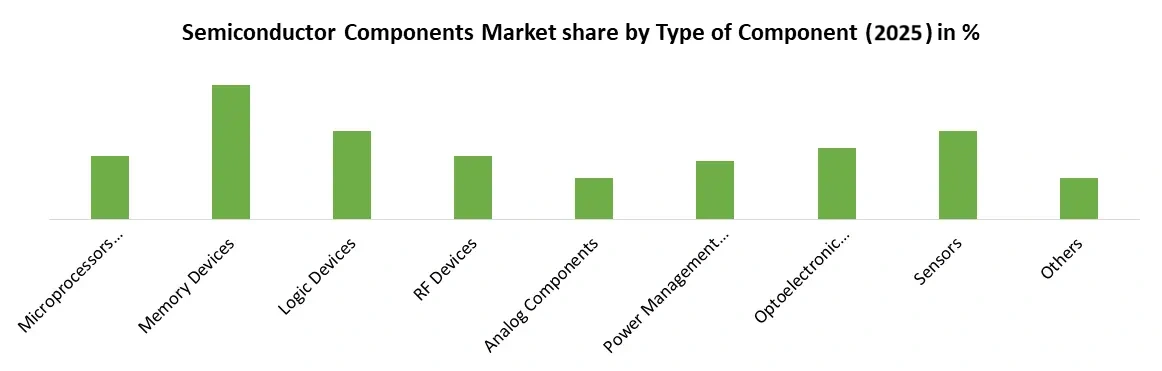
Based on type of component, the market is segmented into Microprocessors and Microcontrollers, Memory Devices, Logic Devices, RF Devices, Analog Components, Power Management ICs, Optoelectronic Components, Sensors, and Others. The memory Devices segment is expected to dominate the Semiconductor components market over the forecast period. Memory devices are of several type used in numerous components. RAM, ROM, and Flash memory are different type of memory devices.
Semiconductor-Components-Market

Based on Application, the market is segmented into Automotive Electronics, Telecommunication, Data Computing, Consumer Electronics, IoT, Space and Defence, Renewable Energy- Solar & Wind, Industrial & Power Electronics, and Railways- Locomotives. The Telecommunication segment includes technologies related to telecommunications, networking, and wireless connectivity. Wireless communication semiconductor components enable data transmission between devices without physical connections.

For example, below is a summary of the telecommunication market

Semiconductor components play a significant role in telecommunication systems, which enable global connectivity for broadcasting, navigation, and data transfer. They include processors and microcontrollers, transceivers, RF devices, and power management components used in telecommunication equipment. Wireline communication includes technologies like digital subscriber line (DSL) and fiber-optic connections for fixed-line internet access. Sub-systems like switches, routers, network interface cards is expected to boost the semiconductor components market growth.

Semiconductor Components Market Regional Insight

Asia Pacific dominated the market in 2025 and is expected to hold the largest Semiconductor Components Market share over the forecast period. The region is the powerhouse of semiconductor manufacturing with central role in innovation. Taiwan, South Korea, China, Japan, Malaysia, and Singapore has reshaped the industry landscape. Taiwan and South Korea are the centers of semiconductor manufacturing with advanced fabrication facilities. The companies in the region are forefront of semiconductor components production specialized in advanced fabrication facilities. China presence in the Semiconductor component industry has grown rapidly due to less dependency on foreign chips.
Hubs for semiconductor research and development activities is growing in the region. Research institutions, universities, and corporate R&D centers are significantly contributing for the growth of the market in upcoming areas such as Artificial intelligence, and IoT Applications.

Technological competition, protection of intellectual property rights, and geopolitical tensions have posed obstacles. Supply chain disruptions, as witnessed in recent times, have also highlighted vulnerabilities in the global semiconductor ecosystem, which is expected to limit the semiconductor components market penetration.

Recent Industry Developments (2025–2026)

Exact Date Company Development Impact
24 February 2026 AMD Announced a multi-year partnership with Meta to deploy 6 gigawatts of AI infrastructure featuring custom AMD Instinct MI450 GPUs. Secures a massive long-term revenue stream and establishes AMD as a primary custom-silicon provider for hyperscale data centers.
27 February 2026 Texas Instruments Proposed a $7 billion acquisition of Silicon Labs to integrate their advanced embedded wireless connectivity portfolio. Significantly consolidates the IoT component market and reduces the total number of primary global suppliers for wireless ICs.
01 December 2025 NVIDIA Formed a strategic alliance with Synopsys, including a $2 billion equity investment, to accelerate AI-driven chip design workflows. Reduces time-to-market for complex components by leveraging GPU-accelerated simulation across the entire semiconductor R&D lifecycle.
07 January 2025 SEMI Confirmed the start of 18 new semiconductor fab construction projects globally, with many aimed at 300mm wafer capacity. Expands global wafer-per-month capacity by 6.6%, addressing long-term component shortages in the automotive and AI sectors.
15 April 2025 LeddarTech Launched Leddar Sight, a high-durability 2D solid-state LiDAR sensor component for industrial and ADAS applications. Advances solid-state sensing adoption by providing a more cost-effective alternative to traditional mechanical scanning components.

Semiconductor Components Market Competitive Landscape

The Semiconductor Components Market is highly fragmented and is expected to witness increased competition due to several key players’ presence. Semiconductor components key players are heavily spending on research and development activities to integrate advanced technologies in the market. The market features a wide array of players, each with its own specialization. From microprocessors and memory chips to sensors and power management solutions, companies are catering to various industries and applications. Market players such as Intel, Samsung, and TSMC have dominated the market and will continue the dominance over the forecast period. The strategies adopted by the Semiconductor Components key player, such as expansion of product portfolio, mergers & acquisitions, geographical expansion, and collaborations, to enhance the Semiconductor Components Market penetration.

Global Semiconductor Components Market Scope: Inquire before buying

Semiconductor Components Market
Report Coverage Details
Base Year: 2025 Forecast Period: 2026-2032
Historical Data: 2020 to 2025 Market Size in 2025: 722.78 USD Bn.
Forecast Period 2026-2032 CAGR: 7% Market Size in 2032: 1160.62 USD Bn.
Segments Covered: by Type of Component Microprocessors and Microcontrollers
Memory Devices
Logic Devices
RF Devices
Analog Components
Power Management ICs
Optoelectronic Components
Sensors
Others
by Industry Automotive Electronics
Telecommunication
Data Computing
Consumer Electronics
IoT
Space and Defence
Renewable Energy- Solar & Wind
Industrial & Power Electronics
Railways- Locomotives
Healthcare
by Application Automotive Electronics
Telecommunication
Data Computing
Consumer Electronics
IoT
Space and Defence
Space Application
Defence Application
Renewable Energy- Solar & Wind
Solar & Wind Inverters
Industrial & Power Electronics
Railways- Locomotives
Power Converters

Semiconductor Components Market, by Region

North America (United States, Canada and Mexico)
Europe (UK, France, Germany, Italy, Spain, Sweden, Austria and Rest of Europe)
Asia Pacific (China, South Korea, Japan, India, Australia, Indonesia, Malaysia, Vietnam, Taiwan, Bangladesh, Pakistan and Rest of APAC)
Middle East and Africa (South Africa, GCC, Egypt, Nigeria and Rest of ME&A)
South America (Brazil, Argentina Rest of South America)

Key Players / Competitors Profiles Covered in Brief in Global Semiconductor Components Market Report in Strategic Perspective:

  1. Intel Corporation
  2. Samsung Electronics Co. Ltd
  3. Taiwan Semiconductor Manufacturing Co. Ltd
  4. Texas Instruments Inc
  5. STMicroelectronics N.V.
  6. NXP Semiconductors N.V.
  7. Analog Devices Inc
  8. Infineon Technologies AG
  9. Renesas Electronics Corporation
  10. Microchip Technology Inc
  11. Advanced Micro Devices Inc
  12. Micron Technology Inc
  13. Broadcom Inc
  14. . NVIDIA Corporation
  15. Qualcomm Inc
  16. SK Hynix Inc
  17. ON Semiconductor Corporation
  18. Toshiba Corporation
  19. MediaTek Inc
  20. Skyworks Solutions Inc
  21. Murata Manufacturing Co. Ltd
  22. Rohm Semiconductor
  23. Vishay Intertechnology Inc
  24. Littelfuse Inc
  25. Kyocera Corporation

Table of Contents

1. Semiconductor Components Market Introduction
1.1. Study Assumption and Market Definition
1.2. Scope of the Study
1.3. Executive Summary
2. Global Semiconductor Components Market: Competitive Landscape
2.1. MMR Competition Matrix
2.2. Competitive Landscape
2.3. Key Players Benchmarking
2.3.1. Company Name
2.3.2. Business Segment
2.3.3. End-user Segment
2.3.4. Revenue (2025)
2.3.5. Company Locations
2.4. Leading Semiconductor Components Market Companies, by market capitalization
2.5. Market Structure
2.5.1. Market Leaders
2.5.2. Market Followers
2.5.3. Emerging Players
2.6. Mergers and Acquisitions Details
3. Semiconductor Components Market: Dynamics
3.1. Semiconductor Components Market Trends by Region
3.1.1. North America Semiconductor Components Market Trends
3.1.2. Europe Semiconductor Components Market Trends
3.1.3. Asia Pacific Semiconductor Components Market Trends
3.1.4. Middle East and Africa Semiconductor Components Market Trends
3.1.5. South America Semiconductor Components Market Trends
3.2. Semiconductor Components Market Dynamics by Region
3.2.1. North America
3.2.1.1. North America Semiconductor Components Market Drivers
3.2.1.2. North America Semiconductor Components Market Restraints
3.2.1.3. North America Semiconductor Components Market Opportunities
3.2.1.4. North America Semiconductor Components Market Challenges
3.2.2. Europe
3.2.2.1. Europe Semiconductor Components Market Drivers
3.2.2.2. Europe Semiconductor Components Market Restraints
3.2.2.3. Europe Semiconductor Components Market Opportunities
3.2.2.4. Europe Semiconductor Components Market Challenges
3.2.3. Asia Pacific
3.2.3.1. Asia Pacific Semiconductor Components Market Drivers
3.2.3.2. Asia Pacific Semiconductor Components Market Restraints
3.2.3.3. Asia Pacific Semiconductor Components Market Opportunities
3.2.3.4. Asia Pacific Semiconductor Components Market Challenges
3.2.4. Middle East and Africa
3.2.4.1. Middle East and Africa Semiconductor Components Market Drivers
3.2.4.2. Middle East and Africa Semiconductor Components Market Restraints
3.2.4.3. Middle East and Africa Semiconductor Components Market Opportunities
3.2.4.4. Middle East and Africa Semiconductor Components Market Challenges
3.2.5. South America
3.2.5.1. South America Semiconductor Components Market Drivers
3.2.5.2. South America Semiconductor Components Market Restraints
3.2.5.3. South America Semiconductor Components Market Opportunities
3.2.5.4. South America Semiconductor Components Market Challenges
3.3. PORTER's Five Forces Analysis
3.4. PESTLE Analysis
3.5. Technology Roadmap
3.6. Regulatory Landscape by Region
3.6.1. North America
3.6.2. Europe
3.6.3. Asia Pacific
3.6.4. Middle East and Africa
3.6.5. South America
3.7. Key Opinion Leader Analysis For Semiconductor Components Industry
3.8. Analysis of Government Schemes and Initiatives For Semiconductor Components Industry
3.9. Semiconductor Components Market Trade Analysis
3.10. The Global Pandemic Impact on Semiconductor Components Market
4. Semiconductor Components Market: Global Market Size and Forecast by Segmentation (in USD Bn.) 2025-2032
4.1. Semiconductor Components Market Size and Forecast, by Type of Component (2025-2032)
4.1.1. Microprocessors and Microcontrollers
4.1.2. Memory Devices
4.1.3. Logic Devices
4.1.4. RF Devices
4.1.5. Analog Components
4.1.6. Power Management ICs
4.1.7. Optoelectronic Components
4.1.8. Sensors
4.1.9. Others
4.2. Semiconductor Components Market Size and Forecast, by Industry (2025-2032)
4.2.1. Automotive Electronics
4.2.2. Telecommunication
4.2.3. Data Computing
4.2.4. Consumer Electronics
4.2.5. IoT
4.2.6. Space and Defence
4.2.7. Renewable Energy- Solar & Wind
4.2.8. Industrial & Power Electronics
4.2.9. Railways- Locomotives
4.2.10. Healthcare
4.3. Semiconductor Components Market Size and Forecast, by Application (2025-2032)
4.3.1. Automotive Electronics
4.3.2. Telecommunication
4.3.3. Data Computing
4.3.4. Consumer Electronics
4.3.5. IoT
4.3.6. Space and Defence
4.3.7. Space Application
4.3.8. Defence Application
4.3.9. Renewable Energy- Solar & Wind
4.3.10. Solar & Wind Inverters
4.3.11. Industrial & Power Electronics
4.3.12. Railways- Locomotives
4.3.13. Power Converters
4.4. Semiconductor Components Market Size and Forecast, by Region (2025-2032)
4.4.1. North America
4.4.2. Europe
4.4.3. Asia Pacific
4.4.4. Middle East and Africa
4.4.5. South America
5. North America Semiconductor Components Market Size and Forecast by Segmentation (in USD Bn.) 2025-2032
5.1. North America Semiconductor Components Market Size and Forecast, by Type of Component (2025-2032)
5.1.1. Microprocessors and Microcontrollers
5.1.2. Memory Devices
5.1.3. Logic Devices
5.1.4. RF Devices
5.1.5. Analog Components
5.1.6. Power Management ICs
5.1.7. Optoelectronic Components
5.1.8. Sensors
5.1.9. Others
5.2. North America Semiconductor Components Market Size and Forecast, by Industry (2025-2032)
5.2.1. Automotive Electronics
5.2.2. Telecommunication
5.2.3. Data Computing
5.2.4. Consumer Electronics
5.2.5. IoT
5.2.6. Space and Defence
5.2.7. Renewable Energy- Solar & Wind
5.2.8. Industrial & Power Electronics
5.2.9. Railways- Locomotives
5.2.10. Healthcare
5.3. North America Semiconductor Components Market Size and Forecast, by Application (2025-2032)
5.3.1. Automotive Electronics
5.3.2. Telecommunication
5.3.3. Data Computing
5.3.4. Consumer Electronics
5.3.5. IoT
5.3.6. Space and Defence
5.3.7. Space Application
5.3.8. Defence Application
5.3.9. Renewable Energy- Solar & Wind
5.3.10. Solar & Wind Inverters
5.3.11. Industrial & Power Electronics
5.3.12. Railways- Locomotives
5.3.13. Power Converters
5.4. North America Semiconductor Components Market Size and Forecast, by Country (2025-2032)
5.4.1. United States
5.4.1.1. United States Semiconductor Components Market Size and Forecast, by Type of Component (2025-2032)
5.4.1.1.1. Microprocessors and Microcontrollers
5.4.1.1.2. Memory Devices
5.4.1.1.3. Logic Devices
5.4.1.1.4. RF Devices
5.4.1.1.5. Analog Components
5.4.1.1.6. Power Management ICs
5.4.1.1.7. Optoelectronic Components
5.4.1.1.8. Sensors
5.4.1.1.9. Others
5.4.1.2. United States Semiconductor Components Market Size and Forecast, by Industry (2025-2032)
5.4.1.2.1. Automotive Electronics
5.4.1.2.2. Telecommunication
5.4.1.2.3. Data Computing
5.4.1.2.4. Consumer Electronics
5.4.1.2.5. IoT
5.4.1.2.6. Space and Defence
5.4.1.2.7. Renewable Energy- Solar & Wind
5.4.1.2.8. Industrial & Power Electronics
5.4.1.2.9. Railways- Locomotives
5.4.1.2.10. Healthcare
5.4.1.3. United States Semiconductor Components Market Size and Forecast, by Application (2025-2032)
5.4.1.3.1. Automotive Electronics
5.4.1.3.2. Telecommunication
5.4.1.3.3. Data Computing
5.4.1.3.4. Consumer Electronics
5.4.1.3.5. IoT
5.4.1.3.6. Space and Defence
5.4.1.3.7. Space Application
5.4.1.3.8. Defence Application
5.4.1.3.9. Renewable Energy- Solar & Wind
5.4.1.3.10. Solar & Wind Inverters
5.4.1.3.11. Industrial & Power Electronics
5.4.1.3.12. Railways- Locomotives
5.4.1.3.13. Power Converters
5.4.2. Canada
5.4.2.1. Canada Semiconductor Components Market Size and Forecast, by Type of Component (2025-2032)
5.4.2.1.1. Microprocessors and Microcontrollers
5.4.2.1.2. Memory Devices
5.4.2.1.3. Logic Devices
5.4.2.1.4. RF Devices
5.4.2.1.5. Analog Components
5.4.2.1.6. Power Management ICs
5.4.2.1.7. Optoelectronic Components
5.4.2.1.8. Sensors
5.4.2.1.9. Others
5.4.2.2. Canada Semiconductor Components Market Size and Forecast, by Industry (2025-2032)
5.4.2.2.1. Automotive Electronics
5.4.2.2.2. Telecommunication
5.4.2.2.3. Data Computing
5.4.2.2.4. Consumer Electronics
5.4.2.2.5. IoT
5.4.2.2.6. Space and Defence
5.4.2.2.7. Renewable Energy- Solar & Wind
5.4.2.2.8. Industrial & Power Electronics
5.4.2.2.9. Railways- Locomotives
5.4.2.2.10. Healthcare
5.4.2.3. Canada Semiconductor Components Market Size and Forecast, by Application (2025-2032)
5.4.2.3.1. Automotive Electronics
5.4.2.3.2. Telecommunication
5.4.2.3.3. Data Computing
5.4.2.3.4. Consumer Electronics
5.4.2.3.5. IoT
5.4.2.3.6. Space and Defence
5.4.2.3.7. Space Application
5.4.2.3.8. Defence Application
5.4.2.3.9. Renewable Energy- Solar & Wind
5.4.2.3.10. Solar & Wind Inverters
5.4.2.3.11. Industrial & Power Electronics
5.4.2.3.12. Railways- Locomotives
5.4.2.3.13. Power Converters
5.4.3. Mexico
5.4.3.1. Mexico Semiconductor Components Market Size and Forecast, by Type of Component (2025-2032)
5.4.3.1.1. Microprocessors and Microcontrollers
5.4.3.1.2. Memory Devices
5.4.3.1.3. Logic Devices
5.4.3.1.4. RF Devices
5.4.3.1.5. Analog Components
5.4.3.1.6. Power Management ICs
5.4.3.1.7. Optoelectronic Components
5.4.3.1.8. Sensors
5.4.3.1.9. Others
5.4.3.2. Mexico Semiconductor Components Market Size and Forecast, by Industry (2025-2032)
5.4.3.2.1. Automotive Electronics
5.4.3.2.2. Telecommunication
5.4.3.2.3. Data Computing
5.4.3.2.4. Consumer Electronics
5.4.3.2.5. IoT
5.4.3.2.6. Space and Defence
5.4.3.2.7. Renewable Energy- Solar & Wind
5.4.3.2.8. Industrial & Power Electronics
5.4.3.2.9. Railways- Locomotives
5.4.3.2.10. Healthcare
5.4.3.3. Mexico Semiconductor Components Market Size and Forecast, by Application (2025-2032)
5.4.3.3.1. Automotive Electronics
5.4.3.3.2. Telecommunication
5.4.3.3.3. Data Computing
5.4.3.3.4. Consumer Electronics
5.4.3.3.5. IoT
5.4.3.3.6. Space and Defence
5.4.3.3.7. Space Application
5.4.3.3.8. Defence Application
5.4.3.3.9. Renewable Energy- Solar & Wind
5.4.3.3.10. Solar & Wind Inverters
5.4.3.3.11. Industrial & Power Electronics
5.4.3.3.12. Railways- Locomotives
5.4.3.3.13. Power Converters
6. Europe Semiconductor Components Market Size and Forecast by Segmentation (in USD Bn.) 2025-2032
6.1. Europe Semiconductor Components Market Size and Forecast, by Type of Component (2025-2032)
6.2. Europe Semiconductor Components Market Size and Forecast, by Industry (2025-2032)
6.3. Europe Semiconductor Components Market Size and Forecast, by Application (2025-2032)
6.4. Europe Semiconductor Components Market Size and Forecast, by Country (2025-2032)
6.4.1. United Kingdom
6.4.1.1. United Kingdom Semiconductor Components Market Size and Forecast, by Type of Component (2025-2032)
6.4.1.2. United Kingdom Semiconductor Components Market Size and Forecast, by Industry (2025-2032)
6.4.1.3. United Kingdom Semiconductor Components Market Size and Forecast, by Application (2025-2032)
6.4.2. France
6.4.2.1. France Semiconductor Components Market Size and Forecast, by Type of Component (2025-2032)
6.4.2.2. France Semiconductor Components Market Size and Forecast, by Industry (2025-2032)
6.4.2.3. France Semiconductor Components Market Size and Forecast, by Application (2025-2032)
6.4.3. Germany
6.4.3.1. Germany Semiconductor Components Market Size and Forecast, by Type of Component (2025-2032)
6.4.3.2. Germany Semiconductor Components Market Size and Forecast, by Industry (2025-2032)
6.4.3.3. Germany Semiconductor Components Market Size and Forecast, by Application (2025-2032)
6.4.4. Italy
6.4.4.1. Italy Semiconductor Components Market Size and Forecast, by Type of Component (2025-2032)
6.4.4.2. Italy Semiconductor Components Market Size and Forecast, by Industry (2025-2032)
6.4.4.3. Italy Semiconductor Components Market Size and Forecast, by Application (2025-2032)
6.4.5. Spain
6.4.5.1. Spain Semiconductor Components Market Size and Forecast, by Type of Component (2025-2032)
6.4.5.2. Spain Semiconductor Components Market Size and Forecast, by Industry (2025-2032)
6.4.5.3. Spain Semiconductor Components Market Size and Forecast, by Application (2025-2032)
6.4.6. Sweden
6.4.6.1. Sweden Semiconductor Components Market Size and Forecast, by Type of Component (2025-2032)
6.4.6.2. Sweden Semiconductor Components Market Size and Forecast, by Industry (2025-2032)
6.4.6.3. Sweden Semiconductor Components Market Size and Forecast, by Application (2025-2032)
6.4.7. Austria
6.4.7.1. Austria Semiconductor Components Market Size and Forecast, by Type of Component (2025-2032)
6.4.7.2. Austria Semiconductor Components Market Size and Forecast, by Industry (2025-2032)
6.4.7.3. Austria Semiconductor Components Market Size and Forecast, by Application (2025-2032)
6.4.8. Rest of Europe
6.4.8.1. Rest of Europe Semiconductor Components Market Size and Forecast, by Type of Component (2025-2032)
6.4.8.2. Rest of Europe Semiconductor Components Market Size and Forecast, by Industry (2025-2032)
6.4.8.3. Rest of Europe Semiconductor Components Market Size and Forecast, by Application (2025-2032)
7. Asia Pacific Semiconductor Components Market Size and Forecast by Segmentation (in USD Bn.) 2025-2032
7.1. Asia Pacific Semiconductor Components Market Size and Forecast, by Type of Component (2025-2032)
7.2. Asia Pacific Semiconductor Components Market Size and Forecast, by Industry (2025-2032)
7.3. Asia Pacific Semiconductor Components Market Size and Forecast, by Application (2025-2032)
7.4. Asia Pacific Semiconductor Components Market Size and Forecast, by Country (2025-2032)
7.4.1. China
7.4.1.1. China Semiconductor Components Market Size and Forecast, by Type of Component (2025-2032)
7.4.1.2. China Semiconductor Components Market Size and Forecast, by Industry (2025-2032)
7.4.1.3. China Semiconductor Components Market Size and Forecast, by Application (2025-2032)
7.4.2. S Korea
7.4.2.1. S Korea Semiconductor Components Market Size and Forecast, by Type of Component (2025-2032)
7.4.2.2. S Korea Semiconductor Components Market Size and Forecast, by Industry (2025-2032)
7.4.2.3. S Korea Semiconductor Components Market Size and Forecast, by Application (2025-2032)
7.4.3. Japan
7.4.3.1. Japan Semiconductor Components Market Size and Forecast, by Type of Component (2025-2032)
7.4.3.2. Japan Semiconductor Components Market Size and Forecast, by Industry (2025-2032)
7.4.3.3. Japan Semiconductor Components Market Size and Forecast, by Application (2025-2032)
7.4.4. India
7.4.4.1. India Semiconductor Components Market Size and Forecast, by Type of Component (2025-2032)
7.4.4.2. India Semiconductor Components Market Size and Forecast, by Industry (2025-2032)
7.4.4.3. India Semiconductor Components Market Size and Forecast, by Application (2025-2032)
7.4.5. Australia
7.4.5.1. Australia Semiconductor Components Market Size and Forecast, by Type of Component (2025-2032)
7.4.5.2. Australia Semiconductor Components Market Size and Forecast, by Industry (2025-2032)
7.4.5.3. Australia Semiconductor Components Market Size and Forecast, by Application (2025-2032)
7.4.6. Indonesia
7.4.6.1. Indonesia Semiconductor Components Market Size and Forecast, by Type of Component (2025-2032)
7.4.6.2. Indonesia Semiconductor Components Market Size and Forecast, by Industry (2025-2032)
7.4.6.3. Indonesia Semiconductor Components Market Size and Forecast, by Application (2025-2032)
7.4.7. Malaysia
7.4.7.1. Malaysia Semiconductor Components Market Size and Forecast, by Type of Component (2025-2032)
7.4.7.2. Malaysia Semiconductor Components Market Size and Forecast, by Industry (2025-2032)
7.4.7.3. Malaysia Semiconductor Components Market Size and Forecast, by Application (2025-2032)
7.4.8. Vietnam
7.4.8.1. Vietnam Semiconductor Components Market Size and Forecast, by Type of Component (2025-2032)
7.4.8.2. Vietnam Semiconductor Components Market Size and Forecast, by Industry (2025-2032)
7.4.8.3. Vietnam Semiconductor Components Market Size and Forecast, by Application (2025-2032)
7.4.9. Taiwan
7.4.9.1. Taiwan Semiconductor Components Market Size and Forecast, by Type of Component (2025-2032)
7.4.9.2. Taiwan Semiconductor Components Market Size and Forecast, by Industry (2025-2032)
7.4.9.3. Taiwan Semiconductor Components Market Size and Forecast, by Application (2025-2032)
7.4.10. Rest of Asia Pacific
7.4.10.1. Rest of Asia Pacific Semiconductor Components Market Size and Forecast, by Type of Component (2025-2032)
7.4.10.2. Rest of Asia Pacific Semiconductor Components Market Size and Forecast, by Industry (2025-2032)
7.4.10.3. Rest of Asia Pacific Semiconductor Components Market Size and Forecast, by Application (2025-2032)
8. Middle East and Africa Semiconductor Components Market Size and Forecast by Segmentation (in USD Bn.) 2025-2032
8.1. Middle East and Africa Semiconductor Components Market Size and Forecast, by Type of Component (2025-2032)
8.2. Middle East and Africa Semiconductor Components Market Size and Forecast, by Industry (2025-2032)
8.3. Middle East and Africa Semiconductor Components Market Size and Forecast, by Application (2025-2032)
8.4. Middle East and Africa Semiconductor Components Market Size and Forecast, by Country (2025-2032)
8.4.1. South Africa
8.4.1.1. South Africa Semiconductor Components Market Size and Forecast, by Type of Component (2025-2032)
8.4.1.2. South Africa Semiconductor Components Market Size and Forecast, by Industry (2025-2032)
8.4.1.3. South Africa Semiconductor Components Market Size and Forecast, by Application (2025-2032)
8.4.2. GCC
8.4.2.1. GCC Semiconductor Components Market Size and Forecast, by Type of Component (2025-2032)
8.4.2.2. GCC Semiconductor Components Market Size and Forecast, by Industry (2025-2032)
8.4.2.3. GCC Semiconductor Components Market Size and Forecast, by Application (2025-2032)
8.4.3. Nigeria
8.4.3.1. Nigeria Semiconductor Components Market Size and Forecast, by Type of Component (2025-2032)
8.4.3.2. Nigeria Semiconductor Components Market Size and Forecast, by Industry (2025-2032)
8.4.3.3. Nigeria Semiconductor Components Market Size and Forecast, by Application (2025-2032)
8.4.4. Rest of ME&A
8.4.4.1. Rest of ME&A Semiconductor Components Market Size and Forecast, by Type of Component (2025-2032)
8.4.4.2. Rest of ME&A Semiconductor Components Market Size and Forecast, by Industry (2025-2032)
8.4.4.3. Rest of ME&A Semiconductor Components Market Size and Forecast, by Application (2025-2032)
9. South America Semiconductor Components Market Size and Forecast by Segmentation (in USD Bn.) 2025-2032
9.1. South America Semiconductor Components Market Size and Forecast, by Type of Component (2025-2032)
9.2. South America Semiconductor Components Market Size and Forecast, by Industry (2025-2032)
9.3. South America Semiconductor Components Market Size and Forecast, by Application (2025-2032)
9.4. South America Semiconductor Components Market Size and Forecast, by Country (2025-2032)
9.4.1. Brazil
9.4.1.1. Brazil Semiconductor Components Market Size and Forecast, by Type of Component (2025-2032)
9.4.1.2. Brazil Semiconductor Components Market Size and Forecast, by Industry (2025-2032)
9.4.1.3. Brazil Semiconductor Components Market Size and Forecast, by Application (2025-2032)
9.4.2. Argentina
9.4.2.1. Argentina Semiconductor Components Market Size and Forecast, by Type of Component (2025-2032)
9.4.2.2. Argentina Semiconductor Components Market Size and Forecast, by Industry (2025-2032)
9.4.2.3. Argentina Semiconductor Components Market Size and Forecast, by Application (2025-2032)
9.4.3. Rest Of South America
9.4.3.1. Rest Of South America Semiconductor Components Market Size and Forecast, by Type of Component (2025-2032)
9.4.3.2. Rest Of South America Semiconductor Components Market Size and Forecast, by Industry (2025-2032)
9.4.3.3. Rest Of South America Semiconductor Components Market Size and Forecast, by Application (2025-2032)
10. Company Profile: Key Players
10.1. Intel Corporation
10.1.1. Company Overview
10.1.2. Business Portfolio
10.1.3. Financial Overview
10.1.4. SWOT Analysis
10.1.5. Strategic Analysis
10.1.6. Scale of Operation (small, medium, and large)
10.1.7. Details on Partnership
10.1.8. Regulatory Accreditations and Certifications Received by Them
10.1.9. Awards Received by the Firm
10.1.10. Recent Developments
10.2. Samsung Electronics Co. Ltd
10.3. Taiwan Semiconductor Manufacturing Co. Ltd
10.4. Texas Instruments Inc
10.5. STMicroelectronics N.V.
10.6. NXP Semiconductors N.V.
10.7. Analog Devices Inc
10.8. Infineon Technologies AG
10.9. Renesas Electronics Corporation
10.10. Microchip Technology Inc
10.11. Advanced Micro Devices Inc
10.12. Micron Technology Inc
10.13. Broadcom Inc
10.14. . NVIDIA Corporation
10.15. Qualcomm Inc
10.16. SK Hynix Inc
10.17. ON Semiconductor Corporation
10.18. Toshiba Corporation
10.19. MediaTek Inc
10.20. Skyworks Solutions Inc
10.21. Murata Manufacturing Co. Ltd
10.22. Rohm Semiconductor
10.23. Vishay Intertechnology Inc
10.24. Littelfuse Inc
10.25. Kyocera Corporation
11. Key Findings
12. Industry Recommendations
13. Semiconductor Components Market: Research Methodology
14. Terms and Glossary

Custom Market Research Services

We Will Customise The Research For You, In Case The Report Listed Above Does Not Meet With Your Requirements