
Semiconductor Chemical Market – Global Market Size, Strategic Growth Drivers, Risk Assessment Framework, Regulatory Landscape Review, Competitive Intensity Mapping & Long-Term Industry Outlook to 2030
Overview
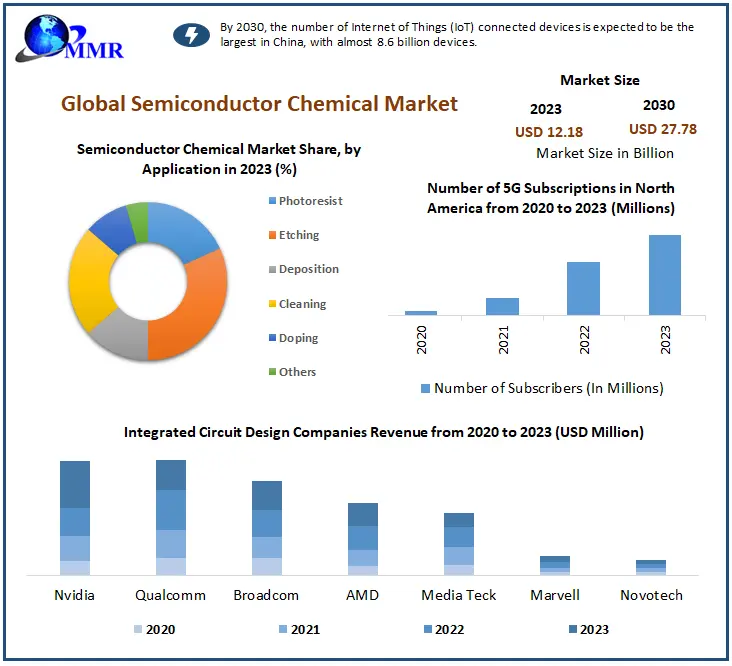
Semiconductor Chemical Market size was valued at USD 12.18 billion in 2023 and the total Semiconductor Chemical revenue is expected to grow at a CAGR of 12.50% from 2024 to 2030, reaching nearly USD 27.78 billion by 2030.
Semiconductor Chemical Market Overview
A semiconductor chemical refers to a range of chemicals extensively used in the fabrication and processing of semiconductor materials, electronic circuits, and devices. These chemicals hold a substantial role in the high-tech, rapid-paced industry as they highly contribute to the functionality and efficiency of electronic mechanisms.
 To know about the Research Methodology :- Request Free Sample Report
1.The chemical industry is a key supplier to semiconductor manufacturing because it accounts for $48 billion in semiconductor sales,
The semiconductor chemicals market is poised for significant growth between 2024 and 2030 driven by a mix of factors that offer promising opportunities. The report offers a comprehensive analysis of the sector, providing in-depth insights into market divisions based on type, end-use, application, and geographical region.
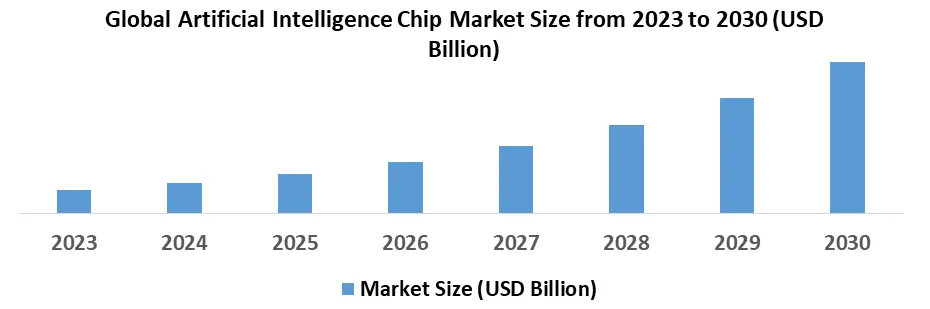
Semiconductor chemicals play a crucial role in the fabrication and advancement of electronic devices. The increasing demand for Artificial Intelligence (AI), 5G, and the Internet of Things (IoT) is expected to grow significantly during the forecast period. As technology evolves, semiconductor chemicals remain at the forefront of research and development, shaping the future of electronics and contributing to the ongoing progress of various technological fields.
The global Semiconductor Chemicals market is segmented by type, end-use, and applications. Based on the Type, the market is segmented into High-Performance Polymers, Acid-Base, Chemicals, Adhesives, Solvents, and Others. Further, based on applications, the market is sub-segmented into photoresist, etching, deposition, cleaning, doping, and others. Etching chemicals held a dominant position thanks to their indispensable role in precisely carving out circuit features on the wafer.
Through meticulous research, the report reveals crucial information such as market size, share, growth trajectory, competitive framework, and key factors that drive or hinder market growth. This complete perspective of the Global Semiconductor chemicals market assists stakeholders in identifying growth opportunities within the industry and making well-informed decisions.
Semiconductor Chemical Market Dynamics
Growth of Semiconductor Chemicals Market Driven by AI, IoT, and 5G Innovations
Artificial Intelligence (AI), the Internet of Things (IoT), and 5G are driving the growth of the semiconductor chemicals market. AI requires powerful and efficient chips with its ever-increasing processing demands. The manufacturing of AI chips includes complex manufacturing processes that rely on special cleaning, etching, and deposition chemicals. The millions of IoT-connected devices depend upon miniaturized and low-powered semiconductors that rely upon a mix of chemicals for their manufacturing driving the demand for specialized chemicals market. For instance, the development of chips that imitate human synapses and non-volatile memory relies on semiconductor chemicals to enable these designs. The 5G network requires sophisticated and high-performance electronic components to enable fast data transfer and improve connection density, which has increased the need for semiconductor chemicals contributing to the acceleration of 5G adoption. As more sectors integrate AI, IoT, and 5G into their products the demand for the semiconductor chemical industry increases. Also, the miniaturization trends rely on highly pure chemicals and any contamination negatively impacts the device's performance further creating opportunities for the key players in the semiconductor chemicals market to develop and innovate special chemicals according to the manufacturing needs. Additionally, the growth in the consumer electronics market and the shift of the automotive industry towards electric vehicles further fuel the growth of the semiconductor chemicals market. As the chip designs become more complex and layered, the demand for advanced chemicals increases to ensure performance, energy efficiency, and compatibility with the latest technologies.
Health Risks Associated with Semiconductor Chemicals Manufacturing
The manufacturing of semiconductor devices involves the use of hazardous chemicals such as acids, solvents, and gases. The workforce employed in manufacturing gets exposed to these chemicals leading to health issues such as respiratory problems, skin irritations, and long-term conditions like cancer. The environmental impacts such as water pollution and soil pollution because of the waste generated during semiconductor chemical manufacturing pose a threat to both human health and ecosystems. Stringent regulations and certain environmental standards impact the cost of manufacturing and prevent the companies from extending their operations affecting the competitiveness and growth of the semiconductor chemicals market. The increased awareness prompts strict regulations on the use, storage, and disposal of hazardous chemicals in semiconductor manufacturing leading to a decrease in profitability. The balance between workforce and environmental safety while maintaining an efficient production process presents a challenge for the semiconductor chemicals industry.
Semiconductor Chemical Market Segment Analysis
Based on End-Use, the Integrated Circuits segment held the largest market share in the global Semiconductor Chemical Market. According to MMR analysis, the segment is further expected to grow at a CAGR of 12.50% during the forecast period and stands out as the dominant segment within the Global Semiconductor Chemical Market. ICs are an integral part of several electronic devices including consumer electronics, telecommunication equipment, automotive systems, and industrial equipment. The manufacturing of the ICs requires high-purity chemicals which significantly contribute to the semiconductor chemicals market demand. The dominance of the segment is further attributed to the continuous advances in IC technology such as the shift to smaller process nodes and the development of 3D and stacked ICs that increase the demand for ultra-pure and specialized chemicals that meet the strict requirements of manufacturing processes.
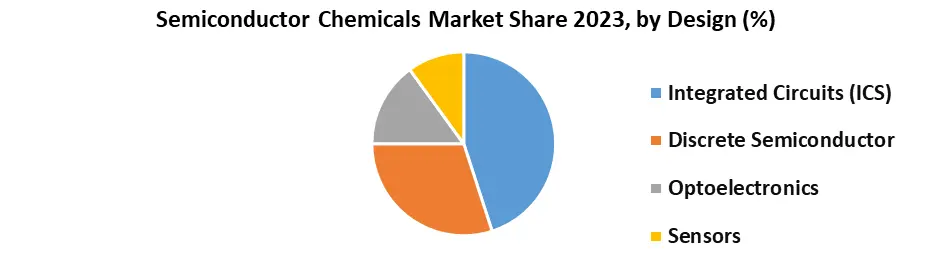
Additionally, the increase in semiconductor complexity such as FINFET and 3D ICs requires special chemicals to produce complicated designs & layered solutions. These enhance the performance of the ICs driving the demand for chemicals in the fabrication processes. The growth of data centers and cloud computing infrastructure also fuels the demand for high-performance ICs which drives the demand for the semiconductor chemicals market. Also, the proliferation of AI, IoT, and 5G technologies fuels the demand for integrated circuits making the segment dominant. The continuous growth of IC technology drives the demand for specific and high-purity chemicals, vital for attaining the accuracy and efficiency needed in IC production.
Semiconductor Chemical Market Regional Insights
Asia Pacific dominated the Global Semiconductor Chemical Market with the highest share in 2023 and is expected to grow at a CAGR of 12.50% during the forecast period and maintain its dominance during the forecast period. The dominance of the region is supported by its robust supply chain and huge semiconductor manufacturing industries. Countries such as South Korea, China, Taiwan, and Japan are home to several semiconductor manufacturing companies and are involved in R&D of advanced technology development. South Korea & Taiwan are known for their innovation in chip designs while Japan plays a crucial role with its emphasis on high-purity chemicals contributing to the dominance of the region in the global semiconductor chemicals market. The vicinity of the raw material suppliers, manufacturers, and chemical producers reduces production costs making the region competitive in the global semiconductor chemicals market. The closeness of China and India enables continuous distribution and logistics. The key players in the region continuously focus on creating highly pure chemicals required for specific applications such as AI and 5G chip components.
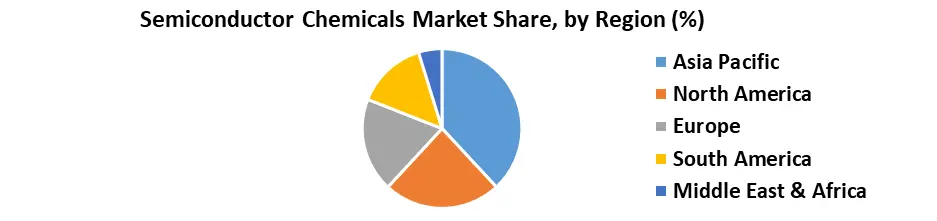
Additionally, the availability of a skilled workforce and access to cutting-edge technologies further solidifies the dominance of Asia Pacific in the global market. The regulatory authorities in the region have imposed stringent regulations to ensure the safe handling and disposal of hazardous chemicals used in semiconductor manufacturing enhancing the industry's reputation for long-term viability. The dominance of the Asia Pacific in the global semiconductor chemicals market is not only driven by existing strengths but also by its adaptability to emerging trends and technologies. With its manufacturing ability, skilled workforce, and dedication to innovation Asia Pacific remains a dominant region in the semiconductor chemicals market.
Semiconductor Chemical Market Competitive Landscapes
The Global Semiconductor Chemical Market is competitive among companies owing to the presence of numerous players across the industry. The major players in the market include Arm Limited (UK), Synopsys, Inc. (US), Cadence Design Systems, Inc. (US), Imagination Technologies(UK), CEVA, Inc. (US), Lattice Semiconductor (US), Rambus (US), eMemory Technology Inc. (Taiwan), VeriSilicon (China), Achronix Semiconductor Corporation (US), among others. These companies are pushing boundaries, investing in research and development to expand their product lines, and undertaking strategic activities including new product launches, contractual agreements, mergers and acquisitions, and collaborations with other organizations.
1. In 2023, JSR Corporation made a significant announcement regarding its subsidiary, JSR Electronic Materials Korea. The company disclosed its intention to acquire further shares of JSR Electronic Materials Korea Co., Ltd. (JEMK), with the ultimate objective of establishing complete ownership of JEMK as a wholly owned subsidiary within the JSR Corporation portfolio.
2. In 2023, NLM Photonics, a semiconductor company utilizing its innovative hybrid electro-optic modulation technology to transmit data more efficiently while conserving power, has secured $1 million in additional funding. This funding will be used to accelerate product commercialization efforts, including collaboration with semiconductor fabrication facilities and large-scale data center operators.
3. In 2022, BASF has inaugurated a brand-new Research and development (Ramp;D) facility located within Ansan, South Korea, known as the Engineering Plastics Innovation Center (EPIC). This state-of-the-art facility serves as the consolidated hub for BASFs Ramp;D team, encompassing expertise acquired through the recent acquisition of Solvays polyamide business, alongside other fresh competencies.
Semiconductor Chemical Market Scope: Inquire Before Buying
| Global Semiconductor Chemical Market | |||
|---|---|---|---|
| Report Coverage | Details | ||
| Base Year: | 2023 | Forecast Period: | 2024-2030 |
| Historical Data: | 2018 to 2023 | Market Size in 2023: | US $ 12.18 Bn. |
| Forecast Period 2024 to 2030 CAGR: | 12.50% | Market Size in 2030: | US $ 27.78 Bn. |
| Segments Covered: | by Type | High-Performance Polymers Acid-Base Chemicals Adhesives Solvents Others |
|
| by End Use | Integrated Circuits (ICS) Discrete Semiconductor Optoelectronics Sensors |
||
| by Application | Photoresist Etching Deposition Cleaning Doping Others |
||
Semiconductor Chemical Market, by Region
North America (United States, Canada and Mexico)
Europe (UK, France, Germany, Italy, Spain, Sweden, Austria and Rest of Europe)
Asia Pacific (China, South Korea, Japan, India, Australia, Indonesia, Malaysia, Vietnam, Taiwan, Bangladesh, Pakistan and Rest of APAC)
Middle East and Africa (South Africa, GCC, Egypt, Nigeria and Rest of ME&A)
South America (Brazil, Argentina Rest of South America)
Semiconductor Chemical Market Key Players
1. North America
1. Dow Chemical Company (US)
2. Honeywell International Inc. (US)
2. Europe
1.Solvay SA (Belgium)
2.Linde plc (UK)
3.Merck KGaA (Germany)
4.BASF SE (Germany)
3. Asia Pacific
1.Adeka Corporation (Japan)
2.Fujifilm Holdings Corporation (Japan)
3.Capchem (China)
4.Mitsubishi Chemical Corporation (Japan)
5.Daikin Chemicals Ltd. (Japan)
6.Hitachi Chemical Co., Ltd.(Japan)
7.JSR Corporation (Japan)
8.Shin-Etsu Chemical Co., Ltd. (Japan)
9.Sumitomo Chemical Co., Ltd. (Japan)
10.Tokyo Ohka Kogyo Co., Ltd. (TOK) (Japan)
FAQs:
1. What are the growth drivers for the Semiconductor Chemical Market?
Ans. Growing miniaturization and adoption of AI, IoT, and 5G-enabled devices fuels the Semiconductor Chemical market growth.
2. What are the opportunities for Semiconductor Chemical Market growth?
Ans. The development of new semiconductor materials and increasing focus on sustainability are the opportunities for Semiconductor Chemical Market.
3. Why does the Etching segment have the largest market share in the Semiconductor Chemical Market?
Ans. The etching segment have largest market share as it is crucial for shaping precise circuit features on the wafer. Etching chemicals remove unwanted material, following the patterns created by another major segment, Photoresist.
4. What is the projected market size & and growth rate of the Semiconductor Intellectual Property Market?
Ans. Semiconductor Chemical Market size was valued at USD 12.18 billion in 2023 and the total Semiconductor Chemical revenue is expected to grow at a CAGR of 12.50% from 2024 to 2030, reaching nearly USD 27.28 billion by 2030.
5. What segments are covered in the Semiconductor Chemical Market report?
Ans. The segments covered in the Semiconductor Chemical Market report are Type, End-Use, Application, and Region.