Secure Access Service Edge Market - Industry Structure Evaluation, Demand Drivers Analysis, Regional Growth Analysis and Identification, Competitive Positioning Review & Global Market Size Forecast to 2032

24.5%
CAGR (2026-2032)
3.47 USD Bn.
Market Size
300
Report Pages
126
Market Tables

Overview

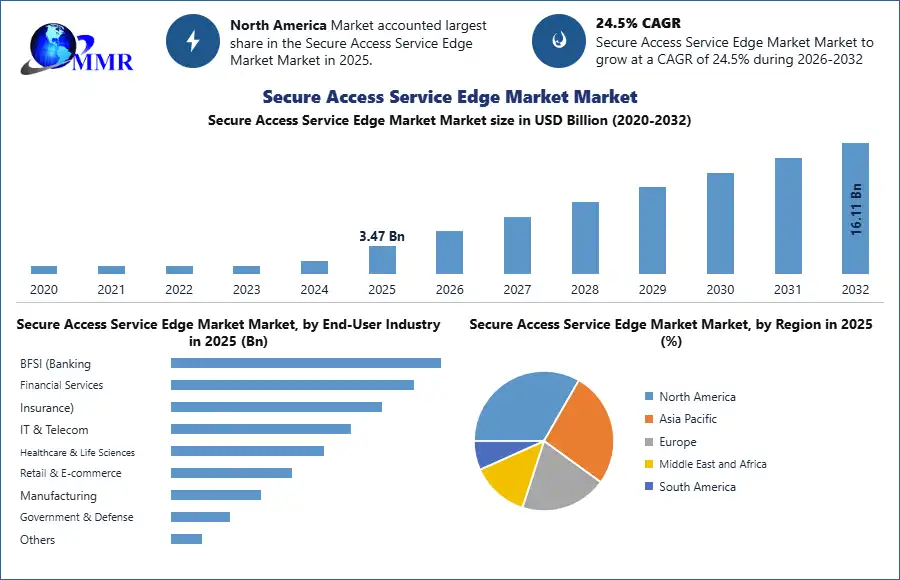
Secure Access Service Edge Market size was valued at USD 3.47 Bn. in 2025 and the total Global Secure Access Service Edge revenue is expected to grow by 24.5 % from 2026 to 2032, reaching nearly USD 16.11 Bn.

Secure Access Service Edge Market Overview:

The Secure Access Service Edge(SASE) is a cloud-based enterprise security framework and a network architecture that combines VPN and SD-WAN challenges caused by digital business transformation. The SASE model responds to reversal delivering network and controlling the network security for the users. Using secure access service edge distributed enterprises access network resources rapidly and safely. The SASE products combine software-defined wide-area networking (SD-WAN) with network security technologies to offer protection end-to-end, including Secure Web Gateways (SWG), Zero-Trust Network Access (ZTNA), and Cloud Access Security Brokers (CASB). Major key players are spending a lot to increase their product lines, which helps to grow SASE. Hence, the demand for the Secure Access Service Edge Market is growing rapidly.
Secure Access Service Edge Market Market Snapshot

To know about the Research Methodology :- Request Free Sample Report

Drivers

Usage of SASE is increased as cyberattacks and data breaches have increased

The usage of cloud-based has grown in recent years as more organizations and industry verticals transfer the data of an organization to the cloud to boost productivity, cut costs, and scalability. With the increasing usage of cloud-based applications, cyber security also increases because cyber attacks and data breaches have increased. Secure Access Service Edge Market reduces the cost, reduces complexity, helps to secure access for users continuously, and enables more secure remote and mobile access. The growth in mobile devices and the IoT is raising the demand for effective and rapid access to network resources from remote places and devices (IoT). SASE provides solutions that are scalable and adaptive network security solutions that can change to meet the requirements of businesses. As a result, the

Secure Access Service Edge Market growing its demand.

Restraints

Migration of IT infrastructure to public clouds compromising security architecture

As migration of many applications and workloads are on the public cloud, organizations need to check that the data is protected which can hamper the market. For understanding the security capabilities it’s important to work closely with cloud service providers. It is important for organizations to clearly understand these responsibilities to ensure the proper security measures are implemented. Cloud security controls, configurations, and the integration of security services are difficult to handle within the SASE framework which can create challenges if organizations lack the necessary knowledge and resources. Cloud environments are striking targets for cyber threats or cyber attackers and organizations must keep an eye on evolving security challenges.

Secure Access Service Edge Market Opportunity

Rise in cloud adoption helps the Secure Access Service Edge Market

The Secure Access Service Edge Market is poised for substantial growth due to several factors such as increasing adoption cloud services. Migration of Applications and workloads to the cloud for its scalability, agility, and cost-efficiency is done by organizations. As more businesses hold cloud computing, there is a rising need for a complete and secure approach to connect users and applications across dispersed environments.

Secure Access Service Edge provides a unified solution that combines network and security services in the cloud, making it an ideal choice for cloud-centric organizations. The ability to provide secure access from remote places, on any device, guarantees that remote employees can work efficiently while maintaining a high level of security. SASE's integrated many security services, including advanced threat detection which can prevent cyber threats, secure web gateways, and prevention of data loss, offer a more widespread and proactive approach to security, helping enterprises defend against emerging threats.

Secure Access Service Edge Market Segment Analysis:

Based on the Offerings,

The security as a service(SaaS) segment has witnessed market growth in the year 2025 and is expected to dominate during the forecast period. It is cloud-based that provides security solutions that are found in Business Intelligence and Data centers. SaaS offers harmless access to apps and services as it is a very important component of the market across the world. Network as a Service is expected to gain popularity in the coming years. Network as a Service is another essential component of the market. NaaS in SASE influences virtualization technologies that do not rely on physical network appliances, The network services are provided through software-defined networking (SDN) and network function virtualization (NFV).

Based on Organization Size,

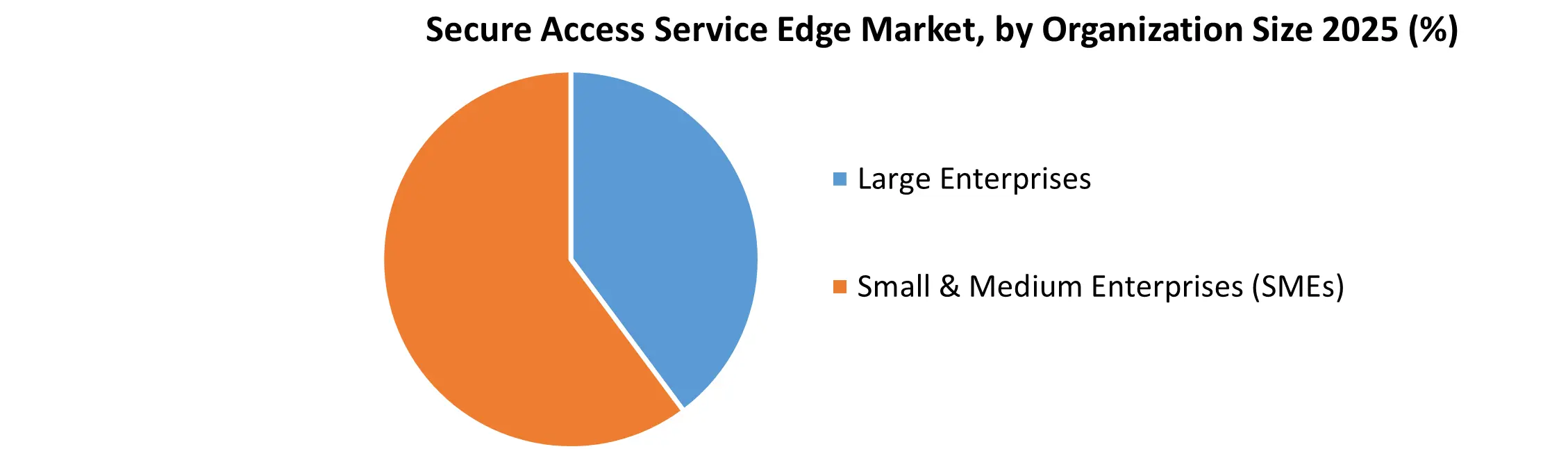
The large Enterprises segment has dominated the Secure Access Service Edge Market revenue in the year 2025 and is projected to grow during the forecast period. The SASE market segmentation is based on organization size, divided into Small & Medium Enterprises and Large Enterprises. Big organizations use SASE to prevent cyberattacks and for the safety of crucial information hence, large businesses are redesigning security architecture and policies. As large companies have a cost advantage for the use of SASE. However, Small and Medium enterprises use cloud-based solutions in the secure access service edge business. As a result, Large enterprises have dominated the SASE market.
Secure Access Service Edge Market

Regional Insights:

North America region acquired the largest revenue in the year 2025 and is expected to grow during the forecast period. SASE is growing substantially as it has advanced technology, and the adoption of cloud services is increasing in the US and Canada. The regional market in the US is increasing rapidly and SASE is used across the region widely due to the rising number of cyberattacks against large enterprises or organizations which affects the overall business. Whereas Asia-Pacific is anticipated to witness considerable market growth in the upcoming years. The rising demand for security and cloud networks increases the progress of the market. Software and support services adoption strongly drives revenue growth in the market during the assessment period.

Secure Access Service Edge Market Scope: Inquire before buying

Secure Access Service Edge Market Market
Report Coverage Details
Base Year: 2025 Forecast Period: 2026-2032
Historical Data: 2020 to 2025 Market Size in 2025: 3.47 USD Billion
Forecast Period 2026-2032 CAGR: 24.5% Market Size in 2032: 16.11 USD Billion
Segments Covered: by Offering SD-WAN (Network Layer)
    Software-defined SD-WAN
    Appliance-based SD-WAN
Security Service Edge (SSE)
    Zero Trust Network Access (ZTNA)
    Cloud Access Security Broker (CASB)
    Secure Web Gateway (SWG)
    Firewall-as-a-Service (FWaaS)
    Others
by Component Solutions
    Integrated SASE platforms
    Standalone modules
Services
    Managed Services
    Professional Services (consulting, integration, support)
by Deployment Mode Cloud-native SASE
Hybrid SASE
On-premise
by Organization Size Large Enterprises
Small & Medium Enterprises (SMEs)
by Access Type / User Environment Remote / Mobile Users
Branch Offices
Headquarters / Data Centers
IoT & Edge Devices
by End-User Industry BFSI (Banking, Financial Services, Insurance)
IT & Telecom
Healthcare & Life Sciences
Retail & E-commerce
Manufacturing
Government & Defense
Others

Secure Access Service Edge Market by Region

North America (United States, Canada, and Mexico)
Europe (UK, France, Germany, Italy, Spain, Sweden, Austria, and the Rest of Europe)
Asia Pacific (China, South Korea, Japan, India, Australia, Indonesia, Malaysia, Vietnam, Taiwan, Bangladesh, Pakistan, and the Rest of APAC)
Middle East and Africa (South Africa, GCC, Egypt, Nigeria, and the Rest of ME&A)
South America (Brazil, Argentina Rest of South America)

Key Players

1. Cisco
2. HPE
3. Broadcom
0. Fortinet
5. Akamai
6. Oracle
7. Extreme Networks
8. Palo Alto Networks
9. Barracuda Networks
10.Riverbed Technology
11.Forcepoint
12.Zscaler
13.Cloudflare
14.Netskope
15.McAfee
16.Proofpoint
17.SonicWall
18.Open Systems
19.Exium
20.Twingate
21.Aryaka
22.FlexiWAN
23.Cato Networks
24.Peplink
25.Check Point Software Technologies
26.Versa Networks
27.FatPipe Networks
28.Lavelle Networks
29.NordLayer
30.Verizon
31.AT&T
32.Lumen Technologies
33.Comcast Corporation
34.GTT Communications
35.BT Group
36.Vodafone
37.Orange Business
38.Deutsche Telekom
39.Colt Technology Services
40.Zain Group
41.Tata Communications
42.NTT Communications
43.Saudi Telecom Company
44.Singtel
45.Telefónica
46.Telstra International
47.Claro Enterprise Solutions
48.MCM Telecom
49.Kyndryl Solutions
50.HCLTech
51.Microland
52.Wipro
53.TIBCO Software
64.Nour Global
65.Others

Frequently Asked Questions:

1] What segments are covered in the Global Secure Access Service Edge Market report?
Ans. The segments covered in the market report are based on Offerings, Organization Size, Industry Vertical, Component, and Region.

2] Which region is expected to hold the highest share of the Global Secure Access Service Edge Market?
Ans. The North American region is expected to hold the highest share of the Secure Access Service Edge Market.

3] What is the market size of the Global Secure Access Service Edge Market by 2032?
Ans. The market size of the market by 2032 is expected to reach US$ 16.11 Bn.

4] What is the forecast period for the Global Secure Access Service Edge Market?
Ans. The forecast period for the Secure Access Service Edge Market is 2026-2032.

5] What was the market size of the Global NLP in the Education Market in 2025?
Ans. The market size of the NLP in the Education Market in 2025 was valued at US$ 3.47 Bn.

Table of Contents

SECTION A – GLOBAL SECURE ACCESS SERVICE EDGE MARKET INTRODUCTION A1. Executive Market Landscape and Industry Overview 1.1. Global Secure Access Service Edge Market Size (USD Bn), 2025–2032 1.2. Market Definition, Scope, and Key Segmentation Criteria for Global SASE Market 1.3. Global SASE Market Ecosystem: Network Providers, Security Vendors, Cloud Providers, MSPs 1.4. Competitive Landscape Overview: Integrated Vendors, Pure-Play SSE Vendors, Telecom Operators, New Entrants A2. Global Secure Access Service Edge Market Dynamics 2.1. Global Secure Access Service Edge Market Trends 2.2. Global Secure Access Service Edge Market DROC Analysis 2.3. PORTER’s Five Forces Analysis 2.4. PESTLE Analysis A3. Industry Ecosystem and Value Chain 3.1. Data sources and endpoints (users, devices, applications, cloud workloads) 3.2. SASE solution providers (SD-WAN + SSE vendors) 3.3. Integration with cybersecurity tools (SIEM, XDR, Zero Trust) 3.4. Service providers (MSPs, MSSPs, system integrators) 3.5. Distribution channels (direct sales, partners, cloud marketplaces) 3.6. Regulatory and compliance bodies influencing security requirements A4. Technological Innovations & Advancements 4.1. AI/ML-driven threat detection in SASE 4.2. Zero Trust Network Access (ZTNA) evolution 4.3. Secure Web Gateway (SWG) modernization 4.4. CASB integration with SaaS ecosystems 4.5. Firewall-as-a-Service (FWaaS) scalability 4.6. API-based integrations across cloud platforms 4.7. Automation and orchestration in SASE platforms A5. Adoption and Market Penetration Modeling (2025) 5.1. Adoption Rate (%) of SASE by Industry (BFSI, Healthcare, IT, etc.) 5.2. Enterprise Adoption Split (SMEs vs Large Enterprises) (%) 5.3. Cloud-native vs Hybrid SASE Penetration (%) 5.4. Regional Penetration Analysis 5.5. SASE Integration with Security Ecosystems (ZTNA, CASB, XDR) (%) 5.6. Adoption by Use Case (Remote Access, Branch Security, Cloud Security) 5.7. Regulated vs Non-Regulated Industry Penetration 5.8. Early vs Mature Adoption Distribution A6. SASE Architecture and Deployment Models 6.1. Single-vendor SASE architecture vs multi-vendor architecture 6.2. Cloud-native SASE vs hybrid deployment architecture 6.3. Edge-based vs cloud-delivered security models 6.4. Integration with existing enterprise infrastructure 6.5. Role of PoPs (Points of Presence) in performance optimization A7. Cloud Security Architecture within SASE 7.1. Role of Security Service Edge (SSE) in cloud security 7.2. Integration of CASB, ZTNA, SWG, and FWaaS for cloud protection 7.3. Cloud-native vs hybrid cloud security architectures 7.4. Secure access to SaaS, IaaS, and PaaS environments 7.5. Identity-centric security models (Zero Trust for cloud) A8. Current Secure Access Service Edge Landscape in 2026 8.1. Shift toward unified SASE platforms 8.2. Rise of single-vendor SASE architectures 8.3. Increasing adoption in remote workforce security 8.4. Convergence of networking and security teams 8.5. North America leadership, APAC fastest growth 8.6. Challenges in multi-cloud and SaaS security A9. SASE Adoption for Remote Workforce and Cloud Security 9.1. Secure remote access via ZTNA 9.2. Protection of SaaS and cloud workloads 9.3. Integration with endpoint and identity security 9.4. Real-time monitoring and policy enforcement 9.5. Demand for scalable cloud-native security A10. Growth of SASE by End-Use Industries (2025–2032) 10.1. BFSI SASE Growth Rate (%) by Region 10.2. IT & Telecom Growth Rate (%) 10.3. Government & Defense Growth Rate (%) 10.4. Healthcare Growth Rate (%) 10.5. Retail & E-commerce Growth Rate (%) 10.6. Manufacturing Growth Rate (%) A11. Applications Across SASE Use Cases 11.1. Secure Remote Access (ZTNA) 11.2. Cloud Application Security (CASB) 11.3. Web Security (SWG) 11.4. Network Security (FWaaS) 11.5. Data Protection & DLP Integration 11.6. Identity-based Access Control A12. Pricing Analysis and Cost Structure Evaluation (2025) 12.1. Subscription-based and user-based pricing models dominate 12.2. Costs include licensing, implementation, and support services 12.3. Cloud-native SASE reduces infrastructure costs 12.4. Pricing varies by features (ZTNA, CASB, SWG, FWaaS) 12.5. Managed services add to total cost 12.6. Advanced AI-driven features increase pricing A13. SASE Market Statistics and Quantitative Insights 13.1. Percentage of enterprises adopting SASE solutions globally (%) 13.2. Adoption rate of Zero Trust and cloud security (%) 13.3. Average IT security spending per enterprise (USD) 13.4. Average SASE deployment timeline (months) 13.5. Number of applications secured per enterprise 13.6. Digital maturity levels across region A14. SaaS Security and CASB Deep Dive 14.1. Visibility and control over SaaS applications (Microsoft 365, Salesforce, Google Workspace 14.2. Shadow IT discovery and risk assessment 14.3. Data access monitoring across SaaS platforms 14.4. Policy enforcement for SaaS usage 14.5. API-based CASB vs proxy-based CASB comparison A15. Customer Insights & Buying Behavior Analysis 15.1. Buyer preference for unified SASE platforms 15.2. High demand from regulated industries (BFSI, healthcare, government) 15.3. Decision driven by compliance and risk management 15.4. Preference for integrated platforms over standalone tools 15.5. Growing focus on AI-driven security capabilities 15.6. Influence of remote work on purchasing decisions 15.7. Importance of vendor reputation and scalability A16. Country-Level Growth Opportunity Mapping (2026–2032) 16.1. High-growth countries (India, UAE, Brazil, etc.) 16.2. Investment hotspots 16.3. Industry-specific growth drivers 16.4. Cloud adoption vs SASE growth correlation 16.5. Future expansion strategies for vendors A17. Next-Generation SASE Platform Integration 17.1. Integration with Zero Trust security frameworks 17.2. Convergence with XDR, SIEM, and DSPM 17.3. Unified policy enforcement across cloud and endpoints 17.4. Improved visibility across SaaS and multi-cloud environments 17.5. AI-driven automation and analytics 17.6. Strong alignment with cloud-first strategies A18. Impact of Cloud Deployment on SASE Market 18.1. Shift from MPLS/VPN to cloud-native SASE solutions 18.2. Increased need for securing SaaS and multi-cloud environments Enhanced scalability and flexibility of deployments 18.3. Improved real-time monitoring and remote protection 18.4. Integration with CASB, SSE, and Zero Trust 18.5. Challenges in visibility and governance A19. Case Studies: SASE Deployment Success Stories 19.1. Enterprises securing remote workforce 19.2. BFSI implementing Zero Trust 19.3. Healthcare protecting patient data 19.4. IT firms securing cloud applications 19.5. Government securing critical infrastructure A20. Customer Insights & Buying Behavior Analysis 20.1. Preference for unified SASE platforms 20.2. Demand from regulated industries 20.3. Decision factors: security, scalability, compliance 20.4. Shift toward subscription-based models 20.5. Influence of remote work trends A21. Comparative Analysis: Legacy vs SASE Architecture 21.1. VPN/MPLS vs SASE adoption trends 21.2. Capex vs Opex comparison 21.3. Scalability and performance comparison 21.4. Security control comparison 21.5. Accessibility and user experience A22. Sustainability and Environmental Impact Assessment 22.1. Reduction in hardware dependency via cloud SASE 22.2. Green IT initiatives and cloud efficiency 22.3. Reduction in energy consumption and emissions 22.4. Sustainable data center operations A23. Artificial Intelligence in SASE 23.1. AI-driven threat detection and response 23.2. Behavioral analytics and anomaly detection 23.3. Machine learning in network optimization 23.4. Automation in security operations A24. Public vs Private Sector SASE Adoption 24.1. Adoption trends in government vs private enterprises 24.2. Differences in security requirements 24.3. Government cybersecurity initiatives 24.4. Future outlook for sector-wise adoption A25. Investment and Funding Trends 25.1. Growth in cybersecurity and SASE funding 25.2. Rising venture capital investments in SASE startups 25.3. Investments in Zero Trust and cloud security platforms 25.4. Enterprise spending growth due to cyber threats A26. Risk Assessment and Sensitivity Analysis 26.1. Risk of cyber threats and evolving attack vectors 26.2. Sensitivity to regulatory and compliance changes 26.3. Dependence on cloud adoption trends 26.4. Budget constraints impacting enterprise adoption 26.5. Integration complexity with existing IT infrastructure 26.6. Vendor lock-in risks 26.7. Rapid evolution of cybersecurity requirements A27. Data Protection Regulations and Compliance Framework 27.1. General Data Protection Regulation (GDPR) 27.2. Health Insurance Portability and Accountability Act (HIPAA) 27.3. Payment Card Industry Data Security Standard (PCI DSS) 27.4. ISO/IEC 27001 Security Standards 27.5. NIST Zero Trust Framework 27.6. Regional data protection laws 27.7. Global Secure Access Service Edge Market Size and Forecast, By Offering 27.7.1. SD-WAN (Network Layer) 27.7.1.1. Software-defined SD-WAN 27.7.1.2. Appliance-based SD-WAN 27.7.2. Security Service Edge (SSE) 27.7.2.1. Zero Trust Network Access (ZTNA) 27.7.2.2. Cloud Access Security Broker (CASB) 27.7.2.3. Secure Web Gateway (SWG) 27.7.2.4. Firewall-as-a-Service (FWaaS) 27.7.2.5. Others 27.8. Global Secure Access Service Edge Market Size and Forecast, By Component 27.8.1. Solutions 27.8.1.1. Integrated SASE platforms 27.8.1.2. Standalone modules 27.8.2. Services 27.8.2.1. Managed Services 27.8.2.2. Professional Services (consulting, integration, support) 27.9. Global Secure Access Service Edge Market Size and Forecast, By Deployment Mode 27.9.1. Cloud-native SASE 27.9.2. Hybrid SASE 27.9.3. On-premise 27.10. Global Secure Access Service Edge Market Size and Forecast, By Organization Size 27.10.1. Large Enterprises 27.10.2. Small & Medium Enterprises (SMEs) 27.11. Global Secure Access Service Edge Market Size and Forecast, By Access Type / User Environment 27.11.1. Remote / Mobile Users 27.11.2. Branch Offices 27.11.3. Headquarters / Data Centers 27.11.4. IoT & Edge Devices 27.12. Global Secure Access Service Edge Market Size and Forecast, By End-User Industry 27.12.1. BFSI (Banking, Financial Services, Insurance) 27.12.2. IT & Telecom 27.12.3. Healthcare & Life Sciences 27.12.4. Retail & E-commerce 27.12.5. Manufacturing 27.12.6. Government & Defense 27.12.7. Others 27.13. Global Secure Access Service Edge Market Size and Forecast, By Region 27.13.1. North America 27.13.1.1. United States 27.13.1.2. Canada 27.13.1.3. Mexico 27.13.2. Europe 27.13.2.1. United Kingdom 27.13.2.2. France 27.13.2.3. Germany 27.13.2.4. Italy 27.13.2.5. Spain 27.13.2.6. Sweden 27.13.2.7. Russia 27.13.2.8. Rest of Europe 27.13.3. Asia Pacific 27.13.3.1. China 27.13.3.2. S. Korea 27.13.3.3. India 27.13.3.4. Japan 27.13.3.5. Australia 27.13.3.6. Indonesia 27.13.3.7. Philippines 27.13.3.8. Malaysia 27.13.3.9. Vietnam 27.13.3.10. Thailand 27.13.3.11. Rest of Asia Pacific 27.13.4. Middle East and Africa 27.13.4.1. South Africa 27.13.4.2. GCC 27.13.4.3. Egypt 27.13.4.4. Nigeria 27.13.4.5. Rest of ME&A 27.13.5. South America 27.13.5.1. Brazil 27.13.5.2. Argentina 27.13.5.3. Chile 27.13.5.4. Colombia 27.13.5.5. Rest Of South America SECTION B – COMPETITIVE INTELLIGENCE & INDUSTRIAL ECOSYSTEM B1. Company Profiles: Key Players 1.1. Cisco 1.2. HPE 1.3. Broadcom 1.4. Fortinet 1.5. Akamai 1.6. Oracle 1.7. Extreme Networks 1.8. Palo Alto Networks 1.9. Barracuda Networks 1.10. Riverbed Technology 1.11. Forcepoint 1.12. Zscaler 1.13. Cloudflare 1.14. Netskope 1.15. McAfee 1.16. Proofpoint 1.17. SonicWall 1.18. Open Systems 1.19. Exium 1.20. Twingate 1.21. Aryaka 1.22. FlexiWAN 1.23. Cato Networks 1.24. Peplink 1.25. Check Point Software Technologies 1.26. Versa Networks 1.27. FatPipe Networks 1.28. Lavelle Networks 1.29. NordLayer 1.30. Verizon 1.31. AT&T 1.32. Lumen Technologies 1.33. Comcast Corporation 1.34. GTT Communications 1.35. BT Group 1.36. Vodafone 1.37. Orange Business 1.38. Deutsche Telekom 1.39. Colt Technology Services 1.40. Zain Group 1.41. Tata Communications 1.42. NTT Communications 1.43. Saudi Telecom Company 1.44. Singtel 1.45. Telefónica 1.46. Telstra International 1.47. Claro Enterprise Solutions 1.48. MCM Telecom 1.49. Kyndryl Solutions 1.50. HCLTech 1.51. Microland 1.52. Wipro 1.53. TIBCO Software 1.54. Nour Global 1.55. Increasing mergers and acquisitions among SASE vendors to strengthen cloud security and networking capabilities 1.56. Strategic partnerships between SASE providers and hyperscalers (AWS, Azure, Google Cloud) 1.57. Integration of SASE platforms with CASB, DSPM, Zero Trust, and XDR ecosystems 1.58. Growth of AI-driven and cloud-native SASE platforms 1.59. Development of AI and machine learning-based threat detection in SASE platforms 1.60. Behavioral analytics and risk-based access control for identity-driven security 1.61. Cloud-native SASE architecture with globally distributed Points of Presence (PoPs) 1.62. Integration of SASE with DSPM, CASB, Zero Trust, and CNAPP platforms 1.63. Advanced data classification, encryption, and real-time visibility tools 1.64. Implementation of Zero Trust security frameworks across enterprise environments 1.65. Continuous monitoring of network traffic, user behavior, and cloud access 1.66. Strong identity and access management (IAM) integration 1.67. Encryption, tokenization, and data protection technologies for cloud environments 1.68. Expansion toward unified, cloud-native SASE platforms 1.69. Increased focus on AI-driven cybersecurity and automation capabilities 1.70. Greater integration with Zero Trust, CASB, DSPM, and cloud-native security solutions 1.71. Growth through mergers, acquisitions, and ecosystem partnerships 1.72. Expansion into multi-cloud, SaaS, and edge computing security use cases 1.73. Direct enterprise sales vs partner-led sales models 1.74. Cannel strategy: VARs, MSSPs, system integrators 1.75. Cloud marketplace distribution (AWS, Azure Marketplace) 1.76. Industry-specific GTM strategies (BFSI, healthcare, government) 1.77. Regional expansion strategies (North America vs APAC vs Europe) 1.78. Freemium and trial-based adoption strategies 1.79. Integrated SASE platforms vs best-of-breed solutions 1.80. Differentiation based on SD-WAN + SSE integration depth 1.81. Vendor positioning based on Zero Trust maturity 1.82. Feature comparison: ZTNA, CASB, SWG, FWaaS, DLP 1.83. Cloud-native vs appliance-based architecture differentiation 1.84. Customization and scalability of solutions C. Strategic Outlook C1. Key Findings C2. Strategic Moves & Industry Outlook C3. Research Methodology

Custom Market Research Services

We Will Customise The Research For You, In Case The Report Listed Above Does Not Meet With Your Requirements