
Sciatica Market Size by Disease Type, Drug Type, Route of Administration, End-User, Region – Segment-Level Market Assessment, Growth Opportunity Analysis, Competitive Mapping & Forecast to 2032
Overview
Global Sciatica Market size was valued at USD 7.28 Bn. in 2024 and the total Sciatica revenue is expected to grow by 6.5% from 2025 to 2032, reaching nearly USD 12.05 Bn.
Sciatica Market Overview:
Sciatica is a medical condition characterized by pain that radiates along the path of the sciatic nerve, which runs from the lower back through the hips, buttocks, and down each leg. The sciatica market has been growing due to rising cases of spinal disorders, sedentary lifestyles, an aging population, and advancements in non-surgical and minimally invasive treatments. for example, in 2024, over 650 million people worldwide are estimated to be affected by low back pain, a leading cause of sciatica, driving increased demand for effective treatments. The sciatica market is further driven by rising healthcare spending, growing awareness and early diagnosis, the expansion of telemedicine services, a surge in sports-related injuries, and increased cases linked to poor workplace ergonomics.
North America dominated the Sciatica Market in 2024, due to its high prevalence of spinal disorders and well-established healthcare infrastructure. Sciatica Market key players are Scilex Pharmaceuticals, Pfizer Inc., Teva Pharmaceuticals, Endo Pharmaceuticals, and Medtronic plc because they each play a critical role in addressing different aspects of sciatica care. On February 6, 2024, Boston Scientific received FDA approval for its WaveWriter™ SCS Systems to treat chronic low back and leg pain in non-surgical candidates, marking a major advancement in sciatica treatment. End users in the Sciatica Market include hospital pharmacies, retail pharmacies, online retail, and others such as specialty clinics and rehabilitation centers.
In 2024, many countries apply tariffs of 5% to 12% on medical products used in sciatica treatment, like pain relief devices and spinal implants, which increases import costs and makes treatments more expensive or less accessible in those regions.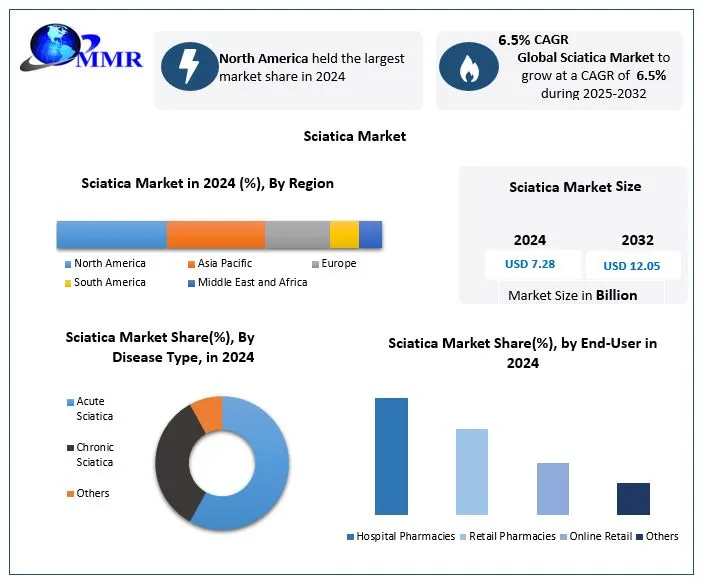 To know about the Research Methodology :- Request Free Sample Report
Global Sciatica Market Dynamics
Advancements in Medical Imaging & Minimally Invasive Procedures
Advancements in Medical Imaging and a Rising focus on minimally invasive procedures represent pivotal drivers propelling the Sciatica Market forward. The growing consumer preferences for less invasive treatment options underscores a shift towards patient-centric care. This shift is further strengthened by the increasing brand awareness surrounding specific drugs tailored to lessen sciatica symptoms, positioning them as viable alternatives to traditional therapies, driving the Sciatica Market. Also, ongoing innovation trends in medical imaging technologies have revolutionized diagnostic capabilities, enabling healthcare professionals to accurately identify and assess sciatica-related pathologies with unprecedented precision. This enhanced diagnostic accuracy not only facilitates prompt intervention but also contributes to improved patient outcomes, which results in Sciatica Market growth. Additionally, the beginning of online retail platforms has improved market accessibility, allowing patients to access information, resources, and treatment options conveniently from the comfort of their homes.
This balancing of information nurtures informed decision-making and promotes proactive management of sciatica symptoms. Besides, the emphasis on minimally invasive procedures reflects a growing recognition of the benefits of less traumatic interventions, such as endoscopic discectomy and percutaneous decompression, in reducing postoperative pain and accelerating recovery times. The rising adoption of these procedures not only minimizes patient discomfort but also mitigates the risk of complications associated with traditional open surgeries, thereby contributing to enhanced patient satisfaction and reduced healthcare costs. The convergence of advancements in medical imaging and a heightened focus on minimally invasive procedures represents a new era of innovation and patient-centered care in the Sciatica Market, poised to drive sustained growth and transformation.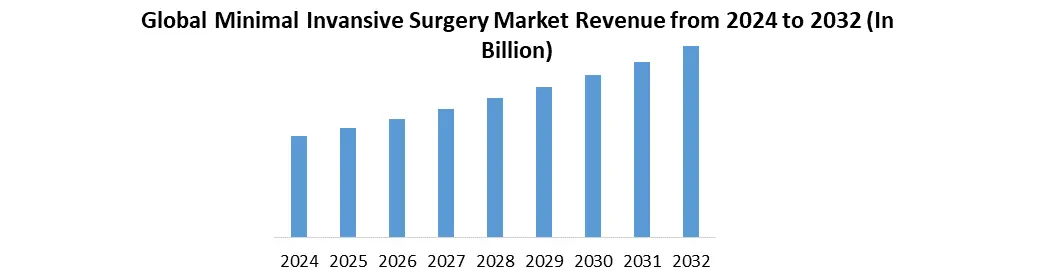
Challenges of Healthcare Accessibility and Affordability
In regions where healthcare resources are scarce, market saturation worsens the challenge of accessing timely diagnosis and treatment for sciatica patients. Moreover, the escalating competition among leading players in the pharmaceutical and medical device industries drives up the cost of sciatica medications and procedures, further limiting accessibility for economically poor individuals. The prevalence of market consolidation within the healthcare sector further complicates this issue, as dominant players exert considerable pricing power, resulting in inflated treatment costs. Additionally, the inherent dynamics of the healthcare industry's life cycle present tough barriers to entry for new market entrants, who need to contend with stringent regulatory requirements and substantial upfront investment costs. These market barriers to entry prevent potential competitors, spreading a lack of competition that contributes to constant high treatment costs. So, many individuals suffering from sciatica face significant financial burdens when seeking care, leading to delayed or inadequate treatment and complications of their condition. Therefore, addressing the issue of limited access to healthcare and the high cost of treatment is vital for fostering impartial healthcare delivery and improving outcomes for sciatica patients.
Sciatica Market Segment Analysis
Based on Drug Type, the Non-Steroidal Anti-inflammatory Drugs (NSAIDs) segment held the largest market share of about 50% in the Global Sciatica Market in 2024. According to MMR analysis, the segment is further expected to grow at a CAGR of 6.5% during the forecast period and stands out as the dominant segment within the Global Sciatica Market. NSAIDs have established a strong presence in the sciatica market owing to a combination of innovative trends, strategic product positioning, and effective market access strategies. Innovation trends are centered on the creation of long-action formulations that have minimal side effects, thereby expanding their effectiveness in managing chronic pain. This perfectly aligns with the product positioning of NSAIDs as the primary choice for combating inflammation and pain caused by sciatica, thereby increasing its demand in the global sciatica market. This dominance is contributed by strong insurance coverage, high disposable income, and a huge aging population who are prone to sciatica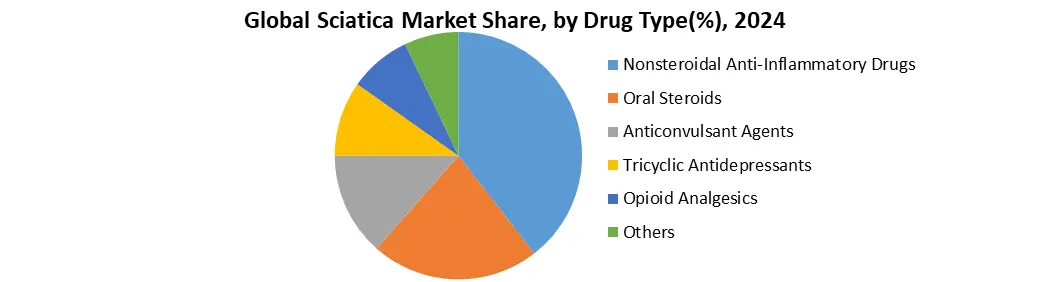
Distribution channels for NSAIDs are well-established, with a presence in both retail pharmacies and hospital settings. This widespread availability ensures easy access for patients marking the dominance of the segment in the Sciatica Market. The cost of manufacturing NSAIDs is relatively low compared to other drug classes and this affordability translates into a competitive price point for consumers and healthcare providers. Additionally, volatility in the NSAID market segment is relatively low owing to the established nature of the drugs and the chronic, recurring nature of sciatica. This probability allows for even production volume, ensuring consistent supply to meet patient demand. The NSAID segment's dominance pivots on a combination of factors like innovation that caters to chronic pain management, strategic product positioning for sciatica, strong presence in key markets, established distribution channels, affordability, and predictable demand. This dominance is likely to continue as the focus remains on optimizing these factors and catering to the evolving needs of the sciatica patient population.
Sciatica Market Regional Insights
North America dominated the Global Sciatica Market with the highest share in 2024. The region is expected to grow at a CAGR of 6.5% during the forecast period and maintain its dominance by 2032. The dominance of North America in the Global Sciatica Market is a result of a combination of cutting-edge innovations and strategic market positioning. This region, including the United States, Canada, and Mexico, holds a significant share of the global sciatica market, driven by its dedication to healthcare digital transformation. North America promises effortless access and tailored treatment choices for individuals suffering from sciatica by utilizing a strong foundation that supports telemedicine, electronic health records, and AI-powered diagnostics. By capitalizing on the latest pharmaceutical trends in the pharmaceutical market, the region remains dominant in creating and introducing innovative sciatica treatment drugs that cater to the unique requirements and preferences of patients, which drives the sciatica market growth. Additionally, robust global trade relations in the region support the smooth flow of pharmaceutical products, facilitating effective supply chains and guaranteeing the continuous availability of sciatica medications across international borders. The dominance of the region is particularly marked in top-selling regions such as California, New York, and Ontario, where high healthcare expenditure and a concentration of leading pharmaceutical companies fuel sciatica market growth. Additionally, the region’s positive approach to addressing economic impact creates a favorable atmosphere for investing in research and development, drawing talent, and nurturing innovation. By prioritizing the advancement of healthcare technology and nurturing collaborative environments, North America strengthens its position in the global sciatica market, providing a conducive environment for stakeholders to excel and drive significant progress in sciatica care and treatment.
Europe is the second-largest in the Global Sciatica Market, growing significantly during the forecast period and is driven by its strategic use of trade relations. Leading countries like Germany, France, and the United Kingdom benefit from their widespread network of trade agreements to enhance collaboration and simplify the flow of sciatica-related pharmaceuticals and medical devices. Through trade economic mechanisms, the region supports research and development initiatives, fostering innovation and maintaining a competitive edge globally. The region's success in the sciatica market is further boosted by its advanced approach to market penetration, utilizing sophisticated distribution channels and targeted marketing efforts to reach diverse consumer segments. By placing a strong emphasis on fostering cross-border partnerships and facilitating knowledge exchange, Europe strengthens its position in the global sciatica market, fostering an environment that promotes growth and innovation. Through prioritizing advancements in healthcare technology, Europe solidifies its role as a key player in the global sciatica market, providing valuable opportunities for stakeholders and driving advancements in the management and treatment of sciatica.
Sciatica Market: Competitive Landscape
This report covers the top key players in the Sciatica Market, including Scilex Pharmaceuticals, Pfizer Inc., Teva Pharmaceuticals, Endo Pharmaceuticals and Medtronic plc. Scilex Pharmaceuticals reported USD 56.6 million in total revenue with its groundbreaking therapy SP-102 (SEMDEXA™), the only late-stage, non-opioid injectable specifically developed for sciatica, showing strong clinical results and receiving FDA Fast Track designation. Also, Abbott Laboratories, Aurobindo Pharma, Sun Pharmaceutical, Boston Scientific, and Grünenthal GmbH are prominent players contributing to market growth through innovations in neuromodulation systems, affordable generics, chronic pain formulations, and precision stimulation technologies. Technological innovation (such as extended-release injectables), a shift toward opioid alternatives, and robust distribution through hospitals, clinics, and specialty providers are reshaping the competitive landscape, with these firms at the forefront of sciatica treatment innovation.
Key Trends in the Sciatica Market:
• Shift Toward Non-Opioid Therapies
Rising demand for safer, non-addictive treatments is driving investment in steroid injections, anticonvulsants, and neuromodulation over traditional opioids.
• Growth in Neuromodulation Devices
Increased adoption of spinal cord stimulators and minimally invasive nerve stimulation technologies for chronic sciatica pain management.
• Expansion of Generic Pain Medications
Wider availability of cost-effective generics like gabapentin and pregabalin is making early-stage treatment more accessible, especially in emerging markets.
Recent Devlopments in Sciatica Market:
| Date | Company | Region | Recent Development |
| April 26, 2024 | Medtronic plc | Ireland / USA | Received FDA approval for the Inceptiv™ closed-loop spinal cord stimulator, which auto-adjusts in real time to optimize chronic pain therapy, including sciatica. |
| May 30, 2024 | Abbott Laboratories | USA | Gained FDA approval to expand indications of Proclaim™ XR and Eterna™ SCS systems to cover non-surgical back pain and diabetic neuropathy |
| February 6, 2024 | Boston Scientific | USA | FDA approved WaveWriter™ SCS Systems for treating chronic low back and leg pain in patients not eligible for surgery, extending their sciatica application |
| June 14, 2024 | Scilex Pharmaceuticals | USA | Released Phase III results of SP-102 (SEMDEXA™) in PAIN, showing statistically significant improvement in sciatica pain; also held FDA Type C meeting |
| January 23, 2025 | Saluda Medical | USA | Secured FDA clearance for its EVA™ programming platform with Evoke® SCS, enabling real-time biomarker-driven therapy adjustment for chronic pain sufferers. |
Sciatica Market Scope: Inquire before buying
| Sciatica Market | |||
|---|---|---|---|
| Report Coverage | Details | ||
| Base Year: | 2024 | Forecast Period: | 2025-2032 |
| Historical Data: | 2019 to 2024 | Market Size in 2024: | USD 7.28 Bn. |
| Forecast Period 2025 to 2032 CAGR: | 6.5% | Market Size in 2032: | USD 12.05 Bn. |
| Segments Covered: | by Disease Type | Acute Sciatica Chronic Sciatica Others |
|
| by Drug Type | Nonsteroidal Anti-Inflammatory Drugs, Oral Steroids Anticonvulsant Agents Tricyclic Antidepressants Opioid Analgesics Others |
||
| by Route of Administration | Oral Injectable |
||
| by End-User | Hospitals Pharmacies Retail Pharmacies Online Retail Others |
||
Sciatica Market, by Region
North America (United States, Canada and Mexico)
Europe (UK, France, Germany, Italy, Spain, Sweden, Austria and Rest of Europe)
Asia Pacific (China, South Korea, Japan, India, Australia, Indonesia, Malaysia, Vietnam, Taiwan, Bangladesh, Pakistan and Rest of APAC)
Middle East and Africa (South Africa, GCC, Egypt, Nigeria and Rest of ME&A)
South America (Brazil, Argentina Rest of South America)
North America:
1. Mylan Pharmaceuticals (USA)
2. Abbott Laboratories (USA)
3. Johnson & Johnson Services, Inc. (USA)
4. Amneal Pharmaceuticals LLC (USA - New Jersey)
5. SCILEX Pharmaceuticals, Inc. (USA)
6. SpineThera, Inc. (USA)
7. Endo Pharmaceuticals (USA)
8. Bristol Myers Squibb (USA)
9. Sollis Therapeutics (USA)
10. Pfizer Inc. (USA)
11. Saluda Medical (USA)
12. Medtronic plc (USA)
Europe:
13. AstraZeneca (UK)
14. Novartis AG (Switzerland)
15. Bayer AG (Germany)
16. Hikma Pharmaceuticals (UK)
17. Sanofi (France)
Asia-Pacific:
18. Aurobindo Pharma Ltd. (India)
19. Zydus Cadila (India)
20. Glenmark Pharmaceuticals Ltd (India)
21. Sun Pharmaceutical Industries Ltd (India)
22. Alkem Labs (India)
23. Seikagaku Corporation (Japan)
24. Kolon Life Science, Inc. (South Korea)
25. Teijin Limited (Japan)
26. Omron Healthcare, Inc. (Japan)
Middle East & Africa
27. Teva Pharmaceuticals (Israel)
Frequently Asked Questions:
1. What are the growth drivers for the Sciatica market?
Ans. Rising Prevalence of Sciatica and demand for early treatment are the drivers of the Global Sciatica Market.
2. What are the opportunities in the Sciatica market growth?
Ans. Development of Novel Diagnostic therapies & rising focus on minimally invasive procedures are opportunities in the Sciatica Market.
3. Which region is the fastest-growing region in the global Sciatica market during the forecast period?
Ans. Asia Pacific is the fastest-growing region in the global Sciatica market during the forecast period.
4. What is the projected market size & and growth rate of the Sciatica Market?
Ans. Global Sciatica Market size was valued at USD 7.28 Bn. in 2024 and the total Sciatica revenue is expected to grow by 6.5% from 2025 to 2032, reaching nearly USD 12.05 Bn.
5. What segments are covered in the Sciatica Market report?
Ans. The segments covered in the Sciatica market report are disease type, drug type, route of administration, end-user, and region.