
Satellite Ground Station Market– Industry Structure Evaluation, Demand Drivers Analysis, Regional Growth Analysis and Identification, Competitive Positioning Review & Global Market Size Forecast to 2032
Overview
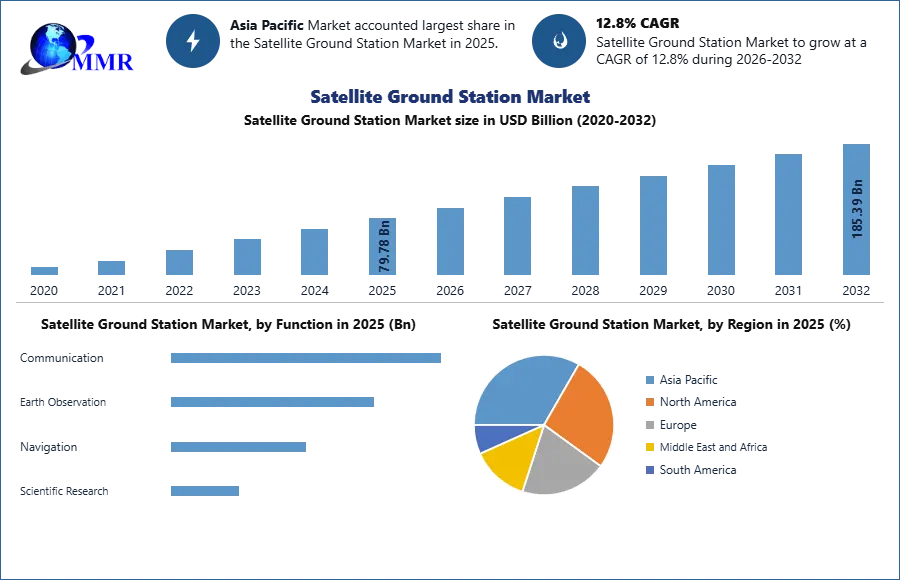
The Global Satellite Ground Station Market size was valued at USD 79.78 Billion in 2025 and the total Satellite Ground Station revenue is expected to grow at a CAGR of 12.8% from 2026 to 2032, reaching nearly USD 185.39 Billion By 2032
Satellite Ground Stations (SGS) are vital links between orbiting satellites and Earth's communication systems. Equipped with antennas and transmitters, these stations manage data transmission, reception, and control, enabling seamless communication for industries like telecommunications, weather monitoring, navigation, and Earth observation.
The rising demand for satellite communication across sectors like telecommunications, Earth observation, and weather monitoring is a driving force behind the growth of the satellite ground station market. As industries increasingly rely on satellite data for various applications, including communication and information gathering, the need for efficient and reliable ground stations amplifies. This surge in demand drives advancements in ground station technology to ensure better data transmission, leading to the evolution of these stations for improved performance and expanded capabilities.
As the number of satellites in orbit increases, there's a parallel escalation in the requirement for ground stations to manage and handle this amplified data flow, consequently driving the expansion of the satellite ground station market. In Europe, a strong focus lies on harnessing satellite data for sustainability endeavors, notably seen in Germany's use of satellite sensors to monitor pollution levels and implement responsive measures like traffic bans, reflecting a commitment to environmental management. Additionally, countries in the APAC region, such as India and China, heavily rely on satellite technology across various sectors such as telecommunications, agriculture, disaster management, and navigation. The rising demand for robust ground station infrastructure to manage the surging volume of satellite data, driving market growth and innovation.
 To know about the Research Methodology :- Request Free Sample Report
Satellite Ground Station Market Dynamics:
Increasing Satellite Deployment Driving Exponential Growth in Satellite Ground Station Market
The satellite ground station market is undergoing a significant transformation due to a rapid surge in satellite launches. With more than 7,000 operational satellites and a remarkable 45% increase in 2025 alone, there's a massive demand for top-notch ground station infrastructure. This upsurge is driven by reduced costs in building and launching satellites attracting a wide range of investors and driving a substantial rise in satellite deployments. The escalating demand for mobile communications and Earth observation services is putting ground stations at the forefront, playing a crucial role in seamless satellite communication for the satellite ground station market. The increasing need for high-speed data transfer demands, especially for high-resolution imaging and real-time communication, are pushing for more advanced ground stations. As a result, the market is witnessing a surge in innovation and infrastructure improvements tailored to meet the diverse needs of an increasingly satellite-dependent world.
Technological Innovations revolutionize the Satellite Ground Station Market
The satellite ground station market has transformed significantly thanks to groundbreaking technology such as Phased-array antennas that have changed the game by making it easier to capture and send signals from multiple satellites at the same time making the satellite ground station market revolutionize. The introduction of Software-Defined Radios (SDRs) is a prime example where SDRs allow ground stations to easily talk with different satellite systems, broadening the market by handling various communication styles and frequencies.
Additionally, advancements in signal processing, automation, standardization, and equipment design have amped up the market. These improvements boost data accuracy, help make quick decisions, and ensure compatibility, flexibility, and security, all driving market growth to keep up with the rising needs of satellite communication and Earth observation. Improving ground station equipment to be more adaptable and secure has boosted market growth. This upgrade allows for better flexibility and toughness in meeting the increasing needs for satellite communication and Earth observation, ultimately pushing the market forward.
Navigating Risks In A Sensitive Communication Landscape
Cybersecurity risks within the satellite ground station industry pose significant hurdles due to the critical role satellite communication plays. These risks involve diverse threats, including potential data breaches, unauthorized access attempts, deliberate signal disruptions like jamming, and the looming threat of cyber attacks targeting ground station systems. Additionally, vulnerabilities within the supply chain and the potential for insider threats add to these concerns, necessitating stringent security measures. To counter these risks, comprehensive cybersecurity strategies become paramount. These include encryption protocols, regular security audits, intrusion detection systems, extensive employee training, and the implementation of robust network security practices.
As the satellite industry expands rapidly, the importance of fortified cybersecurity measures cannot be emphasized enough, ensuring the safeguarding of essential infrastructure and the protection of sensitive data transmitted via ground stations.
Satellite Ground Station Market Segment Analysis:
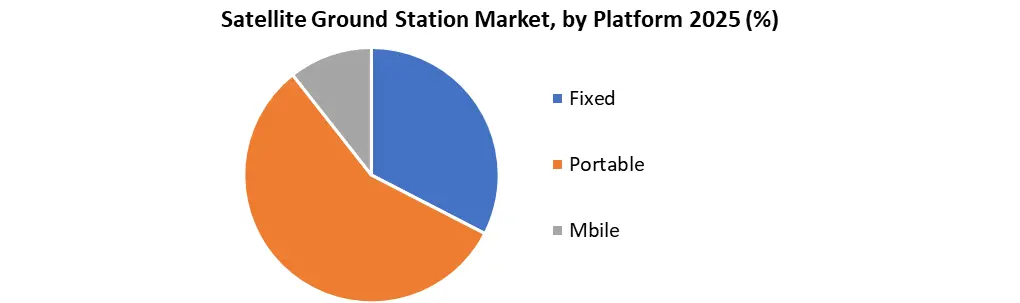
Based on Platform, the Fixed Platform segment held the largest market share of more than 80% and dominated the global Satellite Ground Station market in 2025. The segment is further expected to grow at a CAGR of 13.1% and maintain its dominance during the forecast period. The rising demand for various Satellite Ground Station applications including those designed to accelerate and streamline business processes using high bandwidth satellite communications, coupled with government investments in national security and space exploration are expected to be the major factors driving the segment growth.
 Additionally, fixed platforms are crucial for various applications, including telecommunications, broadcasting, government and defense networks, satellite internet, and earth observation, businesses rely on these applications to meet their unique needs. As businesses increasingly rely on technology to remain competitive and efficient, the fixed platform segment continues to dominate the Satellite Ground Station market and shape the way satellites operate in the digital age.
In addition, the portable platform segment is expected to grow at a significant CAGR during the forecast period. It covers a wide range of portable platform that has been designed for temporary deployments and ease of transportation as they are small and offer greater flexibility and responsiveness. This category is fundamentally used for disaster relief efforts, emergency response, military operations, and temporary communication needs in remote locations for the Satellite Ground Station portable platform. The continuous demand for satellite-based communication in disaster-prone areas and remote locations is expected to drive the segment growth during the forecast period.
The Mobile Platform segment hold the smallest market share in 2025. This category is designed for integration with vehicles, aircraft, or other mobile platforms, enabling communication on the move, as they are lightweight and compact are some factors driving the segment's growth. They are fundamentally used for maritime communication, aviation communication, military communication, and other mobile platforms requiring satellite connectivity to play a crucial role in driving the growth of the mobile platform segment.
Satellite Ground Station Market Regional Insights:
North America led the global Satellite Ground Station market with the highest market share of 41% in 2025. The region is further expected to grow at a CAGR of 13.1% and maintain its dominance throughout the forecast period. The strong adoption of various Satellite Ground stations across the business is expected to be the major factor driving the regional market growth. In addition, the region is further expected to continue to maintain its dominance throughout the forecast period due to the presence of a substantial number of small and medium-sized firms (SMEs), and a growing adoption of satellite-based services, including broadband internet, satellite television, and government and defense applications.
The United States is expected to be the lucrative region for the global Satellite Ground Station market vendors with a diverse landscape that includes established tech giants and a vibrant startup ecosystem. Significant investments in Satellite Ground Station solutions by major firms and SMEs in the country contributed extensively to Satellite Ground Station market revenue growth. The U.S. boasts an extensive network of ground stations, both government-owned and private, catering to diverse satellite communication needs boosting the U.S. market. As a result, continued investments and groundbreaking innovations in next-generation ground stations, high-throughput satellites, and expanded coverage are further contributing factors to the North America market growth.
Canada region is expected to experience steady growth, attributed to its vast remote areas and need for satellite-based communication for resource exploration, disaster management, and maritime applications. The country is globally contributing to satellite technology development and ground station operations thanks to its vast Canadian geography necessitates driving the market growth. Notably, the Canadian Satellite Ground Station focused investments on enhancing ground station infrastructure and optimizing satellite networks for diverse applications. Additionally, Canada boasts international partnerships to extend coverage and leverage shared expertise for advanced satellite services contributing to the satellite ground station market. Mexico region is experiencing steady growth, attributed to its growing demand for satellite-based communications for telecommunications, broadcasting, and government applications further contributing to the Mexican market.
Satellite Ground Station Market Competitive Landscapes:
The Global Satellite Ground Station market is expected to be the highly competitive active presence of numerous market players. Major companies are striving to introduce consolidation trends, technology advancements, and global expansion promoting overall market growth. In addition, Several Satellite Ground Station manufacturers are focused on enhancing and expanding their core business through the launch of additional efficient products to keep up with conventional Satellite Ground Station sales. Key players are adopting various business strategies, including technical partnerships and mergers and acquisitions (M&A) to remain competitive in the Satellite Ground Station market. For instance,
1. SES acquired Telesat, a Canadian satellite operator for $2.3 billion in 2023, creating a global satellite communications provider with a combined ground station network spanning multiple continents.
2. Viasat acquired Kymeta Corporation, a developer of electronically steerable phased array (ESA) antennas for $240 million in 2023, gaining access to Kymeta’s innovative ground station technology for next-generation satellite communications.
3. Honeywell partnered with OneWeb to provide a user terminal that enables access to OneWeb’s Low Earth Orbit (LEO) satellite network in 2022. This partnership aimed to expand connectivity in remote or challenging environments.
4. Hisdesat acquired Avanti Communications, a global provider of satellite data connectivity, for 1 billion euros in 2022, expanding its satellite ground station network and reaching into new markets.
These strategic endeavors underscore the Satellite Ground Station industry's commitment to diversifying product lines, innovating within segments, and adopting strategic partnerships to compete effectively in the market landscape. As consumer preferences evolve, these proactive strategies position Satellite Ground Station manufacturers for sustained growth and competitiveness in the aerospace market.
Satellite Ground Station Industry Ecosystem
Recent Industry Developments
| Exact Date | Company | Development | Impact |
|---|---|---|---|
| 12 December 2025 | Novaspace | Released the 6th Ground Segment Market Prospects report projecting the ground market to reach $106 billion. | The report signals a fundamental shift toward service-driven economics and virtualized ground station architectures. |
| 22 October 2025 | Amazon | Granted regulatory approval to construct a major satellite ground station facility in Cork, Ireland, for Project Kuiper. | This expansion strengthens European broadband coverage and increases competition in the commercial GSaaS sector. |
| 14 August 2025 | KSAT (Kongsberg Satellite Services) | Announced the launch of 'Hyper', a new fleet of orbiting ground stations designed for LEO constellations. | The development aims to provide low-latency, high-speed space-to-ground connectivity by bypassing traditional terrestrial limits. |
| 10 June 2025 | Airbus & CNES | Develoyed four advanced satellites with optical ground station support as part of the CO3D constellation project. | This marks a significant milestone in high-resolution Earth observation data handling through laser communication links. |
| 15 May 2025 | Northrop Grumman | Awarded a US Space Force contract to develop advanced Relay Ground Stations (RGS) in the US and the UK. | The contract bolsters military satellite command and control resilience across the Atlantic region. |
Satellite Ground Station Market Scope: Inquiry Before Buying
| Satellite Ground Station Market | |||
|---|---|---|---|
| Report Coverage | Details | ||
| Base Year: | 2025 | Forecast Period: | 2026-2032 |
| Historical Data: | 2020 to 2025 | Market Size in 2025: | 79.78 USD Billion |
| Forecast Period 2026-2032 CAGR: | 12.8% | Market Size in 2032: | 185.39 USD Billion |
| Segments Covered: | by Platform | Fixed Portable Mobile |
|
| by Function | Communication Earth Observation Navigation Scientific Research |
||
| by End User | Defense Government Commercial |
||
Satellite Ground Station Market by Region:
North America (United States, Canada, and Mexico)
Europe (UK, France, Germany, Italy, Spain, Sweden, Austria, and the Rest of Europe)
Asia Pacific (China, South Korea, Japan, India, Australia, Indonesia, Malaysia, Vietnam, Taiwan, Bangladesh, Pakistan, and the Rest of APAC)
Middle East and Africa (South Africa, GCC, Egypt, Nigeria, and the Rest of ME&A)
South America (Brazil, Argentina Rest of South America)
Key Players / Competitors Profiles Covered in Brief in Global Satellite Ground Station Market Report in Strategic Perspective:
- AIRBUS
- Cobham SATCOM
- ESS Weathertech
- General Dynamics Mission Systems
- Kongsberg Defence & Aerospace
- Kratos Defense & Security Solutions
- Lockheed Martin Corporation
- Maxar Technologies
- Viasat
- SES S.A.
- EchoStar Corporation
- Gilat Satellite Networks
- Thales Group
- Comtech Telecommunications
- SpaceX
- L3Harris Technologies
- RTX (Raytheon Technologies)
- Telesat Canada
- Iridium Communications
- Eutelsat Communications
- Northrop Grumman
- Mitsubishi Electric Corporation
- Honeywell International
- Swedish Space Corporation
- ST Engineering