
Residential Solar (PV) Inverter Market - Industry Structure Evaluation, Demand Drivers Analysis, Regional Growth Analysis and Identification, Competitive Positioning / Landscape Review & Global Market Size Forecast to 2032
Overview
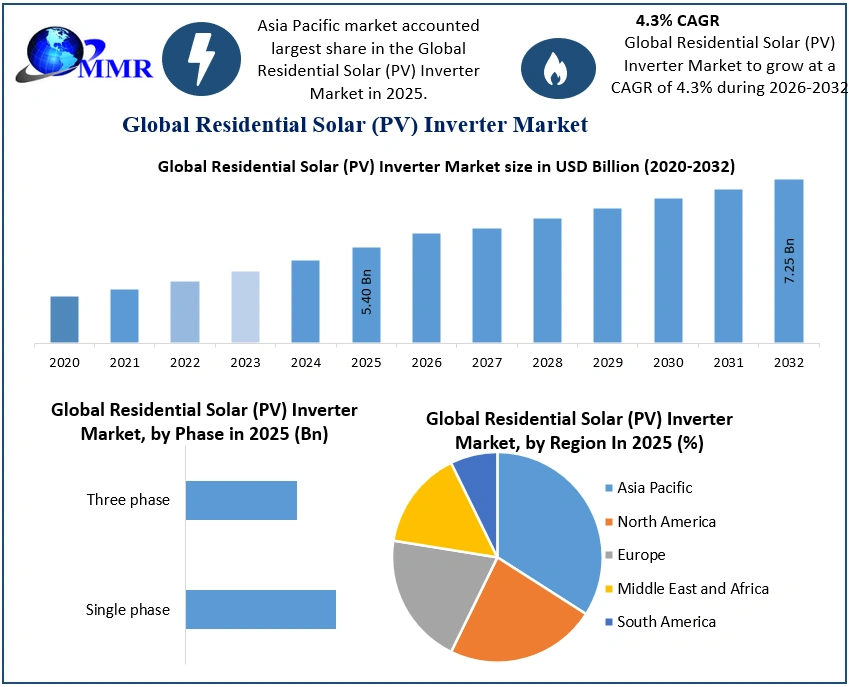
The Residential Solar (PV) Inverter Market size was valued at USD 5.40 Billion in 2025 and the total Residential Solar (PV) Inverter revenue is expected to grow at a CAGR of 4.3% from 2026 to 2032, reaching nearly USD 7.25 Billion by 2032.
Residential Solar (PV) Inverter Market Overview:
The global Residential Solar (PV) Inverter market is witnessing significant growth, driven by the increasing adoption of rooftop solar photovoltaic systems, supportive government incentives for renewable energy, and rising consumer awareness regarding clean energy generation. Residential solar inverters play a critical role in converting direct current (DC) generated by solar panels into alternating current (AC) for household electricity consumption while optimizing system performance, energy efficiency, and grid compatibility. The growing emphasis on reducing electricity costs, achieving energy independence, and lowering carbon emissions is encouraging homeowners to invest in residential solar energy systems, thereby driving demand for advanced PV inverter technologies.
The market is further supported by rapid technological advancements in string inverters, microinverters, and hybrid inverters that offer higher conversion efficiency, remote monitoring, enhanced safety features, and seamless integration with battery energy storage systems. The increasing deployment of smart homes, rising adoption of distributed energy resources, and expansion of net metering and feed-in tariff programs are also contributing to market growth.
To know about the Research Methodology:-Request Free Sample Report
Residential Solar (PV) Inverter Market Dynamics:
Increasing Adoption of Rooftop Solar and Supportive Government Policies is driving the Market
The growing installation of residential rooftop solar photovoltaic (PV) systems is a major factor driving the Residential Solar (PV) Inverter market. Rising electricity prices, increasing consumer awareness of renewable energy, and government initiatives such as net metering, feed-in tariffs, tax credits, and solar subsidy programs are encouraging homeowners to invest in solar power systems. Additionally, global efforts to reduce carbon emissions and achieve energy transition goals are further accelerating the demand for efficient residential PV inverters.
High Initial Investment and Grid Integration Challenges
Despite the declining cost of solar technology, the high upfront investment associated with residential solar installations, battery storage systems, and advanced inverter technologies remains a key challenge, particularly in price-sensitive markets. In addition, varying grid regulations, interconnection requirements, and compatibility issues with aging electrical infrastructure can delay project implementation. Supply chain disruptions and fluctuations in semiconductor and electronic component prices also continue to impact inverter manufacturing costs and availability.
Expansion of Smart Inverters and Solar-Plus-Storage Solutions is an opportunity to enter into the market
The increasing adoption of smart inverters, hybrid inverter systems, and residential battery energy storage is creating significant growth opportunities for the market. Modern PV inverters equipped with artificial intelligence (AI), Internet of Things (IoT), remote monitoring, and energy management capabilities enable homeowners to optimize energy consumption, improve system efficiency, and maximize self-consumption of solar power. The growing popularity of home energy storage systems and electric vehicle charging integration is further expanding the market potential.
Intensifying Competition and Continuous Technological Innovation
The market is becoming increasingly competitive as global and regional manufacturers focus on developing high-efficiency, compact, and digitally connected inverter solutions. Companies are investing in product innovation, enhanced conversion efficiency, cybersecurity features, and advanced grid-support functionalities to differentiate their offerings. At the same time, manufacturers face pressure to reduce production costs, comply with evolving grid standards, and provide reliable after-sales service while maintaining product performance and long-term durability.
Residential Solar (PV) Inverter Market Segment Analysis:
Based on Product, the Residential Solar (PV) Inverter Market is segmented into Central Inverter, String Inverter, and Micro Inverter.
The Central inverter segment has highest the market share accounting for 52% in 2025 and forecasted that it will boost the market growth during the forecasted period. The reason for this is the increasing demand for central inverters across the world, as well as the rapid development of renewable power infrastructure in developing economies such as China, India, and Japan as well as the rapid industrialization of these countries.

Based on Phase, the Residential Solar (PV) Inverter Market is segmented into Single phase and Three phase.
Three phase segment has the highest market share and is forecasted that it will boost the market growth during the forecasted period. Due to the gaining importance from the power generation, distribution, and transmission sectors as well as the increase in PV power plants in large commercial, industrial and utility installations, are resulting in the growth of three phase solar. As a result, PV power plants have grown in size from 1000 volts to 1500 volts.
Based on Connection, the market is segmented into On-grid and Off-grid.
The On-grid segment has the highest market share and is forecasted that it will boost the market growth during the forecasted period. . Due to an increase in investment in direct electricity supply instead of storing in batteries, the market is forecasted to grow in the next few years due to the advantages of On grid Solar Inverters, including easy energy installation, cost effectiveness, and capable of managing high electricity demands.
Regional Insights – Residential Solar (PV) Inverter Market
Asia-Pacific dominated the global Residential Solar (PV) Inverter market, driven by rapid solar photovoltaic deployment, supportive government policies, and strong manufacturing capabilities in countries such as China, Japan, India, South Korea, and Australia. Rising electricity demand, declining solar installation costs, and increasing investments in residential renewable energy systems continue to strengthen the region's market leadership.
Europe holds a significant share of the market, supported by ambitious renewable energy targets, favorable net metering policies, and increasing residential adoption of rooftop solar systems. The growing integration of battery energy storage, smart homes, and energy-efficient technologies is further driving demand for advanced residential PV inverters across countries such as Germany, Italy, Spain, and the Netherlands.
North America is witnessing steady growth due to rising investments in residential solar installations, supportive federal and state-level incentive programs, and increasing consumer demand for energy independence. The expanding adoption of hybrid inverters, home battery storage systems, and electric vehicle charging infrastructure is further contributing to market expansion, particularly in the United States and Canada.
Latin America is emerging as a promising market, driven by abundant solar resources, increasing electricity costs, and government initiatives promoting distributed solar generation. Countries such as Brazil, Mexico, and Chile are witnessing growing adoption of residential rooftop solar systems, creating demand for efficient PV inverter solutions.
Middle East & Africa is expected to experience gradual growth, supported by rising investments in renewable energy infrastructure, favorable climatic conditions for solar power generation, and government programs encouraging residential solar adoption. Increasing awareness of clean energy, coupled with efforts to diversify energy sources and improve energy access, is expected to create new opportunities for residential PV inverter manufacturers across the region.
Competitive Landscape – Residential Solar (PV) Inverter Market
The global Residential Solar (PV) Inverter market is highly competitive, with leading companies focusing on technological innovation, product efficiency, smart energy management, and expansion of their global distribution networks. Manufacturers are investing in the development of high-efficiency string inverters, microinverters, and hybrid inverters integrated with battery energy storage systems, artificial intelligence (AI), and Internet of Things (IoT)-based monitoring capabilities. Strategic initiatives such as mergers and acquisitions, partnerships with solar installers, manufacturing capacity expansion, and new product launches are enabling companies to strengthen their market presence. In addition, increasing investments in localized production, cybersecurity-enabled smart inverters, and solar-plus-storage solutions are helping market players address evolving customer requirements and regulatory standards.
Residential Solar (PV) Inverter Market Scope: Inquire before buying
| Global Residential Solar (PV) Inverter Market | |||
|---|---|---|---|
| Report Coverage | Details | ||
| Base Year: | 2025 | Forecast Period: | 2026-2032 |
| Historical Data: | 2020 to 2025 | Market Size in 2025: | USD 5.40 Bn. |
| Forecast Period 2026 to 2032 CAGR: | 4.3% | Market Size in 2032: | USD 7.25 Bn. |
| Segments Covered: | by Product | Central Inverter String Inverter Micro Inverter |
|
| by Phase | Single phase Three phase |
||
| by Connection | On-grid Off-grid |
||
| by End-User | Residential Commercial Utilities |
||
Residential Solar (PV) Inverter Market, by Region:
North America (United States, Canada and Mexico)
Europe (UK, France, Germany, Italy, Spain, Sweden, Austria and Rest of Europe)
Asia Pacific (China, South Korea, Japan, India, Australia, Indonesia, Malaysia, Vietnam, Taiwan, Bangladesh, Pakistan and Rest of APAC)
Middle East and Africa (South Africa, GCC, Egypt, Nigeria and Rest of ME&A)
South America (Brazil, Argentina Rest of South America)
Residential Solar (PV) Inverter Market, Key Players:
1. General Electric
2. SMA Solar Technology AG
3. Sungrow
4. Darfon Electronics Corp.
5. Schneider Electric
6. Enphase Energy
7. Siemens, Fimer Group
8. Eaton SolarEdge Technologies
9. Huawei Technologies
10.Fronius International GmbH
11.Delta Electronics
12.Altenergy Power System
13.Hitachi Hi-Rel Power Electronics Pvt. Ltd.
14.TMEIC
15.Sineng Electric
16.Tabuchi Electric
17.Canadian Solar
18.Panasonic Corporation
19.GoodWe
Frequently Asked Questions:
1. What was the Global Residential Solar (PV) Inverter Market size in 2025?
Ans: The Global Residential Solar (PV) Inverter Market size was USD 5.40 Billion in 2025.
2. What is the growth rate of Residential Solar (PV) Inverter Market?
Ans. The Global market is growing at a CAGR of 4.3% over next 6 years.
3. Which region has largest share in The Global Residential Solar (PV) Inverter Market?
Ans. Asia Pacific holds the largest share.
4. What is the Global Residential Solar (PV) Inverter Market segment based on End User?
Ans. Based on End User, The Global market is divided into Supermarket, Convenience Store, E-Commerce, Food Service, and Others.
5. Who are the key players in the Global Market?
Ans. The key players in the Global market are General Electric, SMA Solar Technology AG, Sungrow, Darfon Electronics Corp., Schneider Electric, Enphase Energy, Siemens, Fimer Group, Eaton SolarEdge Technologies, Huawei Technologies, Fronius International GmbH, Delta Electronics, Altenergy Power System, Hitachi Hi-Rel Power Electronics Pvt. Ltd., TMEIC, Sineng Electric, Tabuchi Electric, Canadian Solar, Panasonic Corporation, Ginlong Technologies, GoodWe, and SHENZHEN SOFARSOLAR.