
Pseudomonas Putida Market Size by Type, End User, Region – Segment-Level Market Assessment, Growth Opportunity Analysis, Competitive Mapping & Forecast to 2032
Overview
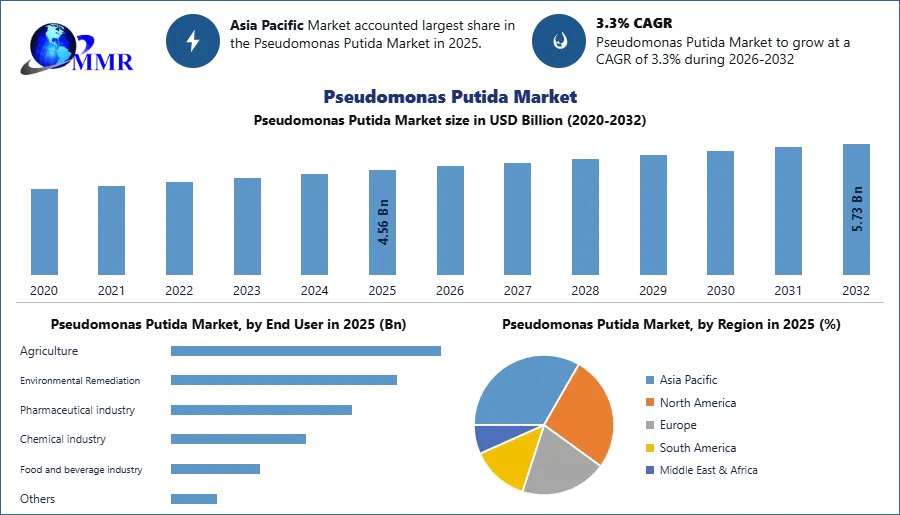
Global Pseudomonas Putida Market size was valued at USD 4.56 Bn in 2025 and is expected to reach USD 5.73 Bn by 2032, at a CAGR of 3.3 %.
Pseudomonas Putida Market Overview
Pseudomonas Putida is a species of rod-shaped bacteria generally found in several environmental niches. It belongs to the genus Pseudomonas, which involves various species recognized for their versatility as well as adaptability to diverse environments. Pseudomonas Putida has gained consideration due to its potential applications in bioremediation, industrial processes and research. It is a Gram-negative bacterium such as E. coli but is generally used in environmental studies because it is capable of degrading many aromatic compounds. Streptomyces coelicolor is a soil bacterium that is Gram-positive.
Increasing demand for plant growth promoters and growing investment in research and development are the driving factors of the Pseudomonas Putida industry growth. The report includes historical data, present and future trends, competitive environment of the Pseudomonas Putida industry. The bottom-up approach was used to estimate the market size. For a deeper knowledge of Pseudomonas Putida market penetration, competitive structure, pricing and demand analysis are included in the report. The qualitative and quantitative methods are included in the report for the analysis of the data of the Market.
Pseudomonas Putida Market Snapshot
 To know about the Research Methodology :- Request Free Sample Report
Pseudomonas Putida Market Dynamics
Advancements in Genetic Engineering to Boost Pseudomonas Putida Market
Genetic engineering enables researchers to modify Pseudomonas Putida’s metabolic pathways, allowing it to efficiently produce specific compounds or perform desired functions. This customization has been tailored for bioremediation, biofuel production, enzyme synthesis, and more applications. By introducing genetic modifications, scientists can enhance Pseudomonas Putida ’s natural capabilities. This has led to increased substrate utilization, higher product yields, improved tolerance to extreme conditions and improved efficiency in several applications. Genetic engineering has made Pseudomonas Putida more effective at degrading specific pollutants or contaminants. This level of specificity permits specific bioremediation strategies, minimizing the environmental impact of pollutants. Genetic modifications have resulted in the production of an extensive range of valuable products. Pseudomonas Putida has been engineered to produce biofuels, bio plastics, enzymes, pharmaceuticals and other high-demand compounds, thus escalating its potential market influence. Genetic engineering has been enhancing the cost-effectiveness of Pseudomonas Putida -based processes.
Higher yields, reduced production time and optimized resource application contribute to economic capability and competitiveness in the market, which drive Pseudomonas Putida Market growth. Advanced genetic engineering tools such as CRISPR-Cas9 permit quicker and more specific modifications. This accelerates the development of genetically engineered Pseudomonas Putida strains with desired traits, advancing time-to-market for new applications. In addition, as biofuel production gains traction as a sustainable energy solution, there has been increasing demand for microbial strains including Pseudomonas putida that have been efficiently converting feedstocks into biofuels. This increased demand has encouraged the market for Pseudomonas putida strains and associated products.
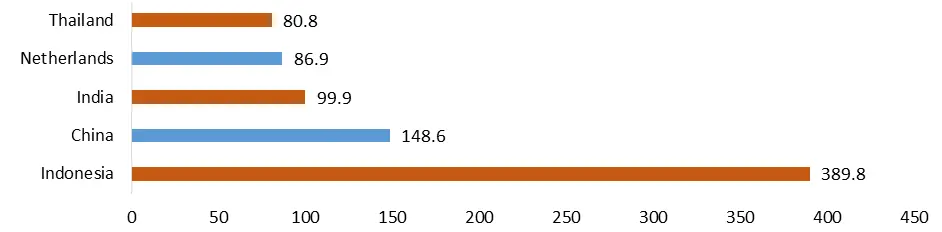
Leading Countries Based On Biofuel Production Worldwide In 2022 (In Petajoules)
Increasing demand for bioremediation to fuel Pseudomonas Putida Market growth
Rising environmental awareness and concerns about pollution, contamination, and their impact on ecosystems and human health are forceful industries and governments to seek sustainable solutions such as bioremediation. Stricter environmental regulations worldwide need industries to manage and clean up polluted sites. Bioremediation, particularly using natural microorganisms including Pseudomonas Putida, aligns with regulatory expectations for green and cost-effective solutions. Bioremediation provides a way to restore contaminated sites to their natural condition without the widespread disruption caused by traditional remediation methods. This is particularly attractive in urban areas and sensitive ecosystems.
Bioremediation is often more cost-effective than mechanical or chemical remediation methods. The use of microorganisms including Pseudomonas Putida has been substantially reducing cleanup costs, making it an attractive option for industries and governments looking to manage their budgets. Bioremediation is viewed as a more environmentally friendly method compared to harsh chemicals or physical interventions and boosts the Pseudomonas Putida Market growth. Companies that adopt such solutions have improved their public image and reputation. Bioremediation has been offered sustainable, long-term solutions that address the root causes of pollution. Microorganisms such as Pseudomonas Putida have been adapting to changing conditions and continue to remediate over time.
Pseudomonas Putida Market Trend
Increasing innovations in wastewater treatment
The world is facing substantial environmental challenges such as water pollution and scarcity. Growing industrialization, urbanization and agricultural activities contribute to the contamination of water bodies. As these concerns intensify, there's a pressing requirement for innovative solutions to treat wastewater effectively. Traditional wastewater treatment methods have included energy-intensive processes and the use of chemicals. The trend toward sustainability is boosting the search for greener alternatives which Pseudomonas Putida Market growth. Pseudomonas Putida’s capability to naturally degrade pollutants aligns well with this shift, as it provides a more environmentally friendly approach. Microbial bioremediation, which embraces using microorganisms to break down pollutants, is gaining traction due to its effectiveness and low environmental impact.
Pseudomonas Putida is a versatile bacterium that has been harnessed for bioremediation purposes, making it a leading candidate for innovations in wastewater treatment. Advances in genetic engineering aid scientists in modifying microorganisms including Pseudomonas Putida to improve their abilities. Researchers have been tailoring these bacteria to degrade specific pollutants more efficiently or operate under varying conditions, broadening their applicability in wastewater treatment. Pseudomonas Putida ’s capability to form biofilms enhances its attachment to surfaces and pollutant degradation efficiency. Innovations are being explored in optimizing biofilm formation and engineering biofilms for targeted pollutant exclusion within wastewater treatment systems.
Pseudomonas Putida Market Restraint
The Emergence of Contaminants to Restrain Pseudomonas Putida Market Growth
The continuous development of new industrial processes, products and chemicals has introduced novel pollutants into wastewater streams. Pseudomonas Putida's effectiveness in degrading specific contaminants depends on its metabolic abilities. If emerging contaminants have structures or properties that are challenging for Pseudomonas Putida to break down, the bacteria's efficiency has been compromised. Pseudomonas putida's ability to degrade pollutants is based on its natural metabolic pathways. It has not evolved to efficiently break down certain emerging contaminants that are structurally diverse from pollutants it has encountered in its natural environment. Some emerging contaminants have been more resistant to microbial degradation, making it stimulating for Pseudomonas Putida to effectively break them down. These contaminants have been determined in the environment, resulting in inadequate treatment outcomes.
Pseudomonas Putida Market Regional Insights
Asia Pacific dominated the largest Pseudomonas Putida Market share in 2025 and is expected to continue its dominance while growing at the highest CAGR during the forecast period (2026–2032). The region, particularly countries such as China, India, and Japan, has been witnessing rapid industrialization along with increasing investments in biotechnology and environmental sustainability. Governments across Asia Pacific have been actively promoting eco-friendly technologies and sustainable industrial practices, which has significantly boosted the adoption of Pseudomonas putida in applications such as wastewater treatment, bioremediation, and bio-based production.
The rising environmental concerns and strict regulations regarding industrial waste management have accelerated the demand for advanced microbial solutions. Additionally, the growing focus on circular economy practices and sustainable development has driven industries to adopt biological alternatives, including Pseudomonas putida, for pollution control and resource recovery. Expanding agricultural activities and the increasing need for biofertilizers and soil health improvement solutions have further supported market growth in the region.
Moreover, the presence of a large number of manufacturing industries, coupled with increasing R&D activities and collaborations between research institutions and biotech companies, has strengthened the commercialization of Pseudomonas putida-based technologies. Advancements in synthetic biology, genetic engineering, and microbial biotechnology have enhanced the efficiency and application scope of these organisms. Rising investments in clean technologies and government-backed sustainability initiatives have also created significant opportunities for market expansion in Asia Pacific.
Pseudomonas Putida Market Regional Analysis
Based on Type, the market is segmented into the Pseudomonas putida KT2440, Pseudomonas putida GB-1, Pseudomonas putida B13, Pseudomonas putida PCL145 and Others. Pseudomonas Putida KT2440 held the largest Pseudomonas Putida Market share in 2022 and is expected to grow at a significant CAGR during the forecast period. Pseudomonas putida KT2440 is known for its versatility and wide range of applications. It has been broadly deliberate and engineered for several industrial as well as environmental applications such as bioremediation, bioplastics production and enzyme synthesis. Its adaptability makes it a go-to choice for multiple sectors, contributing to its authority. Pseudomonas putida KT2440's genome has been sequenced and well-studied, enabling researchers to genetically manipulate it more efficiently. This characteristic enables the development of strains with specific traits tailored for different applications, improving its utility in various industries.
The strain's capability to degrade a wide range of pollutants, including hydrocarbons and aromatic compounds, makes it a valued asset in bioremediation efforts. This capacity to address environmental pollution issues contributes to its dominance, particularly in the setting of sustainable solutions. Pseudomonas Putida KT2440 has garnered substantial research attention over the years, leading to a wealth of knowledge about its genetics, physiology, and behavior. This research has facilitated its optimization for targeted applications, further solidifying its position in the market and boosting the Pseudomonas Putida Market growth. Pseudomonas Putida KT2440's track record of successful applications in several industries offers a level of trust and reliability. This history of practical use has encouraged industries to select this strain over others when looking for solutions for their specific requirements.
Global Pseudomonas Putida Market Share, By Type in 2025 (%)

Pseudomonas Putida Market Competitive Landscape
The competitive analysis of the Pseudomonas Putida Market includes the Market size, growth rate and key trends. The report provides information about the Key companies, such as their size, Pseudomonas Putida market share, and geographic presence. The report provides such type of competitive landscape of all Pseudomonas Putida Key Players to assist new market entrants. The report provides such type of competitive landscape of all Key Players to assist new market entrants. The report offers Competitive benchmarking of the Pseudomonas Putida industry through the Market revenue, share and size of the key players. Some of the key players are Novozymes (Denmark), DSM (Netherlands), Versalis (Italy), Mitsubishi Chemical (Japan), DuPont (US), BioLineRx (Israel), Cyanotech (US), Earthrise Nutritionals (US), Biologics(Scotland), Petro China (China) and Others. Many companies conducted research and development activities to increase their portfolio and fulfil consumer demand. For instance, in 2022, Petro China (China): The company have collaborated with the Chinese Academy of Sciences to develop a new strain of Pseudomonas putida that is more efficient at degrading oil spills.
Pseudomonas Putida Marke Recent Industry Developments (2025–2026)
| Date | Company | Development | Impact |
|---|---|---|---|
| 19 March 2026 | PNNL (Pacific Northwest National Laboratory) | The laboratory integrated robotics and AI to accelerate the metabolic engineering of Pseudomonas putida for advanced biomanufacturing. | This milestone significantly reduces the R&D timeline for developing specialized microbial chassis for sustainable fuel production. |
| 26 February 2026 | Mitsubishi Chemical | Mitsubishi Chemical partnered with Xanadu Quantum Technologies to apply quantum algorithms to microbial research, including P. putida metabolic modeling. | The collaboration aims to optimize biochemical pathways with higher precision than classical computing, leading to superior product yields. |
| 14 January 2026 | Novozymes | Novozymes announced the commercialization of a new genetically modified P. putida strain tailored for industrial wastewater detoxification. | This development strengthens the company's position in the bioremediation sector, targeting a 15% efficiency increase in aromatic compound degradation. |
| 05 November 2025 | LanzaTech Global | LanzaTech successfully scaled its carbon-capture platform using Pseudomonas strains to convert waste gases into biodegradable plastics. | The expansion supports circular economy initiatives and provides a scalable alternative to petroleum-based polymers. |
| 12 August 2025 | Evonik Industries AG | Evonik secured regulatory approval for its biosurfactant produced via P. putida fermentation for use in global personal care markets. | The approval allows for the mass-market launch of sustainable ingredients, reducing industry reliance on synthetic chemical surfactants. |
| 20 May 2025 | Syngenta AG | Syngenta launched a bio-based soil conditioner utilizing Pseudomonas putida to enhance nutrient uptake in cereal crops. | The product aims to reduce chemical fertilizer usage by 10%, appealing to the growing demand for regenerative agriculture solutions. |
Pseudomonas Putida Market Scope: Inquire Before Buying
| Pseudomonas Putida Market | |||
|---|---|---|---|
| Report Coverage | Details | ||
| Base Year: | 2025 | Forecast Period: | 2026-2032 |
| Historical Data: | 2020 to 2025 | Market Size in 2025: | 4.56 USD Billion |
| Forecast Period 2026-2032 CAGR: | 3.3% | Market Size in 2032: | 5.73 USD Billion |
| Segments Covered: | by Type | Pseudomonas putida KT2440 Pseudomonas putida GB-1 Pseudomonas putida B13 Pseudomonas putida PCL145 Others |
|
| by Product Form | Liquid Formulations Powder Formulations Granular Formulations Encapsulated Forms |
||
| by Functionality | Pollutant Degradation Heavy Metal Removal Plant Growth Promotion Antimicrobial Production Solvent Tolerance Applications |
||
| by Process Type | Aerobic Processes Anaerobic Processes Fermentation-Based Processes |
||
| by End User | Agriculture Environmental Remediation Pharmaceutical industry Chemical industry Food and beverage industry Others |
||
Pseudomonas Putida Market, by Region
North America (United States, Canada and Mexico)
Europe (UK, France, Germany, Italy, Spain, Sweden, Austria and the Rest of Europe)
Asia Pacific (China, South Korea, Japan, India, Australia, Indonesia, Malaysia, Vietnam, Taiwan, Bangladesh, Pakistan and the Rest of APAC)
South America (Brazil, Argentina Rest of South America)
Middle East & Africa (South Africa, GCC, Egypt, Nigeria and the Rest of ME&A)
Pseudomonas Putida Market key players
- Novozymes A/S
- DSM-Firmenich
- Versalis (Italy)
- Mitsubishi Chemical Group
- DuPont de Nemours, Inc.
- BioLineRx Ltd.
- Cyanotech Corporation
- Earthrise Nutritionals LLC
- Green Biologics Ltd.
- PetroChina Company Limited
- Kemira Oyj
- LanzaTech Global, Inc.
- Innophos Holdings, Inc.
- Gevo, Inc.
- Bayer AG
- Evonik Industries AG
- Genomatica, Inc.
- Syngenta AG
- Carbios
- Marrone Bio Innovations, Inc.
- Futureco Bioscience S.A.
- Sumitomo Corporation
- AstraZeneca plc
- Merck & Co., Inc.
- Pfizer Inc.