
Protein Crystallization Market Size by Products, Technology, End-user, Region – Revenue Pool Analysis, Margin Structure Assessment, Capital Flow Trends, Competitive Benchmarking & Forecast to 2032
Overview
Global Protein Crystallization Market size was valued at USD 1.4 Billion in 2025 and the total Protein Crystallization revenue is expected to grow at 8.5% from 2026 to 2032, reaching nearly USD 2.48 Billion in 2032.
Protein crystallization is a process in structural biology and biophysics where proteins are encouraged to form ordered three-dimensional arrangements called crystals. These crystals are essential for various analytical techniques, such as X-ray crystallography, which allows scientists to determine the atomic and molecular structure of proteins.
The protein crystallization market is showing a high growth rate mainly due to advanced technologies in the protein crystallization market and increased applications of crystallization techniques. The growth in the technological sector and robotics have helped the Protein Crystallization market grow. Various techniques and technologies are used for protein crystallization, including vapour diffusion, microbatch, dialysis, and free-interface diffusion. The Pharmaceuticals and Biotechnology Industries Segment is Expected to Hold a Significant Market Share in the Protein Crystallization Market. These techniques are complemented by automation and robotics, which improve the efficiency and accuracy of the protein crystallization industry. For instance, in March 2022, Flow Eighteen38, a protein sciences division created to facilitate and accelerate antibody characterization and protein purification projects, announced a EUR 5 million (USD 5.48 million) investment into its protein production.
The US leads the protein crystallization market and has a market share of 35%, while Asia Pacific is the fastest-growing region in the protein crystallization market. Thus, the increasing demand and huge investment in research justifies such a high CAGR of 8.5%. Some key players like Bruker Corporation, Structure Probe, Inc., Emerald BioStructures, Thermo Fischer, etc. have a significant share in the protein crystallization market.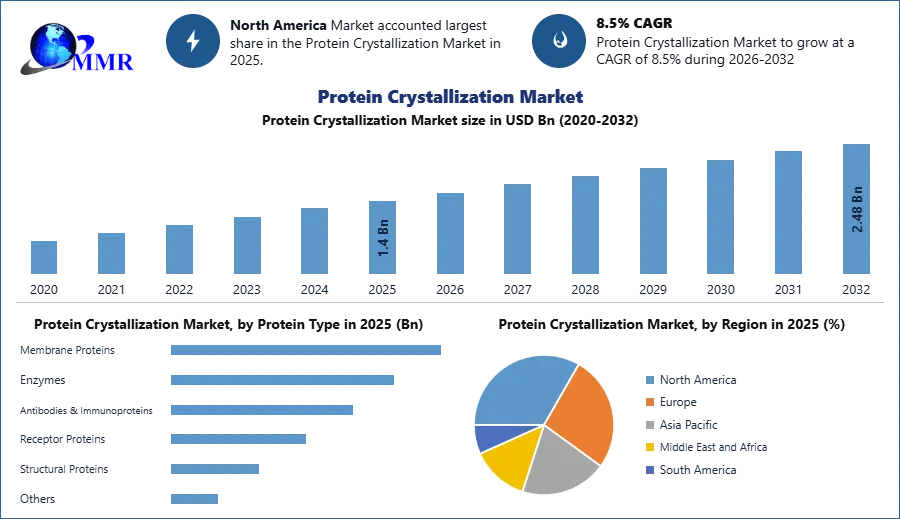 To know about the Research Methodology :- Request Free Sample Report
Protein Crystallization Market Dynamics:
Protein Crystallization is Crucial in the Drug Discovery and Development Process.
Protein crystallization significantly influences the advancement of biotherapeutics and the design of drug delivery systems, even though specific numeric data directly linking it to drug delivery may be limited. The global biotherapeutics market, encompassing protein-based drugs, has experienced consistent growth. According to an MMR report, the market is expected to reach a value of $170-180 billion by 2025, with ongoing growth, serving as a driving force for the protein crystallization market.
Numerous biopharmaceutical companies are heavily investing in the creation of innovative protein therapeutics, contributing significantly to the biotherapeutics market. Protein crystallization plays a pivotal role in this landscape by furnishing intricate structural details crucial for drug design and formulation. The key factor driving the protein crystallization market is Pharmacophore Modelling and Virtual Screening. Pharmacophore modeling can be used to understand the design and optimize small molecules or ligands that can bind to a target protein. The models represent a 3D arrangement of these features and make it easier to analyze complex data and complex structures of protein.
Challenges in Protein Crystallization Market
Proteins are naturally not compounds that can easily be crystallized. Proteins are inherently complex and sensitive molecules. Maintaining their stability during the crystallization process can be a challenging task in the protein crystallization market. Factors such as temperature, pH, protein concentration, and affect protein stability and lead to aggregation or denaturation which can disrupt the crystals. Thus, maintaining the right environment becomes a challenging task in the protein crystallization market. Obtaining sufficient quantities of pure and high-quality protein samples can be another challenge, especially for membrane proteins or protein complexes.
Protein purification processes may introduce contaminants or alter protein properties, affecting crystallization outcomes which need to be taken care of during the crystallization process. The crystals are preserved in cryopreservation and utmost care must be taken, to ensure that the crystal does not denature. Cryoprotectants and cooling methods can introduce additional stress to the crystals, leading to damage or ice artifacts which poses another challenge in Protein Crystallization Market.
Key Trends in the Protein Crystallization Market Include
1. Increasing investment in research and development of biopharmaceuticals
2. Growing focus on structural biology research
3. Advancements in continuous protein crystallization processes
4. Development of new cell-free protein crystallization (CFPC) methods
5. Increasing demand for high-quality protein crystals for various applications
6. Potential for growth in emerging markets such as Asia-Pacific and Latin America
7. Rising initiatives from key market players
8. Technological advancements in crystallization techniques such as cell-free protein crystallization and serial crystallography
Protein Crystallization Market Segment Analysis:
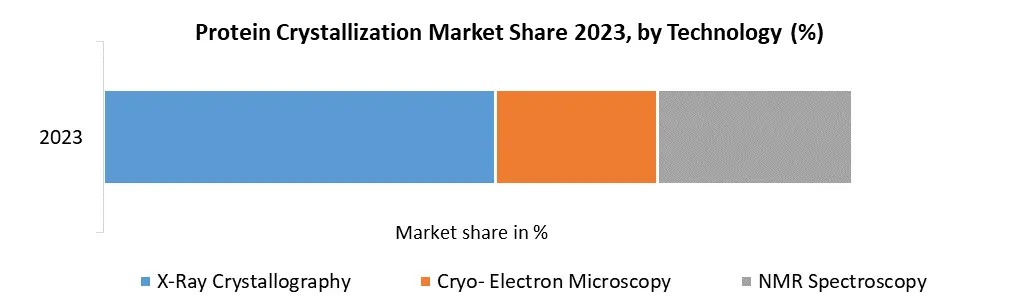
By Product, The protein crystallization market encompasses a diverse range of products, such as instruments, consumables, and software and services. The consumables segment dominates in terms of market share with approx. 65%, encompassing reagents, kits, screens, microplates, and other products that support various crystallization techniques. Meanwhile, the software and services segment is experiencing the highest CAGR during the forecast period, offering services like analysis, dispensing, design, and image viewing.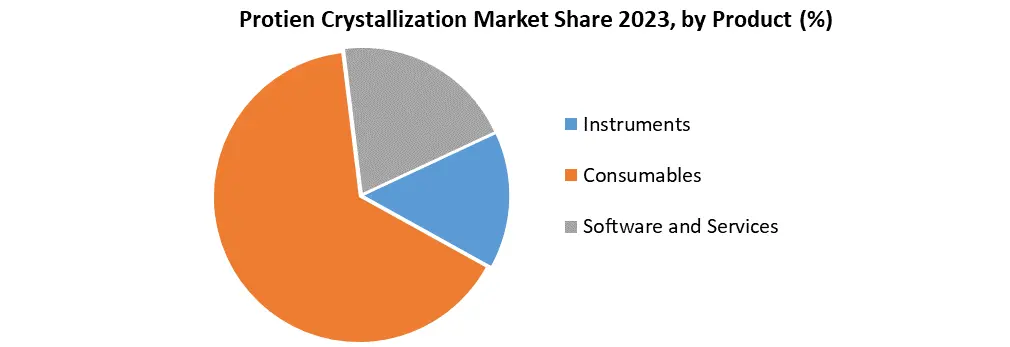 By Technology, X-ray Crystallography, Cryo-electron Microscopy, and NMR Spectroscopy are the 3 segments in the protein crystallization market. In 2023, X-ray crystallography Technology secured the largest market share at 52.3%, establishing itself as the preferred technology for determining the structure of biological molecules. X-ray Crystallography is simple, easy, and effective which makes it one of the most prominent technologies in use in the protein crystallization market. Cryo–electron microscope is forecasted to grow at a high CAGR of approx. 9-11%. This technology plays a pivotal role in providing detailed insights into the three-dimensional arrangement of proteins.
 By End-User, Pharmaceutical And Biotechnology Companies and Academic and Research Institutes are the two segments in the protein crystallization market. Pharma and Biotechnology companies have acquired a higher market share more than 60%, as funding and resource availability is seen more in Pharma companies than in research. Thus, pharmaceutical and biotechnology companies can produce high-quality protein crystals more quickly and easily than academic research institutions. This gives them a competitive advantage in the protein crystallization market and thus has a larger market share. The market is moderately competitive and consists of several major players, including Rigaku Corporation, Molecular Dimensions, QIAGEN, Bruker Corporation, Jena Bioscience GmbH, Formulatrix, MiTeGen LLC, Agilent Technologies, Thermo Fisher Scientific, ARIANNE Life Sciences AG, and Art Robbins Instruments.
Protein Crystallization Market Regional Insights:
North America Holds a Significant Revenue Share in the Protein Crystallization Market
North America is leading the protein crystallization market and accounts for 41.3% of the entire protein crystallization market. The US leads the market and has a huge influence on market dynamics. The US has been the market leader with almost 32% of the market share. The US government has invested intending to support the development of new protein therapies and diagnostics, as well as to improve the understanding of protein structure and function. The NIH's Small Business Innovation Research (SBIR) and Small Business Technology Transfer (STTR) programs are providing funding to small businesses to develop new protein crystallization technologies.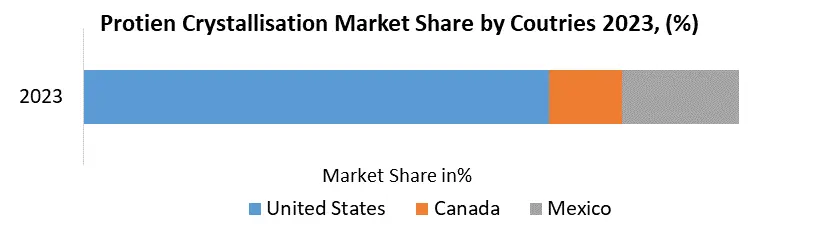 The Asia-Pacific region is emerging as a significant center for drug discovery and development, obvious by substantial investments in research and development and the prominent presence of numerous pharmaceutical and biotechnology companies. Leading countries in the Asia-Pacific region, including China, Japan, and India, are at the forefront of driving advancements in the life sciences. The protein crystallization market of the Asia-Pacific region is poised for robust growth, anticipating a Compound Annual Growth Rate (CAGR) of 8-9% during the forecast period.
Protein Crystallization Competitive Landscapes:
Bruker Acquires Electron Microscopy Company Nion on January 3, 2024
Bruker Corporation, a leading provider of scientific instruments and solutions, strengthened its position in the electron microscopy sector with the acquisition of Nion. Nion, being an electron microscopy company, likely brought advanced technology and expertise to complement Bruker's existing portfolio. This move by Bruker enhances its capabilities in the field of electron microscopy, enabling the company to offer a broader range of solutions to its customers. This acquisition enhances Bruker’s product offerings and technology portfolio in materials science research and provides the technology base for applications in electron diffraction crystallography.
On 20th Nov 2023, Molecular Dimensions introduce the Kryos Protein Crystallisation Screen
The cryoprotectants for this screen were selected based on our customer feedback and in-house trial, to optimize the crystallizing potential of each condition. Collaborates with research institutions and actively participates in supporting advancements in structural biology and related fields.
In June 2023, Iktos Initiated A Collaboration With Curreio, Inc.
A Japanese company renowned for its expertise in biomolecular structural analysis using cryo-electron microscopy and artificial intelligence in new drug design. This partnership aims to leverage Iktos' de novo generative design technology in conjunction with Curreio's cutting-edge cryo-EM platform. The synergistic efforts of these advanced technologies are anticipated to facilitate the efficient and cost-effective design of innovative preclinical drug candidates targeting an undisclosed molecular target.
Protein Crystallization Market Scope: Inquiry Before Buying
| Protein Crystallization Market | |||
|---|---|---|---|
| Report Coverage | Details | ||
| Base Year: | 2025 | Forecast Period: | 2026-2032 |
| Historical Data: | 2020 to 2025 | Market Size in 2025: | 1.4 USD Bn |
| Forecast Period 2026-2032 CAGR: | 8.5% | Market Size in 2032: | 2.48 USD Bn |
| Segments Covered: | by Crystallization Method | Vapor Diffusion Microbatch Crystallization Dialysis Free Interface Diffusion Microfluidic Crystallization Seeding Techniques |
|
| by Products | Instruments Consumables Software and Services |
||
| by Technology | X-ray Crystallography Cryo-electron Microscopy NMR Spectroscopy |
||
| by Protein Type | Membrane Proteins Enzymes Antibodies & Immunoproteins Receptor Proteins Structural Proteins Others |
||
| by End-user | Pharmaceutical and Biotechnology Companies Academic and Research Institutes |
||
Protein Crystallization Market by Region:
North America (United States, Canada, and Mexico)
Europe (UK, France, Germany, Italy, Spain, Sweden, Austria, and the Rest of Europe)
Asia Pacific (China, South Korea, Japan, India, Australia, Indonesia, Malaysia, Vietnam, Taiwan, Bangladesh, Pakistan, and the Rest of APAC)
Middle East and Africa (South Africa, GCC, Egypt, Nigeria, and the Rest of ME&A)
South America (Brazil, Argentina Rest of South America)
Protein Crystallization Market Key Players:
North America market Key Players
1. Bruker Corporation (United States)
2. Hampton Research (United States)
3. RayBiotech, Inc. (United States)
4. Fluidigm Corporation (United States)
5. Emerald BioStructures (United States)
6. MiTeGen (United States)
7. Formulatrix (United States)
8. Innovadyne Technologies, Inc. (United States)
9. Art Robbins Instruments (United States)
10. ProteinWave (United States)
11. Structure Probe, Inc. (United States)
12. Creative Biostructure (United States)
Europe market Key Players
1. CrystalMaker Software Ltd. (United Kingdom)
2. TTP Labtech (United Kingdom)
3. JPK Instruments AG (Germany)
4. MiTeGen (United States)
5. Microlytic (United Kingdom)
6. Molecular Dimensions (United Kingdom)
7. Jena Bioscience (Germany)
8. Qiagen (Germany)
9. Bruker AXS (Germany)
10. Attana AB (Sweden)
Asia Pacific Protein Crystallization Market Key Players
1. Rigaku Corporation (Japan)
2. Nextal Biotechnology (South Korea)