
Precision Fermentation Market Size: Industry Analysis and Forecast (2026-2032)
Overview
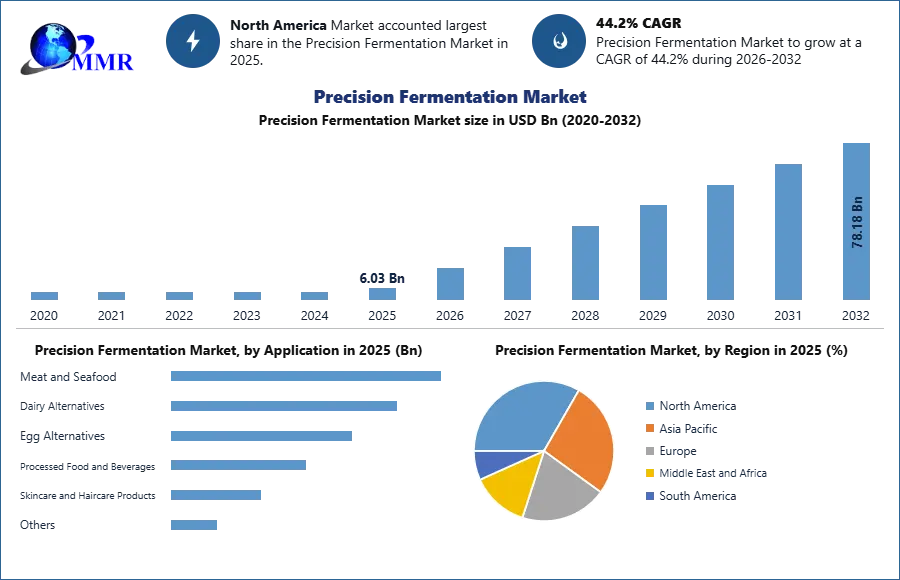
Precision Fermentation Market size was valued at USD 6.03 Bn. in 2025 and the total Precision Fermentation revenue is expected to grow by 44.2% from 2026 to 2032, reaching nearly USD 78.18 Bn.
Overview
The precision fermentation market refers to the application of fermentation technology to produce a wide range of products in a precise and controlled manner. Precision fermentation involves using microorganisms, such as bacteria or yeast, to produce specific proteins, enzymes, or other biochemicals through genetic engineering and fermentation processes. The precision fermentation market has experienced significant growth in the observed period. Advancements in genetic engineering, synthetic biology, and fermentation technologies have expanded the potential applications of precision fermentation, driving market expansion.
To know about the Research Methodology:- Request Free Sample Report
Precision fermentation finds applications in various industries, including food and beverages, pharmaceuticals, agriculture, cosmetics, and biofuels. It enables the production of proteins, enzymes, flavour compounds, nutraceuticals, and other high-value chemicals with improved functionality and efficiency. The precision fermentation market is witnessing the emergence of numerous startups and established companies specialising in this field. These companies are developing innovative fermentation platforms, genetic engineering tools, and proprietary microbial strains to cater to the growing demand for precision fermentation products. As precision fermentation involves genetic engineering, companies operating in this space must comply with regulations related to biotechnology, genetically modified organisms (GMOs), and food safety. Regulatory frameworks vary across countries, and ensuring compliance is crucial for market entry and acceptance.
The precision fermentation market is expected to continue its growth trajectory as advancements in biotechnology and fermentation technologies accelerate. The demand for sustainable and plant-based products, coupled with the need for efficient and eco-friendly manufacturing processes, will drive further adoption of precision fermentation across various industries.
Research Methodology
The research used primary and secondary data to thoroughly examine and validate all possible market factors. The market size for top-level markets and sub-segments is normalized and the impact of inflation, economic downturns, regulatory & policy changes, and other variables is factored into the market forecast. The bottom-up approach and multiple data triangulation methodologies are used to estimate the market size and forecasts. The percentage splits, market shares and breakdowns of the segments are derived based on weights assigned to each of the segments on their utilization rate and average sale price. The country-wise analysis of the overall market and its sub-segments are based on the percentage adoption or utilization of the given market Size in the respective region or country. Major players in the market are identified through secondary research based on indicators that include market revenue, price, services offered, advancements, mergers and acquisitions, and joint.
Extensive primary research was conducted to acquire information and verify and confirm the crucial numbers arrived at after comprehensive market engineering and calculations for market statistics, market size estimations, market forecasts, market breakdown, and data triangulation.
Precision Fermentation Market Dynamics
Market Drivers:
The increasing focus on sustainability and environmental concerns is driving the adoption of precision fermentation. The rising demand for alternative proteins is a significant driver of the precision fermentation market. For instance, companies like Impossible Foods and Beyond Meat are using precision fermentation to produce plant-based meat substitutes. Advances in genetic engineering techniques have opened up new possibilities in precision fermentation. For example, companies like Perfect Day and Clara Foods are using precision fermentation to produce animal-free dairy products. The precision fermentation market is fueled by technological advancements, such as CRISPR-Cas9, which enable precise modifications of microorganisms. Ongoing research and development in fermentation technologies are driving innovations in precision fermentation. For instance, Ginkgo Bioworks, a synthetic biology company, raised USD 1.4 billion in funding to expand its precision fermentation capabilities. These advancements allow for the production of complex molecules and bioactive compounds with improved efficiency.
Challenges:
Precision fermentation faces regulatory challenges due to the use of genetically modified organisms (GMOs) and biotechnology. Regulatory bodies, such as the U.S. Food and Drug Administration (FDA) and the European Food Safety Authority (EFSA), have regulations in place to ensure the safety and labelling of precision fermentation products. Consumer acceptance and perception of precision fermentation products, particularly in the food industry, can be a challenge. Education and awareness campaigns are necessary to inform consumers about the safety, sustainability, and benefits of precision fermentation products. Scaling up precision fermentation processes and optimizing production costs can be challenging.
Opportunities:
Precision fermentation offers opportunities for companies to diversify their product portfolios. For example, Biossance, a skincare brand, uses precision fermentation to produce squalane, a sustainable and cruelty-free alternative to traditional squalane derived from sharks. Precision fermentation enables the production of tailored products to meet specific consumer needs. For instance, Clara Foods is working on precision fermentation techniques to create custom-designed egg proteins for food manufacturers. Collaborations between industry players, research institutions, and academia can drive innovation and accelerate the commercialization of precision fermentation products. For example, DuPont Nutrition & Biosciences collaborated with the BioAg Alliance to develop precision fermentation-based microbial solutions for agriculture.
Restraints:
Intellectual property rights and patent disputes can pose restraints on the precision fermentation market. Companies need to navigate patent landscapes and protect their intellectual property to ensure market competitiveness. Precision fermentation may face technical challenges related to strain optimization, metabolic engineering, and scaling up processes.
Market Trends:
Precision fermentation is driving the development of plant-based meat and dairy alternatives. For example, Perfect Day uses precision fermentation to produce animal-free dairy proteins, while companies like Beyond Meat and Impossible Foods use precision fermentation to create plant-based meat products. Precision fermentation is playing a crucial role in the development of cell-based meat and seafood products. Companies like Memphis Meats and BlueNalu are utilizing precision fermentation to produce cultured meat and seafood, offering sustainable alternatives to traditional animal farming. Precision fermentation is used to produce functional ingredients and nutraceuticals.
Precision Fermentation Market Segmentation
By Microbe:
The Precision Fermentation Market is delineated by the type of microbes employed, featuring Yeast, Algae, Fungi, and Bacteria. Yeast dominated the Precision Fermentation Marketin 2025. It is widely recognised for its role in fermentation processes, is pivotal in the production of various bio-based products. Algae, known for its sustainability, contributes to precision fermentation in the creation of diverse products, including food supplements and biofuels. Fungi, with their versatile enzymatic capabilities, find applications in producing enzymes and flavor compounds. Bacteria, owing to their unique metabolic pathways, are integral to the precision fermentation landscape, particularly in the pharmaceutical and food industries.
By Ingredients:
The market is segmented by ingredients, encompassing Whey & Casein Protein, Egg White, Collagen Protein, Heme Protein, Enzymes, and Others. Whey & Casein Proteins play a crucial role in precision fermentation, serving as primary ingredients in protein-rich products. Egg White, with its protein content and functional properties, is employed in various applications, including plant-based alternatives. Collagen Protein, derived through precision fermentation, caters to the growing demand for skin care and nutraceutical products. Heme Protein, known for its meat-like characteristics, contributes to the development of plant-based meat alternatives. Enzymes, a key component, enable precise control of fermentation processes, while the 'Others' category encompasses diverse ingredients, showcasing the adaptability of precision fermentation across various product formulations.
By End Use:
The Precision Fermentation Market addresses distinct end-use sectors, primarily categorizing into Food & Beverages, Pharmaceuticals, and Cosmetics & Others. In the Food & Beverages sector, precision fermentation plays a pivotal role in the production of alternative proteins, flavors, and nutritional supplements. The Pharmaceutical industry benefits from precision fermentation in the production of therapeutic proteins, vaccines, and other bioactive compounds. The Cosmetics & Others category highlights the expanding applications of precision fermentation in the production of sustainable and bio-based ingredients for skincare, personal care, and industrial processes.
Precision Fermentation Market Regional Insights
North America:
North America held the largest Precision Fermentation Market in 2025 and is driven by the strong presence of key players and research institutions in the precision fermentation industry. The region has witnessed increasing demand for sustainable and alternative protein sources, leading to the adoption of precision fermentation for the production of plant-based meat substitutes and dairy alternatives. North America is home to notable companies such as Ginkgo Bioworks, Perfect Day, Zymergen, Pivot Bio, and Modern Meadow, which are actively involved in precision fermentation. These companies are at the forefront of innovation and investment in precision fermentation technologies.
Europe:
In Europe, the Precision Fermentation Market is influenced by stringent regulations promoting sustainable practices and reducing reliance on traditional agriculture and chemical industries. The region has seen a rising consumer awareness and demand for eco-friendly products, driving the adoption of precision fermentation. The market is expanding in areas such as pharmaceuticals and speciality chemicals. Key players in the European Precision Fermentation Market include Novozymes, BioNTech, AbSci, Genomatica, and Amyris. These companies are at the forefront of developing precision fermentation solutions and collaborating with traditional industries to drive sustainable practices.
Asia Pacific:
The region's growing population and increasing demand for food, fuel, and chemicals are driving the adoption of precision fermentation. Supportive government initiatives promoting biotechnology and sustainable practices further contribute to market growth. Precision fermentation is being increasingly utilized in the production of traditional Chinese medicines and nutraceuticals. Key players in the Asia Pacific region include Ouroboros, Zymtronix, Tianjin Institute of Industrial Biotechnology, and Billings. The region is experiencing the emergence of precision fermentation startups and the establishment of research institutes to foster innovation and collaboration.
South America:
South America is experiencing growth in the Precision Fermentation Market due to the expanding food and beverage industry and increasing consumer preference for sustainable and plant-based products. The region offers abundant agricultural resources, making it suitable for precision fermentation processes. Precision fermentation is being adopted for the production of specialty enzymes and bioactive compounds used in the cosmetics and pharmaceutical sectors. Prominent players in the region include Natura &Co, Biotecmar, and INBIOTECH, which are driving the development and application of precision fermentation solutions in Latin America.
Middle East & Africa:
The Middle East & Africa region is focusing on sustainable agriculture and the development of bio-based products, driving the Precision Fermentation Market. Governments are investing in biotechnology and research infrastructure to support innovation and sustainability. Precision fermentation is being utilized in the production of biofuels and sustainable agricultural solutions in the region. Key players in the Middle East & Africa include PlantArcBio, Lycored, and Red Sea Farms, which are contributing to the growth and development of precision fermentation technologies in the region.
Precision Fermentation Market Competitive Analysis
The Precision Fermentation Market is highly competitive, with numerous players striving to establish their presence and gain a competitive edge. The market is characterized by intense research and development activities, collaborations, partnerships, and strategic initiatives. Here is a detailed competitive analysis of the Precision Fermentation Market: The market consists of a mix of established companies, startups, and research institutions.
Research and development activities play a crucial role in the Precision Fermentation Market. Companies invest significant resources in developing and optimizing precision fermentation technologies, improving the efficiency of microorganisms, and exploring new applications. The focus is on enhancing productivity, scalability, and cost-effectiveness while maintaining product quality. Research collaborations between academic institutions, industry players, and government organizations further drive innovation in the market.
Companies in the Precision Fermentation Market often engage in strategic partnerships and collaborations to leverage complementary expertise, expand market reach, and accelerate product development.
Entering the Precision Fermentation Market can be challenging due to various factors. Intellectual property rights, patents, and regulatory requirements create barriers for new entrants. Established players with well-established customer relationships and strong distribution networks have a competitive advantage.
To stand out in the competitive landscape, companies differentiate themselves through product quality, performance, cost-effectiveness, and sustainability. Developing unique and patented technologies, offering a diverse product portfolio, and highlighting the benefits of precision fermentation over traditional methods are key strategies for market differentiation. Companies also emphasize their commitment to sustainability and environmental responsibility to attract environmentally conscious customers.
Precision Fermentation Industry Ecosystem
Recent Developments
12 June 2025 – Ginkgo Bioworks
Ginkgo Bioworks expanded its biotechnology platform partnerships to accelerate precision fermentation applications in sustainable food production. The company collaborated with alternative protein startups to optimize microbial strains and fermentation processes for producing high-value proteins and ingredients. These developments support the commercialization of animal-free dairy, egg, and seafood products produced through engineered microbes. The initiative strengthens Ginkgo’s position as a key technology provider enabling scalable precision fermentation manufacturing and supporting the growth of sustainable food innovation worldwide.
18 April 2025 – Perfect Day
Perfect Day continued expanding the commercialization of its animal-free dairy proteins produced through precision fermentation. The company focused on scaling production of beta-lactoglobulin, a whey protein created using engineered microorganisms instead of cows. These proteins are being used in dairy-alternative products such as ice cream, cream cheese, and nutritional beverages. The development reflects growing demand for sustainable protein ingredients and highlights the increasing adoption of precision fermentation technologies in food manufacturing and alternative dairy product innovation.
Precision Fermentation Market Scope: Inquire before buying
| Precision Fermentation Market | |||
|---|---|---|---|
| Report Coverage | Details | ||
| Base Year: | 2025 | Forecast Period: | 2026-2032 |
| Historical Data: | 2020 to 2025 | Market Size in 2025: | 6.03 USD Bn |
| Forecast Period 2026-2032 CAGR: | 44.2% | Market Size in 2032: | 78.18 USD Bn |
| Segments Covered: | by Microbe Type | Bacteria Yeast Algae Fungi |
|
| by Fermentation Type | Precision Biomass Traditional |
||
| by Ingredient | Egg Protein Heme Protein Collagen Protein Whey and Casein Protein Enzymes Others |
||
| by Application | Meat and Seafood Dairy Alternatives Egg Alternatives Processed Food and Beverages Skincare and Haircare Products Others |
||
| by End User | Food and Beverages Cosmetics Pharmaceuticals Others |
||
Precision Fermentation Market, by Region
North America (United States, Canada and Mexico)
Europe (UK, France, Germany, Italy, Spain, Sweden, Austria and Rest of Europe)
Asia Pacific (China, South Korea, Japan, India, Australia, Indonesia, Malaysia, Vietnam, Taiwan, Bangladesh, Pakistan and Rest of APAC)
Middle East and Africa (South Africa, GCC, Egypt, Nigeria and Rest of ME&A)
South America (Brazil, Argentina, Rest of South America)
Key players/Competitors profiles covered in the Precision Fermentation Market report in a strategic perspective
1. Ginkgo Bioworks - USA
2. Perfect Day - USA
3. Zymergen - USA
4. Pivot Bio - USA
5. Modern Meadow - USA
6. Novozymes - Denmark
7. BioNTech - Germany
8. AbSci -USA
9. Genomatica - USA
10. Amyris - USA
11. Ouroboros - USA
12. Zymtronix - USA
13. Tianjin Institute of Industrial Biotechnology - China
14. Biolingus - Germany
15. Natura &Co - Brazil
16. Biotecmar - Chile
17. INBIOTECH - Argentina
18. PlantArcBio - Israel
19. .Lycored - Israel
20. Red Sea Farms - Saudi Arabia
21. Clara Foods - USA
22. Nature's Fynd - USA
23. Biomilk - Rehovot, Israel
24. Motif FoodWorks - USA
25. Calysta - USA