
Power Inverter Market Size by Type, Application, End User, Region – Segment-Level Market Assessment, Growth Opportunity Analysis, Competitive Mapping & Forecast to 2032
Overview
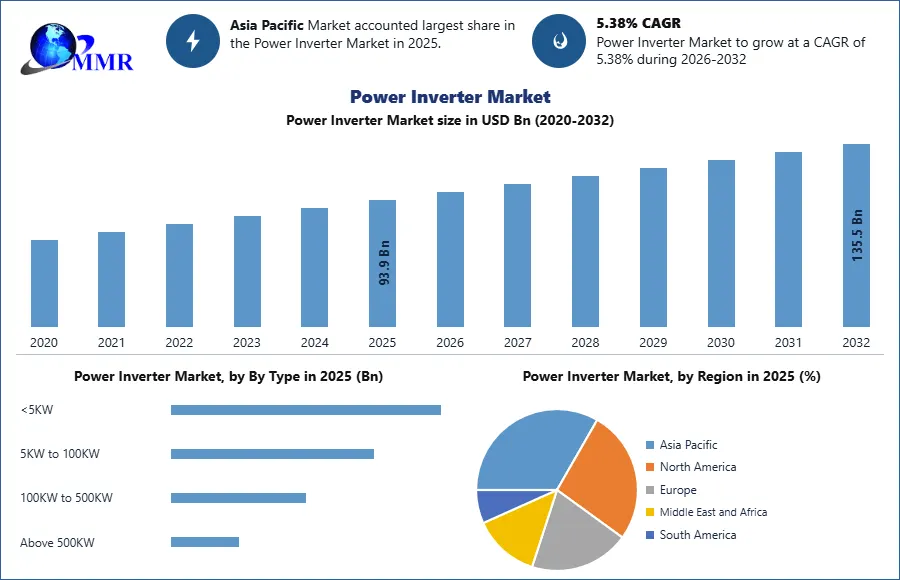
Power Inverter Market was valued at USD 93.9 Bn in 2025 and is expected to reach USD 135.5 Bn by 2032, growing at a CAGR of 5.38% during the forecast period.
A power inverter is an electric device that transforms direct current (DC) into alternating current (AC). Power inverters have a low running cost and do away with the hassle of change-over switches. The sales of power inverters are expected to rise as a result of the rising demand for electricity, and the widening gap between that need and supply across the world. With the capacity to convert Direct Current (DC) to Alternating Current (AC), which enables them to offer electricity similar to that found in households, power inverters are likely to experience a rise in demand. This makes it possible for electricity to flow smoothly into the intended device.
Analysis from MMR Analysts shows global inverter demand grew by more than 22% last year. The ten largest inverter suppliers including players like Huawei, Sungrow Power Supply, SMA, and Power Electronics accounted for more than 60% of the global share. Additionally, The power inverter industry is dominated by a number of companies, which has created intense price competition. Unorganized players typically charge far cheaper rates for their goods, organized players typically charge higher prices. The higher product quality and superior after-sales services provided by the more well-known brands are responsible for the price disparity. It is also getting harder for players to maintain constant product prices due to increased raw material costs and inflationary pressures.
 To know about the Research Methodology :- Request Free Sample Report
Power Inverter Market Analyst Insights
Although the inverter market is currently comparatively steady, it is still important to keep an eye out for emerging trends in cutting-edge electronics, such as Internet of Things-based and smart grid-connected devices. Inverters would be seen as more than just power suppliers as a result, giving the business a unique and futuristic perspective.
The market for power inverter systems has made R&D one of its primary focus areas. It has become crucial for companies to invest in R&D operations so as for the industry to flourish generally and for players to be able to boost profitability. Greater revenue would result from making power inverter equipment less sized, particularly from the SME and SOHO groups. Companies can also test with doorstep delivery services and e-commerce business models.
Superior after-sales services are another growing industry. A large service center network will assist businesses in establishing credibility and securing repeat business, enhancing their goodwill and brand value. Additionally, platforms for cross-selling low-voltage items across dispersed channels are expected to increase their exposure among end users and boost sales.
Power Inverter Market Dynamics:
Economic Growth and Rising Disposable Income:
Individuals all over the world are now willing to spend more on products like power inverters, which enhance their lifestyles and provide comfort, thanks to continuous economic growth and rising disposable incomes. For instance, in comparison to other nations, the United States has the greatest average disposable income. In 2022, the average gross disposable income in the US is $54,854. Most people these days rely on electronic devices and appliances due to growing urbanization and rising electrification rates. This has led to a significant requirement for a constant power supply increasing the need for power inverters as a replacement backup solution for power outages. Additionally, as they don't emit carbon dioxide and eliminate the need for gasoline, which is needed to drive generators, they are noiseless and environmentally beneficial.
| Exact Date | Company | Development | Impact |
|---|---|---|---|
| 13 January 2026 | Sungrow | Launched the SG465HX, a next-generation 465kW utility string inverter, featuring advanced PV-GFM Grid-Forming capabilities at WFES 2026. | The high-power density solution addresses grid stability challenges and is expected to accelerate project delivery timelines by up to one month. |
| 04 February 2026 | Enphase Energy, Inc. | Commenced high-volume shipments of its first Gallium Nitride (GaN) based microinverters produced in the United States. | The use of GaN technology improves power conversion efficiency while helping commercial projects qualify for Domestic Content Bonus Tax Credits. |
| 08 September 2025 | SMA Solar Technology AG | Signed a strategic memorandum of understanding with Create Energy to manufacture Sunny Highpower PEAK3 string inverters in Portland, Tennessee. | This collaboration localizes the supply chain for the U.S. market, targeting a 2 MW per block performance for utility-scale solar installations. |
| 06 October 2025 | Enphase Energy, Inc. | Officially launched the IQ Battery 5P with FlexPhase technology in India to support three-phase residential solar applications. | The system provides reliable backup power for high-load homes and expands the company's footprint in emerging rooftop PV segments. |
| 11 December 2025 | FIMER | Announced plans to localize the manufacturing of 100 kW string inverters at its Bangalore facility by mid-2026. | The move strengthens regional production capacity and supports the "Make in India" initiative within the commercial and industrial (C&I) sector. |
| 15 January 2026 | Huawei | Unveiled intelligent PV trends for 2026, focusing on increasing the power density of PV inverters by over 40% through high-frequency material innovations. | These advancements aim to drive down the Levelized Cost of Electricity (LCOE) and improve the safety and reliability of high-voltage power systems. |
Growing Dependence on Electronics Devices to boost the Power Inverter Market Growth
Thanks to the higher electrification rate and rapid urbanization, the majority of the population is now dependent on electronic appliances and devices like air conditioners, televisions, computers, and refrigerators. The demand for Power Inverters to deliver a consistent electricity supply and a trustworthy backup option in the case of a power loss has significantly increased as a result. In addition, inverters are far quieter than conventional generators and emit no emissions when producing energy. Manufacturers in the industry are spending money on R&D to create new technologies that would enhance the capabilities of these inverters. As a result, these factors are driving the power inverter market growth across the world.
Government-led Incentives and Programs and a Rising number of Solar Installations are Driving the Power Inverter Market Growth
The increase in solar PV installations for various uses around the world is being attributed to quick advancements in the solar energy sector in terms of power generation and utilization. According to MMR analysis, the world's solar fleet's capacity doubled in just three years from 2018 to reach one Terawatt in April 2022. Over half of the 302 GW of renewable energy capacity installed globally in 2021 had come from solar, the renewable energy with the fastest rate of growth. Major markets with the biggest number of new solar installations in 2019 and 2020 are China, the US, Germany, and Japan. Growing solar energy markets, such as those in China, Brazil, and India, are expected to offer prospects for market growth. Additionally, a surge in the installation of PV power plants globally is generating significant growth possibilities for the power inverter market.
To promote the use of inverters in industrial applications, several programs and efforts are launched by the governments of various nations. For instance, as part of the 14th Five-year Plan (2021-2025), China's national energy agency (NEA) established a target in 2020 for renewable energy to account for more than 50% of all installed capacity by 2025. Solar energy and energy storage are appealing options for commercial end users thanks to the Self-generation Incentive Program (SGIP - California only) and US tax benefits. Incentives offered by various governments of different countries to encourage residential and small commercial PV installations have fueled the market growth for power inverter systems.
Increasing Demand for Electric Vehicles Driving the Power Inverter Market Growth
Automotive applications, such as EV power trains, use inverters. These inverters transform the DC electricity extracted from a vehicle's batteries into usable AC. Motors and onboard electronic systems of vehicles are operated by use of vehicle inverters. Some of the leading producers and suppliers of car inverters include Continental (Germany), Samlex Europe (Netherlands), Delphi Technologies (UK), Toyota Industries (Japan), Sensata Technologies, and BESTEK (US). The demand for electronic systems in vehicles has increased as a result of technological developments in the automotive sector and the emergence of trends like connected, autonomous, and electrified vehicles. The electric car market has grown very well across the globe as a result of the emphasis placed on various environmental regulations. The market for vehicle inverters is expected to be driven by consumers' rising preference for electric automobiles. The reduction in EV costs, the extension of vehicle range, and improvements in charging infrastructure brought about by ambitious EV objectives set by governments of various nations and the necessary policy backing have increased demand for EVs globally. These factors are expected to create huge opportunities for the providers of vehicle inverters during the forecast period.
Power Inverter Market Segment Analysis:
In 2025, the <5KW and 5KW to 100KW segments dominate the Power Inverter Market due to their extensive use in residential solar systems, small commercial setups, and backup power applications. These segments benefit from rising rooftop solar installations and increasing demand for energy-efficient solutions in households and small businesses. The 100KW to 500KW segment is widely used in commercial and mid-scale industrial applications, supporting energy management and operational continuity. Meanwhile, the Above 500KW segment is gaining traction in large-scale industrial operations, utility-scale renewable projects, and infrastructure developments, where high-capacity power conversion is essential.
Based on application, Solar PVs hold the largest market share in 2025, driven by the global shift toward renewable energy and supportive government policies promoting solar installations. Uninterruptible Power Supply (UPS) systems also show strong demand, particularly in data centers, healthcare, and IT infrastructure where power reliability is critical. Electric Vehicles/Hybrid Electric Vehicles (EVs/HEVs) represent the fastest-growing segment due to rapid electrification in the automotive sector. Motor Drives maintain steady demand across industrial automation, while Wind Turbines contribute significantly in renewable-heavy regions. Rail Traction and other applications exhibit moderate growth, supported by infrastructure modernization.
In 2025, the Utility segment leads the market, driven by large-scale renewable energy projects and grid infrastructure development. Industrial end users represent a significant share due to the need for efficient power management and uninterrupted operations across manufacturing facilities. The Commercial segment is expanding steadily with increased adoption of solar energy and backup systems in offices, malls, and institutions. The Residential segment continues to grow due to rising awareness of energy independence, frequent power outages in developing regions, and increasing adoption of rooftop solar solutions.
Based on technology, String Inverters dominate the market in 2025 due to their cost-effectiveness, ease of installation, and widespread use in residential and commercial solar systems. Central Inverters are preferred in utility-scale solar projects owing to their high capacity and efficiency in large installations. Micro Inverters are gaining popularity in residential applications due to their ability to optimize individual panel performance and enhance system reliability. Hybrid Inverters are the fastest-growing segment, driven by increasing demand for energy storage integration and smart energy management systems.
| Power Inverter Market | |||
|---|---|---|---|
| Report Coverage | Details | ||
| Base Year: | 2025 | Forecast Period: | 2026-2032 |
| Historical Data: | 2020 to 2025 | Market Size in 2025: | 93.9 USD Bn |
| Forecast Period 2026-2032 CAGR: | 5.38% | Market Size in 2032: | 135.5 USD Bn |
| Segments Covered: | By Type | <5KW 5KW to 100KW 100KW to 500KW Above 500KW |
|
| By Application | Motor Drives Uninterruptible Power Supply (UPS) Rail Traction Wind Turbines Electric Vehicles/Hybrid Electric Vehicles (EVs/HEVs) Solar PVs Others |
||
| By End User | Utility Residential Commercial Industrial |
||
| By Technology | Central Inverters String Inverters Micro Inverters Hybrid Inverters |
||
Power Inverter Market Regional Insights:
Power Inverter Market Competitive Landscape
The market players are working on different development strategies to take advantage of the current market opportunities and get an advantage over rivals. The need for green electricity generation has increased, which has increased investment in solar and wind power facilities and increased demand for power inverters. Key developments in the global power inverter market trends have been attained through the use of additional growth strategies, including the increase of storage capacities, acquisitions, partnerships, and research & innovation in the optimization and improvement of the efficiency and reliability of power inverters.
Some of the major players in the power inverter market are Huawei Technologies Co., Ltd, ABB, Omron Corporation, ABB Ltd, Tabuchi Electric Co., Ltd, Toshiba Mitsubishi-Electric Industrial Systems Corporation (TMEIC), Advanced Energy Industries, Inc, Enphase Energy, Inc, Schneider Electric SE, SolarEdge Technologies Inc, Sungrow Power Supply, Power Electronics, Fronius International, Altenergy Power System, and Darfon Electronics.
Power Inverter Market Scope: Inquiry Before Buying
Key Players /Competitor Profiles Covered in the Power Inverter Market Report from a Strategic Perspective
- Huawei Technologies Co., Ltd
- Sungrow Power Supply Co., Ltd
- ABB Ltd
- Schneider Electric SE
- Eaton Corporation plc
- Omron Corporation
- Delta Electronics Inc
- Enphase Energy Inc
- SolarEdge Technologies Inc
- Fronius International GmbH
- Power Electronics S.L.
- Toshiba Mitsubishi-Electric Industrial Systems Corporation
- Advanced Energy Industries Inc
- KACO New Energy GmbH
- SMA Solar Technology AG
- Siemens AG
- Mitsubishi Electric Corporation
- Ginlong Technologies (Solis)
- GoodWe Power Supply Technology Co., Ltd
- Growatt New Energy Technology Co., Ltd
- Altenergy Power System Inc
- Darfon Electronics Corp
- Continental AG
- Valeo SA
- Yaskawa Solectria Solar