Portable Air Conditioner Market - Industry Structure Evaluation, Demand Drivers Analysis, Regional Growth Analysis and Identification, Competitive Positioning Review & Global Market Size Forecast to 2032

4.3%
CAGR (2026-2032)
2.88 USD Bn.
Forecast Market Size
329
Report Pages
131
Market Tables

Overview

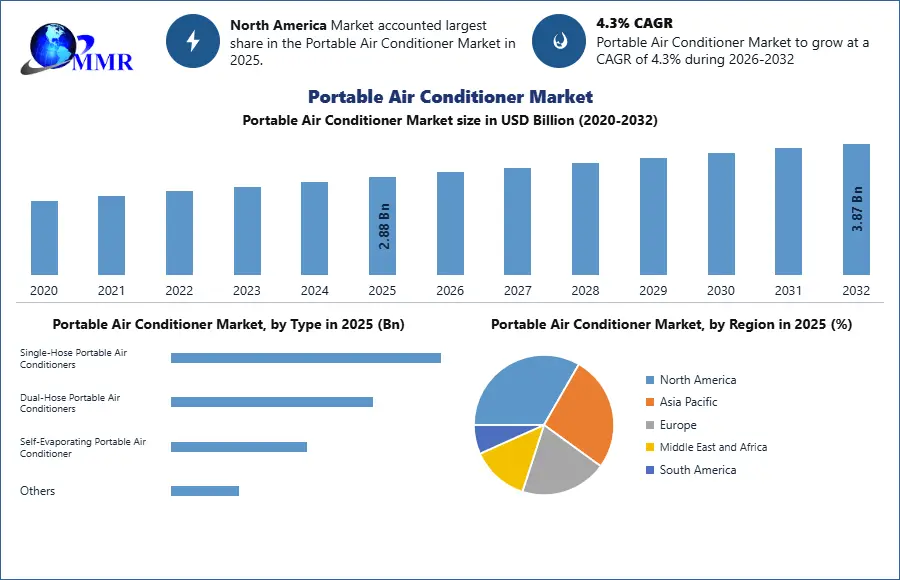
Portable Air Conditioner Market size was valued at USD 2.88 Bn. in 2025 and the total Global Portable Air Conditioner Market revenue is expected to grow at a CAGR of 4.3% from 2026 to 2032, reaching nearly USD 3.87 Bn. by 2032.

Portable Air Conditioner Market Overview

A portable air conditioner (PAC) is a compact, standalone unit designed specifically for cooling individual rooms.

Portable Air Conditioner Market has been growing by increasing demand from residential users, small scale commercial setups, temporary workspaces and hospitality sectors. Rising focus on indoor air comfort, energy efficient climate control in confined environments and compliance with environmental standards is accelerating market adoption. Expanding application of portable air conditioners across apartments, rental spaces, mobile homes, data centers, emergency cooling situations and recreational vehicles is reshaping traditional HVAC usage and supporting the rise of flexible, user-friendly cooling systems. Technological advancements like dual hose designs, inverter compressor integration, smart thermostat connectivity and AI assisted climate regulation are enhancing efficiency, portability and real time responsiveness of portable air conditioner production and utilization. Market is supported by increasingly stringent energy efficiency regulations, growing emphasis on personalized comfort solutions, rising demand for smart and connected appliances and global shift toward compact, sustainable and automated living spaces. North America dominated Portable Air Conditioner Market, driven by region’s variable climatic conditions, high adoption of smart home appliances, early integration of IoT based cooling technologies and significant investments in home improvement and temporary infrastructure solutions. Key players in Portable Air Conditioner Market include LG Electronics, Honeywell International Inc., and Haier Group Corporation. Companies are focusing on expanding energy rated product portfolios, innovating with compact and low noise cooling solutions, forming strategic partnerships with home appliance distributors and smart ecosystem providers and investing in scalable, eco-friendly and region-specific air conditioning technologies to meet increasing global demand.
Portable Air Conditioner MarketTo know about the Research Methodology :- Request Free Sample Report

Report covers portable air conditioner market dynamics, structure by analyzing market segments and projecting portable air conditioner market size. Clear representation of competitive analysis of key players By Type, price, financial position, product portfolio, growth strategies and regional presence in portable air conditioner market.

Portable Air Conditioner Market Dynamics

Changing Climate Patterns to Fuel the Demand in Portable Air Conditioners Market

The portable air conditioner market has experienced significant growth recently due to various key factors. One of the primary drivers is the escalating demand for flexible and convenient cooling solutions in both residential and commercial spaces. Portable air conditioners provide the advantage of mobility, allowing users to cool specific rooms without the need for permanent installations or duct work. The rising temperatures and the growing unpredictability of climate patterns have sparked a substantial surge in the need for efficient cooling solutions. Thus, portable air conditioners have experienced a remarkable rise in popularity and widespread adoption. These portable units provide a convenient and effective way to combat heat waves and maintain indoor temperatures.

Limitations in Cooling Capacity to Restrain the Portable Air Conditioner Market Growth

Portable air conditioners have limited cooling capacity ranging from 5000 BTUs to 20000 BTUs. Portable air conditioner offers mobility and flexibility, and their cooling capabilities are better suited for smaller spaces or individual rooms. In commercial settings like offices, retail stores, or restaurants that require substantial cooling, portable air conditioners may not provide sufficient cooling power. Larger spaces with multiple workstations or high foot traffic demand more robust cooling systems, such as fixed air conditioning systems with higher capacities and centralized distribution.

In the same way, in industrial settings with heat-generating machinery, portable air conditioners may fall short of meeting the cooling demands. Industrial applications often require specialized cooling solutions like rooftop units or chilled water systems. Consequently, fixed air conditioning systems that offer greater cooling capacities and centralized distribution are preferred in these large commercial and industrial environments. To overcome these limitations, businesses turn to more robust and centralized cooling solutions that can effectively meet the specific cooling demands of their spaces.

Advancements In Portable Air Conditioner Technology to Boost Opportunities for Market Expansion

Advancements in portable air conditioner technology, including the integration of smart features, IoT connectivity, and improved energy efficiency, present significant market opportunities for expansion. These advancements revolutionize the functionality and performance of portable air conditioners, enhancing their appeal to consumers and driving market growth. Adding smart features to portable air conditioners enhances user control and convenience. Users can easily monitor and adjust their cooling units through smartphone apps or voice commands, creating a customized cooling experience. This aligns with the increasing popularity of smart home devices, improving overall user satisfaction. Additionally, integrating IoT connectivity allows seamless integration with other smart home systems, broadening the market potential and attracting consumers.

Energy-efficient portable air conditioners offer a market opportunity as consumers highly value their ability to reduce electricity bills and contribute to environmental sustainability by lowering carbon emissions. Manufacturers can seize this demand by developing and promoting energy-efficient options in the portable air conditioner industry. The integration of smart features, IoT connectivity, and improved energy efficiency presents significant market opportunities for manufacturers.

Portable Air Conditioner Market Segment Analysis

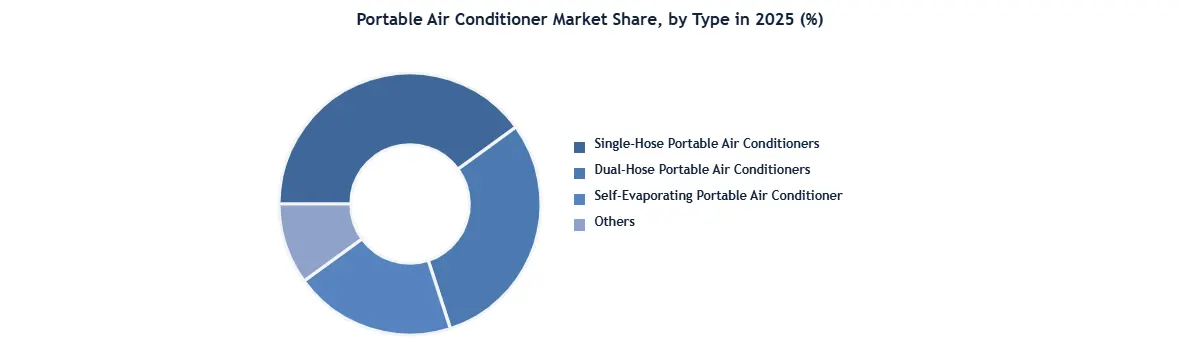
Based on Type, Single-hose portable AC is expected to grow at a fast rate during the forecast period as it is easy to install and is ideal for small spaces, but it can be less efficient due to negative air pressure. Dual-hose portable AC dominated the market in 2025, as it has separate intake and exhaust hoses, offers better cooling performance and is suitable for larger rooms. Window portable AC units are a growing segment in the portable air conditioner market, provide powerful cooling but require proper installation and are more suitable for semi-permanent use. Evaporative portable ACs are energy-efficient and work well in dry climates, but they are best for personal use rather than cooling entire rooms. Personal portable ACs are compact and portable, ideal for small areas or when on the go, but they may not be effective in larger rooms.
Based on End User, commercial users dominated the market in 2025 and is expected to continue their dominance by 2032, as portable air conditioners play an important role in maintaining the temperature of machine-occupied rooms in various locations such as supermarkets, hypermarkets, residential buildings, and commercial complexes. Urbanization and the adoption of automation in major industries have contributed to the growing demand for smart and advanced portable air conditioners in commercial buildings.

Portable Air Conditioner Market Regional Analysis

North America dominated the Portable Air Conditioner Market in 2025  and is expected to have significant growth during 2025-2032. Climate change, energy conservation awareness, the need for flexible cooling options and the presence of major key players in the region are contributing factors to the market growth in these regions. As a result of technological advancements including smart features and eco-friendly refrigerants, portable air conditioners have become increasingly popular in these markets. Innovative portable cooling solutions with enhanced functionality are becoming increasingly popular in these regions because consumers seek convenience, mobility, and energy efficiency.

Portable Air Conditioner Market Competitive Landscape

Report covers 25 key players in Portable Air Conditioner Market, including a strategic mix of market leaders, market challengers, market followers and niche players. Market leaders such as LG Electronics and Haier Group Corporation dominate global supply and innovation in mobile cooling technologies. Companies lead in energy efficient product lines, smart climate control systems and extensive global distribution networks. Advancements in dual hose systems, inverter compressor technologies and smart home integrations position them at forefront of performance driven and environmentally compliant cooling solutions. Market challengers like Honeywell International Inc. and De Longhi S.p.A. are investing significantly in intelligent air management solutions, increasing their global presence across residential, hospitality, commercial and temporary infrastructure applications. Players are enhancing their product portfolio with low noise, compact and region specific portable air conditioners, aligned with trends in connected appliances, energy efficiency regulations and personalized comfort technologies. Market followers such as Whirlpool Corporation and Midea Group offer reliable, cost effective portable air conditioners targeting steady demand across small to mid sized homes, offices and rental markets. Companies’ regional customization, modular product formats and adaptability to varying climate conditions support mid scale and budget conscious customer segments. Niche players including NewAir and Black+Decker focus on applications such as portable air conditioners for dormitories, RVs and compact urban apartments. Companies leverage innovation in space saving designs, eco friendly refrigerants and targeted cooling performance to meet specific customer needs in dynamic and space constrained environments.

Portable Air Conditioner Market Trends

• Rising Demand for Smart and Connected Acs
Integration of Wi-Fi, smartphone control, voice assistants (like Alexa and Google Assistant) is becoming standard and consumers prefer units with remote diagnostics, scheduling, and climate optimization.

• Focus on Energy Efficiency and Green Refrigerants
Growing adoption of energy-efficient models using eco-friendly refrigerants like R290 (propane) and R32. Compliance with stricter energy regulations in the U.S., EU and APAC driving innovation.

• Compact, Multi-functional Designs
Portable ACs now often include dehumidifier, air purifier and heater functions in a single unit and demand for all in one climate control solutions in small living spaces is rising.

Portable Air Conditioner Market Recent Developments

• On May 9, 2025, De’Longhi (UK) De’Longhi released the Pinguino PACEX130CST Smart Portable Air Conditioner in the UK. This 13,000 BTU unit augmented with Wi Fi connectivity through the De’Longhi Comfort app, voice assistant support (Alexa & Google) and eco-friendly R290 refrigerant offers high energy efficiency (A++), Real Feel humidity management, quiet operation modes and washable allergen filters.

• On May 8, 2025, LG Electronics (Singapore) LG expanded its 2025 air care and cooling lineup featuring DUALCOOL AI Air in Singapore, alongside PuriCare purification and dehumidifier units all centralized under the ThinQ smart app ecosystem.

• In February 29, 2024, Honeywell International Inc. (USA) Honeywell announced that Hisense will integrate Honeywell’s low GWP refrigerant Solstice 454B in their residential air conditioners, supporting the shift toward environmentally friendly refrigerants in portable and home AC units.

Portable Air Conditioner Market Scope: Inquire before buying

Portable Air Conditioner Market
Report Coverage Details
Base Year: 2025 Forecast Period: 2026-2032
Historical Data: 2020 to 2025 Market Size in 2025: 2.88 USD Billion
Forecast Period 2026-2032 CAGR: 4.3% Market Size in 2032: 3.87 USD Billion
Segments Covered: by Type Single-Hose Portable Air Conditioners
Dual-Hose Portable Air Conditioners
Self-Evaporating Portable Air Conditioner
Others
by Capacity 5000-10000 BTUs
11000-15000BTUs
16000-20000 BTUs
21000 & Above BTUs
by Energy Efficiency Energy Star Certified
Non-Energy Star Certified
by Distribution Channel Supermarket & Hypermarket
Specialty Stores
Departmental Stores
E-commerce
Others
by End-User Residential
Commercial
Medical & Hospitals
Corporate Businesses
Others
Industrial

Portable Air Conditioner Market, by Region

North America (United States, Canada, and Mexico)
Europe (UK, France, Germany, Italy, Spain, Sweden, Austria, and the Rest of Europe)
Asia Pacific (China, South Korea, Japan, India, Australia, ASEAN, Indonesia, Philippines, Malaysia, Vietnam, Thailand, ASEAN, Rest of Asia Pacific)
Middle East & Africa (South Africa, GCC, Nigeria, Rest of ME&A)
South America (Brazil, Argentina, Rest of South America)

Portable Air Conditioner Market Key Players

  1. Carrier
  2. LG Electronics Inc.
  3. Haier Group Corporation
  4. Daikin Industries Ltd.
  5. Panasonic Corporation
  6. Whirlpool Corporation
  7. Gree Electric Appliances Inc.
  8. Honeywell International Inc.
  9. De’Longhi S.p.A.
  10. Black+Decker
  11. Toshiba Corporation
  12. TCL Technology Group Corporation
  13. Hisense Co., Ltd.
  14. Whynter LLC
  15. Midea Group Co., Ltd.
  16. Olimpia Splendid S.p.A.
  17. Blue Star Limited
  18. Hitachi Global Life Solutions, Inc.
  19. GE Appliances
  20. Frigidaire
  21. Royal Sovereign International, Inc.
  22. NewAir
  23. Qlima
  24. Trotec GmbH
  25. Sharp Corporation
  26. Mitsubishi Electric Corporation
  27. Toyotomi Co., Ltd
  28. Shanghai Glomro Industrial Co., Ltd
  29. Oceanaire Inc.
  30. Friedrich Air Conditioning Co.
    Others

Table of Contents

1. Portable Air Conditioner Market : Market Introduction 1.1. Executive Summary 1.2. Market Size (2025) & Forecast (2026-2032) 1.3. Market Size (Value in USD Million and Volume in 000'Units) and Market Share (%) - By Segments, Regions and Country 2. Competitive Landscape 2.1. MMR Competition Matrix 2.2. Competitive Analysis of key players 2.3. Key Players Benchmarking 2.3.1 Company Name 2.3.2 Headquarter 2.3.3 Business Portfolio 2.3.4 Technology & Innovation Capability 2.3.5 Patent Portfolio Strength 2.3.6 Production Capacity (000'Units) 2.3.7 Customer Engagement Metrics 2.3.8 Distribution Network Strength 2.3.9 Sustainability Initiatives 2.3.10 Certifications 2.3.11 Revenue (2025) 2.3.12 Market Share (%)2025 2.3.13 Growth Rate(%) 2.3.14 R&D Investment 2.3.15 Geographical Presence 2.4. Market Structure 2.4.1 Market Leaders 2.4.2 Market Followers 2.4.3 Emerging Players 2.5 Market Share Distribution of Leading Portable Air Conditioner Manufacturers (2025) 2.5.1 Market share analysis of top global portable AC manufacturers by revenue and unit shipments (2025) 2.5.2 Vendor revenue benchmarking across single-hose, dual-hose, and smart portable AC segments 2.5.3 Production capacity and shipment scale comparison of global appliance brands vs niche portable AC players 2.5.4 Top 10 vendor share analysis across residential, light commercial, and rental applications 2.5.5 Vendor concentration ratio (Top 5 vs Top 10 players) 2.5.6 Regional market share distribution: North America, Europe, Asia-Pacific, MEA 2.5.7 Historical market share shifts driven by rising urbanization, climate change, and seasonal demand spikes 2.6 Strategic Partnerships & OEM Ecosystem Collaborations 2.6.1 Collaborations between portable AC manufacturers and component suppliers (compressors, refrigerants, electronics) 2.6.2 Strategic alliances with retail chains and e-commerce platforms 2.6.3 Partnerships with smart home ecosystem providers and IoT platforms 2.6.4 Joint development agreements for energy-efficient and compact cooling solutions 2.6.5 Collaborations with sustainability and energy-efficiency certification bodies 2.6.6 Supply agreements with large retail distributors and online marketplaces 2.6.7 OEM partnerships for private label and white-label portable AC manufacturing 2.7 Technology Leadership & Performance Benchmarking 2.7.1 Innovation benchmarking in energy-efficient and low-noise portable AC technologies 2.7.2 Adoption of eco-friendly refrigerants and inverter-based systems 2.7.3 Cooling performance benchmarking (BTU capacity, energy efficiency ratio - EER) across leading brands 2.7.4 Manufacturing innovation including compact design and modular assembly 2.7.5 R&D investment trends among leading portable AC manufacturers 2.7.6 Technology leadership comparison across residential and light commercial applications 2.7.7 Smart features benchmarking including Wi-Fi control, app integration, and voice assistants 2.8 Product Portfolio Positioning & Application Coverage Mapping 2.8.1 Product portfolio comparison: single-hose, dual-hose, smart portable ACs, and evaporative coolers 2.8.2 End-use application coverage across residential, small offices, retail spaces, and temporary cooling needs 2.8.3 Specialization in compact, mobility-focused, and easy-installation cooling solutions 2.8.4 Vendor positioning in premium vs budget portable AC segments 2.8.5 Product differentiation: standard vs feature-rich smart and energy-efficient models 2.8.6 Component and design innovation comparison (compressors, airflow systems, refrigerants) 2.8.7 White-space opportunities in ultra-compact, silent, and eco-friendly portable AC solutions 2.9 Competitive Differentiation & Strategic Positioning 2.9.1 Global appliance brands vs specialized portable AC manufacturers comparison 2.9.2 Differentiation through portability, energy efficiency, and smart connectivity features 2.9.3 Competitive positioning based on pricing, cooling capacity, and brand reliability 2.9.4 Specialization across residential, rental, and small commercial cooling segments 2.9.5 Strategic positioning through design innovation and user convenience features 2.9.6 Differentiation via distribution network strength (offline retail vs e-commerce dominance) 2.9.7 Long-term competitive strategies focused on smart, energy-efficient, and sustainable cooling solutions 3. Portable Air Conditioner Market Dynamics 3.1. Portable Air Conditioner Market Trends 3.2. Portable Air Conditioner Market Dynamics 3.2.1 Drivers 3.2.2 Restraints 3.2.3 Opportunities 3.2.4 Challenges 3.3. PORTER’s Five Forces Analysis 3.4. PESTLE Analysis 4. Global Portable Air Conditioner Supply Chain Ecosystem Analysis 4.1 End-to-end supply chain mapping: raw materials → manufacturing → distribution → end-users 4.2 Key stakeholders: OEMs, component suppliers, distributors, service providers 4.3 Geographic distribution of production facilities and assembly units 4.4 Supplier concentration and dependency risk analysis 4.5 Role of third-party logistics (3PL) in portable AC distribution 4.6 Digitalization and traceability adoption in supply chains 4.7 Inventory management practices and lead time benchmarking 5. Raw Material Sourcing & Logistics Assessment 5.1 Global procurement of compressors, refrigerants, plastics, and electronic components 5.2 Supplier country concentration and geopolitical risk mapping 5.3 Transportation modes and cost benchmarking for raw materials 5.4 Import dependency and cross-border logistics efficiency 5.5 Impact of tariffs, duties, and regulations on sourcing costs 5.6 Lead-time analysis from raw material sourcing to manufacturing 5.7 Strategic sourcing opportunities for risk mitigation 6. Manufacturing & Intra-Region Logistics Analysis 6.1 Portable AC production hub mapping (Asia-Pacific, North America, Europe) 6.2 Factory-to-distributor logistics efficiency 6.3 Transportation cost breakdown by unit size and type 6.4 Inventory turnover and capacity utilization benchmarking 6.5 Impact of automation and modular assembly on internal logistics 6.6 Bottleneck analysis in production and distribution flows 6.7 Factory-to-distributor Logistics Efficiency 6.8 Just-in-time vs bulk manufacturing strategies 7 Portable vs Conventional Air Conditioner Analysis 7.1 Comparative assessment of portable ACs vs window, split, and central AC systems 7.2 Cooling performance benchmarking (BTU, EER, and energy efficiency) 7.3 Installation complexity, portability, and space requirements comparison 7.4 Cost analysis: upfront price, maintenance, and operational electricity consumption 7.5 Noise levels, airflow coverage, and comfort performance evaluation 7.6 Adoption trends across residential, commercial, and rental segments 7.7 Consumer preference insights and use-case suitability analysis 7.8 Market opportunities for hybrid or complementary AC solutions 8. Distribution Network & Transportation Intelligence 8.1 Global distribution network mapping for residential and commercial portable ACs 8.2 Regional hubs, transshipment points, and last-mile delivery strategies 8.3 Logistics cost per unit benchmarking by region 8.4 Fleet optimization and multi-modal transport adoption 8.5 Handling and packaging requirements for portable AC units 8.6 Shipping lead times and delivery performance metrics 8.7 Distributor vs direct sales logistics performance 9. Inventory, Warehousing & Fulfillment Analysis 9.1 Warehouse network mapping by region 9.2 Inventory holding patterns and optimization strategies 9.3 Storage requirements for seasonal demand products 9.4 Turnaround time benchmarking for order fulfillment 9.5 Distribution center performance metrics 9.6 Multi-location inventory allocation and efficiency analysis 9.7 Impact of warehouse automation on logistics costs 10. Logistics Cost & Efficiency Benchmarking 10.1 Total landed cost calculation per unit (raw materials + production + distribution) 10.2 Transportation cost benchmarking: sea vs air vs road 10.3 Cost-to-service analysis for logistics providers 10.4 Logistics efficiency comparison among major OEMs 10.5 Impact of fuel and energy costs on logistics 10.6 Benchmarking reverse logistics for returns and replacements 10.7 Cost reduction opportunities in supply chain and logistics 11. Portable Air Conditioner Production & Manufacturing Capacity Analysis (2025) 11.1 Regional production output trends across major manufacturing hubs 11.2 Manufacturing capacity utilization rates among leading players 11.3 Production cost breakdown (components, refrigerants, labor, logistics) 11.4 Geographic concentration of manufacturing facilities by country 11.5 OEM vs branded manufacturing share assessment 11.6 Impact of automation and smart assembly lines on production efficiency 11.7 Inventory cycles and supply stability analysis 12. Demand Analysis & Consumption Patterns (2020–2025) 12.1 Historical demand trends by region and end-use segment 12.2 Household penetration and per-capita AC ownership trends 12.3 Replacement cycle and seasonal demand patterns 12.4 Demand spikes during extreme weather conditions 12.5 Demand elasticity relative to pricing and energy efficiency 12.6 Premium vs budget segment adoption trends 12.7 Urban vs semi-urban demand growth analysis 13. Consumer & Buyer Behavior Analysis 13.1 Key purchase drivers: portability, price, cooling capacity, energy efficiency 13.2 Brand loyalty vs price sensitivity among consumers 13.3 Influence of compact living spaces and rental housing trends 13.4 Decision-making factors in residential vs small commercial buyers 13.5 After-sales service importance and repeat purchase behavior 13.6 Online reviews and digital influence on purchase decisions 13.7 Role of warranties and product features in buying decisions 14. Pricing Structure & Margin Benchmarking 2025 14.1 Historical price trends by capacity and features (2020–2025) 14.2 Price variance across regions and distribution channels 14.3 Cost-to-retail markup analysis 14.4 Private label vs branded pricing strategies 14.5 Impact of component cost fluctuations on pricing 14.6 Seasonal discounts and promotional pricing trends 14.7 Margin distribution across manufacturers, retailers, and e-commerce 15. Technology & Innovation Analysis 15.1 Adoption of energy-efficient and inverter-based portable ACs 15.2 Smart portable ACs with IoT and app-based controls 15.3 Compact and noise-reduction technology advancements 15.4 Refrigerant innovation (low-GWP refrigerants) 15.5 Design innovation for mobility and ease of installation 15.6 Integration with smart home ecosystems 15.7 R&D investment benchmarking across leading players 16. Digital Transformation & E-Commerce Penetration 16.1 Online sales penetration for portable AC units 16.2 Marketplace vs brand-owned platform performance 16.3 Conversion rates and digital campaign ROI 16.4 Role of e-commerce during seasonal peaks 16.5 AI-driven recommendation engines and personalization 16.7 Digital buyer journey and decision-making process 17. Import–Export & Trade Flow Analysis (2025) 17.1 Global portable AC import/export volume trends 17.2 Major exporting countries and trade dependency analysis 17.3 Regional trade flows and cross-border logistics mapping 17.4 Tariff, customs, and regulatory impact on trade 17.5 Price competitiveness of imported vs domestic products 17.6 Impact of energy efficiency standards on trade 17.7 Emerging markets import growth potential 18. Retail, Project & Installation Channel Performance 18.1 Distribution of sales by channel: retail, e-commerce, distributors 18.2 E-commerce penetration and seasonal sales spikes 18.3 Retail store performance and in-store conversion rates 18.4 Service and installation support network coverage 18.5 Delivery timelines and fulfillment efficiency 18.6 Role of retail chains and electronics stores 18.7 Multi-channel sales integration strategies 19. Value Chain Analysis 19.1 End-to-end value chain mapping: components → assembly → distribution → end-user 19.2 Key stakeholders: OEMs, suppliers, retailers, service providers 19.3 Value contribution (%) across each stage 19.4 Regional value chain differences 19.5 Emerging trends in value creation and integration 19.6 Digitalization in value chain operations 19.7 Bottleneck identification across the value chain 20. Installation, Maintenance & Service Intelligence 20.1 Average installation and setup cost benchmarking 20.2 Maintenance cost trends for portable AC units 20.3 Product lifespan and replacement cycle analysis 20.4 Energy efficiency maintenance practices 20.5 Warranty coverage and service contracts 20.6 OEM vs third-party service providers comparison 20.7 Customer satisfaction and service quality trends 21. Market Risk Assessment & Strategic Resilience 21.1 Supply chain disruption risks 21.2 Impact of energy costs and environmental regulations 21.3 Seasonal demand dependency risks 21.4 Competition from split and window ACs 21.5 Regulatory compliance risks 21.6 Currency fluctuation and import dependency risks 21.7 Risk mitigation strategies by leading players 22. Investment Landscape & Strategic Opportunities 22.1 ROI analysis for new entrants vs established brands 22.2 M&A and strategic partnership trends 22.3 Capital investment in manufacturing and R&D 22.4 Market attractiveness by region and segment 22.5 Private equity and venture capital trends 22.6 Expansion opportunities in emerging markets 22.7 Future investment hotspots in smart and energy-efficient ACs 23. Sustainability, ESG & Green Technology Adoption 23.1 Adoption of eco-friendly refrigerants 23.2 Carbon footprint and lifecycle analysis 23.3 Energy efficiency benchmarking across brands 23.4 Circular economy and recycling initiatives 23.5 Sustainable packaging practices 23.6 ESG reporting trends among manufacturers 23.7 Government regulations on energy-efficient appliances 24. Regulatory Landscape By Region 24.1 Overview of global AC regulations 24.2 Energy efficiency standards (BEE, EU, US DOE) 24.3 Environmental regulations and refrigerant compliance 24.4 Safety and certification standards 24.5 Import-export compliance requirements 24.6 Regional regulatory comparison 24.7 Future regulatory outlook 25. Global Portable Air Conditioner Market : Market size and Forecast by Segmentation (by Value USD Million and Volume in 000'Units) (2025-2032) 25.1. Global Portable Air Conditioner Market Size and Forecast, By Type 25.1.1 Single-Hose Portable Air Conditioners 25.1.2 Dual-Hose Portable Air Conditioners 25.1.3 Self-Evaporating Portable Air Conditioner 25.1.4 Others 25.2. Global Portable Air Conditioner Market Size and Forecast, By Capacity 5000-10000 BTUs 11000-15000BTUs 16000-20000 BTUs 21000 & Above BTUs 25.3. Global Portable Air Conditioner Market Size and Forecast, By Energy Efficiency 25.3.1 Energy Star Certified 25.3.2 Non-Energy Star Certified 25.4. Global Portable Air Conditioner Market Size and Forecast, By Distribution Channel 25.4.1 Supermarket & Hypermarket 25.4.2 Specialty Stores 25.4.3 Departmental Stores 25.4.4 E-commerce 25.4.5 Others 25.5. Global Portable Air Conditioner Market Size and Forecast, By End-User 25.5.1 Residential 25.5.2 Commercial 25.5.3 Medical & Hospitals 25.5.4 Corporate Businesses 25.5.5 Others 25.5.6 Industrial 25.6. Global Portable Air Conditioner Market Size and Forecast, by Region 25.6.1 North America 25.6.2 United States 25.6.3 Mexico 25.6.4 Canada 25.6.5 Europe 25.6.6 United Kingdom 25.6.7 France 25.6.8 Germany 25.6.9 Italy 25.6.10 Spain 25.6.11 Sweden 25.6.12 Russia 25.6.13 Rest of Europe 25.6.14 Asia Pacific 25.6.15 China 25.6.16 South Korea 25.6.17 Japan 25.6.18 India 25.6.19 Australia 25.6.20 Indonesia 25.6.21 Philippines 25.6.22 Malaysia 25.6.23 Vietnam 25.6.24 Thailand 25.6.25 Rest of Asia Pacific 25.6.26 Middle East and Africa 25.6.27 South Africa 25.6.28 GCC 25.6.29 Turkey 25.6.30 Egypt 25.6.31 Nigeria 25.6.32 Rest of ME&A 25.6.33 South America 25.6.34 Brazil 25.6.35 Argentina 25.6.36 Colombia 25.6.37 Chile 25.6.38 Rest Of South America 26. Company Profile: Key Players 26.01.Carrier 26.01.1 Overview 26.01.2 Business Portfolio 26.01.3 Financial Overview 26.01.4 SWOT Analysis 26.01.5 Strategic Analysis 26.01.6 Recent Developments 26.02.LG Electronics Inc. 26.03.Haier Group Corporation 26.04.Daikin Industries Ltd. 26.05.Panasonic Corporation 26.06.Whirlpool Corporation 26.07.Gree Electric Appliances Inc. 26.08.Honeywell International Inc. 26.09.De’Longhi S.p.A. 26.10.Black+Decker 26.11.Toshiba Corporation 26.12.TCL Technology Group Corporation 26.13.Hisense Co., Ltd. 26.14.Whynter LLC 26.15.Midea Group Co., Ltd. 26.16.Olimpia Splendid S.p.A. 26.17.Blue Star Limited 26.18.Hitachi Global Life Solutions, Inc. 26.19.GE Appliances 26.20.Frigidaire 26.21.Royal Sovereign International, Inc. 26.22.NewAir 26.23.Qlima 26.24.Trotec GmbH 26.25.Sharp Corporation 26.26.Mitsubishi Electric Corporation 26.27.Toyotomi Co., Ltd 26.28.Shanghai Glomro Industrial Co., Ltd 26.29.Oceanaire Inc. 26.30.Friedrich Air Conditioning Co. 26.30.1 Others 27. Key Findings 28. Strategic Moves & Industry Outlook 29. Global Portable Air Conditioner Market : Research Methodology

Custom Market Research Services

We Will Customise The Research For You, In Case The Report Listed Above Does Not Meet With Your Requirements