
Porous Silicon Substrates Market Size – Industry Structure Evaluation, Demand Drivers Analysis, Regional Growth Analysis and Identification, Competitive Positioning Review & Global Market Size Forecast to 2032
Overview
Porous Silicon Substrates Market was valued at USD 5.87 Bn in 2024, and total global Porous Silicon Substrates Market revenue is expected to grow at a CAGR of 7.1% from 2025 to 2032, reaching nearly USD 10.16 Bn. Rising demand for advanced drug delivery systems.
Porous Silicon Substrates Market Overview
Porous silicon substrates are silicon-based materials modified to contain interconnected pores through electrochemical etching. This process dissolves silicon atoms, creating a porous structure. The substrate's porosity is adjustable by controlling parameters like current density, etching time, and electrolyte composition, resulting in a variety of pore sizes and shapes.. Their increased surface area enables enhanced interactions with molecules, benefiting chemical and biological sensing devices. The porous silicon substrates market is experiencing robust growth across industries due to their unique properties. With high surface area-to-volume ratio and tunable pore structures, these substrates are used in sensing, drug delivery, energy storage, and optoelectronics.
They enhance detection in chemical and biological sensors, enable controlled drug release, and improve energy storage in batteries. The tunable optical properties find application in photonic devices and LEDs. Ongoing R&D and collaborations drive market growth, supported by demand for portable devices, healthcare advancements, and energy efficiency. However, challenges like complex fabrication and scalability need resolution. Overall, the porous silicon substrates market offers significant growth potential, fostering innovation and opportunities for market players.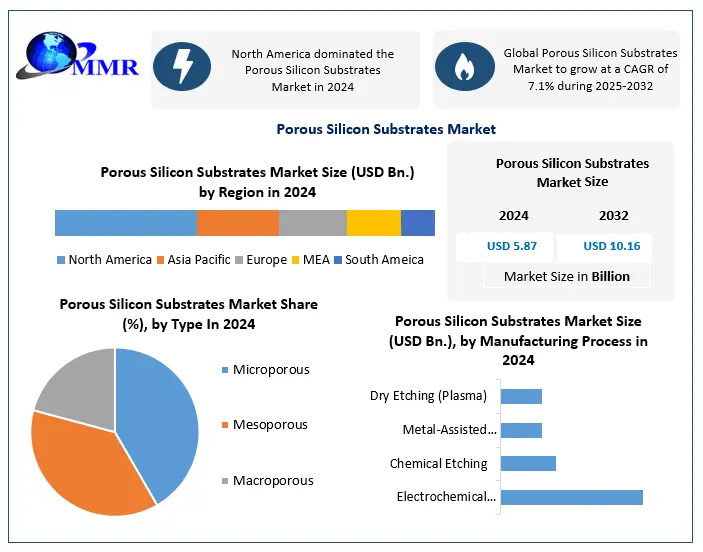 To know about the Research Methodology :- Request Free Sample Report
Porous Silicon Substrates Market Research Methodology
Primary and secondary data sources were used to gather information for the study of the Porous Silicon Substrates Market. The study has considered the potential market influencing aspects and these were assessed to produce results. The market prediction has taken into account the effects of numerous economic factors including inflation, regulatory changes, and policy changes, as well as the market size for top-level markets and sub-segments.
The bottom-up methodology and various data triangulation approaches was considered to assess the market size and forecast. The weights allocated to each segment based on their utilisation rate and average sale price will be used to determine the percentage splits, market shares, and segment breakdowns. Based on the proportion of the provided market size that is adopted or used in each area or nation, the total market and its sub-segments was analysed by country.
The major competitors in the market were also analysed based on metrics such as market revenue, pricing, services supplied, developments, mergers and acquisitions, and joint ventures. Market engineering and calculations for market statistics, market size estimations, market projections, market breakdown, and data triangulation were considered to gather information and verify and confirm the key figures. In order to provide decision-makers with a clear future vision of the industry, external and internal elements that are predicted to have an impact on the firm positively or adversely will be evaluated. By examining market segments and estimating market size, the research can also help in understanding the dynamic structure of the industry. The study will be an investor's guide thanks to the clear depiction of competition analysis of important companies by pricing, financial condition, development plans, and regional presence in the market.
Porous Silicon Substrates Market Dynamics
Major Drivers
The rising need for small and effective gadgets: The escalating requirement for small and effective gadgets in various sectors is a major factor fueling the market of porous silicon substrates. These substrates provide a favorable ratio of surface area to volume, which proves advantageous for miniature devices that demand improved performance. As industries aim for tinier, quicker, and more efficient gadgets, the distinctive characteristics of porous silicon substrates, like their expansive surface area and adjustable pore arrangements, make them immensely appealing.
Advancements in Healthcare Technologies: The healthcare sector presents significant opportunities for porous silicon substrates. These substrates find applications in drug delivery systems, where they provide controlled release and targeted delivery of pharmaceuticals. The ability to tune the pore structures allows for precise control over drug release rates. Additionally, porous silicon substrates are utilized in biosensors for chemical and biological sensing, enabling improved detection capabilities. As healthcare technologies continue to advance, the demand for porous silicon substrates in drug delivery, sensing, and diagnostics is expected to rise, driving the market growth
Opportunities
Energy Storage and Applications in Renewable Energy: The energy storage industry offers a promising opportunity for porous silicon foundations. With their extensive surface area, these foundations enhance the efficiency of batteries and supercapacitors, enabling better energy storage and increased power densities. As the need for sustainable energy solutions and renewable energy sources continues to grow, porous silicon foundations can significantly contribute to the development of more effective and eco-friendly energy systems.
Emerging Fields of Optoelectronics and Photonics: The adjustable optical properties of porous silicon foundations make them highly suitable for implementation in optoelectronics and photonics. These foundations can be utilized to manufacture photonic devices and LEDs, where the precise manipulation of light at the nanoscale is crucial. The ability to control the size and structure of the pores in porous silicon allows for the fine-tuning of its optical properties, creating opportunities for advancements in optical communications, displays, and other emerging fields. With the increasing demand for high-performance optoelectronic devices, the porous silicon foundation market in this sector is expected to witness significant growth.
Major Restraints
Limited Standardization and Industry Guidelines: The porous silicon substrates market currently lacks standardized processes and guidelines for fabrication, characterization, and quality control. The absence of established standards can lead to variations in the properties and performance of porous silicon substrates, making it challenging for end-users to compare and select suitable products. The lack of industry guidelines also hampers the adoption of porous silicon substrates in regulated industries, where standardized procedures and quality assurance are crucial.
Competition from Alternative Materials: Porous silicon substrates face competition from alternative materials with similar or comparable properties. Other materials such as porous alumina, carbon nanotubes, and various polymers offer unique characteristics and functionalities that may overlap with those of porous silicon. The availability of alternative materials presents a restraint for the market, as end-users may consider different options based on factors such as cost, performance, and ease of fabrication. To remain competitive, the porous silicon substrates market needs to continuously demonstrate its distinct advantages and explore new applications where it outperforms alternative materials.
Challenges
Complex Fabrication Processes: The fabrication of porous silicon substrates involves electrochemical etching, which can be a complex and delicate process.Achieving the desired pore structures necessitates accurate monitoring of variables like current density, etching duration, and electrolyte composition. Ensuring uniformity and consistency in the manufacturing procedure can prove to be difficult, particularly when producing on a large scale. The intricate nature of production processes presents a hurdle in terms of scalability and cost-efficiency, impeding the widespread market acceptance of porous silicon substrates.
Scalability and Cost-Effectiveness: While porous silicon substrates offer unique properties and potential applications, scalability remains a challenge. The fabrication techniques used for producing porous silicon substrates may be time-consuming and expensive, limiting their large-scale production. The cost associated with the materials, equipment, and specialized expertise required for fabrication can be a restraint for market growth. Achieving cost-effectiveness and scalability in the production of porous silicon substrates is crucial to make them more accessible and viable for various industries.
Porous Silicon Substrates Market trends
Porous silicon substrates are experiencing increasing adoption in biomedical and healthcare applications due to their unique properties. The ability to control pore size and surface chemistry makes them suitable for drug delivery systems, biosensors, tissue engineering scaffolds, and diagnostic devices. As the demand for personalized medicine and advanced healthcare technologies grows, the use of porous silicon substrates in biomedical applications is expected to rise.
Integration with emerging technologies is another significant trend in the porous silicon substrates market. Their large surface area allows for efficient adsorption and detection of environmental pollutants, making them valuable for environmental monitoring and water purification. Additionally, their potential for energy storage and conversion contributes to renewable energy solutions. As sustainability becomes increasingly important, the use of porous silicon substrates in environmental applications is expected to gain traction.
Research and development efforts are focused on advancing fabrication techniques and materials for porous silicon substrates. This includes exploring new etching methods, surface modifications, and functionalization techniques to improve control, stability, and reproducibility of pore structures. The development of novel materials, such as hybrid or composite structures, is also being pursued to enhance properties and expand application possibilities. These advancements in fabrication techniques and materials are anticipated to drive market growth, enabling the realization of new functionalities and performance enhancements.
Porous Silicon Substrates Market Segment Analysis
Based on Type, Microporous Silicon Substrates are the most widely used and are expected to witness the fastest growth during the forecast period. These substrates are characterized by extremely small pore sizes (less than 2 nm), resulting in a very high surface area and free volume. These features make them highly suitable for applications requiring precision and sensitivity, such as photonics, sensors, and energy storage. Their ability to enhance surface reactivity and absorption capacity makes them especially valuable in advanced nanotechnology and electronics applications.
Mesoporous Silicon Substrates have pore sizes between those of microporous and macroporous types, typically in the range of 2–50 nm. This intermediate structure offers a balance between surface area and pore volume, making mesoporous substrates ideal for catalysis, gas sensing, and drug delivery. Their tunable pore structures are advantageous in chemical reactions where moderate diffusion and controlled transport properties are needed. Macroporous Silicon Substrates possess the largest pore sizes, generally exceeding 50 nm. These substrates are particularly suited for applications requiring high gas permeability, such as hydrogen storage, filtration systems, and microfluidic devices. Due to their open structure, they allow efficient mass transport, making them appropriate for energy and environmental technologies where fluid or gas flow is critical.
Based on End-Users, the porous silicon substrates market is driven by strong demand across key sectors, with consumer electronics expected to hold the largest share due to its use in LCDs, LEDs, and solar cells, where porous silicon enhances light efficiency and thermal management. The healthcare segment is also witnessing rapid growth, fueled by its applications in drug delivery, biosensing, and tissue engineering, thanks to the material's biocompatibility and high surface area. Additionally, the energy sector plays a crucial role, utilizing porous silicon in fuel cells, batteries, and photovoltaic devices to improve energy storage and conversion efficiency. As industries move toward miniaturization, efficiency, and sustainability, the adoption of porous silicon substrates is projected to accelerate across these applications.
Segment by Application
Photonics: The photonics segment is the largest market for porous silicon substrates. Porous silicon substrates are used in a variety of photonic applications, such as light emitting diodes, solar cells, and optical filters.
Sensors: The sensors segment is another important market for porous silicon substrates. Porous silicon substrates are used in a variety of sensor applications, such as gas sensors, bio sensors, and chemical sensors.
Energy Storage: The energy storage segment is also a growing market for porous silicon substrates. Porous silicon substrates are used in a variety of energy storage applications, such as fuel cells, batteries, and supercapacitors.
Segment by Manufacturing Process
Electrochemical Anodization: Electrochemical anodization is the most common manufacturing process for porous silicon substrates. This process is relatively simple and inexpensive, which makes it ideal for mass production.
Chemical Etching: Chemical etching is another manufacturing process for porous silicon substrates. This process is more complex and expensive than electrochemical anodization, but it can produce porous silicon substrates with more uniform pore sizes.
Porous Silicon Substrates Market Regional Insights
Asia Pacific:
The Asia Pacific region is poised to experience substantial expansion in the market for porous silicon substrates. Countries such as China, Japan, South Korea, and India are experiencing notable progress as a result of their significant influence in the domains of technology, medical science, and power. This area proudly showcases a prosperous market for consumer electronics, offering potential for incorporating permeable silicon substrates into diverse electronic apparatus.
Moreover, the growing emphasis on healthcare and the increasing demand for advanced medical technologies contribute to the market's progression in this region. Additionally, the well-established semiconductor industry and ongoing research and development endeavors further bolster the advancement and commercialization of porous silicon substrates in Asia Pacific.
Europe:
Europe is another key region in the porous silicon substrates market. Germany, France, and the United Kingdom have a strong presence in industries such as automotive, healthcare, and electronics, which drive the demand for porous silicon substrates. The region has a well-developed healthcare sector, with a focus on advanced medical devices and drug delivery systems, providing opportunities for the adoption of porous silicon substrates. The European Union's emphasis on sustainability and environmental initiatives also promotes the use of porous silicon substrates in environmental monitoring and renewable energy applications. Additionally, ongoing collaborations between research institutions, universities, and industry players in Europe contribute to advancements in porous silicon technology
North America:
North America holds a significant share in the porous silicon substrates market. Porous silicon substrates are highly sought after in the United States and Canada due to the prominent presence of major chip manufacturers, healthcare companies, and technology-driven industries. These countries have a strong dedication to research and development, which has resulted in notable advancements in fabrication techniques and materials used for porous silicon. In North America, the healthcare sector places great importance on personalized medicine and advanced medical devices, thereby providing significant opportunities for the widespread adoption of porous silicon substrates. Additionally, the region's growing need for energy-efficient solutions and the well-established renewable energy sector further contribute to the expansion of the market for porous silicon substrates.
LAMEA (Latin America, Middle East, and Africa):
The porous silicon substrates industry in Latin America and the LAMEA regions is experiencing consistent growth. Countries such as Brazil, Mexico, South Africa, and the United Arab Emirates are observing a rise in industrialization and technological progress, which is fueling the demand for porous silicon substrates. The healthcare sector in these regions is also expanding, opening up possibilities for the implementation of porous silicon substrates in medical applications. Furthermore, the increasing emphasis on renewable energy sources and environmental monitoring contributes to the market's expansion in these areas. Despite being relatively smaller compared to other regions, the Latin America and LAMEA market holds promising growth prospects due to ongoing economic development and increased investments in key industries. Overall, the porous silicon substrates market demonstrates significant growth potential across various regions, driven by factors such as industrial advancements, healthcare progress, sustainability initiatives, and research and development endeavors.
Porous Silicon Substrates Market Competitive Landscape
The market for hygienic pumps and valves is fiercely competitive and fragmented, with numerous manufacturers and suppliers operating both globally and regionally. Key players in this industry encompass Alfa Laval AB, SPX FLOW, Xylem Inc., Flowserve Corporation, and ITT Inc. These companies provide a wide array of Porous Silicon Substrates Market for various sectors including food and beverages, pharmaceuticals, and biotechnology. Alfa Laval AB is globally recognized as a frontrunner, renowned for its inventive and sustainable solutions that comply with rigorous hygiene standards. SPX FLOW focuses on advancements in technology and customer-centric solutions tailored to meet industry-specific needs. Xylem Inc. specializes in water-related technology solutions offering Porous Silicon Substrates Market for water and wastewater treatment purposes.
Flowserve Corporation offers versatile fluid control solutions, including Porous Silicon Substrates Market suitable for diverse industries. ITT Inc. is acknowledged for its extensive range of sanitary solutions, emphasizing product innovation and customer satisfaction. Other notable competitors in the market additionally include Grundfos Holding A/S, Pentair plc, KSB SE & Co. KGaA, Burkert Fluid Control Systems, and Watts Water Technologies, Inc. These companies engage in competition based on factors such as the quality, performance, reliability, pricing, and customer service of their products. Strategic initiatives such as mergers, acquisitions, partnerships, and collaborations are common as companies strive to expand their product range, geographical reach, and market dominance.
Porous Silicon Substrates Market Scope: Inquire Before Buying
| Porous Silicon Substrates Market | |||
|---|---|---|---|
| Report Coverage | Details | ||
| Base Year: | 2024 | Forecast Period: | 2025-2032 |
| Historical Data: | 2019 to 2024 | Market Size in 2024: | USD 5.87 Bn. |
| Forecast Period 2025 to 2032 CAGR: | 7.1% | Market Size in 2032: | USD 10.16 Bn. |
| Segments Covered: | by Type | Microporous Mesoporous Macroporous |
|
| by Manufacturing Process | Electrochemical Anodization Chemical Etching Metal-Assisted Chemical Etching (MACE) Dry Etching (Plasma) |
||
| by Application | Photonics Sensors Energy Storage Biomedical Applications Microelectronics |
||
| by End-User | Consumer Electronics Healthcare Energy Industrial Semiconductors |
||
Porous Silicon Substrates Market, by Region
North America (United States, Canada and Mexico)
Europe (UK, France, Germany, Italy, Spain, Sweden, Austria, Turkey, Russia and Rest of Europe)
Asia Pacific (China, India, Japan, South Korea, Australia, ASEAN and Rest of APAC)
Middle East and Africa (South Africa, GCC, Egypt, Nigeria and Rest of ME&A)
South America (Brazil, Argentina, Columbia and Rest of South America)
Major Competitors
1. EV Group
2. Nanosys Inc.
3. Porifera Inc.
4. MacDermid Alpha Electronics Solutions
5. Micron Technology Inc.
6. Siltronic AG
7. Shin-Etsu Chemical Co., Ltd.
8. Qromis, Inc.
9. Brewer Science In
10. Silicon Sense Pvt. Ltd.
11. Axcelis Technologies, Inc.
12. Nanowave Technologies Inc.
13. Silex Microsystems AB
14. Poeton Industries Ltd.
15. Sensofar Group
16. Porotech Ltd.
17. Plasma-Therm LLC
18. Microresist Technology GmbH
19. Infinera Corporation
20. Si-Ware Systems
21. SiTime Corporation
22. NXP Semiconductors
23. ON Semiconductor Corporation
24. GLOBALFOUNDRIES
25. STMicroelectronics
FAQS:
1. What are the growth drivers for the Porous Silicon Substrates Market?
Ans. The growth drivers for the Porous Silicon Substrates Market include increasing demand for miniaturized and efficient devices, advancements in healthcare technologies, and expanding applications in sensing, energy storage, and optoelectronics.
2. What is the major restraint for the Porous Silicon Substrates Market growth?
Ans. The major restraint of the Porous Silicon Substrates Market is the complexity of fabrication processes, scalability, and cost-effectiveness challenges.
3. Which region is expected to lead the global Porous Silicon Substrates Market during the forecast period?
Ans. Based on current trends and market analysis, North America is expected to lead the global Porous Silicon Substrates Market during the forecast period.
4. What is the projected market size & growth rate of the Porous Silicon Substrates Market?
Ans. The global Porous Silicon Substrates Market was valued at USD 5.87 Bn. in 2024, and total global Porous Silicon Substrates Market revenue is expected to grow at a CAGR of 7.1% from 2025 to 2032, reaching nearly USD 10.16 Bn..
5. What segments are covered in the Fire Truck Porous Silicon Substrates Market?
Ans. The segments covered in the Porous Silicon Substrates Market report are Type, Manufacturing process, end user, application and region.