Polyclonal Antibodies Market Size by Product, Source, Application, End User, Region, Industry-Wide Analysis, Competitive Landscape Assessment & Long-Term Forecast to 2032

5.74%
CAGR (2026-2032)
1.7 USD Bn.
Market Size
309
Report Pages
157
Market Tables

Overview

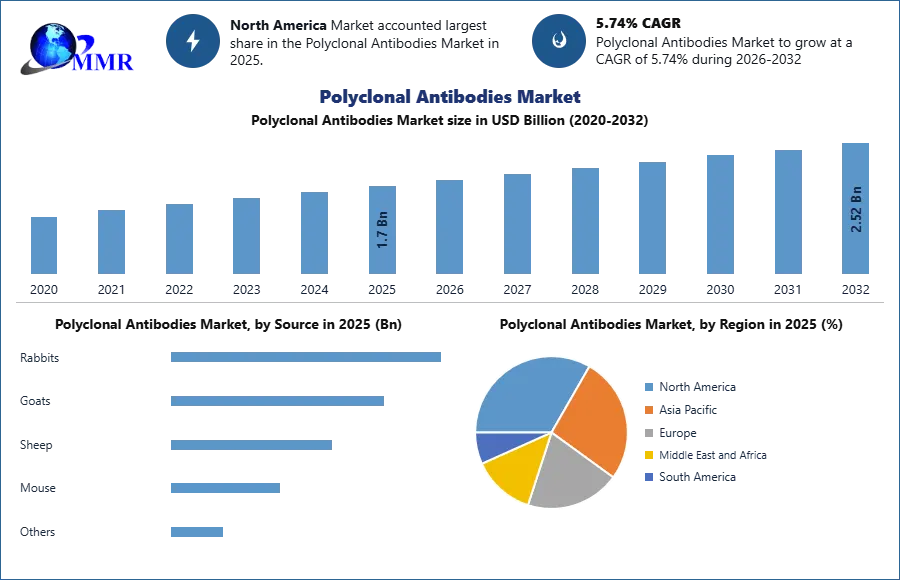
The Global Polyclonal Antibodies Market size is estimated at USD 1.7 billion in 2025 and is expected to hit around USD 2.52 billion by 2032, expected to grow at a CAGR of 5.74% between 2026 to 2032.

Polyclonal Antibodies Market Overview

Polyclonal antibodies are termed complicated mixtures of numerous antibodies that are generally formed by various B-cell clones of an animal. The global polyclonal antibody market is expected to drive due to the increased incidence of cancer, infectious disorders, and antibody research, as well as expanding demand from emerging markets such as the U.S., China, and many others. The report attributes the growth to factors such as increasing demand for personalized medicine, growing research activities in the field of proteomics and genomics, and rising investment in the biotechnology and pharmaceutical industries.

Overall, the polyclonal antibodies market is expected to continue to grow in the coming years, driven by factors such as increasing research and development activities, rising demand for personalized medicine, and growing adoption in cancer research and therapy
To know about the Research Methodology :- Request Free Sample Report

Polyclonal Antibodies Market Dynamics :

Drivers:

The polyclonal antibodies market is primarily driven by the increasing demand for therapeutics and diagnostics. Polyclonal antibodies are highly specific and have high affinity for target molecules, making them effective in the diagnosis and treatment of various diseases. The rising prevalence of chronic diseases such as cancer, autoimmune disorders, and infectious diseases is also driving the growth of the polyclonal antibodies market. Furthermore, technological advancements in antibody production, such as the development of hybridoma technology, phage display, and transgenic animals, are driving the growth of the market.

Opportunities:

The polyclonal antibodies market presents several growth opportunities. There is increasing investment in research and development of polyclonal antibodies. As the demand for personalized medicine increases, there is a growing need for polyclonal antibodies that can be tailored to individual patients. Emerging markets with high unmet medical needs also present a significant growth opportunity for the polyclonal antibodies market.

Restraints:

Despite the many drivers and opportunities, the market faces some restraints. Firstly, the high cost of polyclonal antibodies can limit their accessibility, particularly in developing countries. Secondly, regulatory challenges in antibody development and approval can lead to delays and increased costs. Lastly, the limited availability of high-quality antibodies for certain targets can also be a challenge for the market. However, ongoing research and development efforts are expected to address some of these challenges in the coming years.

Polyclonal Antibodies Market Segment Analysis:

By Product Type, The polyclonal antibodies market is segmented into animal polyclonal antibodies and human polyclonal antibodies. Animal polyclonal antibodies dominate the market due to their cost-effectiveness, ease of production, and broad epitope recognition. They are widely used in research applications such as immunohistochemistry, ELISA, western blotting, and diagnostic assays. Their ability to detect multiple epitopes increases sensitivity, making them suitable for detecting low-abundance proteins. However, batch-to-batch variability can limit reproducibility. Human polyclonal antibodies, although more expensive, are gaining traction in therapeutic applications due to their higher compatibility with the human immune system. They offer improved safety, reduced immunogenicity, and better clinical efficacy, making them valuable in treating infectious diseases, immune disorders, and toxin exposures.

By End User Type, the polyclonal antibodies market is segmented into research institutes, biotechnology companies, contract research organizations (CROs), and others. Biotechnology companies hold the largest market share due to increasing biologics development, rising investment in antibody-based therapeutics, and expanding pipeline activities. These companies utilize polyclonal antibodies extensively for drug discovery, validation studies, and preclinical testing. Research institutes represent a significant segment as well, driven by growing academic research in immunology, oncology, and molecular biology. Contract research organizations are witnessing steady growth due to outsourcing trends in pharmaceutical R&D. The “others” category includes diagnostic laboratories and hospitals, where polyclonal antibodies are used for clinical testing and disease monitoring applications.

Polyclonal Antibodies Market Regional Analysis :

North America dominated Polyclonal Antibodies Market in 2025.The strong biotechnology and pharmaceutical sectors, advanced research infrastructure, and high healthcare expenditure. The United States dominates the regional market due to extensive investment in immunology research, rising demand for antibody-based therapeutics, and the presence of major biopharmaceutical companies. The increasing prevalence of chronic diseases, cancer, and infectious diseases further supports market growth, as polyclonal antibodies are widely used in diagnostics and therapeutic development. Canada also contributes steadily, supported by government-funded research programs and expanding biotech startups. Academic institutions and research laboratories across the region actively utilize animal-derived polyclonal antibodies for proteomics and molecular biology studies. Additionally, growing outsourcing to contract research organizations and advancements in antibody production technologies continue to strengthen North America’s leading position in the polyclonal antibodies market.

Polyclonal Antibodies Market Competitive Landscape:

This market report provides an in-depth analysis of the market's competitive landscape, including the major players and their strategies. Some of the key players in the polyclonal antibodies market include Thermo Fisher Scientific, Merck KGaA, Abcam plc, Bio-Rad Laboratories, Inc., Cell Signaling Technology, Inc., and F. Hoffmann-La Roche Ltd. The report analyzes the market based on factors such as product quality, pricing, distribution channels, and customer service, and provides insights into the competitive strategies of these companies. Additionally, the report highlights the key trends and challenges in the market, such as increasing demand for personalized medicine, growing research and development activities, and the emergence of biosimilars.

The report provides an overview of the global polyclonal antibodies market, including its size, growth rate, and revenue forecast for the coming years. It also includes information on the market segmentation by application, end-user, and geography.

Polyclonal Antibodies Market Scope: Inquire before buying

Polyclonal Antibodies Market
Report Coverage Details
Base Year: 2025 Forecast Period: 2026-2032
Historical Data: 2020 to 2025 Market Size in 2025: 1.7 USD Billion
Forecast Period 2026-2032 CAGR: 5.74% Market Size in 2032: 2.52 USD Billion
Segments Covered: by Product Primary Antibodies
Secondary Antibodies
by Source Rabbits
Goats
Sheep
Mouse
Others
by Application Biomedical Research
Diagnostics
Others
by End User Pharmaceutical & Biotechnology Companies
Hospitals & Diagnostic Centers
Academic & Research Center
Others

Key Players/Competitors Profiles Covered in the Polyclonal Antibodies Market Report in a Strategic Perspective

1. Thermo Fisher Scientific Inc.
2. Abcam plc
3. Merck KGaA
4. Bio-Rad Laboratories, Inc.
5. F. Hoffmann-La Roche AG
6. BioLegend, Inc.
7. GenScript Biotech Corporation
8. Agilent Technologies, Inc.
9. Cell Signaling Technology, Inc.
10.Abnova Corporation
11.Santa Cruz Biotechnology, Inc.
12.Becton, Dickinson and Company
13.Enzo Life Sciences, Inc.
14.Rockland Immunochemicals, Inc.
15.AnaSpec, Inc.
16.Jackson ImmunoResearch Laboratories, Inc.
17.R&D Systems, Inc.
18.Fitzgerald Industries International
19.BioLegend, Inc.
20.Vector Laboratories
21.Bethyl Laboratories, Inc.
22.Novus Biologicals, LLC
23.RayBiotech, Inc.
24.Capra Science
25.Proteintech Group, Inc.

Table of Contents

1. Polyclonal Antibodies Market Introduction 1.1. Study Assumption and Market Definition 1.2. Scope of the Study 1.3. Executive Summary 2. Polyclonal Antibodies Market: Dynamics 2.1. Polyclonal Antibodies Market Trends by Region 2.1.1. North America Polyclonal Antibodies Market Trends 2.1.2. Europe Polyclonal Antibodies Market Trends 2.1.3. Asia Pacific Polyclonal Antibodies Market Trends 2.1.4. Middle East and Africa Polyclonal Antibodies Market Trends 2.1.5. South America Polyclonal Antibodies Market Trends 2.2. Polyclonal Antibodies Market Dynamics by Region 2.2.1. North America 2.2.1.1. North America Polyclonal Antibodies Market Drivers 2.2.1.2. North America Polyclonal Antibodies Market Restraints 2.2.1.3. North America Polyclonal Antibodies Market Opportunities 2.2.1.4. North America Polyclonal Antibodies Market Challenges 2.2.2. Europe 2.2.2.1. Europe Polyclonal Antibodies Market Drivers 2.2.2.2. Europe Polyclonal Antibodies Market Restraints 2.2.2.3. Europe Polyclonal Antibodies Market Opportunities 2.2.2.4. Europe Polyclonal Antibodies Market Challenges 2.2.3. Asia Pacific 2.2.3.1. Asia Pacific Polyclonal Antibodies Market Drivers 2.2.3.2. Asia Pacific Polyclonal Antibodies Market Restraints 2.2.3.3. Asia Pacific Polyclonal Antibodies Market Opportunities 2.2.3.4. Asia Pacific Polyclonal Antibodies Market Challenges 2.2.4. Middle East and Africa 2.2.4.1. Middle East and Africa Polyclonal Antibodies Market Drivers 2.2.4.2. Middle East and Africa Polyclonal Antibodies Market Restraints 2.2.4.3. Middle East and Africa Polyclonal Antibodies Market Opportunities 2.2.4.4. Middle East and Africa Polyclonal Antibodies Market Challenges 2.2.5. South America 2.2.5.1. South America Polyclonal Antibodies Market Drivers 2.2.5.2. South America Polyclonal Antibodies Market Restraints 2.2.5.3. South America Polyclonal Antibodies Market Opportunities 2.2.5.4. South America Polyclonal Antibodies Market Challenges 2.3. PORTER’s Five Forces Analysis 2.4. PESTLE Analysis 2.5. Technology Roadmap 2.6. Regulatory Landscape by Region 2.6.1. North America 2.6.2. Europe 2.6.3. Asia Pacific 2.6.4. Middle East and Africa 2.6.5. South America 2.7. Key Opinion Leader Analysis For Polyclonal Antibodies Industry 2.8. Analysis of Government Schemes and Initiatives For Polyclonal Antibodies Industry 2.9. Polyclonal Antibodies Market Trade Analysis 2.10. The Global Pandemic Impact on Polyclonal Antibodies Market 3. Polyclonal Antibodies Market: Global Market Size and Forecast by Segmentation by Demand and Supply Side (by Value in USD Billion) 2025-2032 3.1. Polyclonal Antibodies Market Size and Forecast, by Product Type (2025-2032) 3.1.1. Primary Polyclonal Antibodies 3.1.2. Secondary Polyclonal Antibodies 3.1.3. Polyclonal Antibody Production Services 3.2. Polyclonal Antibodies Market Size and Forecast, by Application (2025-2032) 3.2.1. Research Applications 3.2.2. Medical Diagnostics 3.2.3. Drug Discovery and Development 3.3. Polyclonal Antibodies Market Size and Forecast, by End User (2025-2032) 3.3.1. Pharmaceutical and Biotechnology Companies 3.3.2. Academic and Research Institutes 3.3.3. Contract Research Organizations 3.3.4. Hospitals and Diagnostic Centres 3.4. Polyclonal Antibodies Market Size and Forecast, by Region (2025-2032) 3.4.1. North America 3.4.2. Europe 3.4.3. Asia Pacific 3.4.4. Middle East and Africa 3.4.5. South America 4. North America Polyclonal Antibodies Market Size and Forecast by Segmentation (by Value in USD Billion) 2025-2032 4.1. North America Polyclonal Antibodies Market Size and Forecast, by Product Type (2025-2032) 4.1.1. Primary Polyclonal Antibodies 4.1.2. Secondary Polyclonal Antibodies 4.1.3. Polyclonal Antibody Production Services 4.2. North America Polyclonal Antibodies Market Size and Forecast, by Application (2025-2032) 4.2.1. Research Applications 4.2.2. Medical Diagnostics 4.2.3. Drug Discovery and Development 4.3. North America Polyclonal Antibodies Market Size and Forecast, by End User (2025-2032) 4.3.1. Pharmaceutical and Biotechnology Companies 4.3.2. Academic and Research Institutes 4.3.3. Contract Research Organizations 4.3.4. Hospitals and Diagnostic Centres 4.4. North America Polyclonal Antibodies Market Size and Forecast, by Country (2025-2032) 4.4.1. United States 4.4.1.1. United States Polyclonal Antibodies Market Size and Forecast, by Product Type (2025-2032) 4.4.1.1.1. Primary Polyclonal Antibodies 4.4.1.1.2. Secondary Polyclonal Antibodies 4.4.1.1.3. Polyclonal Antibody Production Services 4.4.1.2. United States Polyclonal Antibodies Market Size and Forecast, by Application (2025-2032) 4.4.1.2.1. Research Applications 4.4.1.2.2. Medical Diagnostics 4.4.1.2.3. Drug Discovery and Development 4.4.1.3. United States Polyclonal Antibodies Market Size and Forecast, by End User (2025-2032) 4.4.1.3.1. Pharmaceutical and Biotechnology Companies 4.4.1.3.2. Academic and Research Institutes 4.4.1.3.3. Contract Research Organizations 4.4.1.3.4. Hospitals and Diagnostic Centres 4.4.2. Canada 4.4.2.1. Canada Polyclonal Antibodies Market Size and Forecast, by Product Type (2025-2032) 4.4.2.1.1. Primary Polyclonal Antibodies 4.4.2.1.2. Secondary Polyclonal Antibodies 4.4.2.1.3. Polyclonal Antibody Production Services 4.4.2.2. Canada Polyclonal Antibodies Market Size and Forecast, by Application (2025-2032) 4.4.2.2.1. Research Applications 4.4.2.2.2. Medical Diagnostics 4.4.2.2.3. Drug Discovery and Development 4.4.2.3. Canada Polyclonal Antibodies Market Size and Forecast, by End User (2025-2032) 4.4.2.3.1. Pharmaceutical and Biotechnology Companies 4.4.2.3.2. Academic and Research Institutes 4.4.2.3.3. Contract Research Organizations 4.4.2.3.4. Hospitals and Diagnostic Centres 4.4.3. Mexico 4.4.3.1. Mexico Polyclonal Antibodies Market Size and Forecast, by Product Type (2025-2032) 4.4.3.1.1. Primary Polyclonal Antibodies 4.4.3.1.2. Secondary Polyclonal Antibodies 4.4.3.1.3. Polyclonal Antibody Production Services 4.4.3.2. Mexico Polyclonal Antibodies Market Size and Forecast, by Application (2025-2032) 4.4.3.2.1. Research Applications 4.4.3.2.2. Medical Diagnostics 4.4.3.2.3. Drug Discovery and Development 4.4.3.3. Mexico Polyclonal Antibodies Market Size and Forecast, by End User (2025-2032) 4.4.3.3.1. Pharmaceutical and Biotechnology Companies 4.4.3.3.2. Academic and Research Institutes 4.4.3.3.3. Contract Research Organizations 4.4.3.3.4. Hospitals and Diagnostic Centres 5. Europe Polyclonal Antibodies Market Size and Forecast by Segmentation (by Value in USD Billion) 2025-2032 5.1. Europe Polyclonal Antibodies Market Size and Forecast, by Product Type (2025-2032) 5.1. Europe Polyclonal Antibodies Market Size and Forecast, by Application (2025-2032) 5.1. Europe Polyclonal Antibodies Market Size and Forecast, by End User (2025-2032) 5.4. Europe Polyclonal Antibodies Market Size and Forecast, by Country (2025-2032) 5.4.1. United Kingdom 5.4.1.1. United Kingdom Polyclonal Antibodies Market Size and Forecast, by Product Type (2025-2032) 5.4.1.2. United Kingdom Polyclonal Antibodies Market Size and Forecast, by Application (2025-2032) 5.4.1.3. United Kingdom Polyclonal Antibodies Market Size and Forecast, by End User (2025-2032) 5.4.2. France 5.4.2.1. France Polyclonal Antibodies Market Size and Forecast, by Product Type (2025-2032) 5.4.2.2. France Polyclonal Antibodies Market Size and Forecast, by Application (2025-2032) 5.4.2.3. France Polyclonal Antibodies Market Size and Forecast, by End User (2025-2032) 5.4.3. Germany 5.4.3.1. Germany Polyclonal Antibodies Market Size and Forecast, by Product Type (2025-2032) 5.4.3.2. Germany Polyclonal Antibodies Market Size and Forecast, by Application (2025-2032) 5.4.3.3. Germany Polyclonal Antibodies Market Size and Forecast, by End User (2025-2032) 5.4.4. Italy 5.4.4.1. Italy Polyclonal Antibodies Market Size and Forecast, by Product Type (2025-2032) 5.4.4.2. Italy Polyclonal Antibodies Market Size and Forecast, by Application (2025-2032) 5.4.4.3. Italy Polyclonal Antibodies Market Size and Forecast, by End User (2025-2032) 5.4.5. Spain 5.4.5.1. Spain Polyclonal Antibodies Market Size and Forecast, by Product Type (2025-2032) 5.4.5.2. Spain Polyclonal Antibodies Market Size and Forecast, by Application (2025-2032) 5.4.5.3. Spain Polyclonal Antibodies Market Size and Forecast, by End User (2025-2032) 5.4.6. Sweden 5.4.6.1. Sweden Polyclonal Antibodies Market Size and Forecast, by Product Type (2025-2032) 5.4.6.2. Sweden Polyclonal Antibodies Market Size and Forecast, by Application (2025-2032) 5.4.6.3. Sweden Polyclonal Antibodies Market Size and Forecast, by End User (2025-2032) 5.4.7. Austria 5.4.7.1. Austria Polyclonal Antibodies Market Size and Forecast, by Product Type (2025-2032) 5.4.7.2. Austria Polyclonal Antibodies Market Size and Forecast, by Application (2025-2032) 5.4.7.3. Austria Polyclonal Antibodies Market Size and Forecast, by End User (2025-2032) 5.4.8. Rest of Europe 5.4.8.1. Rest of Europe Polyclonal Antibodies Market Size and Forecast, by Product Type (2025-2032) 5.4.8.2. Rest of Europe Polyclonal Antibodies Market Size and Forecast, by Application (2025-2032) 5.4.8.3. Rest of Europe Polyclonal Antibodies Market Size and Forecast, by End User (2025-2032) 6. Asia Pacific Polyclonal Antibodies Market Size and Forecast by Segmentation (by Value in USD Billion) 2025-2032 6.1. Asia Pacific Polyclonal Antibodies Market Size and Forecast, by Product Type (2025-2032) 6.2. Asia Pacific Polyclonal Antibodies Market Size and Forecast, by Application (2025-2032) 6.3. Asia Pacific Polyclonal Antibodies Market Size and Forecast, by End User (2025-2032) 6.4. Asia Pacific Polyclonal Antibodies Market Size and Forecast, by Country (2025-2032) 6.4.1. China 6.4.1.1. China Polyclonal Antibodies Market Size and Forecast, by Product Type (2025-2032) 6.4.1.2. China Polyclonal Antibodies Market Size and Forecast, by Application (2025-2032) 6.4.1.3. China Polyclonal Antibodies Market Size and Forecast, by End User (2025-2032) 6.4.2. S Korea 6.4.2.1. S Korea Polyclonal Antibodies Market Size and Forecast, by Product Type (2025-2032) 6.4.2.2. S Korea Polyclonal Antibodies Market Size and Forecast, by Application (2025-2032) 6.4.2.3. S Korea Polyclonal Antibodies Market Size and Forecast, by End User (2025-2032) 6.4.3. Japan 6.4.3.1. Japan Polyclonal Antibodies Market Size and Forecast, by Product Type (2025-2032) 6.4.3.2. Japan Polyclonal Antibodies Market Size and Forecast, by Application (2025-2032) 6.4.3.3. Japan Polyclonal Antibodies Market Size and Forecast, by End User (2025-2032) 6.4.4. India 6.4.4.1. India Polyclonal Antibodies Market Size and Forecast, by Product Type (2025-2032) 6.4.4.2. India Polyclonal Antibodies Market Size and Forecast, by Application (2025-2032) 6.4.4.3. India Polyclonal Antibodies Market Size and Forecast, by End User (2025-2032) 6.4.5. Australia 6.4.5.1. Australia Polyclonal Antibodies Market Size and Forecast, by Product Type (2025-2032) 6.4.5.2. Australia Polyclonal Antibodies Market Size and Forecast, by Application (2025-2032) 6.4.5.3. Australia Polyclonal Antibodies Market Size and Forecast, by End User (2025-2032) 6.4.6. Indonesia 6.4.6.1. Indonesia Polyclonal Antibodies Market Size and Forecast, by Product Type (2025-2032) 6.4.6.2. Indonesia Polyclonal Antibodies Market Size and Forecast, by Application (2025-2032) 6.4.6.3. Indonesia Polyclonal Antibodies Market Size and Forecast, by End User (2025-2032) 6.4.7. Malaysia 6.4.7.1. Malaysia Polyclonal Antibodies Market Size and Forecast, by Product Type (2025-2032) 6.4.7.2. Malaysia Polyclonal Antibodies Market Size and Forecast, by Application (2025-2032) 6.4.7.3. Malaysia Polyclonal Antibodies Market Size and Forecast, by End User (2025-2032) 6.4.8. Vietnam 6.4.8.1. Vietnam Polyclonal Antibodies Market Size and Forecast, by Product Type (2025-2032) 6.4.8.2. Vietnam Polyclonal Antibodies Market Size and Forecast, by Application (2025-2032) 6.4.8.3. Vietnam Polyclonal Antibodies Market Size and Forecast, by End User (2025-2032) 6.4.9. Taiwan 6.4.9.1. Taiwan Polyclonal Antibodies Market Size and Forecast, by Product Type (2025-2032) 6.4.9.2. Taiwan Polyclonal Antibodies Market Size and Forecast, by Application (2025-2032) 6.4.9.3. Taiwan Polyclonal Antibodies Market Size and Forecast, by End User (2025-2032) 6.4.10. Rest of Asia Pacific 6.4.10.1. Rest of Asia Pacific Polyclonal Antibodies Market Size and Forecast, by Product Type (2025-2032) 6.4.10.2. Rest of Asia Pacific Polyclonal Antibodies Market Size and Forecast, by Application (2025-2032) 6.4.10.3. Rest of Asia Pacific Polyclonal Antibodies Market Size and Forecast, by End User (2025-2032) 7. Middle East and Africa Polyclonal Antibodies Market Size and Forecast by Segmentation (by Value in USD Billion) 2025-2032 7.1. Middle East and Africa Polyclonal Antibodies Market Size and Forecast, by Product Type (2025-2032) 7.2. Middle East and Africa Polyclonal Antibodies Market Size and Forecast, by Application (2025-2032) 7.3. Middle East and Africa Polyclonal Antibodies Market Size and Forecast, by End User (2025-2032) 7.4. Middle East and Africa Polyclonal Antibodies Market Size and Forecast, by Country (2025-2032) 7.4.1. South Africa 7.4.1.1. South Africa Polyclonal Antibodies Market Size and Forecast, by Product Type (2025-2032) 7.4.1.2. South Africa Polyclonal Antibodies Market Size and Forecast, by Application (2025-2032) 7.4.1.3. South Africa Polyclonal Antibodies Market Size and Forecast, by End User (2025-2032) 7.4.2. GCC 7.4.2.1. GCC Polyclonal Antibodies Market Size and Forecast, by Product Type (2025-2032) 7.4.2.2. GCC Polyclonal Antibodies Market Size and Forecast, by Application (2025-2032) 7.4.2.3. GCC Polyclonal Antibodies Market Size and Forecast, by End User (2025-2032) 7.4.3. Nigeria 7.4.3.1. Nigeria Polyclonal Antibodies Market Size and Forecast, by Product Type (2025-2032) 7.4.3.2. Nigeria Polyclonal Antibodies Market Size and Forecast, by Application (2025-2032) 7.4.3.3. Nigeria Polyclonal Antibodies Market Size and Forecast, by End User (2025-2032) 7.4.4. Rest of ME&A 7.4.4.1. Rest of ME&A Polyclonal Antibodies Market Size and Forecast, by Product Type (2025-2032) 7.4.4.2. Rest of ME&A Polyclonal Antibodies Market Size and Forecast, by Application (2025-2032) 7.4.4.3. Rest of ME&A Polyclonal Antibodies Market Size and Forecast, by End User (2025-2032) 8. South America Polyclonal Antibodies Market Size and Forecast by Segmentation (by Value in USD Billion) 2025-2032 8.1. South America Polyclonal Antibodies Market Size and Forecast, by Product Type (2025-2032) 8.2. South America Polyclonal Antibodies Market Size and Forecast, by Application (2025-2032) 8.3. South America Polyclonal Antibodies Market Size and Forecast, by End User(2025-2032) 8.4. South America Polyclonal Antibodies Market Size and Forecast, by Country (2025-2032) 8.4.1. Brazil 8.4.1.1. Brazil Polyclonal Antibodies Market Size and Forecast, by Product Type (2025-2032) 8.4.1.2. Brazil Polyclonal Antibodies Market Size and Forecast, by Application (2025-2032) 8.4.1.3. Brazil Polyclonal Antibodies Market Size and Forecast, by End User (2025-2032) 8.4.2. Argentina 8.4.2.1. Argentina Polyclonal Antibodies Market Size and Forecast, by Product Type (2025-2032) 8.4.2.2. Argentina Polyclonal Antibodies Market Size and Forecast, by Application (2025-2032) 8.4.2.3. Argentina Polyclonal Antibodies Market Size and Forecast, by End User (2025-2032) 8.4.3. Rest Of South America 8.4.3.1. Rest Of South America Polyclonal Antibodies Market Size and Forecast, by Product Type (2025-2032) 8.4.3.2. Rest Of South America Polyclonal Antibodies Market Size and Forecast, by Application (2025-2032) 8.4.3.3. Rest Of South America Polyclonal Antibodies Market Size and Forecast, by End User (2025-2032) 9. Global Polyclonal Antibodies Market: Competitive Landscape 9.1. MMR Competition Matrix 9.2. Competitive Landscape 9.3. Key Players Benchmarking 9.3.1. Company Name 9.3.2. Business Segment 9.3.3. End-user Segment 9.3.4. Revenue (2025) 9.3.5. Company Locations 9.4. Leading Polyclonal Antibodies Market Companies, by market capitalization 9.5. Market Structure 9.5.1. Market Leaders 9.5.2. Market Followers 9.5.3. Emerging Players 9.6. Mergers and Acquisitions Details 10. Company Profile: Key Players 10.1. Thermo Fisher Scientific Inc. 10.1.1. Company Overview 10.1.2. Business Portfolio 10.1.3. Financial Overview 10.1.4. SWOT Analysis 10.1.5. Strategic Analysis 10.1.6. Scale of Operation (small, medium, and large) 10.1.7. Details on Partnership 10.1.8. Regulatory Accreditations and Certifications Received by Them 10.1.9. Awards Received by the Firm 10.1.10. Recent Developments 10.2. Abcam plc 10.3. Merck KGaA 10.4. Bio-Rad Laboratories, Inc. 10.5. F. Hoffmann-La Roche AG 10.6. BioLegend, Inc. 10.7. GenScript Biotech Corporation 10.8. Agilent Technologies, Inc. 10.9. Cell Signaling Technology, Inc. 10.10. Abnova Corporation 10.11. Santa Cruz Biotechnology, Inc. 10.12. Becton, Dickinson and Company 10.13. Enzo Life Sciences, Inc. 10.14. Rockland Immunochemicals, Inc. 10.15. AnaSpec, Inc. 10.16. Jackson ImmunoResearch Laboratories, Inc. 10.17. R&D Systems, Inc. 10.18. Fitzgerald Industries International 10.19. BioLegend, Inc. 10.20. Vector Laboratories 10.21. Bethyl Laboratories, Inc. 10.22. Novus Biologicals, LLC 10.23. RayBiotech, Inc. 10.24. Capra Science 10.25. Proteintech Group, Inc 11. Key Findings 12. Industry Recommendations 13. Polyclonal Antibodies Market: Research Methodology 14. Terms and Glossary

Custom Market Research Services

We Will Customise The Research For You, In Case The Report Listed Above Does Not Meet With Your Requirements