
Petrochemicals Market by Type, Application, End Use Industry and Region – Global Market Size Estimation, Industry-Wide Analysis, Competitive Landscape Assessment & Long-Term Forecast to 2032
Overview
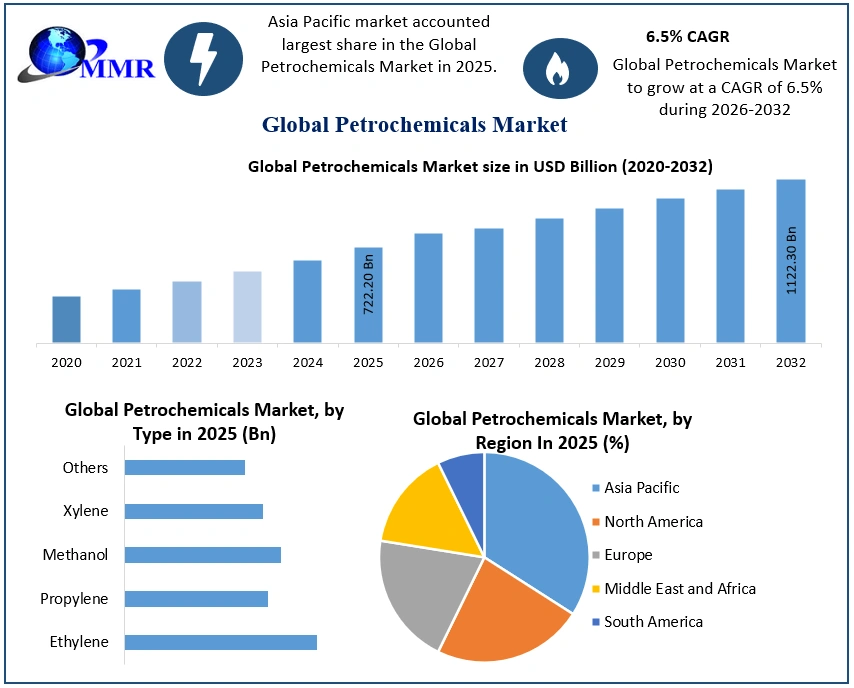
The Petrochemicals Market size was valued at USD 722.20 Billion in 2025 and the total Petrochemicals revenue is expected to grow at a CAGR of 6.5% from 2025 to 2032, reaching nearly USD 1122.30 Billion by 2032.
Petrochemicals Market Overview
Petrochemicals are derived from petroleum or natural gas. Petrochemicals are important part of the chemical industry as the demand for synthetic materials is increasing continually and plays a major role in the growth of the economy. They are used in petrochemical products plastics, medicines, cosmetics, furniture, appliances, electronics, solar power panels, and wind turbines. The automotive industry's growth, including the shift toward electric vehicles, impacts the demand for petrochemical materials used in vehicle production. Changing consumer preferences for convenience, durability, and lightweight materials contribute to the demand for petrochemical-based products. The Petrochemicals Market is highly competitive, leading to price pressures and thinner profit margins. Companies need to invest in innovation to stay ahead.
To know about the Research Methodology :- Request Free Sample Report
Petrochemicals Market Dynamics
Economic Development and Emerging Markets to boost the Petrochemical Industry growth
Robust economic growth, prominently observed within emerging economies, with a focal emphasis on the Asian markets, manifests as a pivotal driver behind the escalated consumer expenditure and heightened industrial activities, which, in turn, propel the demand for petrochemical products. As nations such as China and India continue their developmental trajectory, petrochemical consumption within these regions experiences a concurrent upswing. As the global population continues its steady expansion, paralleled by the ongoing urbanization trend, the concomitant surge in demand for consumer goods, housing, and infrastructure, particularly within urban and metropolitan zones, underscores the indispensable role of petrochemicals in facilitating the production of essential urban requisites like plastics, construction materials, and electronic components.
The petrochemical industry's reliance on hydrocarbons, which exhibit an intrinsic linkage with the energy sector, stipulates that the prevailing growth in energy consumption, encompassing the domains of oil and natural gas, significantly influences the availability and pricing of feedstocks fundamental to the petrochemical sector. The progressive march of technological innovations has bestowed upon the industry an arsenal of new and more efficient petrochemical production processes. These innovations have broadened the spectrum of producible petrochemical products, fostering enhancements in overall industry efficiency and sustainability. The burgeoning traction of the circular economy model, characterized by the recycling, reutilization, and repurposing of products and materials, is permeating the petrochemical landscape. Petrochemical enterprises are actively exploring avenues to engender materials that are more sustainable and amenable to recycling, aligning with the core tenets of the circular economy.
The petrochemical industry is highly interconnected globally, with complex supply chains that can be affected by trade policies, geopolitical tensions, and logistics disruptions. Changes in international trade agreements and global economic dynamics influence Petrochemicals Market dynamics. The availability and cost of feedstocks, such as crude oil and natural gas, significantly influence the Petrochemicals Market growth. Shale gas and other unconventional sources have altered the feedstock landscape, impacting the competitiveness of various regions. Consumer preferences for sustainable and environmentally friendly products have prompted companies to adapt their offerings. Increased consumer awareness of environmental and health-related issues influence the development of petrochemical products. Changing regulations related to chemical safety, emissions, and environmental protection can significantly impact the petrochemical industry.
Compliance with evolving regulations often requires investments in technology and process improvements. The ascendancy of plastics as a pivotal product category within the petrochemical domain is irrefutable. The burgeoning global demand for food necessitates a concurrent surge in the need for agricultural chemicals, sustaining the petrochemical industry's prominence. The transportation sector, particularly the automotive industry, relies substantially on petrochemical products. Petrochemicals are integral to the production of plastics, synthetic rubber, and an array of chemicals employed in vehicle manufacturing. The trajectory of the automotive sector wields a direct and profound influence on the Petrochemicals Market growth.
Volatility in Oil Price to restrain the Petrochemicals Market growth
The petrochemical industry maintains an intricate nexus with crude oil prices, as a substantial proportion of its raw materials are derived from oil. Oscillations in oil prices can exert profound influences on the cost of production for petrochemical companies. When oil prices surge, it translates into elevated operating expenses and diminished profit margins. Conversely, during periods of low oil prices, investments in exploration and production often decline, precipitating supply chain disruptions. The imposition of trade barriers and tariffs can exert a pronounced impact on the industry's global supply chains and profitability. Prolonged trade disputes and tariff conflicts can disrupt established trade routes and inflate costs for petrochemical enterprises. The perception of the Petrochemicals Market within the public sphere can serve as a significant restraint. The petrochemical sector exhibits a pronounced dependence on a limited set of key raw materials, including ethylene and propylene. This reliance on a constrained array of feedstocks renders the supply chain vulnerable and accentuates susceptibility to price fluctuations.
Opportunities in Petrochemical
Manufacturers' mounting environmental concerns fuels market growth. Policymakers have pushed businesses to take action and run the production process responsibly and environmentally friendly in response to growing environmental concerns. In order to comply with new pollution control requirements, a number of significant businesses are updating their operations. This is because reducing pollution from manufacturing facilities have essentials for reducing overall pollution and the effects of climate change. For instance, Dow stated in October 2022 that it build Alberta, Canada's first integrated net-zero carbon ethylene cracker and derivatives plant.
Through 2030, Dow estimates that the new brownfield ethylene cracker gradually increase capacity by about 1.9 million tonnes. This allow the company to produce and supply roughly 3.3 million tonnes of certified low-to-zero-carbon emissions polyethylene and ethylene derivatives for clients and joint venture partners around the world. This made possible by additional derivatives capacity and site retrofit investments. In September 2022, MEGlobal Americas Inc. announced that starting in 2025, it buy renewable energy from Calpine Energy Solutions LLC to meet 100% of the expected power demands for its petrochemical plant in Texas, United States. This was another instance of an industry player taking the initiative to go green. The agreement underlines EQUATE Petrochemical Group, of which MEGlobal is a part steadfast dedication to sustainability.
Advanced petrochemical products with more inventive applications and greater environmental friendliness are required by numerous end-user industries, which is expected to boost the Petrochemicals Market growth. The quickly developing base chemical field is no different in this regard. Aviation, building and construction, agriculture, food and beverage, electrical and electronics, healthcare, and automotive are a few end-use industries that have a greater need for enhanced petrochemical products. This has prompted numerous petrochemical producers to create new technologies to better turn the petrochemicals into newer goods that are more eco-friendly and have more creative and practical uses.
Petrochemicals Market Segment Analysis
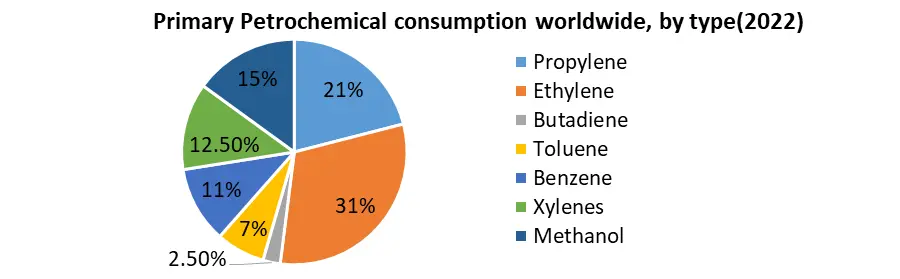
Based on Type, the market is segmented into Ethylene, Propylene, Methanol, Xylene, and Others. Ethylene, and Propylene segment dominated the market in 2025 and is expected to hold the largest Petrochemical share over the forecast period. In the Petrochemicals Market, ethylene and propylene stand out as two of the most pivotal and dominant segments. They are fundamental building blocks for a diverse array of products, finding extensive applications across a multitude of industries. Ethylene holds a pivotal role within the petrochemical industry, central to the production of plastics and a diverse array of chemical compounds. Its versatility and wide-ranging applications solidify its status as a dominant segment in the market. Propylene is instrumental in the creation of diverse chemical intermediates. It plays a key role in the manufacture of propylene oxide (used in polyurethane foam and glycol production), acrylonitrile (employed in acrylic fibers and plastics), and cumene (utilized in the production of phenol and acetone). Propylene constitutes a critical segment in the Petrochemicals Market, closely following ethylene in importance. Its adaptability in the production of plastics, chemicals, and synthetic materials renders it indispensable across various industries.
Based on Application, the market is segmented into Packaging, Electronics, Construction, and Automotive. The automotive segment held the largest Petrochemicals Market share in 2025 and is expected to dominate the market over the forecast period. Petrochemical-derived plastics find extensive applications in the production of various automotive components, including interior elements, bumpers, dashboards, and external panels. These plastics are esteemed for their advantageous properties, such as lightweight characteristics, durability, and design flexibility. Synthetic rubber, produced from Petrochemicals, assumes a pivotal role as a fundamental constituent of tires. The demand for tires within the automotive industry is substantial, influenced by vehicle manufacturing and the necessity for tire replacements, thus making a noteworthy contribution to the Petrochemicals Market growth. The automotive industry's endeavors to enhance fuel efficiency and reduce emissions have stimulated the employment of lightweight materials derived from petrochemicals. These materials encompass advanced polymers and composites, thereby further consolidating the significance of petrochemicals in this sector.

Petrochemicals Market Regional Analysis
Investment in Research and Development sector in Asia Pacific to boost the Market growth
Governments and corporate entities alike are directing resources toward research and development endeavors aimed at the creation of innovative petrochemical products and processes. This encompasses the development of novel materials characterized by enhanced properties and reduced environmental impact. Evolving consumer lifestyles and the increased prevalence of product packaging for convenience and preservation have spurred the demand for petrochemical-based materials such as plastics and flexible packaging. These materials are integral to food packaging, beverage containers, and various other consumer products. The textile industry in the Asia-Pacific region reaps the benefits of synthetic fibers produced from petrochemicals. These fibers, encompassing polyester and nylon, facilitate the production of clothing and textiles that are both cost-effective and widely accessible, satisfying the needs of a burgeoning population. Several countries, including China, have undertaken measures to amplify domestic petrochemical production capacity. This often entails investments in new production facilities and the expansion of existing ones. The establishment of petrochemical manufacturing zones and industrial parks has attracted foreign direct investment, thereby contributing to the growth of the petrochemical industry in the region.
Petrochemicals Market Competitive Landscape
The competitive landscape of the petrochemicals market is characterized by intense competition among a wide range of players, from global giants to regional and specialized companies. Understanding the competition insights in this dynamic market is essential for both established and emerging players. Specialized petrochemical companies like LyondellBasell Industries, INEOS, and Celanese Corporation focus on specific niche areas within the petrochemical industry. They often excel in innovation, producing high-performance materials and specialty chemicals. Technological innovation is a critical competitive factor. Companies that invest in research and development to create novel materials, improve production processes, and enhance sustainability are better positioned to meet market demands. Adherence to stringent environmental and safety regulations is a key competitive factor. Companies that proactively address regulatory challenges and invest in compliance measures demonstrate a commitment to responsible operations. Mergers and acquisitions are common strategies to strengthen market position. Companies acquire competitors or complementary businesses to expand their product portfolios and geographic reach.
Petrochemicals Market Scope: Inquiry Before Buying
| Petrochemicals Market | |||
|---|---|---|---|
| Report Coverage | Details | ||
| Base Year: | 2025 | Forecast Period: | 2026-2032 |
| Historical Data: | 2020 to 2025 | Market Size in 2025: | USD 722.20 Bn. |
| Forecast Period 2026 to 2032 CAGR: | 6.5% | Market Size in 2032: | USD 1122.30 Bn. |
| Segments Covered: | by Type | Ethylene Propylene Methanol Xylene Others |
|
| by Application | Packaging Electronics Construction Automotive |
||
| by End Use Industry | Chemical Industry Plastics Industry Textile and Apparel Industry Automotive Industry Agriculture |
||
Petrochemicals Market, by Region
North America (United States, Canada, and Mexico)
Europe (UK, France, Germany, Italy, Spain, Sweden, Austria and Rest of Europe)
Asia Pacific (China, South Korea, Japan, India, Australia, Indonesia, Malaysia, Vietnam, Taiwan, Bangladesh, Pakistan and Rest of APAC)
Middle East and Africa (South Africa, GCC, Egypt, Nigeria and Rest of ME&A)
South America (Brazil, Argentina Rest of South America)
Petrochemicals Market, Key Players
1. Pampa Energía S.A.
2. BASF SE
3. Chevron Corporation
4. Exxon Mobil Corporation
5. INEOS Group Ltd.
6. Royal Dutch Shell PLC
7. SABIC
8. TotalEnergies
9. Formosa Petrochemical Corporation
10. Reliance Industries Limited
11. Mitsubishi Chemical Holdings
12. Lotte Chemical Corporation
13. Braskem
14. LG Chem
15. Saudi Aramco
Frequently Asked Questions:
1] What is the growth rate of the Global Petrochemicals Market?
Ans. The Global Petrochemicals Market is growing at a significant rate of 6.5 % over the forecast period.
2] Which region is expected to dominate the Global Petrochemicals Market?
Ans. Asia Pacific region is expected to dominate the Petrochemicals Market over the forecast period.
3] What was the Global Petrochemicals Market size in 2025?
Ans: The Global Petrochemicals Market size was USD 722.20 Billion in 2025.
4] Who are the top players in the Global Petrochemical Industry?
Ans. The major key players in the Global Petrochemicals Market are Pampa Energía S.A. , BASF SE, and Chevron Corporation.
5] Which factors are expected to drive the Global Petrochemicals Market growth by 2032?
Ans. Technological advancement in Petrochemical manufacturing is expected to drive the Petrochemicals Market growth over the forecast period (2026-2032).