
Personal Care Emollients Market by Product, by Type, by Application and Regional Insights 2034
Overview
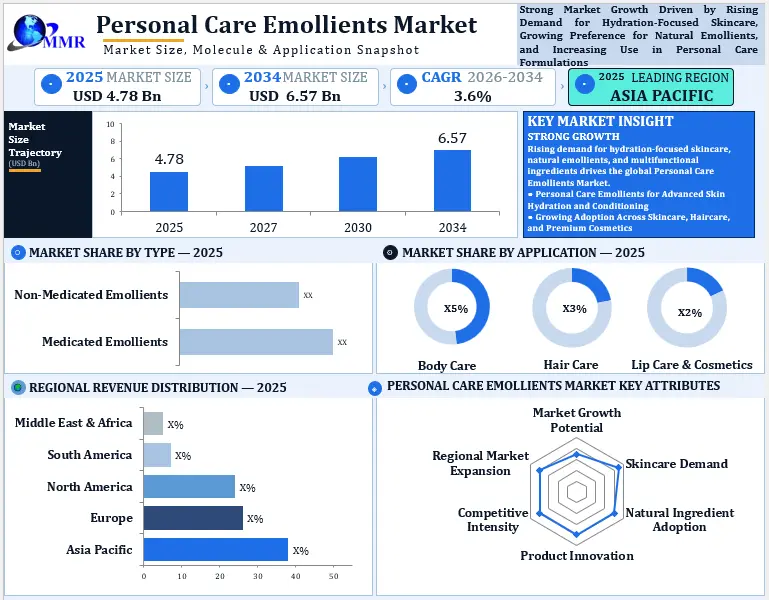
The Global Personal Care Emollients Market is valued at USD 4.78 billion in 2025 and is projected to reach USD 6.57 billion by 2034, registering a CAGR of 3.6% during 2026–2034.
Personal Care Emollients Market Introduction and Market Scenario:
Emollients are mostly utilized in skin care formulations to help keep the skin dampness. Emollients additionally help in making the skin flexible by dropping water misfortune from the external layer of the skin. Emollients offer a defensive film on the skin and in this manner, it is likewise utilized for patients with conditions like psoriasis or dermatitis. These functions of emollient assistance in fixing the skin surface. Consequently, an emollient is a significant part of day-by-day skin care.
Organic growth of the personal care market contributes to the growth of the global personal care emollients market. Also, rising consumption from developing countries such as India, China, and Australia, among others. Moreover, changing lifestyle, rise in spending capacity in the Asia Pacific, increasing demand for multi-functional ingredients are another main driving factor for the growth of the global personal care emollients market.
On the other hand, the major restraining factors such as stringent regulations for personal care ingredients and price sensitivity are hampered the market growth during the forecast period.
Personal Care Emollients Market Growth Outlook
To know about the Research Methodology :- Request Free Sample Report
Global Personal Care Emollients Market Key Highlights
• Steady Market Growth: The Global Personal Care Emollients Market reaches USD 4.78 billion in 2025 and is projected to reach USD 6.57 billion by 2034, registering a CAGR of 3.6% during 2026–2034.
• Growing Demand for Skincare Products: Increasing consumer demand for moisturizers, lotions, facial creams, sunscreens, and anti-aging products supports emollient consumption across personal care formulations.
• Rising Preference for Natural Ingredients: Growing interest in clean beauty, plant-derived oils, bio-based esters, and sustainably sourced ingredients encourages manufacturers to expand natural emollient portfolios.
• Asia Pacific Market Leadership: Asia Pacific benefits from expanding cosmetics manufacturing, rising disposable incomes, growing skincare awareness, and increasing demand for personal care products across China, India, Japan, and South Korea.
• Innovation and Competitive Differentiation: Market participants focus on advanced formulation technologies, multifunctional ingredients, improved sensory performance, and sustainable sourcing to strengthen their competitive positions.
Global Personal Care Emollients Market Dynamics
Global Personal Care Emollients Market Drivers
Rising Demand for Moisturizing and Skin Hydration Products: Increasing consumer awareness of skin health and demand for hydration-focused skincare formulations support the Global Personal Care Emollients Market. In 2025, skincare applications account for 50.05% of personal care emollient revenue, representing USD 792.6 million. Emollients improve skin softness, moisture retention, spreadability, and texture, supporting their use in moisturizers, lotions, sunscreens, and anti-aging creams.
Growing Preference for Natural and Sustainable Ingredients: Rising interest in clean beauty, plant-derived ingredients, and biodegradable formulations encourages manufacturers to incorporate bio-based emollients into personal care products. Green emollients account for 72.5% of the market in 2025 in one product classification, reflecting demand for sustainable alternatives to conventional ingredients. This shift supports innovation in vegetable-oil derivatives, bio-based esters, and other renewable emollient materials.
Expanding Skincare and Haircare Applications: Growing demand for daily skincare, conditioners, styling products, and premium cosmetics strengthens emollient consumption across personal care categories. In 2025, haircare accounts for 22.12% of personal care emollient revenue, equivalent to USD 350.34 million. Emollients enhance conditioning, smoothness, product spreadability, and sensory performance, supporting their inclusion in diverse formulations.
Global Personal Care Emollients Market Restraints
Volatility in Raw Material Prices: Fluctuations in the prices of vegetable oils, fatty alcohols, silicones, and other feedstocks create cost pressures for emollient manufacturers. For example, palm kernel oil prices rise 15% year over year in early 2026 amid supply constraints in Southeast Asia, affecting ingredient sourcing and formulation costs. These fluctuations encourage manufacturers to diversify suppliers and optimize production expenses.
Formulation Stability and Regulatory Challenges: Natural emollients can face oxidation, shelf-life, and formulation-compatibility challenges, while certain synthetic and silicone-based ingredients face increasing environmental scrutiny. Manufacturers must maintain product stability, sensory performance, safety, and regulatory compliance while adapting formulations to changing consumer preferences. These requirements increase formulation testing and product-development costs.
Global Personal Care Emollients Market Opportunities
Innovation in Bio-Based and Multifunctional Emollients: Growing demand for sustainable personal care ingredients creates opportunities for bio-based esters, plant-derived oils, and multifunctional emollients that combine moisturization with improved spreadability and skin feel. The broader global beauty and personal care market reaches USD 640 billion in 2025, providing a substantial downstream customer base for ingredient suppliers.
Growth in Premium and Specialized Skincare: Increasing demand for anti-aging products, sensitive-skin formulations, dermatological skincare, and premium moisturizers creates opportunities for high-performance emollients. Manufacturers can differentiate products through lightweight textures, long-lasting hydration, improved sensory characteristics, and compatibility with active ingredients.
Global Personal Care Emollients Market Challenges
Regulatory and Environmental Compliance: Emollient manufacturers must meet ingredient safety requirements, chemical regulations, and environmental standards across different markets. Increasing scrutiny of ingredient sourcing, biodegradability, and environmental impact encourages manufacturers to improve product transparency and compliance. These requirements can increase testing costs and extend product development timelines.
Competition from Alternative Ingredients: Humectants, occlusive agents, and multifunctional cosmetic ingredients compete with emollients in personal care formulations. Manufacturers must differentiate their products through improved moisturizing performance, skin feel, spreadability, and compatibility with other ingredients to maintain demand across skincare, haircare, and color cosmetics applications.
Global Personal Care Emollients Market Trends
• Shift Toward Bio-Based Emollients: Increasing interest in renewable and naturally derived ingredients supports the development of plant-based oils, bio-based esters, and biodegradable emollients.
• Growing Demand for Multifunctional Ingredients: Cosmetic manufacturers increasingly favor emollients that combine moisturization, improved spreadability, enhanced texture, and desirable sensory properties within a single formulation.
• Rising Adoption in Premium Skincare: Demand for anti-aging products, sensitive-skin formulations, facial moisturizers, and dermatological skincare supports the use of specialized, high-performance emollients.
• Preference for Lightweight and Non-Greasy Formulations: Consumer demand for fast-absorbing skincare products encourages the development of lightweight emollients that provide smooth application without leaving a heavy or oily residue.
• Increasing Focus on Clean Beauty: Greater attention to ingredient transparency, responsible sourcing, and naturally derived ingredients encourages manufacturers to develop emollients that align with clean beauty preferences.
• Advancements in Cosmetic Formulation Technology: Improvements in ester chemistry, ingredient blending, and formulation techniques support the development of emollients with enhanced sensory performance, stability, and compatibility across skincare, haircare, and color cosmetics.
Global Personal Care Emollients Market Segment Analysis
By Product
Synthetic Emollients: Synthetic emollients play an important role due to their consistent performance, formulation flexibility, and ability to improve skin softness and spreadability. Silicones such as cyclomethicone and dimethicone support smooth application, moisture retention, and skin conditioning across skincare, haircare, and cosmetic products. Their versatility supports widespread use in creams, lotions, conditioners, and makeup formulations.
Natural Emollients: Natural emollients gain popularity due to growing demand for plant-derived and naturally sourced ingredients. Castor oil, squalene, jojoba oil, and lanolin provide moisturizing and skin-conditioning benefits, while shea butter helps nourish dry skin. Increasing consumer interest in ingredient transparency and naturally derived personal care products supports demand for this segment.
By Type
Medicated Emollients: Medicated emollients help relieve excessive dryness, reduce moisture loss, and support the skin barrier. They are commonly used in specialized skincare products for dry, irritated, and eczema-prone skin. Growing attention to dermatological care and skin health supports demand for these formulations.
Non-Medicated Emollients: Non-medicated emollients are widely used in everyday personal care products, including moisturizers, body lotions, facial creams, hair conditioners, and cosmetics. They improve skin softness, spread ability, and texture. Rising demand for daily skincare and comfortable, lightweight formulations supports this segment.
Global Personal Care Emollients Market Regional Insights:
Asia Pacific leads the global personal care emollients market, driven by expanding cosmetics manufacturing, rising disposable incomes, growing urbanization, and increasing consumer awareness of skincare and personal grooming. China, India, Japan, and South Korea contribute significantly through demand for moisturizers, facial creams, body lotions, haircare products, and premium cosmetics. The region benefits from a strong beauty and personal care industry, expanding e-commerce channels, and growing demand for multifunctional cosmetic ingredients. Increasing consumer preference for natural emollients, plant-derived oils, lightweight formulations, and skin-friendly ingredients further supports market growth. Continuous product innovation and expanding domestic cosmetics brands strengthen the region's position in the global market.
Europe represents a significant share of the global personal care emollients market, supported by established cosmetics manufacturers, strong demand for premium skincare products, and increasing emphasis on sustainable ingredients. Germany, France, the United Kingdom, and Italy contribute through advanced cosmetic formulation technologies and well-developed beauty and personal care industries. Growing demand for anti-aging creams, moisturizers, sensitive-skin products, and high-performance haircare formulations supports emollient consumption. Increasing interest in bio-based ingredients, biodegradable formulations, clean beauty products, and transparent ingredient sourcing encourages manufacturers to develop innovative and environmentally conscious emollient solutions.
North America maintains a strong position in the personal care emollients market due to high consumer spending on beauty products, established skincare brands, and continuous formulation innovation. The United States and Canada contribute significantly through demand for premium moisturizers, anti-aging products, dermatological skincare, sunscreens, and specialized haircare formulations. Rising consumer interest in skin barrier protection, hydration, and multifunctional cosmetic ingredients supports the adoption of advanced emollients. The growing popularity of clean beauty, naturally derived ingredients, lightweight textures, and non-greasy formulations creates opportunities for manufacturers to introduce innovative products across skincare and personal care applications.
South America experiences growing demand for personal care emollients due to increasing beauty consciousness, expanding urban populations, and rising consumption of skincare and personal hygiene products. Brazil and Argentina contribute to regional demand through established cosmetics markets and growing interest in moisturizing lotions, body creams, hair conditioners, and facial care products. The region's demand for products suitable for different skin types and climatic conditions supports the use of versatile emollient ingredients. Increasing interest in plant-derived oils, natural cosmetic formulations, and affordable beauty products also encourages product development. Expanding retail networks and e-commerce platforms improve access to personal care products and create additional opportunities for emollient manufacturers.
The Middle East and Africa personal care emollients market develops through rising urbanization, increasing disposable incomes, and growing demand for skincare, haircare, and premium personal grooming products. The United Arab Emirates, Saudi Arabia, and South Africa contribute through expanding beauty retail channels and increasing consumption of moisturizing creams, body lotions, facial care products, and haircare formulations. Hot and dry climatic conditions support demand for products that improve skin hydration and help maintain the skin's moisture barrier. Growing interest in premium cosmetics, halal beauty products, natural ingredients, and specialized skincare formulations further creates opportunities for market participants. Expanding modern retail infrastructure and increasing online product availability also support regional market development.
Global Personal Care Emollients Market Competitive Landscape
The global personal care emollients market features a competitive mix of specialty chemical manufacturers, cosmetic ingredient suppliers, and natural oil producers. Market participants compete through product innovation, formulation expertise, sustainable ingredient development, and broad distribution networks. Leading companies strengthen their positions by expanding portfolios of synthetic and natural emollients, including silicones, specialty esters, plant-derived oils, and multifunctional moisturizing ingredients. Increasing demand for clean beauty, bio-based formulations, and high-performance skincare products encourages manufacturers to invest in research and development, develop customer-specific solutions, and establish partnerships with personal care brands. The market also provides opportunities for regional suppliers that offer specialized ingredients, flexible production capabilities, and cost-effective solutions.
Competitive Positioning of Key Market Participants
| Company | Primary Area of Expertise | Competitive Advantage |
| BASF SE | Cosmetic ingredients and specialty chemicals | Extensive formulation capabilities and a broad global customer base |
| Croda International Plc | Specialty ingredients and biotechnology-based solutions | Expertise in high-performance ingredients and sustainable product development |
| Evonik Industries AG | Specialty chemicals and cosmetic actives | Advanced ingredient technologies and application-specific solutions |
| Clariant AG | Specialty chemicals and functional ingredients | Focus on ingredient performance and sustainability-oriented innovation |
| The Lubrizol Corporation | Personal care ingredients and formulation technologies | Technical expertise in developing application-specific cosmetic solutions |
| Eastman Chemical Company | Specialty materials and chemical technologies | Chemical processing expertise and specialty ingredient development |
| Ashland Inc. | Specialty ingredients and formulation systems | Formulation knowledge and customized solutions for personal care applications |
| Innospec Inc. | Specialty chemicals and personal care ingredients | Application-focused product development and customer support |
| Stepan Company | Surfactants and specialty chemicals | Complementary ingredient technologies for cleansing and personal care formulations |
| AAK AB | Vegetable oils and specialty fats | Expertise in plant-derived lipids and emollient ingredients |
Market Competition by Strategic Focus
| Strategic Focus | Key Competitive Priorities | Expected Market Impact |
| Ingredient Specialization | Developing ingredients with distinct sensory and functional properties | Strengthens differentiation across cosmetic formulations |
| Sustainable Sourcing | Expanding traceable, renewable, and responsibly sourced raw materials | Supports environmentally conscious product development |
| Technical Collaboration | Providing formulation guidance and application testing | Improves customer integration and product development efficiency |
| Supply Chain Reliability | Maintaining consistent quality, raw material availability, and delivery | Strengthens supplier relationships and production continuity |
| Emerging Application Development | Addressing requirements in specialized skincare, sun care, and premium cosmetics | Creates opportunities in higher-value personal care applications |
Global Personal Care Emollients Market Recent Developments
| Date | Company | Development | Impact |
| July 17, 2026 | BASF SE | Expands specialty emollient production capacity at its Düsseldorf facility, focusing on skincare and sun protection applications. | Strengthens supply capacity for specialty emollients and supports demand for high-performance, renewable-based ingredients. |
| June 17, 2026 | Croda International Plc | Launches Malvallin™, a botanical skincare active designed to support skin firmness, hydration, and elasticity. | Expands its naturally derived ingredient portfolio and strengthens its position in premium skincare formulations. |
| March 18, 2026 | Evonik Industries AG | Launches SPHINOX® Vively, a biotechnology-based sphingolipid ingredient for advanced skincare applications. | Supports innovation in skin barrier care, skin vitality, and high-performance skincare formulations. |
| March 12, 2026 | Ashland Inc. | Announces an exclusive distribution partnership with IMCD US for personal care and home care ingredients in the United States. | Expands ingredient distribution reach and improves customer access to personal care formulation solutions. |
| March 3, 2026 | Sironix Renewables | Introduces Furasoft™-LFS and Furasoft™-SF, bio-based surfactants for personal care products made using upcycled feedstocks. | Broadens sustainable ingredient options for cleansing formulations and supports demand for renewable personal care ingredients. |
Global Personal Care Emollients Market Scope: Inquire before buying
| Global Personal Care Emollients Market | |||
|---|---|---|---|
| Report Coverage | Details | ||
| Base Year: | 2025 | Forecast Period: | 2026-2034 |
| Historical Data: | 2020 to 2025 | Market Size in 2025: | US $ 4.78 Bn. |
| Forecast Period 2026 to 2034 CAGR: | 3.6 % | Market Size in 2034: | US $ 6.57 Bn. |
| Segments Covered: | by Product | Synthetic Emollients Silicones Cyclomethicone Dimethicone Others Natural Emollients Castor Oil Squalene Jojoba Oil Lanolin Others (Shea Butter, etc.) |
|
| by Type | Medicated Emollients Non-medicated Emollients |
||
| by Application | Body Care Hair Care Lip Care Cosmetics |
||
Personal Care Emollients Market, by Region
North America (United States, Canada, and Mexico)
Europe (UK, France, Germany, Italy, Spain, Sweden, Austria, and the Rest of Europe)
Asia Pacific (China, South Korea, Japan, India, Australia, ASEAN, Indonesia, Philippines, Malaysia, Vietnam, Thailand, ASEAN, Rest of Asia Pacific)
Middle East & Africa (South Africa, GCC, Nigeria, Rest of ME&A)
South America (Brazil, Argentina, Rest of South America)
Personal Care Emollients Market, Key Players are:
1. Croda International Plc
2. The Lubrizol Corporation
3. BASF SE
4. AAK AB
5. Stephenson Group
6. Evonik Industries AG
7. Sonneborn
8. Innospec Inc.
9. Hallstar
10. Vantage Specialty Chemicals
11. Berg + Schmidt GmbH & Co. KG
12. Cargill, Incorporated
13. Yasham Specialty Ingredients
14. Clariant AG
15. Eastman Chemical Company
16. Ashland Inc.
17. Sasol Limited
18. Dow Inc.
19. Stepan Company
20. Oleon NV
21. Emery Oleochemicals
22. Kao Corporation
23. Solvay SA
24. Lonza Group AG
25. Covestro AG
26. Elementis plc
27. Symrise AG
28. Gattefossé SAS
29. SEPPIC
30. ABITEC
31. IOI Oleo GmbH
32. Sophim
33. Inolex Inc.
34. Jarchem Industries Inc.
35. Colonial Chemical, Inc.
36. Lipo Chemicals
37. Phoenix Chemical, Inc.
38. Indorama Ventures
39. Wacker Chemie AG
40. Momentive Performance Materials
41. Nouryon
42. Avril Group
43. Esteem Industries
44. Matangi Industries
45. Azelis Group
46. IMCD Group
47. Aromantic Ltd.
48. MakingCosmetics Inc.
49. AAK Personal Care
50. Nikkol Group
Frequently Asked Questions:
1. What is the Global Personal Care Emollients Market size in 2025?
Ans. The Global Personal Care Emollients Market is valued at USD 4.78 billion in 2025.
2. What is the projected market size by 2034?
Ans. The market is projected to reach USD 6.57 billion by 2034, registering a CAGR of 3.6% during the 2026–2034 forecast period.
3. What are the major segments of the Global Personal Care Emollients Market?
Ans. The market is segmented by product into synthetic and natural emollients; by type into medicated and non-medicated emollients; and by application into body care, haircare, lip care, and cosmetics.
4. Which region leads the Global Personal Care Emollients Market?
Ans. Asia Pacific leads the market, supported by expanding cosmetics manufacturing, rising disposable incomes, growing skincare awareness, and increasing demand for personal care products.
5. What are the key factors driving the Global Personal Care Emollients Market?
Ans. Major growth drivers include increasing demand for moisturizing and skin hydration products, growing preference for natural and sustainable ingredients, expanding skincare and haircare applications, and continued innovation in cosmetic formulations.