
Passenger Boarding Bridges Market Size – Industry Structure Evaluation, Demand Drivers Analysis, Regional Growth Analysis and Identification, Competitive Positioning Review & Global Market Size Forecast to 2034
Overview
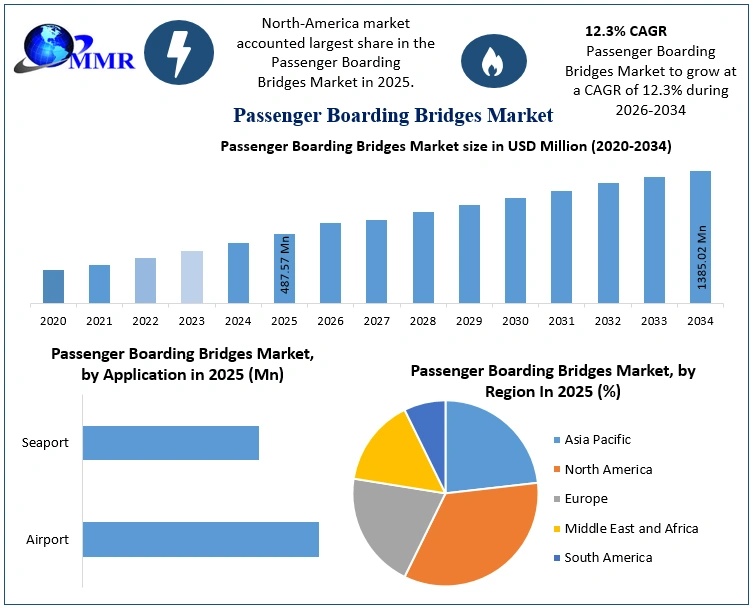
The Passenger Boarding Bridges Market size was valued at USD 487.57 Million in 2025 and the total Passenger Boarding Bridges revenue is expected to grow at a CAGR of 12.3% from 2026 to 2034, reaching nearly USD 1385.02 Million.
Passenger Boarding Bridges Market Overview:
A passenger boarding bridge is an enclosed, elevated walkway with a moveable tunnel that connects a plane to an airport terminal and back. Passengers can board quickly and easily as a result of this. There are some advantages to using a passenger boarding bridge, often known as an aerobridge. It allows passengers to securely go from the airport terminal to the aircraft, protects passengers from inclement weather, and improves security by using aprons. It is primarily intended to allow passengers to move quickly, efficiently, and safely while boarding. A passenger boarding bridge is also used at seaports to load and unload containers from ship to ship.
Passenger Boarding Bridges Market Growth Outlook
To know about the Research Methodology :- Request Free Sample Report
Passenger Boarding Bridges Market Dynamics:
Large Aircraft are high in demand.
The demand for large aircraft is increasing as passenger traffic grows. Despite growing fuel costs and economic slowdowns, air passenger travel has expanded at a 5 % over the last two decades, according to IATA, and is expected to continue at that rate in the future. The overall number of passengers transported on scheduled Bridge Types climbed by 6.4 % to 4.3 billion in 2018, according to ICAO's annual statistics, while the number of departures increased by 3.5 % to 37.8 million in 2018.
Europe accounted for 26.3 % of air passenger traffic, posting a growth of 7.2% ; North America accounted for 22.4 % , posting a growth of 4.7 % ; Asia Pacific accounted for 34.8 % , posting a growth of 9.5 % ; the Middle East accounted for 9.2 % , posting a growth of 3.9 % ; Latin America and the Caribbean accounted for 5.1 % , posting a growth of 7.7 % ; while Africa accounted for 2.1 % of world traffic, posting a growth of 7.5 % .
Passenger boarding bridges have a long life cycle.
New PBBs will be installed in significant part as a result of upcoming airport development and refurbishment projects. Because of the low cost of the latter, the market for PBBs is limited by the refurbishment market for aerobridges. In general, airport authorities choose to rebuild aerobridges because they have an expected lifespan of 8 to 10 years and cost half as much as a new PBB.
High training costs and a shortage of qualified employees
For docking, a PBB must be brought close to the aircraft door. The operator must use the elevation system to modify the height of the PBB and lengthen the telescoped tunnel to line the PBB doors with those of the aircraft. If this procedure is not followed correctly, it may result in an accident. A passenger boarding bridge at Islamabad International Airport, for example, collapsed in October 2018, but no serious damage was reported. PBB docking is only to be done by approved airline personnel or ground handling professionals who are certified to operate them due to the technical and safety concerns around aerobridges.
Airline passenger traffic will expand at a rate of 4.7 % per year, according to Boeing's Commercial Market Outlook 2026–2034. To meet demand over the next two decades, more than 44,004 new commercial aircraft deliveries will be required in the next 20 years. Airlines in the Asia Pacific area will receive 39 % aircraft, while carriers in North America and Europe would receive 41 %.
Partnerships between the public and commercial sectors for airside Elevation systems
A public-private partnership (PPP) is a public-private coElevation system that brings together the public and private sectors to provide airport infrastructure or Bridge Types. Capital investments, developing air Bridge Types, increasing airport commercial activities, and improving customer Bridge Type for competitiveness are all possible purposes of a PPP in aviation.
Passenger Boarding Bridges Market Segment Analysis:
Passenger Boarding Bridges Market is segmented into Bridge type, Elevation system, Application.
Based on Bridge type, the market is segmented into Commuter, Apron, T-Bridge, Nose, and Over-The-Wing Bridge. The apron segment of the passenger boarding bridge market is dominating. This is due to a number of factors, including the fact that it allows for different docking heights for different aircraft types. It has 360-degree directional bogies and a wide range of lateral movement, making it ideal for double-decker aeroplanes such as the A380.
Based on Elevation system, the market is segmented into Hydraulic, Electro-Mechanical. Given the increase in air passenger traffic worldwide as a result of globalization and the growing tourism sector, electro-mechanical will have the largest market share in the passenger boarding bridge market by 2025. In the passenger boarding bridge industry, this electro-mechanical elevation system also offers a high level of dependability, durability, and lifespan. It has cable movements in the telescope tunnels that are directed safely by e-chain systems, as well as vertical movements in the lifting units. As a result, it is simple to operate, and as a result, it has the largest market share.
Based on Application, the market is segmented into Airport and Seaport. The increased need for air traffic and requirement for secure passenger travel, the airport segment is expected to have the biggest market share in the worldwide passenger boarding bridge market in 2025.
Passenger Boarding Bridges Market Regional Insights:
The increasing demand for passenger boarding bridges from airports and seaports in the region, the large number of airports in the United States, and the increasing formulation of regulations to reduce emissions from AI, the North American region holds the largest market share in the passenger boarding bridges market, followed by Europe, and is expected to grow at a rapid rate in the forecast year.
The Asia Pacific region is the world's largest and fastest-growing regional market for passenger boarding bridges, and it is expected to keep this position in the coming years. This can be attributed to a variety of factors, including increased production and demand for boarding bridges in the region, increased R&D spending by economies to develop products that meet the aesthetic requirements of airports while adhering to the agencies' safety requirements, ongoing and upcoming airport projects, and the upgrading of existing airports, among others. India and China are the two key growth engines in the region.
The objective of the report is to present a comprehensive analysis of the Passenger Boarding Bridges Market to the stakeholders in the Equipment. The past and current status of the analysis of complicated data in simple language. The report covers all the aspects of the Equipment with a dedicated study of key players that include market leaders, followers, and new entrants.
PORTER, PESTEL analysis with the potential impact of micro-economic factors of the market has Been presented in the report. External as well as internal factors that are supposed to affect the business positively or negatively have been analyzed, which will give a clear futuristic view of the Equipment to the decision-makers.
The report also helps in understanding the Passenger Boarding Bridges Market dynamics, structure by analyzing the market segments and projects the Passenger Boarding Bridges Market size. Clear representation of competitive analysis of key players by Bridge Type, price, and financial position, Bridge Type portfolio, growth strategies, and Regional presence in the Passenger Boarding Bridges Market make the report investor’s guide.
Passenger Boarding Bridges Market Recent Industry Developments
| Date | Company | Development | Impact |
|---|---|---|---|
| 15 January 2025 | Thyssenkrupp Airport Solutions (TK Airport Solutions) | The company launched its next-generation autonomous passenger boarding bridge system featuring enhanced sensor-fusion positioning capabilities. | This development significantly reduces aircraft turnaround times while boosting operational efficiency and safety at high-traffic international hubs. |
| 28 March 2025 | CIMC Tianda | CIMC Tianda secured a major commercial contract to supply 45 fully electric apron-drive passenger boarding bridges for a major Asian airport expansion. | The initiative directly supports green airport initiatives and carbon-neutral aviation goals across regional transport nodes. |
| 12 June 2025 | JBT Aerotech | JBT Aerotech introduced a remote-monitoring suite integrated with AI-driven predictive maintenance software for jetway systems. | It allows airport operators to minimize unscheduled bridge downtime by up to 35% and optimize maintenance costs. |
| 18 September 2025 | ShinMaywa Industries, Ltd. | ShinMaywa finalized a strategic collaboration with regional airport authorities to deploy smart docking bridge controls for wide-body aircraft. | The partnership enhances docking accuracy and passenger throughput rates during peak travel operations. |
| 10 November 2025 | ADELTE Airport Technologies | ADELTE unveiled a line of climate-insulated glass-walled passenger boarding bridges tailored for extreme temperature environments. | The upgraded design yields a 20% reduction in HVAC energy consumption inside the bridge corridors. |
| 22 January 2026 | Vataple Group | Vataple expanded its manufacturing facility to scale up production of telescopic sea and airport passenger boarding bridges. | This strategic facility expansion strengthens its global supply chain footprint and order fulfillment speed for major infrastructure projects. |
Passenger Boarding Bridges Market Scope: Inquire before buying
| Passenger Boarding Bridges Market | |||
|---|---|---|---|
| Report Coverage | Details | ||
| Base Year: | 2025 | Forecast Period: | 2026-2034 |
| Historical Data: | 2020 to 2025 | Market Size in 2025: | USD 487.57 Mn. |
| Forecast Period 2026 to 2034 CAGR: | 12.3% | Market Size in 2034: | USD 1385.02 Mn. |
| Segments Covered: | by Bridge Type | Commuter Apron T-Bridge Nose Over-The-Wing Bridge |
|
| by Elevation system | Hydraulic Electro-Mechanical |
||
| by Application | Airport Seaport |
||
Passenger Boarding Bridges Market, by Region
North America (United States, Canada and Mexico)
Europe (UK, France, Germany, Italy, Spain, Sweden, Austria and Rest of Europe)
Asia Pacific (China, South Korea, Japan, India, Australia, Indonesia, Malaysia, Vietnam, Taiwan, Bangladesh, Pakistan and Rest of APAC)
Middle East and Africa (South Africa, GCC, Egypt, Nigeria and Rest of ME&A)
South America (Brazil, Argentina Rest of South America)
Passenger Boarding Bridges Market, Key players are
1. FMT Sweden AB
2. Vataple Group Ltd.
3. Hubner GmbH & Co. KG
4. Deerns Groep B.V.
5. Oversys LLC
6. Shanghai Haobo Aviation Equipment Co. Ltd.
7. Aeromobiles Pte. Ltd.
8. Avicorp Middle East
9. Anton Air Support
10. East Island Aviation Bridge Types
11. Dimaim Systems
12. Alpha-CIM
13. Adelte Group
14. John Bean Technologies Corp.
15. Thyssenkrupp AG
Frequently Asked Questions:
1) What was the Global Passenger Boarding Bridges Market size in 2025?
Ans: The Global Passenger Boarding Bridges Market size was USD 487.57 Million in 2025.
2) What is the market segment of Passenger Boarding Bridges Market markets?
Ans -The market segments are based on Bridge type, Elevation system and Application.
3) What is forecast period consider for Passenger Boarding Bridges Market?
Ans -The forecast period for Passenger Boarding Bridges Market is 2026 to 2034.
4) Which are the worldwide major key players covered for Passenger Boarding Bridges Market report?
Ans - FMT Sweden AB, Vataple Group Ltd., Hubner GmbH & Co. KG, Deerns Groep B.V., Oversys LLC, Shanghai Haobo Aviation Equipment Co. Ltd., Aeromobiles Pte. Ltd., Avicorp Middle East, Anton Air Support, East Island Aviation Bridge Types, Dimaim Systems, Alpha-CIM, Adelte Group, John Bean Technologies Corp., Thyssenkrupp AG.
5) Which region is dominated in Passenger Boarding Bridges Market?
Ans -In 2025, Asia Pacific region dominated the Passenger Boarding Bridges Market.