
Paresthesia Treatment Market Size by Causes, Distribution Channels, Region, Industry-Wide Analysis, Competitive Landscape Assessment & Long-Term Forecast to 2032
Overview
The Paresthesia Treatment Market size was valued at USD 6.35 Billion in 2024 and the total Paresthesia Treatment revenue is expected to grow at a CAGR of 3.7% from 2025 to 2032, reaching nearly USD 8.49 Billion.
Paresthesia Treatment Market Overview
Paresthesia is a medical condition, characterized by a burning, tingling, numbness, or prickling sensation in different parts of the body, such as the hands, feet, arms, or legs. The sensation, which occurs without warning, is usually painless and is explained as numbness or tingling, itching, or skin crawling. Chronic paresthesia is usually a symptom of traumatic nerve damage or a neurological disease. It’s caused by disorders concerning the central nervous system like transient ischemic attacks and strokes, transverse myelitis, multiple sclerosis, and encephalitis.
1. The Centre for Disease Control and Prevention (CDC) reports that 37.3 million Americans, or 11.3% of the US population, live with diabetes, and it is estimated that 50.0% of adults with diabetes resolve experience neuropathy during their lifetime.
2. The International Diabetes Federation estimates that 425 million people worldwide have diabetes1, making it the largest global epidemic of the 21st century2, 115 million people in China, 73 million in India and 30 million in the United States have diabetes3.
The growth of the paresthesia treatment market is pushed by the rise in the prevalence of diseases like cancer, the lack of proper nutrients in food, and the surge in the geriatric population.
The global paresthesia treatment industry is highly competitive, with several key players vying for market share. The players are focusing on research and development activities to introduce innovative treatment options for paresthesia.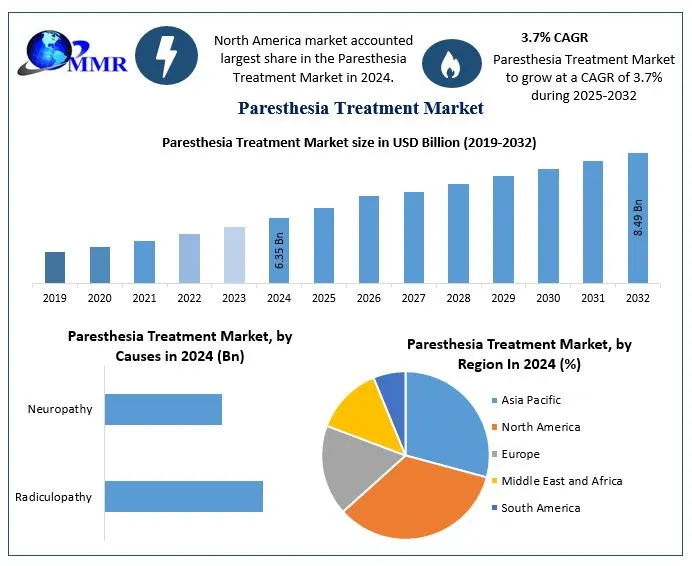 To know about the Research Methodology :- Request Free Sample Report
Paresthesia Treatment Market Dynamics:
Driving Factors and Growth Trends in the Paresthesia Therapy Market
The increasing incidence of neurological disorders like multiple sclerosis, diabetic neuropathy, and carpal tunnel syndrome is driving the growth of the paresthesia therapy market. Carpal tunnel syndrome, resulting from compression or pinching of the median nerve, stands as the most common cause of paresthesia.
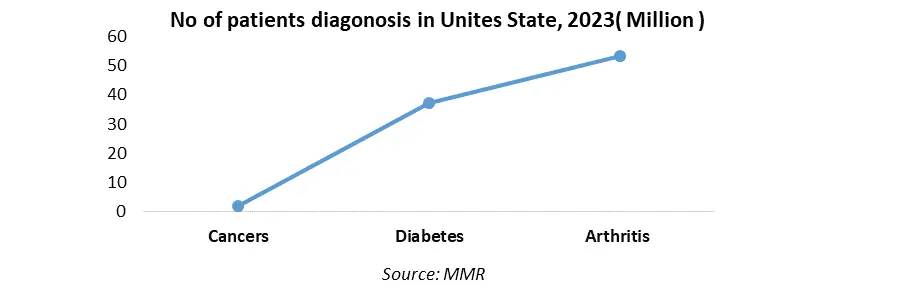
Advancements in medical equipment such as transcutaneous electrical nerve stimulation (TENS) devices and ultrasound are driving the demand for paresthesia therapy. Growing knowledge of paresthesia and the availability of effective treatment options, as well as governments around the world investing in healthcare infrastructure and initiating awareness campaigns, are contributing to market growth. The rising number of cancers, diabetes, and arthritis cases has significantly increased the demand for paresthesia treatment.
 Emerging Treatment Modalities and Opportunities in Paresthesia Therapy
The development of advanced treatment options such as gene therapy and stem cell therapy is predicted to present new opportunities for the growth of the paresthesia treatment industry and the rising number of cancers, diabetes, and arthritis cases has significantly increased the demand for paresthesia treatment. Combining different treatment modalities is being explored to optimize outcomes for patients with complex or chronic paraesthesia. For instance, a combination of medication, and physical aspects of the condition simultaneously.
Challenges and Considerations in Diagnosing and Treating Paresthesia
Accurate diagnosis container be difficult, particularly when it is associated with underlying conditions that share similar symptoms. Lack of awareness or misdiagnosis results in treatment delays or ineffective management. There are several negative effects associated with the medications, including headache, weight gain, nausea, skin rashes, or diarrhoea. The symptoms are transient and minor. After taking antidepressants, some patients experience daytime sleepiness, in the regular schedule. Similarly, branded medications for treating neuropathic pain tend to be costly. In less developed areas of medication adoption within the neuropathic pain market, patients often opt for generic restraints of the paresthesia market.
Paresthesia Treatment Market Segment Analysis:
Based on causes, Radiculopathy is commonly known as a pinched nerve. It is a condition where one or more nerves are affected and stop performing their functions. The condition leads to pain, weakness, numbness and difficulty in controlling certain muscles. Vertebral radiculopathy, cervical radiculopathy, Thoracic radiculopathy, and Lumbar radiculopathy are the types of Radiculopathy. The demand for vertebral radiculopathy market is increasing with the rise in the number of patients suffering from osteoporosis, slipped discs and osteoarthritis. Approximately 10 million Americans have osteoporosis and another 44 million have low bone density, placing them at increased risk. Among adults aged 45 to 65 years, 26% report ever having been diagnosed with arthritis. Among adults aged 18 to 45 years, 5% report ever having been diagnosed with arthritis.
North America followed by Europe is the dominant market of vertebral radiculopathy due to technological advancement, infrastructure and better healthcare facilities and Asia Pacific is expected to grow during the forecast period owed to the rise in the ageing population suffering from osteoarthritis and increasing government initiatives. The key players in the global vertebral radiculopathy market are Bayer AG, Atnahs, Taisho Pharmaceutical Co., ltd., Almatica Pharma, Inc. Canton Laboratories, LLC, etc. Acquisition, mergers, strategic collaborations, and technology play a vital role in the growth of the vertebral radiculopathy market.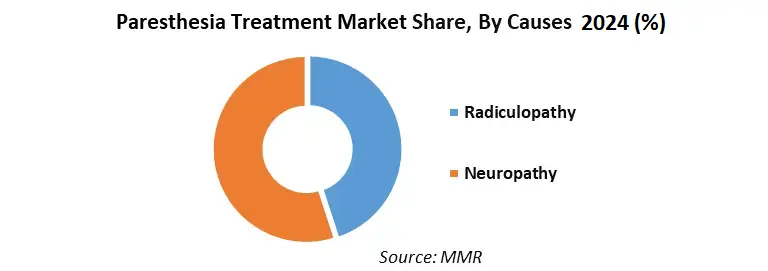
Paresthesia Treatment Market by Regional Insight
North America is a dominant region in the Paresthesia Treatment industry and is expected to grow at a CAGR of 10.8 % through the forecast period, owing to the presence of a large patient population, strong presence of key players, ease of drug availability, well-developed healthcare infrastructure, favourable reimbursement policies in the healthcare system, higher number of research, development & innovation activities and higher adoption of advanced therapeutics.
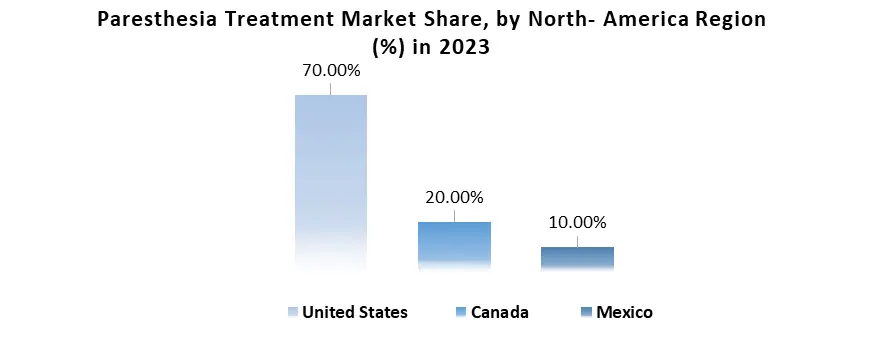
The United States was a dominant region in North America with the market 70 % share in 2024. It has a significant prevalence of neurological conditions, such as diabetic neuropathy, carpal tunnel syndrome, and multiple sclerosis in US. About 20 million Americans suffer from peripheral neuropathy, a general term for damage to nerves located outside the brain and spinal cord. Peripheral nerves carry messages between the central nervous system to the rest of the body, including arms and legs.
The United States is at the forefront of medical research and technological advancement, which has led to the development of innovative treatment modalities for paresthesia, including advanced medical devices like TENS machines, nerve stimulators, and other neurostimulation technologies.
 Competitive landscape:
Boston Scientific Corp. is one of the dominant industries in the paresthesia Treatment Market.
1. In October 2023, Boston Scientific Corp. received FDA (Food and Drug Administration) approval for an expanded indication of the Wave Writer Alpha Spinal Cord Stimulator (“SCS”) Systems for the treatment of painful diabetic peripheral neuropathy (DPN), a complication of diabetes that affect the lower extremities of the body.
2. 26, 2023, Abbott (NYSE: ABT) announced that the U.S. Food and Drug Administration (FDA) has approved its Proclaim™ XR spinal cord stimulation (SCS) system to treat painful diabetic peripheral neuropathy (DPN).
Paresthesia Treatment Market Scope: Inquire before buying
| Global Paresthesia Treatment Market | |||
|---|---|---|---|
| Report Coverage | Details | ||
| Base Year: | 2024 | Forecast Period: | 2025-2032 |
| Historical Data: | 2019 to 2024 | Market Size in 2024: | USD 6.35 Bn. |
| Forecast Period 2025 to 2032 CAGR: | 3.7% | Market Size in 2032: | USD 8.49 Bn. |
| Segments Covered: | By Causes | Radiculopathy Neuropathy |
|
| By Distribution Channels | Hospitals Clinics Diagnostic Centres |
||
Paresthesia Treatment Market, by Region:-
North America (United States, Canada, and Mexico)
Europe (UK, France, Germany, Italy, Spain, Sweden, Austria, and the Rest of Europe)
Asia Pacific (China, South Korea, Japan, India, Australia, Indonesia, Malaysia, Vietnam, Taiwan, Bangladesh, Pakistan, and the Rest of APAC)
Middle East and Africa (South Africa, GCC, Egypt, Nigeria, and the Rest of ME&A)
South America (Brazil, Argentina Rest of South America)
Key Industry Players in the Paresthesia Treatment Market:
1. Pfizer Inc.
2. Novartis AG
3. GlaxoSmithKline plc
4. Merck & Co., Inc.
5. Johnson & Johnson
6. Teva Pharmaceutical Industries Ltd.
7. AbbVie Inc.
8. Amgen Inc.
9. AstraZeneca PLC
10. Bayer AG
11. Eli Lilly and Company
12. Sanofi S.A.
13. Medtronic plc
14. Boston Scientific Corporation
15. Abbott Laboratories
16. Stryker Corporation
17. Siemens Healthineers AG
18. Cardinal Health, Inc.
19. Medtronic Inc.
20. Allergan plc
Frequently Asked Questions:
1] What segments are covered in the Paresthesia Treatment Market report?
Ans. The segments covered in the Paresthesia Treatment Market report are based on Causes and Distribution Channels.
2] Which region is expected to hold the highest share in the Paresthesia Treatment Market?
Ans. The North America region is expected to hold the highest share of the Paresthesia Treatment Market.
3] What is the market size of the Paresthesia Treatment Market by 2032?
Ans. The market size of the Paresthesia Treatment Market by 2032 will be USD 8.49 Billion.
4] What was the Global Paresthesia Treatment Market size in 2024?
Ans: The Global Paresthesia Treatment Market size was USD 6.35 Billion in 2024.