
Oncology Biosimilars Market Size – Industry Structure Evaluation, Demand Drivers Analysis, Regional Growth Analysis and Identification, Competitive Positioning Review & Global Market Size Forecast to 2029
Overview
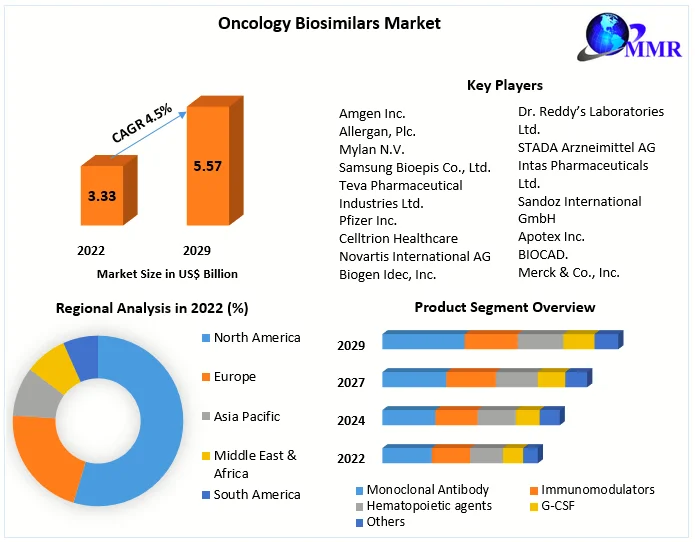
Oncology Biosimilars Market size is expected to grow at 7.61% throughout the forecast period, reaching nearly US$ 5.57 Bn by 2029.
A biosimilar is a biologic drug that is similar to its reference drug, with no clinically meaningful differences in purity, potency, or safety; however, there may be some minor differences in its inactive components. Similarly, oncology biosimilar is the similar copy of oncology biologics used for the treatment of cancer.
 To know about the Research Methodology:-Request Free Sample Report
These oncology biosimilar is cost-effective, efficient, and have the identical ability as biologics. These molecules are easily produce as compared to biologics and it can only be manufactured after patent expiry. These are comparatively cheaper than branded or approved products.
The scope of the report includes a detailed study of global and regional markets for Oncology Biosimilars with the reasons given for variants in the growth of the industry in certain regions. The oncology biosimilars market is anticipated to benefit enormously with the growing demand for reasonable therapies for cancer. Increasing number of occurrences of for cancer such as cervical cancer, stomach cancer, lung cancer, and breast cancer is increasing demand for the appropriate treatment of every type of the caner is anticipated to drive the oncology biosimilars treatment market during forecast period.
Recently, World Health Organization (WHO) reported that, around 8.8 million people died due to cancer in globe. Increasing frequency of several types of cancer across the globe is supporting the market growth. Increasing risk of cancer is related with increasing age, thus nearly 77% of all cancers are detected in elder population and most cases of cancer arise in middle-aged adults or older population.
Considering this factors, the growth for the oncology biosimilars is anticipated to fuel by the expiration of the patents of a large number of biologics. These factors are also anticipated to contribute to the significant and fuel the growth of the oncology biosimilars market. Raising number of associations for development of biosimilar is anticipated to propel the growth of oncology biosimilars market during forecast period.
Implementation of oncology biosimilars for the treatment of cancer is increasing growth of the oncology biosimilars market. Moreover, raising number of product approvals for treatment of several types of cancer is expected to drive the growth of market. Nevertheless, complex manufacturing process and its approval is key factor for hamper the growth oncology biosimilars market.
The report on Oncology Biosimilars market covers segments such as By Cancer Type, Product Type, Distribution Channel and Region. The Cancer Type segment includes Lung Cancer, Colorectal cancer, Cervical Cancer, Breast Cancer, Kidney cancer, Stomach cancer, Brain Cancer, and Others. Among the Cancer Type, Breast cancer is anticipated to dominating segment throughout forecast period owing to raising incidence of breast cancer in globe.
The Product Type segment is further sub-segmented into Monoclonal Antibody, Immunomodulators, Hematopoietic agents, G-CSF and Others. Among the product type, G-CSF is anticipated to hold major market share during forecast period due to raising demand of G-CSF for the treatment of breast cancer across the globe.
Based on Distribution Channel, the Oncology Biosimilars market is sub-segmented into Hospital Pharmacies, Retail Pharmacies, and Online Pharmacies. The hospital Pharmacies occupied highest market share in 2021, due to the convenience of trained & qualified personnel and promising reimbursement structure.
The online Pharmacies is projected to demonstration highest CAGR in the forecast period, which is recognized to the technological adaptation and acceptance of online Pharmacies by population. The retail Pharmacies demonstrated the reasonable market share in 2021 due to increasing geriatric population & developments in the healthcare amenities in emerging countries are estimated to drive the popularity of retail Pharmacies throughout the forecast period.
Based on regional segment, the Oncology Biosimilars market is sub-segmented into North America, Latin America, Europe, Asia Pacific, and Middle East & Africa. North America is expected to hold the largest market share in the oncology biosimilar market throughout the forecast period. According to the American Society of Cancer (ASC), around 1.8 million new cases of cancer were registered and nearby 606,880 deaths from cancer are anticipated to occur in the US in 2021. Europe oncology biosimilar market is anticipated to increase significantly.
Raising occurrence of breast cancer in the U.K and over 55,000 breast cancer cases are register each year in the U.K and about 4,700 in Scotland are the factors anticipated to drive the market growth in the region. Asia Pacific (APAC) is anticipated to the fastest developing oncology biosimilar market throughout the forecast period. Mostly, Breast cancer is commonly spread in Asian countries due to unhealthy lifestyle, increasing obesity which has increased demand of oncology biosimilar market. LAMEA is projected to grow at a steady rate due to the undeveloped healthcare amenities. Lack of awareness about the healthy lifestyle is reducing the cancer treatment in this region.
Key players operating in the Oncology Biosimilars market Amgen Inc., Allergan, Plc, Mylan N.V., Samsung Bioepis Co., Ltd., Teva Pharmaceutical Industries Ltd., Pfizer Inc., Celltrion Healthcare, Novartis International AG, Biogen Idec, Inc., Biocon Limited., Celltrion Inc., Dr. Reddy’s Laboratories Ltd., STADA Arzneimittel AG, Intas Pharmaceuticals Ltd., Sandoz International GmbH, Apotex Inc., BIOCAD, Merck & Co., Inc., and Coherus Biosciences. The companies functioning in the market are concentrating on R&D investments and fund raising activities to drive clinical trials that lead to robust product pipeline. As detection rate and market perception withstand to expand, there are anticipations for market growth during forecast period. Furthermore, innovative product sanctions in the market will further drive the market growth.
The objective of the report is to present a comprehensive assessment of the market and contains thoughtful insights, facts, historical data, industry-validated market data and projections with a suitable set of assumptions and methodology. The report also helps in understanding Oncology Biosimilars market dynamics, structure by identifying and analyzing the market segments and project the global market size.
Further, the report also focuses on the competitive analysis of key players by Product, price, financial position, Product portfolio, growth strategies, and regional presence. The report also provides PEST analysis, PORTER’s analysis, and SWOT analysis to address the question of shareholders to prioritizing the efforts and investment shortly to the emerging segment in the Oncology Biosimilars market.
The report study has analyzed revenue impact of covid-19 pandemic on the sales revenue of market leaders, market followers and disrupters in the report and same is reflected in our analysis.
Scope of the Oncology Biosimilars Market: Inquire before buying
| Global Oncology Biosimilars Market | |||
|---|---|---|---|
| Report Coverage | Details | ||
| Base Year: | 2022 | Forecast Period: | 2023-2029 |
| Historical Data: | 2018 to 2022 | Market Size in 2022: | US $ 3.33 Bn. |
| Forecast Period 2023 to 2029 CAGR: | 7.61% | Market Size in 2029: | US $ 5.57 Bn. |
| Segments Covered: | by Cancer Type | Lung Cancer Colorectal cancer Cervical Cancer Breast Cancer Kidney cancer Stomach cancer Brain Cancer Others |
|
| by Product Type | Monoclonal Antibody Immunomodulators Hematopoietic agents G-CSF Others |
||
| by Distribution Channel | Hospital Pharmacies Retail Pharmacies Online Pharmacies |
||
Oncology Biosimilars Market, By Region
North America (United States, Canada and Mexico)
Europe (UK, France, Germany, Italy, Spain, Sweden, Austria and Rest of Europe)
Asia Pacific (China, South Korea, Japan, India, Australia, Indonesia, Malaysia, Vietnam, Taiwan, Bangladesh, Pakistan and Rest of APAC)
Middle East and Africa (South Africa, GCC, Egypt, Nigeria and Rest)
Key players
1.Amgen Inc.
2.Allergan, Plc.
3.Mylan N.V.
4.Samsung Bioepis Co., Ltd.
5.Teva Pharmaceutical Industries Ltd.
6.Pfizer Inc.
7.Celltrion Healthcare
8.Novartis International AG
9.Biogen Idec, Inc.
10.Biocon Limited.
11.Celltrion Inc.
12.Dr. Reddy’s Laboratories Ltd.
13.STADA Arzneimittel AG
14.Intas Pharmaceuticals Ltd.
15.Sandoz International GmbH
16.Apotex Inc.
17.BIOCAD.
18.Merck & Co., Inc.
19.Coherus Biosciences
20.F Hoffmann-La Roche
21.Momenta Pharmaceuticals Inc.
Frequently Asked Questions:
1. Which region has the largest share in Global Oncology Biosimilars Market?
Ans: Asia Pacific region holds the highest share in 2022.
2. What is the growth rate of Global Oncology Biosimilars Market?
Ans: The Global Market is growing at a CAGR of 7.61% during forecasting period 2023-2029.
3. What is scope of the Global Oncology Biosimilars market report?
Ans: Global Market report helps with the PESTEL, PORTER, COVID-19 Impact analysis, Recommendations for Investors & Leaders, and market estimation of the forecast period.
4. Who are the key players in Global Oncology Biosimilars market?
Ans: The important key players in the Global Oncology Biosimilars Market are – Amgen Inc., Allergan, Plc., Mylan N.V., Samsung Bioepis Co., Ltd., Teva Pharmaceutical Industries Ltd., Pfizer Inc., Celltrion Healthcare, Novartis International AG, Biogen Idec, Inc., Biocon Limited., Celltrion Inc., Dr. Reddy’s Laboratories Ltd., STADA Arzneimittel AG, Intas Pharmaceuticals Ltd., Sandoz International GmbH, Apotex Inc., BIOCAD., Merck & Co., Inc., Coherus Biosciences, F Hoffmann-La Roche, and Momenta Pharmaceuticals Inc.
5. What is the study period of this market?
Ans: The Global Market is studied from 2022 to 2029.