Odor Sensor Market Size: Industry Structure Evaluation, Demand Drivers Analysis, Regional Growth Analysis and Identification, Competitive Positioning Review & Global Market Size Forecast to 2032

28.12%
CAGR (2026-2032)
3.78 USD Bn.
Market Size
303
Report Pages
131
Market Tables

Overview

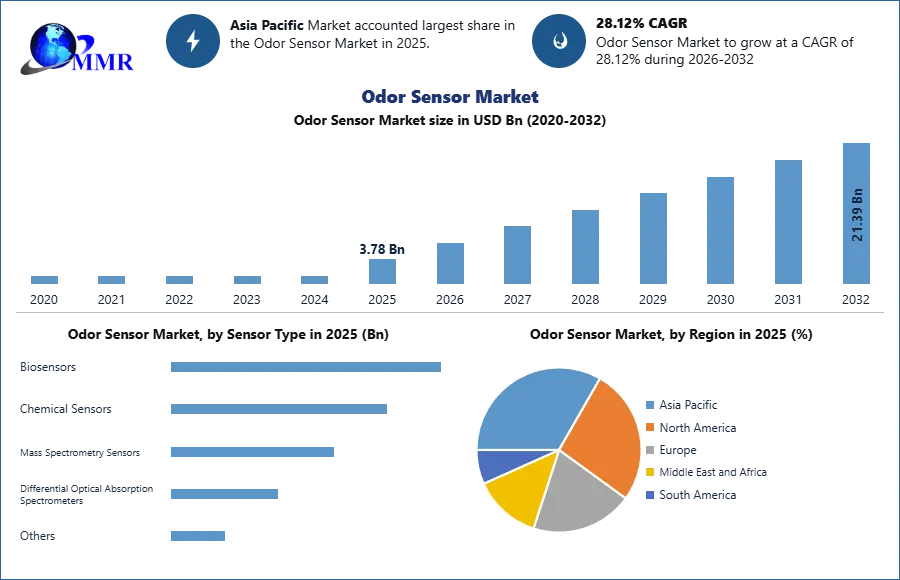
Global Odor Sensor Market size was valued at USD 3.78 Bn in 2025 and is expected to reach USD 21.39 Bn by 2032, at a CAGR of 28.12% over the forecast period.

Odor Sensor Market Overview

Odor Sensors are designed to detect odor in an electrical appliance such as air purifier or breathlyzer. MOS or QCM sensors are types of odor sensor, which has characteristics that respond to different odors. E- Noise technique is used to identify odor by detecting the “fingerprint” of a chemical compound across an array of sensors monitored by pattern-recognition software.
To know about the Research Methodology :- Request Free Sample Report

Odor Sensor Market Dynamics

Rising awareness of air pollution and its negative effects on health to influence the market growth

Increasing demand for smart homes, building automation, food safety and quality control is expected to witness significant growth in the Odor Sensor industry over the forecast period. The system is responsible for the reception of the stimulus initiated by odorants and the transmission & processing of the signals is referred to as the olfactory system. Technological advantages that Odor sensors have over conventional technical sensors for odor detection have been comprehensively analyzed and have resulted in the growth of the Odor Sensor market share.

Biosensors technology helps odor sensors to detect odor through a final breakthrough. Odor sensor technology is made between biosensors and technical sensors. An electronic odor sensor is configured to receive output signals related to the presence or absence of an odor.  Envirosuite, a developer of real-time, and diagnostic environmental management software installed odor monitoring sensor to find the source of a noxious odor.

Industries, such as food and beverage, chemicals, and manufacturing, utilize odor sensors for quality control, process optimization, and compliance with safety regulations. The need for early detection of odor-related issues drives the adoption of odor sensing technologies. Increasing awareness of environmental issues and the need for air quality monitoring contribute to the demand for odor sensors. These sensors are used in environmental monitoring systems to detect and manage pollution and emissions, which is expected to boost the Odor Sensor Market growth.

Odor sensors play a crucial role in maintaining health and safety standards in various environments. In settings such as laboratories, hospitals, and industrial facilities, early detection of noxious or harmful odors is essential for preventing accidents and ensuring worker safety. With the growth of smart home and Internet of Things (IoT) technologies, there's an increased demand for sensors, including odor sensors, to enable automated and intelligent systems. Odor sensors contribute to creating smarter and more responsive living spaces.

Calibration and Maintenance of sensors to restraint the Odor Sensor Market growth

Odor sensors require regular calibration to maintain accuracy. Ongoing maintenance is essential for optimal performance. The need for periodic calibration and maintenance can add complexity and cost to the overall deployment. Achieving a high level of sensitivity and specificity in odor detection can be challenging. Odor sensors Market face limitations in accurately distinguishing between different odors or detecting low concentrations, impacting their overall reliability. Cross-sensitivity refers to the ability of a sensor to respond to multiple odorants.

While some cross-sensitivity can be beneficial, excessive cross-reactivity leads to false positives or inaccurate readings, impacting the reliability of the sensor. The absence of standardized protocols for odor sensor testing and evaluation can pose challenges. Lack of standardization may hinder interoperability, make it difficult to compare different sensor technologies, and create uncertainty among end-users. Handling and interpreting the data generated by odor sensors can be complex. Effective analysis and interpretation of odor data may require advanced algorithms and data processing capabilities, adding complexity to sensor deployment.

Rapid advancements in technology pose challenges in terms of compatibility and integration with existing systems, which significantly restraint the Odor sensor market growth. Upgrading or replacing sensors to keep up with technological advancements may be a consideration for businesses.

Opportunities in the Odor Sensor Market

1. Emerging healthcare applications and medical diagnosis is expected to present lucrative opportunities for the growth of the Odor sensor market.

2. IoT for smart odor monitoring to reduce human involvement is an opportunity to increase the Odor Sensor Market growth.

3. Expansion in Industrial Applications: Continued expansion of odor sensor applications in industries such as food and beverage, chemicals, pharmaceuticals, and manufacturing. Odor sensors can be used for quality control, process optimization, and compliance with safety regulations.

4. Rise in Environmental Monitoring: Growing demand for odor sensors in environmental monitoring systems to detect and manage pollution, emissions, and air quality. Governments and organizations are increasingly investing in monitoring technologies to address environmental concerns.

5. Integration in Consumer Electronics: Increased integration of odor sensors in consumer electronics, including home appliances and wearables. This can enhance user experiences by enabling devices to detect and respond to specific odors, improving functionality and convenience.

Technical Performance Criteria of Odor Sensing Technologies

1. Sensitivity
2. Accuracy
3. Selectivity
4.Resolution
5. Repeatability
6. Lifetime
7. Reliability
8. Multi-sensing capability
9. Operability

Odor Sensor Market Regional Insight

Growing Industrialization in Asia Pacific to dominates the global Odor Sensor Market growth

Increasing demand for power & energy and rapid industrialization, with emission of toxic pollutants and exhaust gases is creating demand for Odor Sensor in the region. Government regulations in India, China, and Japan for the emission of toxic air pollutants create an opportunity for the Odor Sensor industry competitors in the region. China is expected to hold a significant Odor sensor market share in terms of revenue, with rise in investment by major players and security solutions by the government in the region. Growing environmental concerns and increasing regulatory focus on air quality and pollution control have fueled the adoption of odor sensors.

Governments in the Asia-Pacific region are implementing stricter environmental standards, creating opportunities for sensor manufacturers. In agricultural economies within the region, odor sensors are employed in precision agriculture. They can detect odors associated with crop diseases, soil conditions, or animal health, contributing to improved farming practices. The healthcare industry in the Asia-Pacific region is increasingly exploring the use of odor sensors for applications such as disease diagnosis and monitoring. Odor detection plays a role in identifying specific health conditions through breath analysis.

In North America, the United States is expected to acquire the prime market share over the forecast period. The industrial sector in North America, including manufacturing, food processing, and chemicals, has been a significant driver for the adoption of odor sensors. These sensors are used for quality control, safety compliance, and process optimization. Odor sensors play a crucial role in waste management practices in North America.

They are used to monitor and control odors from landfills, waste treatment plants, and recycling facilities, addressing concerns about environmental impact, which is expected to boost the Odor Sensor Market in North America. Ongoing technological innovations in sensor technologies, including improvements in sensitivity, selectivity, and response times, contribute to the development of more efficient and reliable odor sensors in North America. Odor sensors find applications in the energy industry for monitoring and safety purposes. In sectors such as natural gas and oil, odor sensors are used to detect leaks and ensure workplace safety.

In the Europe region, Germany dominated the odor sensor market in 2025 and is expected to continue the trend over the forecast period. Followed by Germany, the UK is the fastest-growing country in Europe and may contribute to market growth.

Odor Sensor Market Segmentation

Based on Sensor type, the market is segmented into biosensors, chemical sensors, mass spectrometry sensors, differential optical absorption spectrometers, and others. Chemical sensor is expected to dominate the Odor Sensor Market over the forecast period.  Chemical sensors contribute to environmental monitoring by detecting pollutants and emissions. They are used in applications such as air quality monitoring, detecting chemical leaks, and ensuring compliance with environmental regulations. In healthcare, chemical sensors find applications in breath analysis for disease diagnosis.

They detect specific chemical markers associated with various health conditions, offering non-invasive and rapid diagnostic capabilities. Chemical sensors aim to provide selective detection of specific chemical compounds, which significantly boost the Odor Sensor Market growth. The sensor's design and materials are tailored to respond to particular target molecules, enhancing accuracy. The sensitivity of chemical sensors determines their ability to detect low concentrations of target compounds. High sensitivity is crucial for applications requiring precise and early detection.

Based on Instrument type, the market is segmented into one-element odor sensors and multiodor sensors. Multiodor sensor held the largest market share in 2025 and is expected to dominate the odor sensor market over the forecast period. A multiodor sensor incorporate an array of sensing elements or technologies to detect a broad range of odors. Each element within the array could be designed to respond to specific classes or types of chemical compounds.

The versatility of a multiodor sensor could lie in its capacity to adapt to various environments or applications, where different combinations of odors present. A well-designed multiodor sensor likely aim for selective detection, meaning it discern between different odors rather than providing a generic response to any odor, which is expected to boost the odor sensor market growth over the forecast period.

Based on End-user, the market is segmented into Military and Defense, Agriculture, Healthcare, Entertainment, Renewal Energy Generation and Waste Management, Food and Beverages, Cosmetics, and Others. The healthcare segment acquired the largest market share in 2025, and is expected to grow at the highest growth rate during the forecast period. Odor sensors contribute to disease diagnosis by detecting specific odors or chemical compounds associated with diseases. The ability to identify unique odor profiles related to diseases can aid in early diagnosis and monitoring. Certain diseases and infections are associated with distinct odors.

Odor sensors are used to detect the unique odor patterns associated with infections, wound healing, or skin disorders. Odor sensors are utilized in sterilization processes to ensure the effectiveness of medical equipment sterilization. They detect residual odors that indicate incomplete sterilization, which is expected to boost the Odor Sensor Market growth.

Competitive Analysis:

The company profiles and competitive analysis of the major players is provided in the Odor Sensor Market report. The regions covered in the report are North America, Europe, Asia-Pacific, and . The strategies adopted by the major player, such as product portfolio expansion, mergers & acquisitions, agreements, geographical expansion, and collaborations, to enhance the Odor Sensor industry penetration. The competitive environment in the market with technological innovation, product extensions, and different strategies are adopted by the key vendors. Some of the Odor Sensor key players in the market are Envirosuite, Figaro, Panasonic, Honeywell, Aryballe, etc.

Recent Developments

January 2025 – Odotech continued strengthening its leadership in industrial odor monitoring networks by expanding real-time odor mapping solutions across wastewater treatment plants, waste management facilities, and manufacturing sites. The company enhanced its electronic nose (e-nose) sensor networks with improved cloud-based analytics, automated compliance reporting, and faster regulatory alert systems. Odotech also advanced site-specific calibration models to improve detection sensitivity and partnered with environmental authorities to deploy large-scale odor management systems aimed at minimising community odor impact and supporting proactive environmental governance.

March 2025 – Airsense Analytics GmbH expanded its modular electronic nose (e-nose) portfolio for industrial and environmental odor monitoring applications. The company enhanced its sensor array technology with improved pattern recognition algorithms and real-time data transmission capabilities for wastewater treatment plants, composting facilities, and landfill sites. It also strengthened integration with cloud-based monitoring platforms, enabling remote diagnostics, automated reporting, and predictive odor event detection. These developments support regulatory compliance, faster response times, and improved odor source identification to help industrial operators reduce environmental impact and community complaints.

Odor Sensor Market Scope: Inquiry Before Buying

Odor Sensor Market
Report Coverage Details
Base Year: 2025 Forecast Period: 2026-2032
Historical Data: 2020 to 2025 Market Size in 2025: 3.78 USD Bn
Forecast Period 2026-2032 CAGR: 28.12% Market Size in 2032: 21.39 USD Bn
Segments Covered: by Sensor Type Biosensors
Chemical Sensors
Mass Spectrometry Sensors
Differential Optical Absorption Spectrometers
Others
by Instrument Type One Element Odor Sensors
Multiodor Sensors
by Application Smell visualization and standardization
Food quality control
Medical diagnosis
Air control and environmental monitoring
Others
by End-User Military defense
Agriculture
Healthcare
Entertainment
Food beverage
Others

Odor Sensor Market, by Region

North America (United States, Canada and Mexico)
Europe (UK, France, Germany, Italy, Spain, Sweden, Austria and Rest of Europe)
Asia Pacific (China, South Korea, Japan, India, Australia, Indonesia, Malaysia, Vietnam, Taiwan, Bangladesh, Pakistan and Rest of APAC)
Middle East and Africa (South Africa, GCC, Egypt, Nigeria and Rest of ME&A)
South America (Brazil, Argentina Rest of South America)

Key players/Competitors profiles covered in the Odor Sensor Market report in strategic perspective

  1. Envirosuite
  2. Figaro Engineering Inc.
  3. Panasonic Corporation
  4. Honeywell International Inc.
  5. Aryballe Technologies
  6. New Cosmos Electric Co. Ltd.
  7. Drägerwerk AG & Co. KGaA
  8. Aeroqual
  9. Comon Invent B.V.
  10. Membrapor AG
  11. Electronic Sensor Technology
  12. Odotech Inc.
  13. Alphasense
  14. Airsense Analytics GmbH
  15. AMS OSRAM AG
  16. Osun Technologies Inc.
  17. Renesas Electronics Corporation
  18. RoboScientific Ltd.
  19. Sensigent LLC
  20. Sensirion AG
  21. SGX Sensortech
  22. Siemens AG
  23. Oizom Instruments Pvt. Ltd.
  24. Vaisala Oyj
  25. Multisensor Systems Ltd.
  26. Agilent Technologies Inc.
  27. Thermo Fisher Scientific Inc.
  28. Owlstone Medical Ltd.
  29. Met One Instruments Inc.
  30. TSI Incorporated
  31. Shinyei Technology Co., Ltd.
  32. PureAire Monitoring Systems, Inc.
  33. BMT MESSTECHNIK GmbH
  34. KIMO Instruments
  35. Olfasense GmbH

Table of Contents

1. Odor Sensor Market Introduction
1.1. Study Assumption and Market Definition
1.2. Scope of the Study
1.3. Executive Summary
2. Global Odor Sensor Market: Competitive Landscape
2.1. MMR Competition Matrix
2.2. Competitive Landscape
2.3. Key Players Benchmarking
2.3.1. Company Name
2.3.2. Business Segment
2.3.3. End-user Segment
2.3.4. Revenue (2025)
2.3.5. Company Locations
2.4. Leading Odor Sensor Market Companies, by market capitalization
2.5. Market Structure
2.5.1. Market Leaders
2.5.2. Market Followers
2.5.3. Emerging Players
2.6. Mergers and Acquisitions Details
3. Odor Sensor Market: Dynamics
3.1. Odor Sensor Market Trends by Region
3.1.1. North America Odor Sensor Market Trends
3.1.2. Europe Odor Sensor Market Trends
3.1.3. Asia Pacific Odor Sensor Market Trends
3.1.4. Middle East and Africa Odor Sensor Market Trends
3.1.5. South America Odor Sensor Market Trends
3.2. Odor Sensor Market Dynamics by Region
3.2.1. North America
3.2.1.1. North America Odor Sensor Market Drivers
3.2.1.2. North America Odor Sensor Market Restraints
3.2.1.3. North America Odor Sensor Market Opportunities
3.2.1.4. North America Odor Sensor Market Challenges
3.2.2. Europe
3.2.2.1. Europe Odor Sensor Market Drivers
3.2.2.2. Europe Odor Sensor Market Restraints
3.2.2.3. Europe Odor Sensor Market Opportunities
3.2.2.4. Europe Odor Sensor Market Challenges
3.2.3. Asia Pacific
3.2.3.1. Asia Pacific Odor Sensor Market Drivers
3.2.3.2. Asia Pacific Odor Sensor Market Restraints
3.2.3.3. Asia Pacific Odor Sensor Market Opportunities
3.2.3.4. Asia Pacific Odor Sensor Market Challenges
3.2.4. Middle East and Africa
3.2.4.1. Middle East and Africa Odor Sensor Market Drivers
3.2.4.2. Middle East and Africa Odor Sensor Market Restraints
3.2.4.3. Middle East and Africa Odor Sensor Market Opportunities
3.2.4.4. Middle East and Africa Odor Sensor Market Challenges
3.2.5. South America
3.2.5.1. South America Odor Sensor Market Drivers
3.2.5.2. South America Odor Sensor Market Restraints
3.2.5.3. South America Odor Sensor Market Opportunities
3.2.5.4. South America Odor Sensor Market Challenges
3.3. PORTER's Five Forces Analysis
3.4. PESTLE Analysis
3.5. Technology Roadmap
3.6. Regulatory Landscape by Region
3.6.1. North America
3.6.2. Europe
3.6.3. Asia Pacific
3.6.4. Middle East and Africa
3.6.5. South America
3.7. Key Opinion Leader Analysis For Odor Sensor Industry
3.8. Analysis of Government Schemes and Initiatives For Odor Sensor Industry
3.9. Odor Sensor Market Trade Analysis
3.10. The Global Pandemic Impact on Odor Sensor Market
4. Odor Sensor Market: Global Market Size and Forecast by Segmentation (in USD Bn) 2025-2032
4.1. Odor Sensor Market Size and Forecast, by Sensor Type (2025-2032)
4.1.1. Biosensors
4.1.2. Chemical Sensors
4.1.3. Mass Spectrometry Sensors
4.1.4. Differential Optical Absorption Spectrometers
4.1.5. Others
4.2. Odor Sensor Market Size and Forecast, by Instrument Type (2025-2032)
4.2.1. One Element Odor Sensors
4.2.2. Multiodor Sensors
4.3. Odor Sensor Market Size and Forecast, by Application (2025-2032)
4.3.1. Smell visualization and standardization
4.3.2. Food quality control
4.3.3. Medical diagnosis
4.3.4. Air control and environmental monitoring
4.3.5. Others
4.4. Odor Sensor Market Size and Forecast, by End-User (2025-2032)
4.4.1. Military defense
4.4.2. Agriculture
4.4.3. Healthcare
4.4.4. Entertainment
4.4.5. Food beverage
4.4.6. Others
4.5. Odor Sensor Market Size and Forecast, by Region (2025-2032)
4.5.1. North America
4.5.2. Europe
4.5.3. Asia Pacific
4.5.4. Middle East and Africa
4.5.5. South America
5. North America Odor Sensor Market Size and Forecast by Segmentation (in USD Bn) 2025-2032
5.1. North America Odor Sensor Market Size and Forecast, by Sensor Type (2025-2032)
5.1.1. Biosensors
5.1.2. Chemical Sensors
5.1.3. Mass Spectrometry Sensors
5.1.4. Differential Optical Absorption Spectrometers
5.1.5. Others
5.2. North America Odor Sensor Market Size and Forecast, by Instrument Type (2025-2032)
5.2.1. One Element Odor Sensors
5.2.2. Multiodor Sensors
5.3. North America Odor Sensor Market Size and Forecast, by Application (2025-2032)
5.3.1. Smell visualization and standardization
5.3.2. Food quality control
5.3.3. Medical diagnosis
5.3.4. Air control and environmental monitoring
5.3.5. Others
5.4. North America Odor Sensor Market Size and Forecast, by End-User (2025-2032)
5.4.1. Military defense
5.4.2. Agriculture
5.4.3. Healthcare
5.4.4. Entertainment
5.4.5. Food beverage
5.4.6. Others
5.5. North America Odor Sensor Market Size and Forecast, by Country (2025-2032)
5.5.1. United States
5.5.1.1. United States Odor Sensor Market Size and Forecast, by Sensor Type (2025-2032)
5.5.1.1.1. Biosensors
5.5.1.1.2. Chemical Sensors
5.5.1.1.3. Mass Spectrometry Sensors
5.5.1.1.4. Differential Optical Absorption Spectrometers
5.5.1.1.5. Others
5.5.1.2. United States Odor Sensor Market Size and Forecast, by Instrument Type (2025-2032)
5.5.1.2.1. One Element Odor Sensors
5.5.1.2.2. Multiodor Sensors
5.5.1.3. United States Odor Sensor Market Size and Forecast, by Application (2025-2032)
5.5.1.3.1. Smell visualization and standardization
5.5.1.3.2. Food quality control
5.5.1.3.3. Medical diagnosis
5.5.1.3.4. Air control and environmental monitoring
5.5.1.3.5. Others
5.5.1.4. United States Odor Sensor Market Size and Forecast, by End-User (2025-2032)
5.5.1.4.1. Military defense
5.5.1.4.2. Agriculture
5.5.1.4.3. Healthcare
5.5.1.4.4. Entertainment
5.5.1.4.5. Food beverage
5.5.1.4.6. Others
5.5.2. Canada
5.5.2.1. Canada Odor Sensor Market Size and Forecast, by Sensor Type (2025-2032)
5.5.2.1.1. Biosensors
5.5.2.1.2. Chemical Sensors
5.5.2.1.3. Mass Spectrometry Sensors
5.5.2.1.4. Differential Optical Absorption Spectrometers
5.5.2.1.5. Others
5.5.2.2. Canada Odor Sensor Market Size and Forecast, by Instrument Type (2025-2032)
5.5.2.2.1. One Element Odor Sensors
5.5.2.2.2. Multiodor Sensors
5.5.2.3. Canada Odor Sensor Market Size and Forecast, by Application (2025-2032)
5.5.2.3.1. Smell visualization and standardization
5.5.2.3.2. Food quality control
5.5.2.3.3. Medical diagnosis
5.5.2.3.4. Air control and environmental monitoring
5.5.2.3.5. Others
5.5.2.4. Canada Odor Sensor Market Size and Forecast, by End-User (2025-2032)
5.5.2.4.1. Military defense
5.5.2.4.2. Agriculture
5.5.2.4.3. Healthcare
5.5.2.4.4. Entertainment
5.5.2.4.5. Food beverage
5.5.2.4.6. Others
5.5.3. Mexico
5.5.3.1. Mexico Odor Sensor Market Size and Forecast, by Sensor Type (2025-2032)
5.5.3.1.1. Biosensors
5.5.3.1.2. Chemical Sensors
5.5.3.1.3. Mass Spectrometry Sensors
5.5.3.1.4. Differential Optical Absorption Spectrometers
5.5.3.1.5. Others
5.5.3.2. Mexico Odor Sensor Market Size and Forecast, by Instrument Type (2025-2032)
5.5.3.2.1. One Element Odor Sensors
5.5.3.2.2. Multiodor Sensors
5.5.3.3. Mexico Odor Sensor Market Size and Forecast, by Application (2025-2032)
5.5.3.3.1. Smell visualization and standardization
5.5.3.3.2. Food quality control
5.5.3.3.3. Medical diagnosis
5.5.3.3.4. Air control and environmental monitoring
5.5.3.3.5. Others
5.5.3.4. Mexico Odor Sensor Market Size and Forecast, by End-User (2025-2032)
5.5.3.4.1. Military defense
5.5.3.4.2. Agriculture
5.5.3.4.3. Healthcare
5.5.3.4.4. Entertainment
5.5.3.4.5. Food beverage
5.5.3.4.6. Others
6. Europe Odor Sensor Market Size and Forecast by Segmentation (in USD Bn) 2025-2032
6.1. Europe Odor Sensor Market Size and Forecast, by Sensor Type (2025-2032)
6.2. Europe Odor Sensor Market Size and Forecast, by Instrument Type (2025-2032)
6.3. Europe Odor Sensor Market Size and Forecast, by Application (2025-2032)
6.4. Europe Odor Sensor Market Size and Forecast, by End-User (2025-2032)
6.5. Europe Odor Sensor Market Size and Forecast, by Country (2025-2032)
6.5.1. United Kingdom
6.5.1.1. United Kingdom Odor Sensor Market Size and Forecast, by Sensor Type (2025-2032)
6.5.1.2. United Kingdom Odor Sensor Market Size and Forecast, by Instrument Type (2025-2032)
6.5.1.3. United Kingdom Odor Sensor Market Size and Forecast, by Application (2025-2032)
6.5.1.4. United Kingdom Odor Sensor Market Size and Forecast, by End-User (2025-2032)
6.5.2. France
6.5.2.1. France Odor Sensor Market Size and Forecast, by Sensor Type (2025-2032)
6.5.2.2. France Odor Sensor Market Size and Forecast, by Instrument Type (2025-2032)
6.5.2.3. France Odor Sensor Market Size and Forecast, by Application (2025-2032)
6.5.2.4. France Odor Sensor Market Size and Forecast, by End-User (2025-2032)
6.5.3. Germany
6.5.3.1. Germany Odor Sensor Market Size and Forecast, by Sensor Type (2025-2032)
6.5.3.2. Germany Odor Sensor Market Size and Forecast, by Instrument Type (2025-2032)
6.5.3.3. Germany Odor Sensor Market Size and Forecast, by Application (2025-2032)
6.5.3.4. Germany Odor Sensor Market Size and Forecast, by End-User (2025-2032)
6.5.4. Italy
6.5.4.1. Italy Odor Sensor Market Size and Forecast, by Sensor Type (2025-2032)
6.5.4.2. Italy Odor Sensor Market Size and Forecast, by Instrument Type (2025-2032)
6.5.4.3. Italy Odor Sensor Market Size and Forecast, by Application (2025-2032)
6.5.4.4. Italy Odor Sensor Market Size and Forecast, by End-User (2025-2032)
6.5.5. Spain
6.5.5.1. Spain Odor Sensor Market Size and Forecast, by Sensor Type (2025-2032)
6.5.5.2. Spain Odor Sensor Market Size and Forecast, by Instrument Type (2025-2032)
6.5.5.3. Spain Odor Sensor Market Size and Forecast, by Application (2025-2032)
6.5.5.4. Spain Odor Sensor Market Size and Forecast, by End-User (2025-2032)
6.5.6. Sweden
6.5.6.1. Sweden Odor Sensor Market Size and Forecast, by Sensor Type (2025-2032)
6.5.6.2. Sweden Odor Sensor Market Size and Forecast, by Instrument Type (2025-2032)
6.5.6.3. Sweden Odor Sensor Market Size and Forecast, by Application (2025-2032)
6.5.6.4. Sweden Odor Sensor Market Size and Forecast, by End-User (2025-2032)
6.5.7. Austria
6.5.7.1. Austria Odor Sensor Market Size and Forecast, by Sensor Type (2025-2032)
6.5.7.2. Austria Odor Sensor Market Size and Forecast, by Instrument Type (2025-2032)
6.5.7.3. Austria Odor Sensor Market Size and Forecast, by Application (2025-2032)
6.5.7.4. Austria Odor Sensor Market Size and Forecast, by End-User (2025-2032)
6.5.8. Rest of Europe
6.5.8.1. Rest of Europe Odor Sensor Market Size and Forecast, by Sensor Type (2025-2032)
6.5.8.2. Rest of Europe Odor Sensor Market Size and Forecast, by Instrument Type (2025-2032)
6.5.8.3. Rest of Europe Odor Sensor Market Size and Forecast, by Application (2025-2032)
6.5.8.4. Rest of Europe Odor Sensor Market Size and Forecast, by End-User (2025-2032)
7. Asia Pacific Odor Sensor Market Size and Forecast by Segmentation (in USD Bn) 2025-2032
7.1. Asia Pacific Odor Sensor Market Size and Forecast, by Sensor Type (2025-2032)
7.2. Asia Pacific Odor Sensor Market Size and Forecast, by Instrument Type (2025-2032)
7.3. Asia Pacific Odor Sensor Market Size and Forecast, by Application (2025-2032)
7.4. Asia Pacific Odor Sensor Market Size and Forecast, by End-User (2025-2032)
7.5. Asia Pacific Odor Sensor Market Size and Forecast, by Country (2025-2032)
7.5.1. China
7.5.1.1. China Odor Sensor Market Size and Forecast, by Sensor Type (2025-2032)
7.5.1.2. China Odor Sensor Market Size and Forecast, by Instrument Type (2025-2032)
7.5.1.3. China Odor Sensor Market Size and Forecast, by Application (2025-2032)
7.5.1.4. China Odor Sensor Market Size and Forecast, by End-User (2025-2032)
7.5.2. S Korea
7.5.2.1. S Korea Odor Sensor Market Size and Forecast, by Sensor Type (2025-2032)
7.5.2.2. S Korea Odor Sensor Market Size and Forecast, by Instrument Type (2025-2032)
7.5.2.3. S Korea Odor Sensor Market Size and Forecast, by Application (2025-2032)
7.5.2.4. S Korea Odor Sensor Market Size and Forecast, by End-User (2025-2032)
7.5.3. Japan
7.5.3.1. Japan Odor Sensor Market Size and Forecast, by Sensor Type (2025-2032)
7.5.3.2. Japan Odor Sensor Market Size and Forecast, by Instrument Type (2025-2032)
7.5.3.3. Japan Odor Sensor Market Size and Forecast, by Application (2025-2032)
7.5.3.4. Japan Odor Sensor Market Size and Forecast, by End-User (2025-2032)
7.5.4. India
7.5.4.1. India Odor Sensor Market Size and Forecast, by Sensor Type (2025-2032)
7.5.4.2. India Odor Sensor Market Size and Forecast, by Instrument Type (2025-2032)
7.5.4.3. India Odor Sensor Market Size and Forecast, by Application (2025-2032)
7.5.4.4. India Odor Sensor Market Size and Forecast, by End-User (2025-2032)
7.5.5. Australia
7.5.5.1. Australia Odor Sensor Market Size and Forecast, by Sensor Type (2025-2032)
7.5.5.2. Australia Odor Sensor Market Size and Forecast, by Instrument Type (2025-2032)
7.5.5.3. Australia Odor Sensor Market Size and Forecast, by Application (2025-2032)
7.5.5.4. Australia Odor Sensor Market Size and Forecast, by End-User (2025-2032)
7.5.6. Indonesia
7.5.6.1. Indonesia Odor Sensor Market Size and Forecast, by Sensor Type (2025-2032)
7.5.6.2. Indonesia Odor Sensor Market Size and Forecast, by Instrument Type (2025-2032)
7.5.6.3. Indonesia Odor Sensor Market Size and Forecast, by Application (2025-2032)
7.5.6.4. Indonesia Odor Sensor Market Size and Forecast, by End-User (2025-2032)
7.5.7. Malaysia
7.5.7.1. Malaysia Odor Sensor Market Size and Forecast, by Sensor Type (2025-2032)
7.5.7.2. Malaysia Odor Sensor Market Size and Forecast, by Instrument Type (2025-2032)
7.5.7.3. Malaysia Odor Sensor Market Size and Forecast, by Application (2025-2032)
7.5.7.4. Malaysia Odor Sensor Market Size and Forecast, by End-User (2025-2032)
7.5.8. Vietnam
7.5.8.1. Vietnam Odor Sensor Market Size and Forecast, by Sensor Type (2025-2032)
7.5.8.2. Vietnam Odor Sensor Market Size and Forecast, by Instrument Type (2025-2032)
7.5.8.3. Vietnam Odor Sensor Market Size and Forecast, by Application (2025-2032)
7.5.8.4. Vietnam Odor Sensor Market Size and Forecast, by End-User (2025-2032)
7.5.9. Taiwan
7.5.9.1. Taiwan Odor Sensor Market Size and Forecast, by Sensor Type (2025-2032)
7.5.9.2. Taiwan Odor Sensor Market Size and Forecast, by Instrument Type (2025-2032)
7.5.9.3. Taiwan Odor Sensor Market Size and Forecast, by Application (2025-2032)
7.5.9.4. Taiwan Odor Sensor Market Size and Forecast, by End-User (2025-2032)
7.5.10. Rest of Asia Pacific
7.5.10.1. Rest of Asia Pacific Odor Sensor Market Size and Forecast, by Sensor Type (2025-2032)
7.5.10.2. Rest of Asia Pacific Odor Sensor Market Size and Forecast, by Instrument Type (2025-2032)
7.5.10.3. Rest of Asia Pacific Odor Sensor Market Size and Forecast, by Application (2025-2032)
7.5.10.4. Rest of Asia Pacific Odor Sensor Market Size and Forecast, by End-User (2025-2032)
8. Middle East and Africa Odor Sensor Market Size and Forecast by Segmentation (in USD Bn) 2025-2032
8.1. Middle East and Africa Odor Sensor Market Size and Forecast, by Sensor Type (2025-2032)
8.2. Middle East and Africa Odor Sensor Market Size and Forecast, by Instrument Type (2025-2032)
8.3. Middle East and Africa Odor Sensor Market Size and Forecast, by Application (2025-2032)
8.4. Middle East and Africa Odor Sensor Market Size and Forecast, by End-User (2025-2032)
8.5. Middle East and Africa Odor Sensor Market Size and Forecast, by Country (2025-2032)
8.5.1. South Africa
8.5.1.1. South Africa Odor Sensor Market Size and Forecast, by Sensor Type (2025-2032)
8.5.1.2. South Africa Odor Sensor Market Size and Forecast, by Instrument Type (2025-2032)
8.5.1.3. South Africa Odor Sensor Market Size and Forecast, by Application (2025-2032)
8.5.1.4. South Africa Odor Sensor Market Size and Forecast, by End-User (2025-2032)
8.5.2. GCC
8.5.2.1. GCC Odor Sensor Market Size and Forecast, by Sensor Type (2025-2032)
8.5.2.2. GCC Odor Sensor Market Size and Forecast, by Instrument Type (2025-2032)
8.5.2.3. GCC Odor Sensor Market Size and Forecast, by Application (2025-2032)
8.5.2.4. GCC Odor Sensor Market Size and Forecast, by End-User (2025-2032)
8.5.3. Nigeria
8.5.3.1. Nigeria Odor Sensor Market Size and Forecast, by Sensor Type (2025-2032)
8.5.3.2. Nigeria Odor Sensor Market Size and Forecast, by Instrument Type (2025-2032)
8.5.3.3. Nigeria Odor Sensor Market Size and Forecast, by Application (2025-2032)
8.5.3.4. Nigeria Odor Sensor Market Size and Forecast, by End-User (2025-2032)
8.5.4. Rest of ME&A
8.5.4.1. Rest of ME&A Odor Sensor Market Size and Forecast, by Sensor Type (2025-2032)
8.5.4.2. Rest of ME&A Odor Sensor Market Size and Forecast, by Instrument Type (2025-2032)
8.5.4.3. Rest of ME&A Odor Sensor Market Size and Forecast, by Application (2025-2032)
8.5.4.4. Rest of ME&A Odor Sensor Market Size and Forecast, by End-User (2025-2032)
9. South America Odor Sensor Market Size and Forecast by Segmentation (in USD Bn) 2025-2032
9.1. South America Odor Sensor Market Size and Forecast, by Sensor Type (2025-2032)
9.2. South America Odor Sensor Market Size and Forecast, by Instrument Type (2025-2032)
9.3. South America Odor Sensor Market Size and Forecast, by Application (2025-2032)
9.4. South America Odor Sensor Market Size and Forecast, by End-User (2025-2032)
9.5. South America Odor Sensor Market Size and Forecast, by Country (2025-2032)
9.5.1. Brazil
9.5.1.1. Brazil Odor Sensor Market Size and Forecast, by Sensor Type (2025-2032)
9.5.1.2. Brazil Odor Sensor Market Size and Forecast, by Instrument Type (2025-2032)
9.5.1.3. Brazil Odor Sensor Market Size and Forecast, by Application (2025-2032)
9.5.1.4. Brazil Odor Sensor Market Size and Forecast, by End-User (2025-2032)
9.5.2. Argentina
9.5.2.1. Argentina Odor Sensor Market Size and Forecast, by Sensor Type (2025-2032)
9.5.2.2. Argentina Odor Sensor Market Size and Forecast, by Instrument Type (2025-2032)
9.5.2.3. Argentina Odor Sensor Market Size and Forecast, by Application (2025-2032)
9.5.2.4. Argentina Odor Sensor Market Size and Forecast, by End-User (2025-2032)
9.5.3. Rest Of South America
9.5.3.1. Rest Of South America Odor Sensor Market Size and Forecast, by Sensor Type (2025-2032)
9.5.3.2. Rest Of South America Odor Sensor Market Size and Forecast, by Instrument Type (2025-2032)
9.5.3.3. Rest Of South America Odor Sensor Market Size and Forecast, by Application (2025-2032)
9.5.3.4. Rest Of South America Odor Sensor Market Size and Forecast, by End-User (2025-2032)
10. Company Profile: Key Players
10.1. Envirosuite
10.1.1. Company Overview
10.1.2. Business Portfolio
10.1.3. Financial Overview
10.1.4. SWOT Analysis
10.1.5. Strategic Analysis
10.1.6. Scale of Operation (small, medium, and large)
10.1.7. Details on Partnership
10.1.8. Regulatory Accreditations and Certifications Received by Them
10.1.9. Awards Received by the Firm
10.1.10. Recent Developments
10.2. Figaro Engineering Inc.
10.3. Panasonic Corporation
10.4. Honeywell International Inc.
10.5. Aryballe Technologies
10.6. New Cosmos Electric Co. Ltd.
10.7. Drägerwerk AG & Co. KGaA
10.8. Aeroqual
10.9. Comon Invent B.V.
10.10. Membrapor AG
10.11. Electronic Sensor Technology
10.12. Odotech Inc.
10.13. Alphasense
10.14. Airsense Analytics GmbH
10.15. AMS OSRAM AG
10.16. Osun Technologies Inc.
10.17. Renesas Electronics Corporation
10.18. RoboScientific Ltd.
10.19. Sensigent LLC
10.20. Sensirion AG
10.21. SGX Sensortech
10.22. Siemens AG
10.23. Oizom Instruments Pvt. Ltd.
10.24. Vaisala Oyj
10.25. Multisensor Systems Ltd.
10.26. Agilent Technologies Inc.
10.27. Thermo Fisher Scientific Inc.
10.28. Owlstone Medical Ltd.
10.29. Met One Instruments Inc.
10.30. TSI Incorporated
10.31. Shinyei Technology Co.
10.32. PureAire Monitoring Systems
10.33. Inc.
10.34. BMT MESSTECHNIK GmbH
10.35. KIMO Instruments
10.36. Olfasense GmbH
11. Key Findings
12. Industry Recommendations
13. Odor Sensor Market: Research Methodology

Custom Market Research Services

We Will Customise The Research For You, In Case The Report Listed Above Does Not Meet With Your Requirements